Canes Venatici is two dogs on a leash, held by Boötes the Herdsman as he chases the Great Bear around the pole. To the naked eye it is barely there: one star of magnitude 2.9 and not much else.
Point a telescope at it and everything changes. Canes Venatici looks straight out of the plane of our galaxy towards the Virgo Cluster, so there is no dust in the way and the view is full of galaxies, including the single most famous spiral in the sky.
Where to find Canes Venatici
It sits in the gap between the Big Dipper's handle and Arcturus in Boötes: a piece of sky that looks conspicuously empty compared with its neighbours.
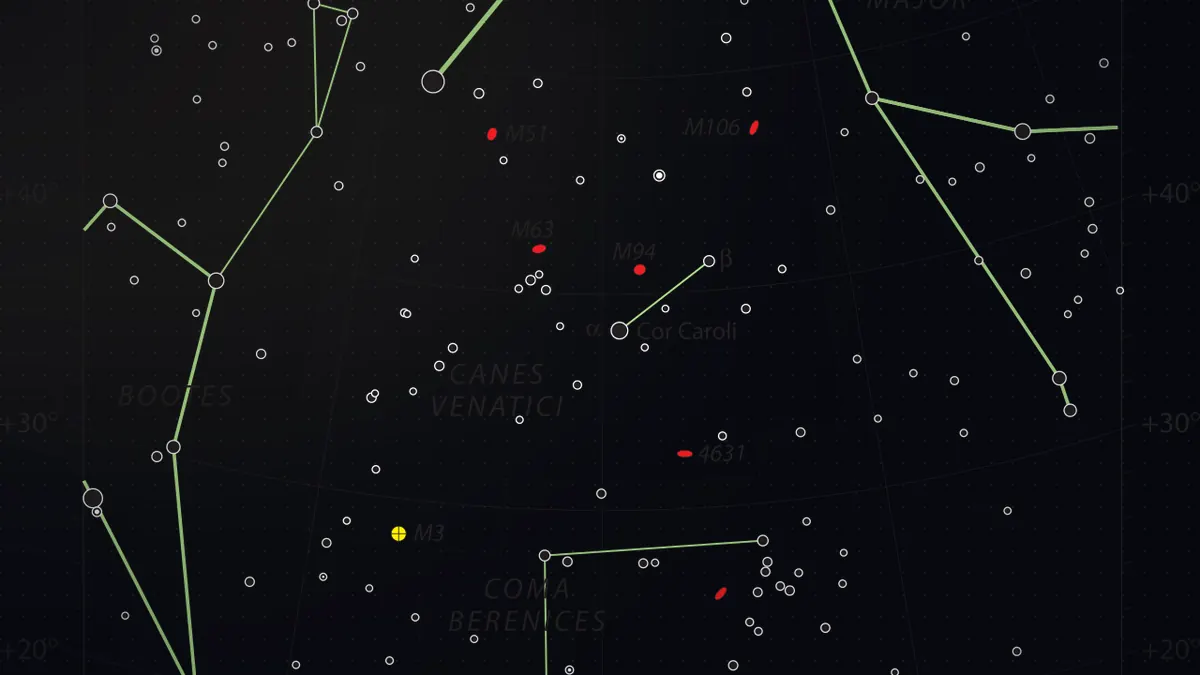
The practical approach is to find Cor Caroli, the constellation's only reasonably bright star. Look below the Dipper's handle, roughly a third of the way towards Arcturus, for a lone moderate star. That is it. The second dog star, Chara, is fainter and sits a few degrees away.
For the galaxies, the best anchor is Alkaid, the last star of the Dipper's handle: the Whirlpool Galaxy sits a short hop south-west of it.
In sky coordinates Canes Venatici sits at right ascension 12h 06m and declination +27.8°. Declination is latitude by another name and right ascension is longitude, so the pair fixes the constellation at one point on the celestial sphere. It sits in the northern half of the sky, riding high for northern observers and low for southern ones. You can see it from anywhere north of latitude 40°S, including the whole northern hemisphere, and it sits highest after dark in May.
What Canes Venatici actually looks like
There is essentially no figure. Two stars, Cor Caroli and Chara, and that is the constellation. Charts draw two hounds straining forward on a leash, but you are supplying nearly all of it.
That is because Canes Venatici is modern. Johannes Hevelius carved it out of blank sky in the 1680s, giving Boötes something to hold. The dogs even acquired names — Asterion and Chara — and Chara stuck as the actual name of Beta Canum Venaticorum. Treat this constellation as a region to point a telescope at, not a pattern to trace.
The stars of Canes Venatici
- Cor Caroli (Alpha Canum Venaticorum, magnitude 2.9) — 'Charles's Heart', named in the seventeenth century for King Charles I of England. It is a fine double star, easily split in a small telescope, and the prototype of a class of magnetic variable stars with enormous starspots.
- Chara (Beta) — a yellow main-sequence star strikingly similar to our own Sun, about 27 light years away, and a long-standing target in searches for life-bearing systems.
- La Superba (Y Canum Venaticorum) — one of the reddest stars visible to the naked eye, and one of the brightest carbon stars. The nineteenth-century astronomer Angelo Secchi named it for its extraordinary colour.
- TON 618 — not visible, but worth knowing about: a quasar powered by one of the most massive black holes ever measured, on the order of forty billion times the mass of the Sun.
The story behind the name
Canes Venatici has no ancient mythology: it did not exist until Hevelius invented it in 1687. Its story is one of astronomical politics rather than Greek gods.
Cor Caroli is the interesting case. The name honours King Charles I, executed in 1649, and was reportedly proposed by the physician Sir Charles Scarborough, who claimed the star shone with particular brilliance on the eve of Charles II's return to London in 1660. Whether or not that is true, it is one of the very few stars named after a specific modern individual, and a reminder that constellation naming was often as much about patronage as astronomy.
The dogs themselves were reverse-engineered from a translation slip: earlier Arabic-to-Latin renderings of Boötes had introduced a word for club or spear that later readers took as hounds.
What else is hiding in Canes Venatici
This is the payoff. Five Messier objects, and one of them is a legend.
- M51, the Whirlpool Galaxy — the first galaxy whose spiral structure was ever recognised, sketched by Lord Rosse in 1845 decades before anyone knew galaxies were separate star systems. It is a face-on spiral with a smaller companion galaxy attached to one arm. In a modest telescope you see two glowing patches; in a larger one under dark sky, the spiral arms emerge. It is arguably the most photographed galaxy after our own.
- M3 — one of the finest globular clusters in the northern sky, with around half a million stars. Brilliant in any telescope.
- M63, the Sunflower Galaxy — a spiral with tightly wound, flocculent arms.
- M94 — a compact spiral with an unusually bright core and a ring of star formation.
- M106 — a large spiral with an active nucleus hiding a supermassive black hole.
When and where to see it
Best placed in the evening sky in May, with a good window through spring and early summer when it rides high in the northern sky.
It reaches down to about 40°S, so it is available from most of the world, but northern observers get it far higher and therefore far clearer. Galaxy observing is unforgiving of atmosphere, so altitude matters more here than for bright-star constellations.
Be honest with yourself about conditions: from a city, Canes Venatici offers Cor Caroli and nothing else. Under a genuinely dark sky with a telescope, M51 and M3 alone justify the trip. This is a constellation that rewards driving somewhere dark more than almost any other.
Canes Venatici at a glance
| Name | Canes Venatici |
| Abbreviation | CVn |
| Genitive form | Canum Venaticorum |
| Meaning | the Hunting Dogs |
| Family | Ursa Major family |
| First recorded | 1690, Hevelius |
| Right ascension | 12h 06m |
| Declination | +27.8° |
| Area | 465 square degrees (38th largest of 88) |
| Main stars in the figure | 2 |
| Stars brighter than magnitude 3 | 1 |
| Named Bayer / Flamsteed stars | 22 |
| Brightest star | Cor Caroli (α CVn) (magnitude 2.90) |
| Messier objects | 5 |
| Meteor showers | Canes Venaticids |
| Visible from | Anywhere north of latitude 40°S, including the whole northern hemisphere |
| Best seen at 9 pm in | May |
| Bordering constellations | Boötes, Coma Berenices, Ursa Major |
Where to go next
Its neighbours in the sky
Everything here shares a border with Canes Venatici. Find one and the rest are a short hop away: Boötes, Coma Berenices, Ursa Major.
The rest of the Ursa Major family
Canes Venatici belongs to the Ursa Major family: the circumpolar northern group anchored by the Big Dipper. The others are: Boötes, Camelopardalis, Coma Berenices, Corona Borealis, Draco, Leo Minor, Lynx, Ursa Major, Ursa Minor.
Start from the beginning
Not sure where to begin? The guide to all 88 constellations explains how the sky is divided, what a constellation really is, and links to each of the 88.
Star chart: Canes Venatici IAU chart by IAU and Sky & Telescope magazine (Roger Sinnott & Rick Fienberg), used under CC BY 3.0. Observing data cross-checked against Wikipedia's Canes Venatici entry.