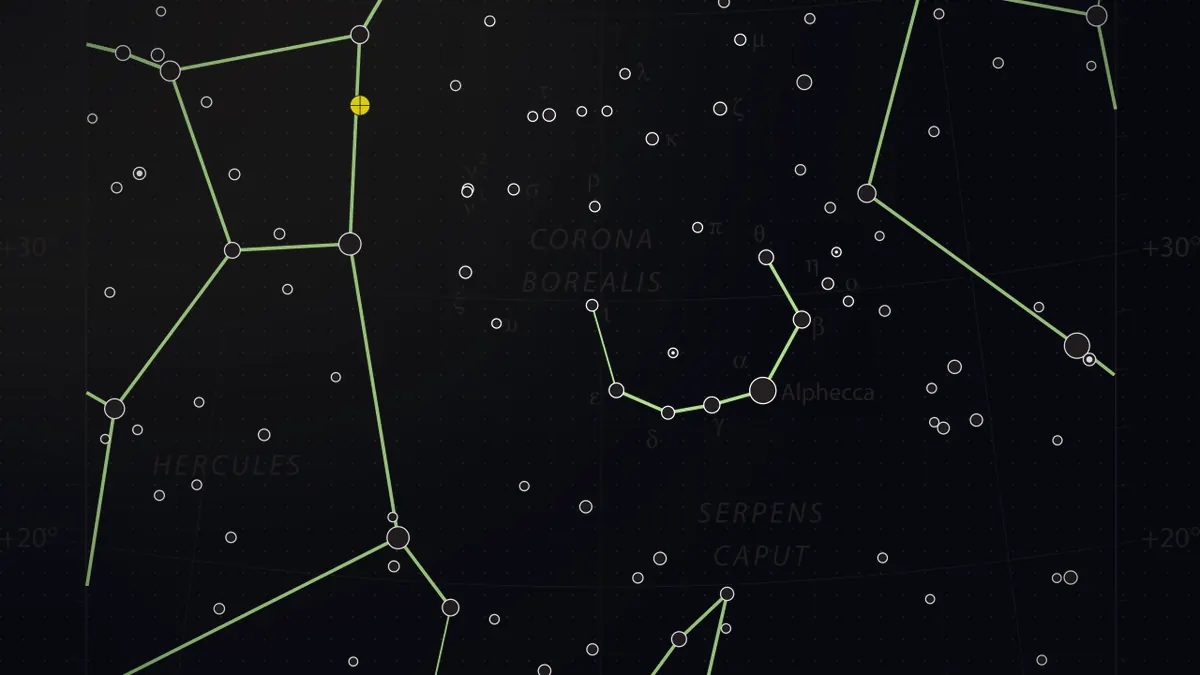
Some constellations demand imagination. Corona Borealis does not. It is a small, tidy semicircle of seven stars that unmistakably looks like a crown or a tiara lying on its side: one of the clearest figure-to-name matches in the entire sky.
It also contains two of the strangest stars known: one that unpredictably vanishes for months at a time, and another that erupts roughly every eighty years and is currently overdue.
Where to find Corona Borealis
Corona Borealis sits in the gap between Arcturus in Boötes and the keystone of Hercules, and that is exactly how to find it.
Arc from the Big Dipper's handle to Arcturus, then continue east about a hand's width. You are looking for a small, distinct arc of stars, about as wide as three fingers held at arm's length. The brightest one, near the centre of the curve, is Alphecca.
It is compact enough that it never gets lost in its surroundings, and once you have found it once you will spot it instantly thereafter.
In sky coordinates Corona Borealis sits at right ascension 15h 16m and declination +39.7°. Right ascension is the sky's version of longitude and declination its version of latitude, so those two numbers pin the constellation to one spot on the celestial sphere the way a map reference pins a town. It sits in the northern half of the sky, riding high for northern observers and low for southern ones. You can see it from anywhere north of latitude 50°S, including the whole northern hemisphere, and it sits highest after dark in June.
What Corona Borealis actually looks like
Seven stars form a graceful open semicircle, with the brightest (Alphecca, also called Gemma) set in the middle like the jewel of a crown. The name Gemma literally means 'jewel'.
The whole figure spans only a few degrees, making it one of the sky's genuinely small and neat patterns. Other cultures read the same arc differently but always as something curved and enclosing: a circle of elders, an eagle's nest, a bear's den, a smoke hole in a roof. Ptolemy recorded a southern counterpart, Corona Australis, with a similar shape.
The stars of Corona Borealis
- Alphecca (Alpha Coronae Borealis, magnitude 2.21) — the crown's jewel, an eclipsing binary about 75 light years away with a dusty debris disc, similar to the one around Vega.
- R Coronae Borealis — a genuinely bizarre star. Normally around magnitude 6 and just visible in binoculars, it unpredictably fades by several magnitudes and disappears for weeks or months. The cause is soot: the star is extremely hydrogen-poor and carbon-rich, and periodically puffs out clouds of carbon dust that block its own light. It has given its name to an entire class of variable stars.
- T Coronae Borealis, the Blaze Star — a recurrent nova. Every eighty years or so, a white dwarf in this binary siphons enough gas from its companion to trigger a thermonuclear flash, and the system jumps to about magnitude 2: bright enough to add a visible new star to the crown. It erupted in 1866 and 1946, and astronomers currently expect the next event at any time. It is worth learning the constellation for that alone.
The story behind the name
The crown belongs to Ariadne, the Cretan princess who gave Theseus the thread that let him escape the labyrinth. Abandoned by him on Naxos, she was found by the god Dionysus, who married her and threw her jewelled crown into the sky where its gems became stars.
It is one of the more generous myths in the sky: most constellations commemorate a punishment, a death or a hunt, while this one marks a wedding gift.
Other traditions kept the circular idea but changed its meaning entirely. Several Native American peoples saw a circle of dancers or a bear's den, with the surrounding stars as hunters. In Welsh legend it is Caer Arianrhod, the Castle of the Silver Circle.
What else is hiding in Corona Borealis
Corona Borealis is small and looks out of the galactic plane, so it has no Messier objects and very little for a small telescope. Its interest is in individual stars and in things far beyond it.
- Abell 2065, the Corona Borealis Cluster — a rich cluster of over 400 galaxies around a billion light years away. Far too faint for casual observing, but it is part of an even larger structure, the Corona Borealis Supercluster, one of the more massive assemblies of matter known.
- T Coronae Borealis — the real observing project. Learn the crown's normal appearance now, so that when the Blaze Star goes off you will notice an extra star immediately. Few people get to spot a nova with the naked eye, and this is the most predictable opportunity there is.
- R Coronae Borealis — worth checking with binoculars every few weeks just to see whether it has disappeared again.
When and where to see it
Best placed in the evening sky in June, and comfortably visible through the northern spring and summer.
It reaches down to about 50°S, so most of the world can see it, though it is very much a northern-sky constellation and sits low from southern latitudes.
The crown is bright enough to hold together under moderate light pollution, which makes it one of the more reliable small constellations for suburban observers. Learn it early. It costs you five minutes now, and it means you are ready when T Coronae Borealis finally erupts.
Corona Borealis at a glance
| Name | Corona Borealis |
| Abbreviation | CrB |
| Genitive form | Coronae Borealis |
| Meaning | The Northern Crown |
| Family | Ursa Major family |
| First recorded | ancient (Ptolemy) |
| Right ascension | 15h 16m |
| Declination | +39.7° |
| Area | 179 square degrees (73rd largest of 88) |
| Main stars in the figure | 7 |
| Stars brighter than magnitude 3 | 1 |
| Named Bayer / Flamsteed stars | 24 |
| Brightest star | α CrB (Alphecca or Gemma) (magnitude 2.21) |
| Messier objects | None |
| Meteor showers | None |
| Visible from | Anywhere north of latitude 50°S, including the whole northern hemisphere |
| Best seen at 9 pm in | June |
| Bordering constellations | Boötes, Hercules, Serpens |
Where to go next
Its neighbours in the sky
These constellations share a border with Corona Borealis, so once you have found it you already know where to look next: Boötes, Hercules, Serpens.
The rest of the Ursa Major family
Corona Borealis belongs to the Ursa Major family: the circumpolar northern group anchored by the Big Dipper. The others are: Boötes, Camelopardalis, Canes Venatici, Coma Berenices, Draco, Leo Minor, Lynx, Ursa Major, Ursa Minor.
Start from the beginning
If you are starting from scratch, the complete beginner's guide to the 88 constellations covers what a constellation actually is, how the sky is carved up, and links to every one of them.
Star chart: Corona Borealis IAU chart by IAU and Sky & Telescope magazine (Roger Sinnott & Rick Fienberg), used under CC BY 3.0. Observing data cross-checked against Wikipedia's Corona Borealis entry.