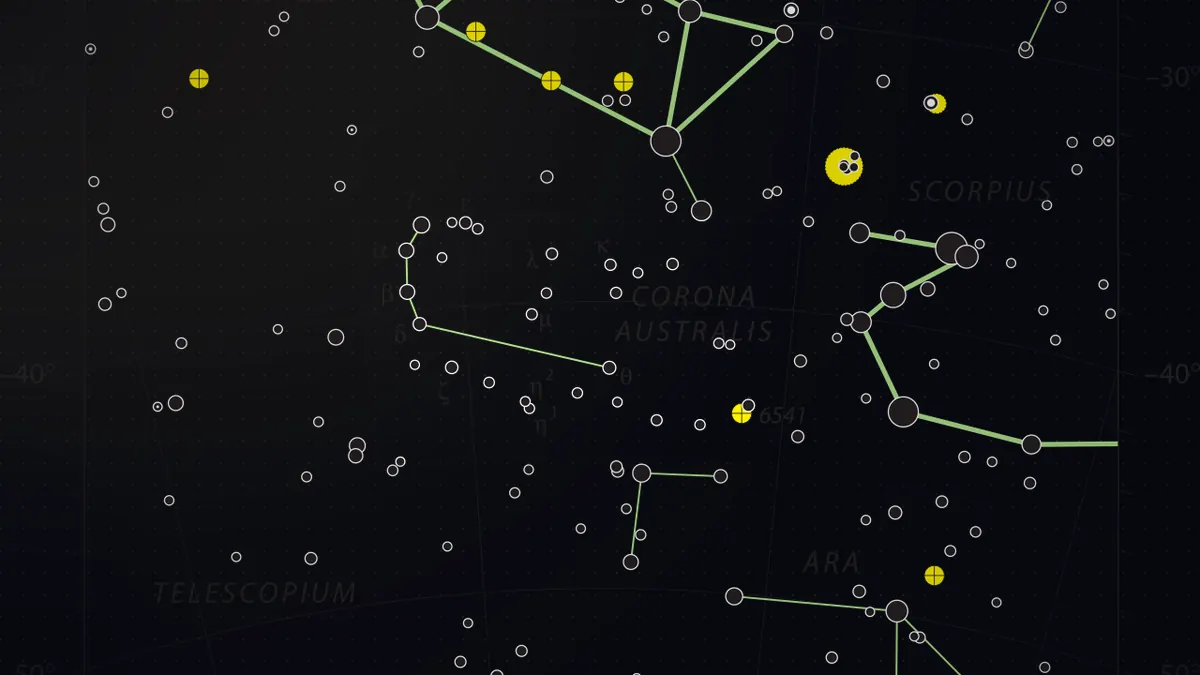
Corona Australis is the southern counterpart to Corona Borealis: a graceful arc of stars forming a crown, sitting just below the Teapot of Sagittarius. It is fainter than its northern twin, but the shape is just as clean.
Behind it lies something far more significant: the Corona Australis molecular cloud, one of the nearest active star-forming regions to the Sun. Stars are being born there right now, about 420 light years away.
Where to find Corona Australis
Find the Teapot of Sagittarius, then look just south: below the base of the teapot. The small, curved arc of faint stars you find there is Corona Australis.
Nothing here is brighter than magnitude 4.1, so you need a reasonably dark sky and dark-adapted eyes. The shape is distinct once you see it: a shallow semicircle, quite compact.
Because it sits right beside the richest part of the Milky Way, the surroundings are crowded, which can make the faint arc harder to pick out than you would expect. Look for the curve rather than individual stars.
In sky coordinates Corona Australis sits at right ascension 17h 58m and declination −36.8°. If the units look unfamiliar, the idea behind them is not: declination is the sky's latitude, right ascension is its longitude, and together they place the constellation exactly. It sits in the southern half of the sky, high for southern observers and low on the horizon for northern ones. Practically speaking it is visible from anywhere south of latitude 45°N, including the whole southern hemisphere, with the best evening views around August.
What Corona Australis actually looks like
A neat semicircular arc of faint stars: a crown or wreath lying on its side. It is genuinely one of the better small figures in the sky, and the curve is regular enough to be immediately convincing.
Ptolemy listed it alongside Corona Borealis as a matched pair, and the two really are similar in form: the same graceful arc, one in the far north and one in the far south, on opposite sides of the sky.
The southern crown is the fainter of the two, which is why far fewer people know it. It has also been read as a wreath, and in some accounts as a laurel garland rather than a jewelled crown.
The stars of Corona Australis
- Alphecca Meridiana (Alpha Coronae Australis, magnitude 4.1) — the brightest star, a white main-sequence star about 130 light years away. Its name deliberately echoes Alphecca in the northern crown, with 'Meridiana' marking it as the southern one.
- Beta Coronae Australis — an orange giant, almost equal in brightness to Alpha.
- Gamma Coronae Australis — a close binary with a roughly 120-year orbit, a challenging but rewarding split.
- R Coronae Australis — a young, variable star still wrapped in the gas and dust it formed from. It illuminates the reflection nebula NGC 6729, and both the star and the nebula visibly change brightness and shape over months and years as material shifts around them.
The story behind the name
Corona Australis is most often described as a wreath or crown laid down rather than worn: sometimes the crown of the centaur Sagittarius, sitting at his feet, or a laurel wreath set aside.
In one Greek account it is the crown of Dionysus, placed in the sky to honour his mother Semele, whom he rescued from the underworld. Dionysus set the wreath among the stars as a memorial, which pairs neatly with Corona Borealis, also associated with Dionysus through Ariadne.
The Greeks treated the two crowns as a matched set, one in each hemisphere. That symmetry was probably as much about celestial bookkeeping as about story: if there is a crown in the north, there ought to be one in the south.
What else is hiding in Corona Australis
Faint constellation, scientifically important contents.
- The Corona Australis molecular cloud — one of the closest active star-forming regions to us, roughly 420 light years away. It contains dozens of very young stars still surrounded by discs of gas and dust, and it is heavily studied as a laboratory for how stars and planetary systems form.
- NGC 6729 — a small, variable reflection nebula lit by R Coronae Australis. It changes appearance over time, which is rare and worth revisiting.
- NGC 6726 and NGC 6727 — reflection nebulae in the same complex. Together these produce some of the more beautiful blue nebulosity in astrophotography.
- NGC 6541 — a bright globular cluster on the constellation's western edge, and the easiest visual target here for a small telescope.
When and where to see it
Best placed in the evening sky in August, alongside Sagittarius through the southern winter.
It is a southern constellation reaching to about 40°N, so it is technically visible low from southern Europe and the southern United States, but southern observers get it properly high.
You need a dark sky: the arc simply does not appear under light pollution. NGC 6541 is the practical telescope target. The reflection nebulae are faint visually and really belong to photography, but knowing that you are looking at one of the nearest places in the galaxy where stars are currently forming gives the faint patch of sky a lot more weight.
Corona Australis at a glance
| Name | Corona Australis |
| Abbreviation | CrA |
| Genitive form | Coronae Australis |
| Meaning | The Southern Crown |
| Family | Hercules family |
| First recorded | ancient (Ptolemy) |
| Right ascension | 17h 58m |
| Declination | −36.8° |
| Area | 128 square degrees (80th largest of 88) |
| Main stars in the figure | 6 |
| Stars brighter than magnitude 3 | 0 |
| Named Bayer / Flamsteed stars | 14 |
| Brightest star | α CrA (Meridiana) (magnitude 4.10) |
| Messier objects | None |
| Meteor showers | Corona Australids |
| Visible from | Anywhere south of latitude 45°N, including the whole southern hemisphere |
| Best seen at 9 pm in | August |
| Bordering constellations | Ara, Sagittarius, Scorpius, Telescopium |
Where to go next
Its neighbours in the sky
These constellations share a border with Corona Australis, so once you have found it you already know where to look next: Ara, Sagittarius, Scorpius, Telescopium.
The rest of the Hercules family
Corona Australis belongs to the Hercules family: the largest family — heroes, serpents and the far southern sky. The others are: Aquila, Ara, Centaurus, Corvus, Crater, Crux, Cygnus, Hercules, Hydra, Lupus, Lyra, Ophiuchus, Sagitta, Scutum, Serpens, Sextans, Triangulum Australe, Vulpecula.
Start from the beginning
New to all this? The 88 constellations: a complete beginner's guide explains what a constellation actually is, how the sky is divided up, and lists all 88 with a link to each one.
Star chart: Corona Australis IAU chart by IAU and Sky & Telescope magazine (Roger Sinnott & Rick Fienberg), used under CC BY 3.0. Observing data cross-checked against Wikipedia's Corona Australis entry.