Telescopium is named after the instrument that changed astronomy more than any other. It is, fittingly and slightly ironically, a faint and unremarkable constellation that you need a telescope to get much out of.
It sits south of Sagittarius and Corona Australis, with nothing brighter than magnitude 3.5, in a region where the Milky Way's glow is beginning to fade.
Where to find Telescopium
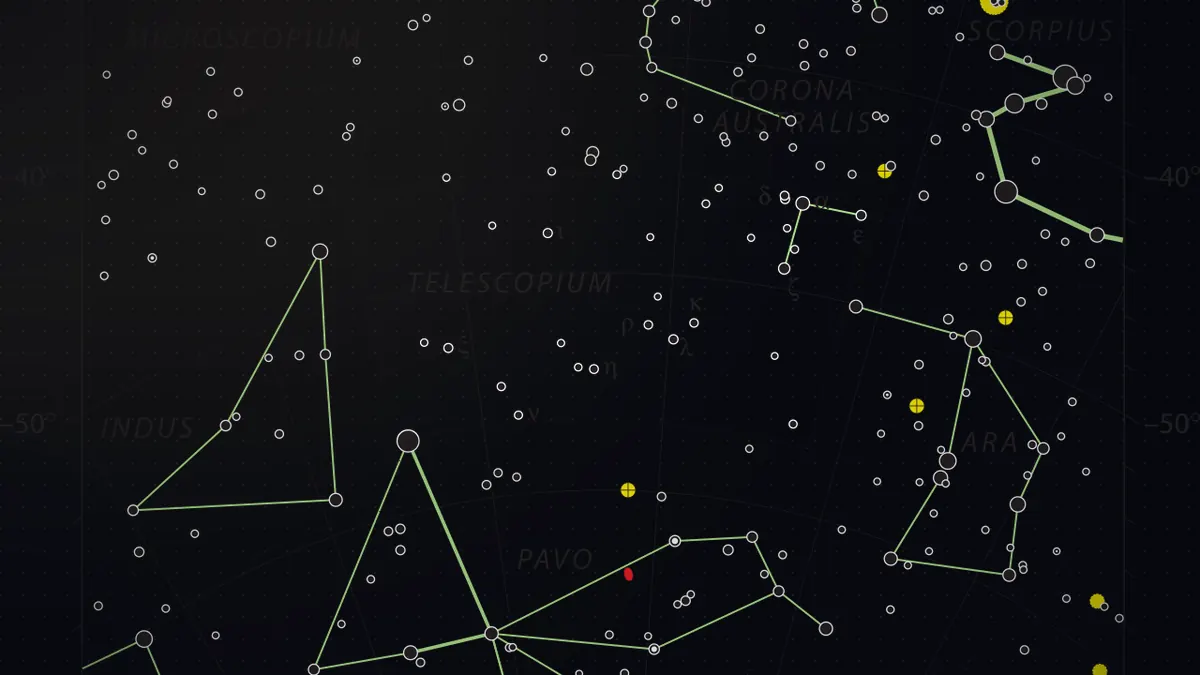
Telescopium lies directly south of Sagittarius and east of Ara.
Find the Teapot of Sagittarius, then look south past Corona Australis. The dim region you reach is Telescopium.
Its brightest star is magnitude 3.5, so a reasonably dark sky is needed. There is no distinctive pattern to look for, which means this is careful navigation from brighter neighbours rather than pattern recognition. From a suburb it effectively disappears.
In sky coordinates Telescopium sits at right ascension 19h 00m and declination −50.0°. Declination is latitude by another name and right ascension is longitude, so the pair fixes the constellation at one point on the celestial sphere. It is a far-southern constellation, so southern observers own it and much of the northern hemisphere never sees it at all. In practice that means you can find it from anywhere south of latitude 40°N, including the whole southern hemisphere; it rides highest in the evening sky in August.
What Telescopium actually looks like
A sparse scatter of faint stars with no coherent figure, mostly just two or three stars of any note in a rough line.
Lacaille created it in the 1750s as Tubus Telescopium, originally depicting a long aerial telescope of the type used in the seventeenth century: the enormously long, unwieldy instruments needed before achromatic lenses existed.
The original constellation was considerably larger and intruded on Sagittarius, Ophiuchus and Corona Australis. Later astronomers, particularly Francis Baily and Benjamin Gould, trimmed it back substantially, which is part of why it ended up so sparse.
The stars of Telescopium
- Alpha Telescopii (magnitude 3.5) — the brightest star, a blue-white subgiant about 250 light years away.
- Zeta Telescopii — an orange giant, second brightest.
- Delta Telescopii — a naked-eye optical double, two unrelated stars that happen to appear close together.
- PV Telescopii — a rare and peculiar variable, a helium star with almost no hydrogen, and the prototype of its own class. Stars like this are thought to result from the merger of two white dwarfs, and only a handful are known.
It is a modest star list, and there is no point pretending Telescopium is rich in bright objects.
The story behind the name
There is no mythology. Lacaille created Telescopium in the 1750s to honour the telescope, and it belongs to his set of fourteen instrument constellations.
The choice is more pointed than it might appear. Lacaille was working at the Cape of Good Hope with a small refracting telescope, systematically measuring the positions of nearly 10,000 stars that Europe had never properly catalogued. His entire expedition was a demonstration of what the instrument made possible.
Placing a telescope in the sky alongside a microscope, a clock, a furnace and a set of compasses was a statement about where astronomical authority now came from. The Greeks had populated the sky with the stories they inherited; Lacaille populated it with the equipment used to measure it.
What else is hiding in Telescopium
A quiet constellation with no Messier objects and modest contents.
- NGC 6584 — a globular cluster, and the best conventional target here. It is reachable in a medium telescope as a small, faint ball that begins to resolve at higher magnification.
- NGC 6868 — an elliptical galaxy, the brightest member of a small galaxy group in this direction.
- The Telescopium Group — a small cluster of galaxies about 120 million light years away, several within reach of a larger amateur telescope under dark skies.
Realistically, Telescopium is a constellation you find because you are working through all 88, and the pleasure is in the name rather than the view. Given what the instrument did for astronomy, that seems a fair trade.
When and where to see it
Best placed in the evening sky in August, through the southern winter.
Telescopium is a southern constellation reaching to about 30°N, so its northern edge is technically glimpsable from southern Europe and the southern United States, but it belongs to the southern hemisphere.
A dark sky is needed for the constellation's stars, and a telescope with dark skies for NGC 6584. Combine it with neighbouring Corona Australis and Ara for a worthwhile southern-winter session: those three together cover a good range of object types, from star-forming regions to globular clusters.
Telescopium at a glance
| Name | Telescopium |
| Abbreviation | Tel |
| Genitive form | Telescopii |
| Meaning | the Telescope |
| Family | La Caille family |
| First recorded | 1756, Lacaille |
| Right ascension | 19h 00m |
| Declination | −50.0° |
| Area | 252 square degrees (57th largest of 88) |
| Main stars in the figure | 2 |
| Stars brighter than magnitude 3 | 0 |
| Named Bayer / Flamsteed stars | 13 |
| Brightest star | α Tel (magnitude 3.49) |
| Messier objects | None |
| Meteor showers | None |
| Visible from | Anywhere south of latitude 40°N, including the whole southern hemisphere |
| Best seen at 9 pm in | August |
| Bordering constellations | Ara, Corona Australis, Indus, Microscopium, Pavo, Sagittarius |
Where to go next
Its neighbours in the sky
These constellations share a border with Telescopium, so once you have found it you already know where to look next: Ara, Corona Australis, Indus, Microscopium, Pavo, Sagittarius.
The rest of the La Caille family
Telescopium belongs to the La Caille family: eighteenth-century southern constellations named after instruments. The others are: Antlia, Caelum, Circinus, Fornax, Horologium, Mensa, Microscopium, Norma, Octans, Pictor, Reticulum, Sculptor.
Start from the beginning
Not sure where to begin? The guide to all 88 constellations explains how the sky is divided, what a constellation really is, and links to each of the 88.
Star chart: Telescopium IAU chart by IAU and Sky & Telescope magazine (Roger Sinnott & Rick Fienberg), used under CC BY 3.0. Observing data cross-checked against Wikipedia's Telescopium entry.