Norma is a small, faint constellation in a dense stretch of the southern Milky Way, and it has a curious defect: it has no Alpha or Beta star. Those designations were reassigned to neighbouring Scorpius when the IAU fixed the boundaries, and nobody ever renamed the remainder.
It also lies in the direction of the Great Attractor, a concentration of mass towards which our entire Local Group of galaxies is being pulled at hundreds of kilometres per second.
Where to find Norma
Norma sits between Scorpius and Centaurus, along the Milky Way, north of Circinus.
Find the tail of Scorpius, then move west along the band of the Milky Way. Norma is the modest region you pass through before reaching Centaurus.
Nothing here is brighter than magnitude 4.0, so the constellation itself is unremarkable. But the surrounding star fields are dense and rewarding, and the open clusters here are easier to find than the constellation's own stars.
In sky coordinates Norma sits at right ascension 15h 12m and declination −42.3°. Those two numbers work like a grid reference. Right ascension runs around the sky the way longitude runs around the Earth, and declination measures north and south the way latitude does. It sits in the southern half of the sky, high for southern observers and low on the horizon for northern ones. You can see it from anywhere south of latitude 30°N, including the whole southern hemisphere, and it sits highest after dark in June.
What Norma actually looks like
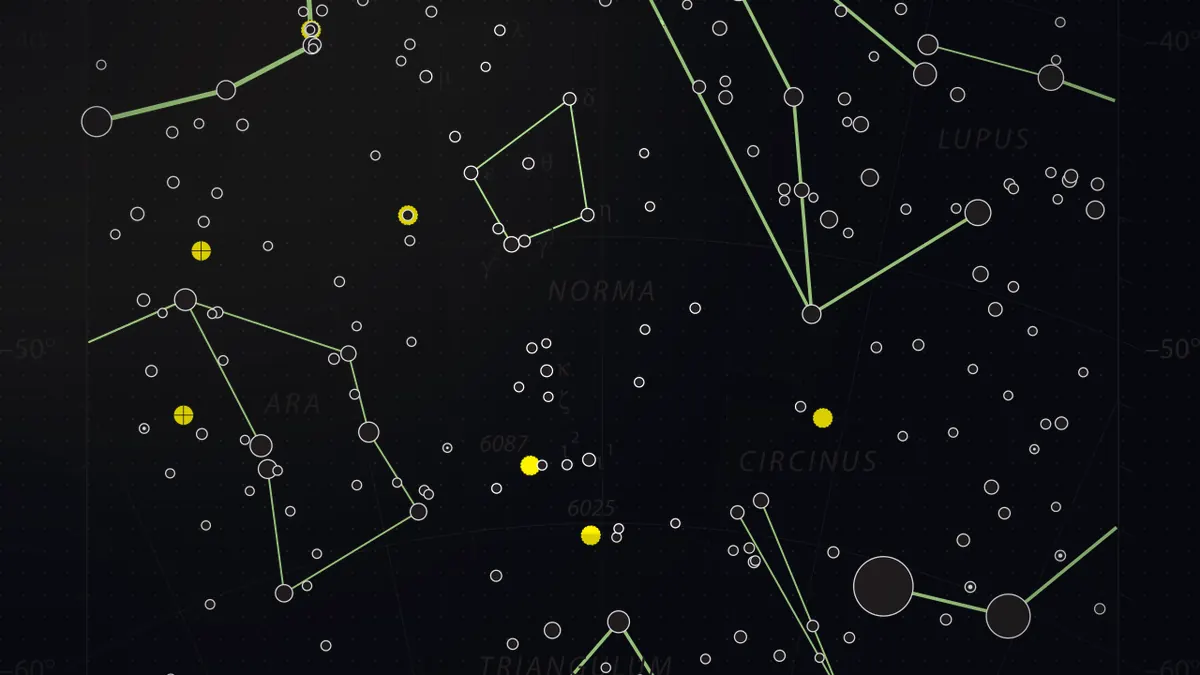
A small, faint rectangle of stars, with no discernible figure.
Lacaille created it in the 1750s as Norma et Regula, the square and rule: a carpenter's set square and straightedge. The name was shortened to Norma.
The missing Bayer letters are a real quirk. When constellation boundaries were formalised in 1930, the stars Lacaille had labelled Alpha and Beta Normae ended up inside Scorpius, where they became N Scorpii and H Scorpii. Norma was left starting at Gamma. It is one of only a handful of constellations missing its leading letters, alongside Puppis and Vela.
The stars of Norma
- Gamma-2 Normae (magnitude 4.0) — the brightest star, a yellow giant about 130 light years away. It forms a wide naked-eye pair with Gamma-1 Normae, which is far more distant: an optical double rather than a physical one.
- Epsilon Normae — a multiple star system, splittable in a small telescope.
- Iota-1 Normae — a triple star system.
- S Normae — a Cepheid variable conveniently located at the centre of the open cluster NGC 6087, which makes it useful for calibrating the Cepheid distance scale: the cluster's distance can be determined independently and compared with what the Cepheid predicts.
The story behind the name
There is no mythology. Norma is a Lacaille creation from the 1750s, named after a carpenter's square and rule: the tools of precise measurement, which suited his Enlightenment programme.
The constellation's modern significance is cosmological. Behind Norma, obscured by the dust and stars of our own galaxy's plane, lies the Great Attractor: a gravitational anomaly around 250 million light years away towards which the Milky Way, Andromeda and the whole Local Group are moving at roughly 600 kilometres per second.
It sits in what astronomers call the Zone of Avoidance, the band of sky blocked by the Milky Way, which is why it took so long to study. It is now understood to be part of the Laniakea Supercluster, an enormous structure of which our galaxy is a peripheral member. Norma is the direction our entire neighbourhood is falling towards.
What else is hiding in Norma
The Milky Way makes Norma richer than its faint stars suggest, though there are no Messier objects.
- NGC 6087 — the best open cluster here, containing the Cepheid variable S Normae at its centre. Bright enough for binoculars and pleasant in a small telescope.
- NGC 6067 — a rich, compact open cluster set in a dense Milky Way field, and a very rewarding binocular target.
- The Norma Cluster (Abell 3627) — a massive galaxy cluster near the core of the Great Attractor region, heavily obscured by our own galaxy's dust. Not an amateur target, but the reason astronomers care about this patch of sky.
- The Ant Nebula (Mz 3) — a bipolar planetary nebula with a striking symmetric structure.
When and where to see it
Best placed in the evening sky in July, through the southern winter.
Norma is a southern constellation reaching to about 30°N, so its northern portion can be glimpsed low from southern Europe and the southern United States. Southern observers get it high and clear.
The constellation itself needs a dark sky. The open clusters are more forgiving and are genuinely good binocular targets. Sweeping the Milky Way through Norma and neighbouring Circinus and Ara is one of the more rewarding low-effort activities in the southern sky, and worth doing even if you never manage to trace the carpenter's square itself.
Norma at a glance
| Name | Norma |
| Abbreviation | Nor |
| Genitive form | Normae |
| Meaning | the carpenter's square |
| Family | La Caille family |
| First recorded | 1756, Lacaille |
| Right ascension | 15h 12m |
| Declination | −42.3° |
| Area | 165 square degrees (74th largest of 88) |
| Main stars in the figure | 4 |
| Stars brighter than magnitude 3 | 0 |
| Named Bayer / Flamsteed stars | 13 |
| Brightest star | γ 2 Nor (magnitude 4.01) |
| Messier objects | None |
| Meteor showers | Gamma Normids |
| Visible from | Anywhere south of latitude 30°N, including the whole southern hemisphere |
| Best seen at 9 pm in | June |
| Bordering constellations | Ara, Circinus, Lupus, Scorpius, Triangulum Australe |
Where to go next
Its neighbours in the sky
Norma borders all of these, which makes them the natural next targets once you can pick it out: Ara, Circinus, Lupus, Scorpius, Triangulum Australe.
The rest of the La Caille family
Norma belongs to the La Caille family: eighteenth-century southern constellations named after instruments. The others are: Antlia, Caelum, Circinus, Fornax, Horologium, Mensa, Microscopium, Octans, Pictor, Reticulum, Sculptor, Telescopium.
Start from the beginning
New to all this? The 88 constellations: a complete beginner's guide explains what a constellation actually is, how the sky is divided up, and lists all 88 with a link to each one.
Star chart: Norma IAU chart by IAU and Sky & Telescope magazine (Roger Sinnott & Rick Fienberg), used under CC BY 3.0. Observing data cross-checked against Wikipedia's Norma entry.