Pictor is a small, faint constellation beside brilliant Canopus, and for most of its history it was entirely unremarkable.
Then, in 1984, astronomers imaged a disc of dust around one of its stars, Beta Pictoris: the first time anyone had directly seen the raw material of a planetary system around another star. Two decades later they photographed a planet inside that disc. Pictor went from footnote to one of the most important constellations in modern astronomy.
Where to find Pictor
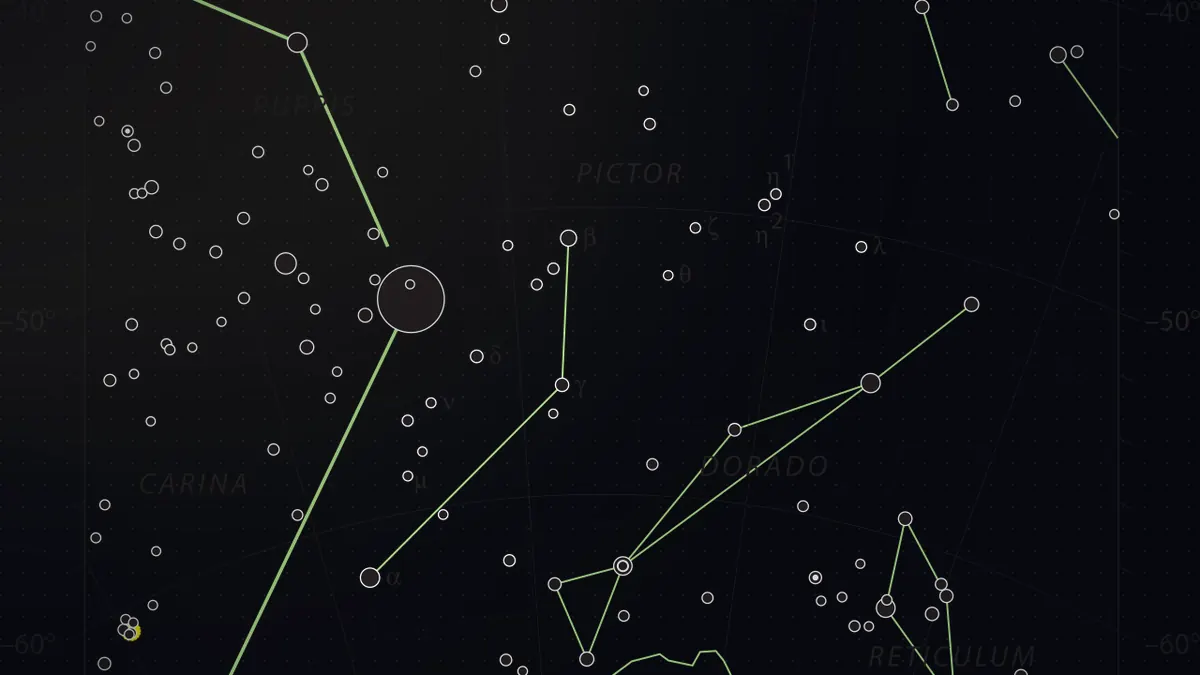
Pictor sits immediately south of Canopus, the second brightest star in the night sky, and west of the Large Magellanic Cloud.
Canopus makes this easy. Find it — impossible to miss from the southern hemisphere — and look just south. The small group of faint stars there is Pictor.
Nothing here is brighter than magnitude 3.3, so you need a reasonably dark sky, but the proximity to such a brilliant anchor makes the region easy to locate even if the stars themselves are hard to pick out.
In sky coordinates Pictor sits at right ascension 4h 32m and declination −43.0°. Those two numbers work like a grid reference. Right ascension runs around the sky the way longitude runs around the Earth, and declination measures north and south the way latitude does. It sits in the southern half of the sky, high for southern observers and low on the horizon for northern ones. In practice you can see it from anywhere south of latitude 26°N, including the whole southern hemisphere, and it stands highest in the evening sky around January.
What Pictor actually looks like
Three faint stars in a narrow, elongated triangle. That is essentially the whole constellation, and no easel is discernible.
Lacaille created it in the 1750s as Equuleus Pictoris, the painter's easel, later shortened to Pictor. It is one of his fourteen instrument constellations, celebrating the arts alongside the sciences.
The name is sometimes mistranslated as 'the painter'. It is the easel, not the person: Lacaille was consistently naming objects and apparatus rather than people.
The stars of Pictor
-
Alpha Pictoris (magnitude 3.3) — the brightest star, a white star about 97 light years away that rotates rapidly.
-
Beta Pictoris — the famous one. A young star, only about 20 million years old, roughly 63 light years away, surrounded by an enormous debris disc first imaged in 1984. That image was the first direct evidence of the material from which planets form around another star.
In 2008 astronomers directly imaged Beta Pictoris b, a gas giant several times Jupiter's mass orbiting within the disc: one of the first exoplanets ever photographed rather than merely inferred. A second planet has since been found. The system is effectively a live laboratory for watching planet formation.
-
Kapteyn's Star — a nearby red dwarf with the second-largest proper motion of any star, and unusual for orbiting the galaxy backwards. It is thought to have been captured from a dwarf galaxy the Milky Way absorbed.
The story behind the name
There is no mythology. Pictor is a Lacaille creation from the 1750s, named after the painter's easel as part of his programme of honouring the arts and sciences in the southern sky.
Its real story is a scientific one, and it is worth telling properly. Before 1984, the idea that other stars had planetary systems was reasonable but entirely unproven. The Beta Pictoris disc changed the conversation: here was visible, photographable evidence of the raw material.
The first confirmed exoplanet around a Sun-like star followed in 1995 (51 Pegasi b), and the first direct images of planets came in the 2000s, with Beta Pictoris b among the earliest. A faint constellation named after a piece of studio furniture turned out to contain the best available picture of how solar systems are built.
What else is hiding in Pictor
Faint constellation, no Messier objects, but scientifically significant.
- The Beta Pictoris system — the star is easily visible to the naked eye at magnitude 3.9, though the disc and planets require professional instruments. It is a good star to point at and explain.
- NGC 1705 — a dwarf irregular galaxy undergoing a burst of star formation, and a useful analogue for what young galaxies in the early universe may have looked like.
- Pictor A — a distant galaxy firing an enormous jet from its central black hole, spanning hundreds of thousands of light years. It is a powerful radio and X-ray source.
The visual observing here is thin, and the honest recommendation is to come for Beta Pictoris and stay for the story.
When and where to see it
Best placed in the evening sky in January, through the southern summer.
Pictor is a southern constellation reaching only to about 25°N, so it is effectively unavailable from most of the northern hemisphere. Southern observers get it comfortably placed near Canopus.
You need a moderately dark sky for the constellation's faint stars, though Beta Pictoris itself is naked-eye. This is a constellation where knowing what you are looking at matters far more than what you can resolve: pointing at an ordinary-looking star and knowing there are photographed planets orbiting inside a disc of debris around it is worth more than most faint fuzzy objects.
Pictor at a glance
| Name | Pictor |
| Abbreviation | Pic |
| Genitive form | Pictoris |
| Meaning | Easel |
| Family | La Caille family |
| First recorded | 1756, Lacaille, as Equuleus Pictoris |
| Right ascension | 4h 32m |
| Declination | −43.0° |
| Area | 247 square degrees (59th largest of 88) |
| Main stars in the figure | 3 |
| Stars brighter than magnitude 3 | 0 |
| Named Bayer / Flamsteed stars | 15 |
| Brightest star | α Pic (magnitude 3.30) |
| Messier objects | None |
| Meteor showers | None |
| Visible from | Anywhere south of latitude 26°N, including the whole southern hemisphere |
| Best seen at 9 pm in | January |
| Bordering constellations | Caelum, Carina, Columba, Dorado, Puppis, Volans |
Where to go next
Its neighbours in the sky
These constellations share a border with Pictor, so once you have found it you already know where to look next: Caelum, Carina, Columba, Dorado, Puppis, Volans.
The rest of the La Caille family
Pictor belongs to the La Caille family: eighteenth-century southern constellations named after instruments. The others are: Antlia, Caelum, Circinus, Fornax, Horologium, Mensa, Microscopium, Norma, Octans, Reticulum, Sculptor, Telescopium.
Start from the beginning
Not sure where to begin? The guide to all 88 constellations explains how the sky is divided, what a constellation really is, and links to each of the 88.
Star chart: Pictor IAU chart by IAU and Sky & Telescope magazine (Roger Sinnott & Rick Fienberg), used under CC BY 3.0. Observing data cross-checked against Wikipedia's Pictor entry.