Columba is a small, modest constellation sitting below Canis Major and Lepus, in a stretch of sky that most northern observers never bother with because it sits so low.
It is one of the few constellations with an explicitly biblical origin: the dove Noah released from the ark. And it contains one of the sky's best pieces of forensic astronomy: a runaway star whose motion can be traced backwards to the Orion Nebula, from which it was violently ejected around two and a half million years ago.
Where to find Columba
Columba sits directly south of Lepus, which is itself directly south of Orion. So the route is simple: Orion, then the hare below it, then keep going down.
From the northern hemisphere that means looking low above the southern horizon on a winter evening, and you will need a clear, unobstructed view. From the southern hemisphere it rides comfortably high.
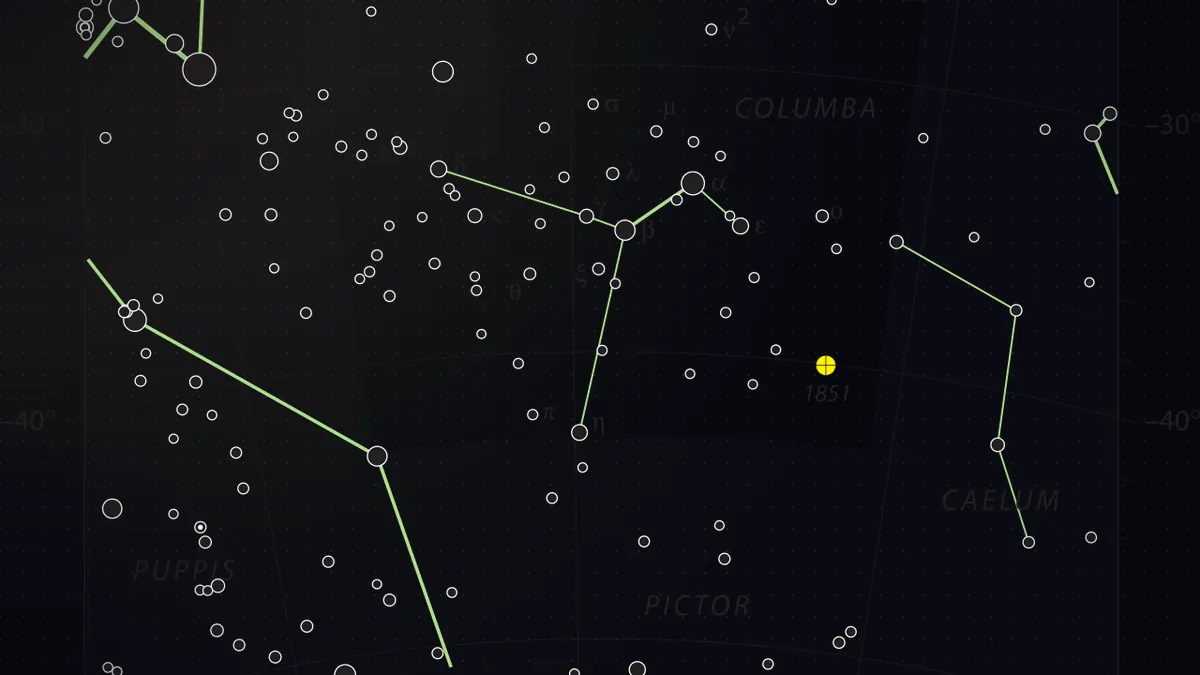
Look for a small group of stars around magnitude 3, with Phact the brightest. It is compact enough to hold together once found, but low altitude and haze work against northern observers.
In sky coordinates Columba sits at right ascension 5h 03m and declination −27.1°. If the units look unfamiliar, the idea behind them is not: declination is the sky's latitude, right ascension is its longitude, and together they place the constellation exactly. It sits in the southern half of the sky, high for southern observers and low on the horizon for northern ones. Practically speaking it is visible from anywhere south of latitude 45°N, including the whole southern hemisphere, with the best evening views around January.
What Columba actually looks like
A small, roughly bird-shaped scatter of stars: a compact body with a suggestion of outstretched wings. It is modest, but at least it is compact, which makes it easier to hold in your head than some larger faint constellations.
Columba was introduced by the Dutch astronomer Petrus Plancius around 1592, carved out of stars that Ptolemy had left unassigned around Canis Major. It was originally named Columba Noachi, Noah's Dove, and the name was later shortened.
Its placement is deliberate and rather charming: the dove flies just ahead of Argo Navis, the great ship, as though scouting for land.
The stars of Columba
-
Phact (Alpha Columbae, magnitude 2.6) — the brightest star, a hot blue-white star about 260 light years away. The name comes from Arabic for 'ring dove'.
-
Wazn (Beta Columbae) — an orange giant, second brightest.
-
Mu Columbae — the interesting one. It is a runaway star, moving at around 100 kilometres per second. Trace its path backwards and it converges on the Orion Nebula about two and a half million years ago, along with AE Aurigae and 53 Arietis, which are heading in other directions at similar speeds.
The accepted explanation is that two binary systems in the young Orion cluster had a close encounter and flung these stars out in different directions. Three stars, now in three widely separated constellations, all traceable to one violent event. It is one of the most satisfying pieces of stellar detective work there is.
The story behind the name
Columba is the dove that Noah released from the ark, which returned with an olive branch to show the flood was receding. Plancius introduced it in the 1590s, in the same wave of biblical constellation-making that produced Camelopardalis and Monoceros.
The positioning is part of the design. Argo Navis, the great ship, occupied the sky just to the east, so Plancius put the dove flying ahead of the vessel: mapping the Noah story onto a ship that the Greeks had intended as Jason's Argo. Two flood-and-voyage traditions overlaid on the same patch of sky.
Some accounts also identify the dove with the one Jason released to guide the Argo safely through the Clashing Rocks, which lets the same stars serve both stories. Either way, it is a bird scouting ahead of a ship.
What else is hiding in Columba
A quiet constellation with one Messier-class highlight and little else.
- NGC 1851 — a bright, compact globular cluster and comfortably the best object here. It is dense enough that small telescopes show it as a fuzzy ball while larger ones begin resolving the outer stars. Worth the trip if you have a southern horizon.
- NGC 1808 — a peculiar barred spiral galaxy with a starburst core, actively forming stars at a high rate. A faint but interesting target.
- Mu Columbae — nothing to look at, but a good thing to point out to someone. Explaining that this ordinary-looking star was flung out of the Orion Nebula, which is visible in the same sky on the same night, connects two parts of the winter sky in a way people remember.
When and where to see it
Best placed in the evening sky in February, alongside Orion and Canis Major.
It sits well south, so southern observers get it high and clear while northern observers see it very low. From northern Europe or Canada it barely rises, and even from the southern United States it stays close to the horizon where haze and light pollution are worst.
If you are north, you need a genuinely clear southern horizon and a transparent night. If you are south, Columba is an easy target and NGC 1851 is a rewarding globular. It is a good example of how much your latitude decides which constellations are worth your time.
Columba at a glance
| Name | Columba |
| Abbreviation | Col |
| Genitive form | Columbae |
| Meaning | the dove |
| Family | Heavenly Waters family |
| First recorded | 1592, Plancius, split from Canis Major |
| Right ascension | 5h 03m |
| Declination | −27.1° |
| Area | 270 square degrees (54th largest of 88) |
| Main stars in the figure | 5 |
| Stars brighter than magnitude 3 | 1 |
| Named Bayer / Flamsteed stars | 18 |
| Brightest star | α Col (Phact) (magnitude 2.65) |
| Messier objects | None |
| Meteor showers | None |
| Visible from | Anywhere south of latitude 45°N, including the whole southern hemisphere |
| Best seen at 9 pm in | January |
| Bordering constellations | Caelum, Canis Major, Lepus, Pictor, Puppis |
Where to go next
Its neighbours in the sky
Columba borders all of these, which makes them the natural next targets once you can pick it out: Caelum, Canis Major, Lepus, Pictor, Puppis.
The rest of the Heavenly Waters family
Columba belongs to the Heavenly Waters family: constellations tied to water, ships and the sea. The others are: Carina, Delphinus, Equuleus, Eridanus, Piscis Austrinus, Puppis, Pyxis, Vela.
Start from the beginning
If you are starting from scratch, the complete beginner's guide to the 88 constellations covers what a constellation actually is, how the sky is carved up, and links to every one of them.
Star chart: Columba IAU chart by IAU and Sky & Telescope magazine (Roger Sinnott & Rick Fienberg), used under CC BY 3.0. Observing data cross-checked against Wikipedia's Columba entry.