Equuleus is the second smallest constellation in the sky, beaten only by Crux. It covers 72 square degrees, has four stars worth mentioning, and contains nothing brighter than magnitude 3.9.
It is also, arguably, the most overlooked object in this entire guide. It sits right beside Pegasus, the great winged horse with its enormous Square, and the comparison does the little foal no favours at all. Yet it is one of Ptolemy's original 48, so somebody in antiquity thought these four faint stars were worth naming.
Where to find Equuleus
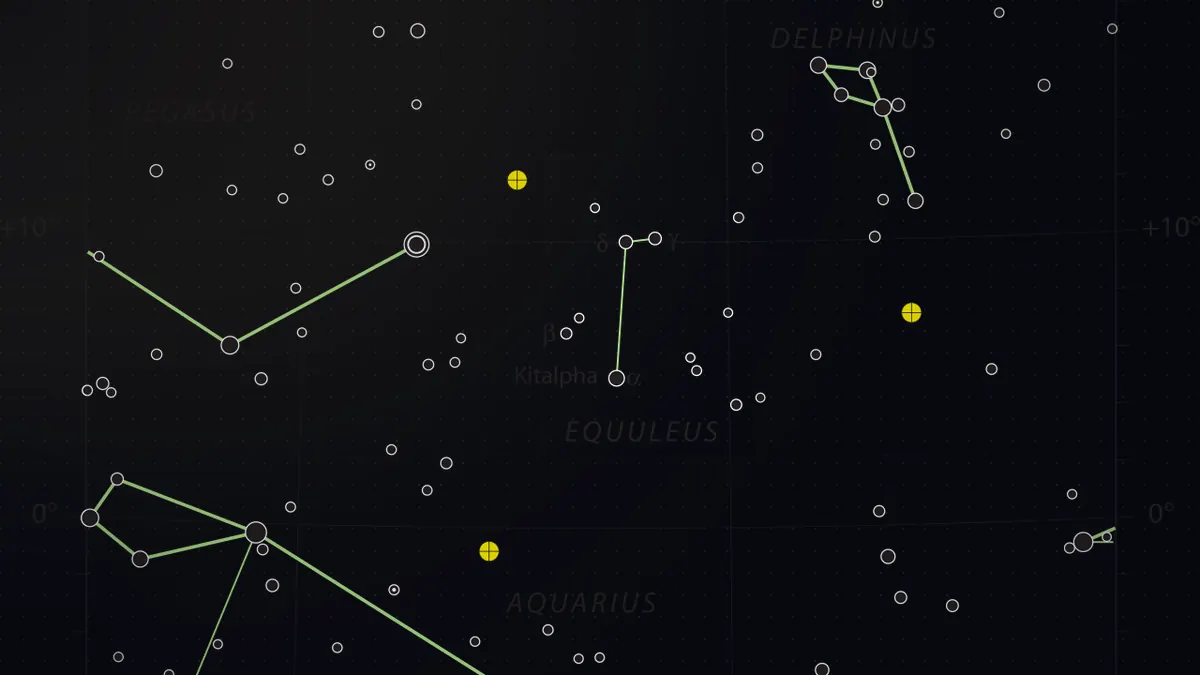
Equuleus sits between Delphinus and Pegasus, just west of the Great Square.
The most reliable route is via Delphinus. Find the little dolphin diamond east of Altair, then look a short distance south-east. The small, very faint triangle of stars you find there is Equuleus.
You will need a dark sky and patience. This is one of those constellations where the honest advice is that from a suburb you probably will not see it at all, and there is no technique that changes that.
In sky coordinates Equuleus sits at right ascension 20h 56m and declination +13.0°. Those two numbers work like a grid reference. Right ascension runs around the sky the way longitude runs around the Earth, and declination measures north and south the way latitude does. It sits in the northern half of the sky, riding high for northern observers and low for southern ones. You can see it from anywhere north of latitude 80°S, including the whole northern hemisphere, and it sits highest after dark in September.
What Equuleus actually looks like
Four faint stars in a small, shallow triangle or trapezoid. That is everything.
The figure represents the head of a small horse or foal: just the head, not a whole animal, which is a sensible piece of scaling given how few stars there are to work with. It sits immediately in front of Pegasus, so the two horses face the same way.
For a constellation of this size to have survived from Ptolemy through to the modern 88 is slightly surprising. Several far more prominent eighteenth-century inventions were abolished in 1922 while this handful of faint stars kept its place, purely on grounds of antiquity.
The stars of Equuleus
- Kitalpha (Alpha Equulei, magnitude 3.9) — the brightest star, a yellow giant about 190 light years away. The name comes from an Arabic phrase meaning 'a piece of the horse', which is a rather good description of a constellation that is only a head.
- Delta Equulei — a close binary with one of the shorter known orbital periods for a visual double, completing a circuit in about six years. Splitting it is a serious challenge.
- Gamma Equulei — a variable star of the rapidly oscillating Ap type, with a strong magnetic field and pulsations lasting minutes rather than days.
- Beta Equulei — a white star completing the small figure.
That is the complete list of anything notable. Equuleus is a four-star constellation and does not pretend otherwise.
The story behind the name
The mythology is thin and slightly contradictory, which is what you would expect for four faint stars.
The most common identification is Celeris, the brother or offspring of Pegasus, given by Mercury to Castor of the Gemini twins. Another version makes it Hippe, a daughter of the centaur Chiron who was turned into a mare to hide her pregnancy from her father and then placed in the sky showing only her head, so that Chiron would not find her.
A third account credits the constellation to the horse Poseidon created by striking the ground with his trident, during his contest with Athena over who would be patron of Athens.
The multiplicity of explanations suggests the stars were named first and the stories attached afterwards, which is probably true of a good deal of the sky.
What else is hiding in Equuleus
Equuleus contains no Messier objects and, realistically, nothing for amateur telescopes. It is a small patch of sky looking away from the galactic plane, and it is genuinely empty.
- NGC 7015 — a faint spiral galaxy, around magnitude 13, requiring a large telescope and a dark sky to register as anything more than a smudge.
- Delta Equulei — the one real observing challenge here. Its two components are extremely close, and splitting them requires excellent optics, steady air and good timing in the orbital cycle.
The honest recommendation is to find Equuleus for the satisfaction of having found it. Working through all 88 constellations means visiting places like this, and there is a particular pleasure in tracking down four faint stars that have carried a name for nearly two thousand years.
When and where to see it
Best placed in the evening sky in September, through late summer and autumn.
It sits just north of the celestial equator, so it is technically visible from almost everywhere on Earth. Whether you can actually see it is a different question, and depends entirely on sky quality.
You need a genuinely dark, transparent night. From a city Equuleus does not exist. From a dark rural site the little triangle appears once your eyes are fully adapted, and it is a satisfying tick precisely because it takes effort. Use the far more obvious Delphinus as your stepping stone, and do not expect the foal to reward you with anything but the finding of it.
Equuleus at a glance
| Name | Equuleus |
| Abbreviation | Equ |
| Genitive form | Equulei |
| Meaning | the pony |
| Family | Heavenly Waters family |
| First recorded | ancient (Ptolemy) |
| Right ascension | 20h 56m |
| Declination | +13.0° |
| Area | 72 square degrees (87th largest of 88) |
| Main stars in the figure | 3 |
| Stars brighter than magnitude 3 | 0 |
| Named Bayer / Flamsteed stars | 10 |
| Brightest star | α Equ (Kitalpha) (magnitude 3.92) |
| Messier objects | None |
| Meteor showers | None |
| Visible from | Anywhere north of latitude 80°S, including the whole northern hemisphere |
| Best seen at 9 pm in | September |
| Bordering constellations | Aquarius, Delphinus, Pegasus |
Where to go next
Its neighbours in the sky
Equuleus borders all of these, which makes them the natural next targets once you can pick it out: Aquarius, Delphinus, Pegasus.
The rest of the Heavenly Waters family
Equuleus belongs to the Heavenly Waters family: constellations tied to water, ships and the sea. The others are: Carina, Columba, Delphinus, Eridanus, Piscis Austrinus, Puppis, Pyxis, Vela.
Start from the beginning
Not sure where to begin? The guide to all 88 constellations explains how the sky is divided, what a constellation really is, and links to each of the 88.
Star chart: Equuleus IAU chart by IAU and Sky & Telescope magazine (Roger Sinnott & Rick Fienberg), used under CC BY 3.0. Observing data cross-checked against Wikipedia's Equuleus entry.