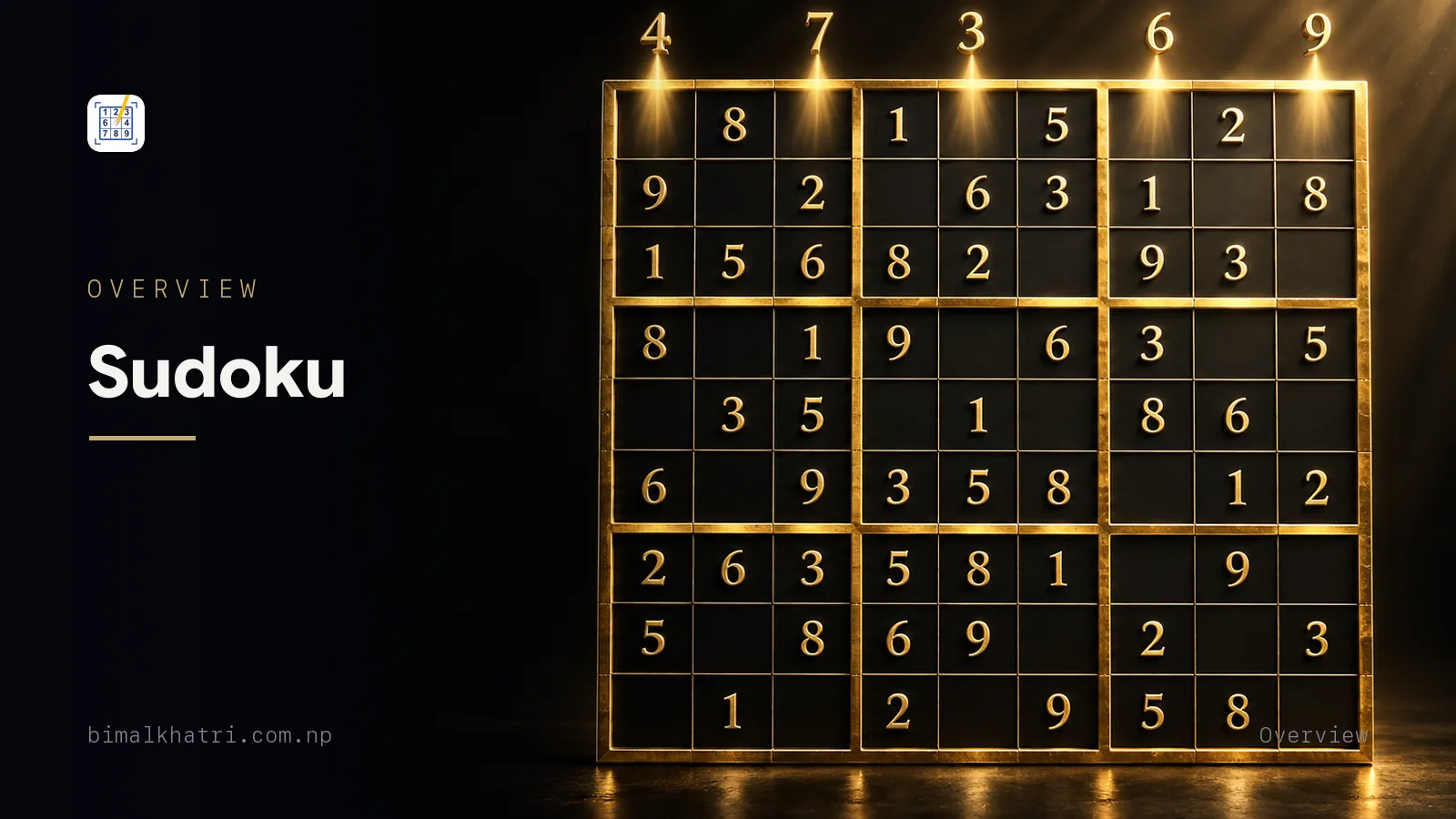
Sudoku has one rule. Every empty cell takes a digit from 1 to 9, and no digit may appear twice in a row, twice in a column, or twice in one of the nine 3x3 boxes.
Nothing adds up. The digits carry no value and could be nine colours without changing a thing. A properly made puzzle has one answer and logic alone reaches it. If a guess feels forced, the puzzle is broken or you have missed a move. There is no third case.
This page is the whole game in one place, and every section points at the post that goes further.
Reading this on the bus? Sudoku Master keeps all 4,000 of its puzzles inside the app, so nothing needs a signal, and there are no ads while you solve.
The rules, complete
Here is a puzzle. Dots are the cells you have to fill.
5 3 . . 7 . . . .
6 . . 1 9 5 . . .
. 9 8 . . . . 6 .
8 . . . 6 . . . 3
4 . . 8 . 3 . . 1
7 . . . 2 . . . 6
. 6 . . . . 2 8 .
. . . 4 1 9 . . 5
. . . . 8 . . 7 9
The digits printed for you are the givens. They never change, and a fair puzzle never asks you to.
Now the notation, because every technique below is written in it. Number the
rows 1 to 9 downward and the columns 1 to 9 rightward, then name a cell by row
and then column: r4c7 sits in row 4, column 7. Boxes take the same reading
order, left to right and then down, which puts box 1 in the top left and box 9
in the bottom right.
One more word earns its keep. A cell's peers are the twenty other cells sharing its row, column or box: eight, eight and eight, minus four counted twice. The whole game is one statement about peers. A cell can never hold a digit that a peer already holds.
That is all of it. No diagonals, no sums, no special squares. The complete rules for beginners walk through the edge cases, and the words the series uses sit in one place.
Start by scanning, not by writing
New solvers fill every empty cell with a list of possible digits. Do that on the grid above and you write for ten minutes before placing anything. There is a faster opening.
Pick a digit and hunt it box by box. Take the 6, and take box 4, the middle left. Its first column is already full of givens, so the digit has six cells to choose from, all of them in columns 2 and 3.
Row 4 carries a 6 at r4c5, which kills both of box 4's cells in row 4. Row 6
carries a 6 at r6c9, which kills both in row 6. That is down to r5c2 and
r5c3. Then column 2 turns out to hold a 6 already, at r7c2.
One cell survives. Place a 6 at r5c3.
That is cross-hatching, the habit that pays best. You are not asking what a cell can be. You are asking where a digit can go, a much smaller question, and a box gives it only nine places to hide. Work all nine digits through all nine boxes and an easy grid usually solves itself. Cross-hatching in detail sets out the order to run them in.
The two singles that finish most easy puzzles
Everything after scanning proves a cell has run out of options. There are two shapes of that proof, and they are opposites.
The first is the naked single: one cell, one candidate. Take r7c6. Its row
already holds 6, 2 and 8. Its column holds 5, 3 and 9. Box 8 adds a 4 and a 1.
Eight digits are spoken for, so the cell has exactly one option. Place a 7.
The hidden single runs the other way, and it is the one people walk past. The cell has several candidates. One of those digits simply has nowhere else to go in its row, its column or its box.
Look at box 2, the top middle. Row 3 carries an 8 at r3c3, so the bottom line
of the box cannot take one. The middle line is already full: 1, 9 and 5. That
leaves the top line, where r1c5 is a given and column 4 has an 8 at r5c4
that rules out r1c4.
So the 8 goes to r1c6, and r1c6 looks like nothing on its own. Its own
candidates are {2,4,6,8}. The cell tells you no answer. The box does.
Naked singles are visible. Hidden singles sit behind three or four other candidates, which is why a grid can look stuck when it is not. Naked and hidden singles, worked takes both apart slowly, and your first puzzle, move by move runs a whole grid start to finish.
When to start writing pencil marks
Scan until scanning stops paying. When two full passes of the digits give you nothing, write candidates down.
Mark a region at a time. A box with three empty cells is worth marking; a box with seven is not. And keep them current. The cost is never the writing, it is the stale mark you forgot to rub out, which invents a contradiction that was never on the grid. Pencil marks without drowning in them has the maintenance rules, and nine beginner mistakes the habits worth dropping early.
The techniques, in the order you need them
Each becomes useful only when the one above it stops producing placements. Skipping ahead to X-Wings on an easy puzzle is a good way to miss a hidden single sitting in plain sight.
| Level | Technique | What it does |
|---|---|---|
| 1 | Cross-hatching | Finds where a digit can go in a box, before any writing |
| 2 | Naked and hidden singles | Places a digit outright |
| 3 | Naked pairs, triples, quads | Two cells sharing two candidates lock both digits away from the unit |
| 4 | Hidden pairs and triples | Two digits confined to two cells clear those cells of everything else |
| 5 | Pointing pairs, box-line | A digit stuck on one line of a box leaves the rest of that line |
| 6 | X-Wing | One digit, two rows, the same two columns: those columns clear |
| 7 | Swordfish, XY-Wing | The three-row X-Wing, and the first proper chain |
| 8 | Colouring and chains | What extreme puzzles are built to need |
Levels 1 and 2 finish an easy puzzle. Levels 3 to 5 clear almost anything a newspaper prints as hard. Level 6 and up is expert territory, and level 8 is somewhere many good solvers never go. The full list is the reference version of this table; hard Sudoku strategy is about choosing between them.
Difficulty is not the number of clues
Count the givens and you have measured nothing. A grid with 30 of them can be far harder than one with 24. What sets the grade is the hardest move the puzzle makes you find, and the number of times it makes you find it. One buried X-Wing outweighs six spare clues.
Two numbers are worth carrying. Filled grids that break no rule: 6,670,903,752,021,072,936,960 of them, counted exhaustively by Felgenhauer and Jarvis in 2005. And the fewest givens that can pin an answer down is 17, settled in 2012 when McGuire, Tugemann and Civario had a computer walk every arrangement of 16 and found not one with a single solution. That is a search, not a theorem anybody proved by hand.
Grades are local to whoever printed them. No two publishers share a scale, so the word on the page describes the publisher rather than the puzzle. What makes a Sudoku easy, medium, hard or extreme explains how graders work, and seventeen clues covers the minimum.
When the grid stops moving
Everybody hits the wall. Work it in this order rather than staring.
- Re-scan every digit, box by box. Most stuck grids are a missed hidden single, not a missing technique.
- Check your last few placements. One bad digit makes every later deduction unsound, and a broken grid feels exactly like a hard one.
- Count a unit. A row with two empty cells is missing exactly two digits.
- Update the marks in whatever you changed, then look for pairs.
- Only then reach further. Pointing pairs before X-Wings.
The stuck checklist is the long version, and why some puzzles feel impossible separates a hard grid from one you have already broken. Take hints one digit at a time: a revealed digit teaches you something, a revealed grid nothing. Why guessing never pays is in solving without guessing.
Where the puzzle came from
Sudoku is neither ancient nor Japanese in origin, though both stories circulate freely. The ancestor is the Latin square, which Leonhard Euler studied in the 1780s. He gets the credit constantly and should not: the box constraint is not his, and neither is the puzzle.
The modern form ran as Number Place in Dell's Pencil Puzzles & Word Games for May 1979. Howard Garns, a retired Indianapolis architect, is credited with it on thin but consistent evidence: his name sits in the contributor list of every issue that carried the puzzle and none that did not. Dell printed no bylines, so "credited" is as far as the record goes. Garns died in 1989.
Japan supplied the name and the craft. Nikoli ran it from 1984, Maki Kaji shortened 数字は独身に限る, "the digits must be single", to 数独, and the house conventions still shaping a handmade puzzle came from there: 32 givens at most, placed symmetrically. The boom has a date. Wayne Gould, a retired New Zealand judge in Hong Kong, spotted the puzzle in a Tokyo bookshop in 1997, spent six years building a generator, and got it into The Times of London on 12 November 2004.
The full history has the rest.
The variants, and what each changes
Classic 9x9 is one puzzle in a family. Each variant keeps the row, column and box rule and adds something.
| Variant | The extra rule |
|---|---|
| Killer | Dashed cages carry a sum; digits in a cage cannot repeat |
| Jigsaw | The nine boxes become nine irregular shapes |
| Samurai | Five 9x9 grids overlapping at four corner boxes |
| Sudoku X | Both main diagonals must also hold 1 to 9 |
| Other grid sizes | Small grids for children, larger ones using 0-9 plus A-F |
The techniques transfer almost completely: a hidden single is a hidden single whatever shape the box is. Types of Sudoku is the tour.
Is it good for your brain?
The honest answer is smaller than the headlines. PROTECT, run by the University of Exeter and King's College London and published in 2019, is the largest study anyone can point at. More than 19,000 people between 50 and 93 reported how often they did puzzles, then sat cognitive tests. The regular number-puzzle group came out ahead on attention, reasoning and memory, by a gap the authors likened to several years of age-related decline.
Now the small print. PROTECT watched people who had picked their own hobbies, which makes it observational: it found an association and cannot say which way the arrow runs. Sharper people may simply like puzzles more. The authors were the first to say so. And nothing in that study, or in any other, shows that Sudoku lowers a person's risk of dementia.
What is left needs no citation at all. It absorbs you. It is twenty minutes of holding attention on one thing, at no cost when you fail. And it is a screen that is not a feed. What the studies found goes through the evidence, and Sudoku or crosswords compares the two.
Paper, newspaper or phone
Paper is better for learning, because the marks stay put and the whole grid is visible at once. Printing them properly matters more than it sounds, since most printable grids come out too small to pencil into. A phone is better for the bus, and the undo button changes what you dare try: paper against phone is the long comparison. Newspapers grade to their own scale, which is why NYT Sudoku and the other dailies never line up.
I built Sudoku Master for the two things I kept wanting on a phone: 4,000 bundled puzzles across four grades that need no connection, and a camera that reads a printed grid, so you can settle the newspaper puzzle you have been arguing with. Recognition runs on the device, so the photo goes nowhere. It plays classic 9x9 and nothing else. The seven tests worth running work on any app in the store, mine included.
Questions people ask
Is Sudoku a maths puzzle?
No. Classic Sudoku contains no arithmetic, and the digits stand for nothing. Swap them for nine shapes and the solving is identical.
Can a Sudoku have fewer than 17 clues?
No. In 2012 McGuire, Tugemann and Civario had a computer check every possible arrangement of 16 givens, and none of them pins down a single answer. Puzzles with 17 do exist, and they are not automatically the hardest thing you will meet.
How long should a Sudoku take?
There is no should. An easy grid runs a few minutes once scanning is automatic; an extreme one can take half an hour. How long a Sudoku takes has the numbers.
Do I ever have to guess?
Not on a properly made puzzle. One solution exists and logic reaches it. If you are guessing, you are missing a technique or holding a faulty puzzle, and a guess repairs neither.
Can I solve a printed Sudoku with my phone?
Yes. Point the camera at the grid, read the digits in, fix whatever it got wrong, and solve. Glare, a curled page and an angled shot all hurt recognition, so a flat page in even light pays. Scanning with your camera covers what works, and how a solver works what happens after the read.
Why is one paper's hard easier than another's medium?
Because nobody agreed a scale. Each publisher grades against its own back catalogue. Judge a grid by the technique it demands, not by the word above it.
What does the word Sudoku mean?
It is Japanese, short for a longer Nikoli phrase meaning that the digits must be single: 数 is number, 独 is single or solitary. It does not mean difficult, and it is not a Hindi word. The word, unpacked.
Is Sudoku a good puzzle for older solvers?
The format adapts well: large print, easier grids, shorter sittings. The evidence for the cognitive benefit is weaker than the claims made for it. Sudoku for seniors covers the practical side and Sudoku for kids the other end.
Keep reading
- How to play Sudoku: the complete rules, for the rules on their own
- Your first Sudoku, solved one move at a time, one grid from its first placement to its last
- Every Sudoku technique, easiest to hardest, the reference version of the ladder above
- Stuck on a Sudoku? Work this checklist in order, when a grid refuses to move and staring is not working
- What makes a Sudoku easy, medium, hard or extreme, because clue count is not the answer
Get the app: Sudoku Master, free for iPhone and Android. The link works out which store your phone needs.