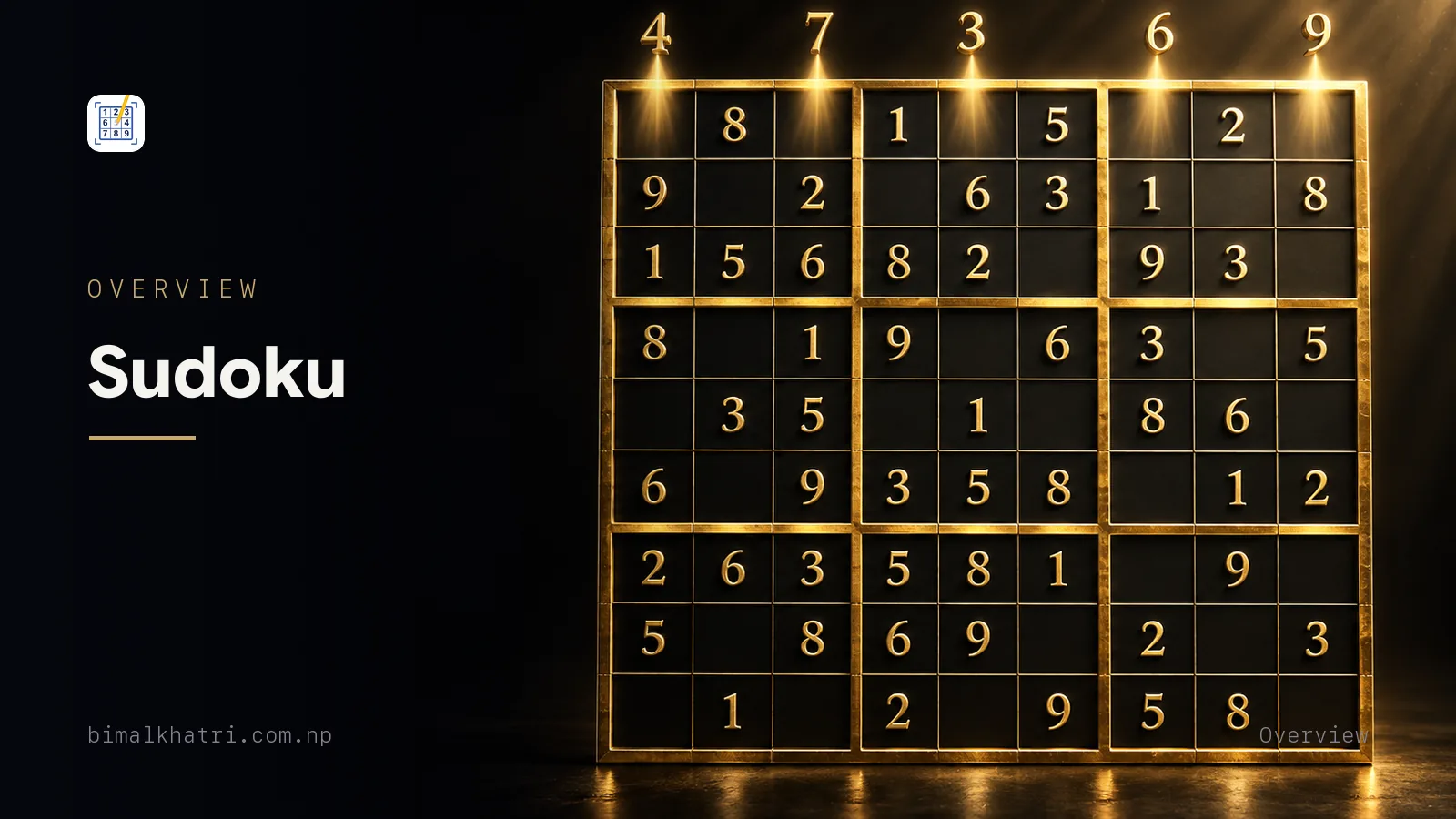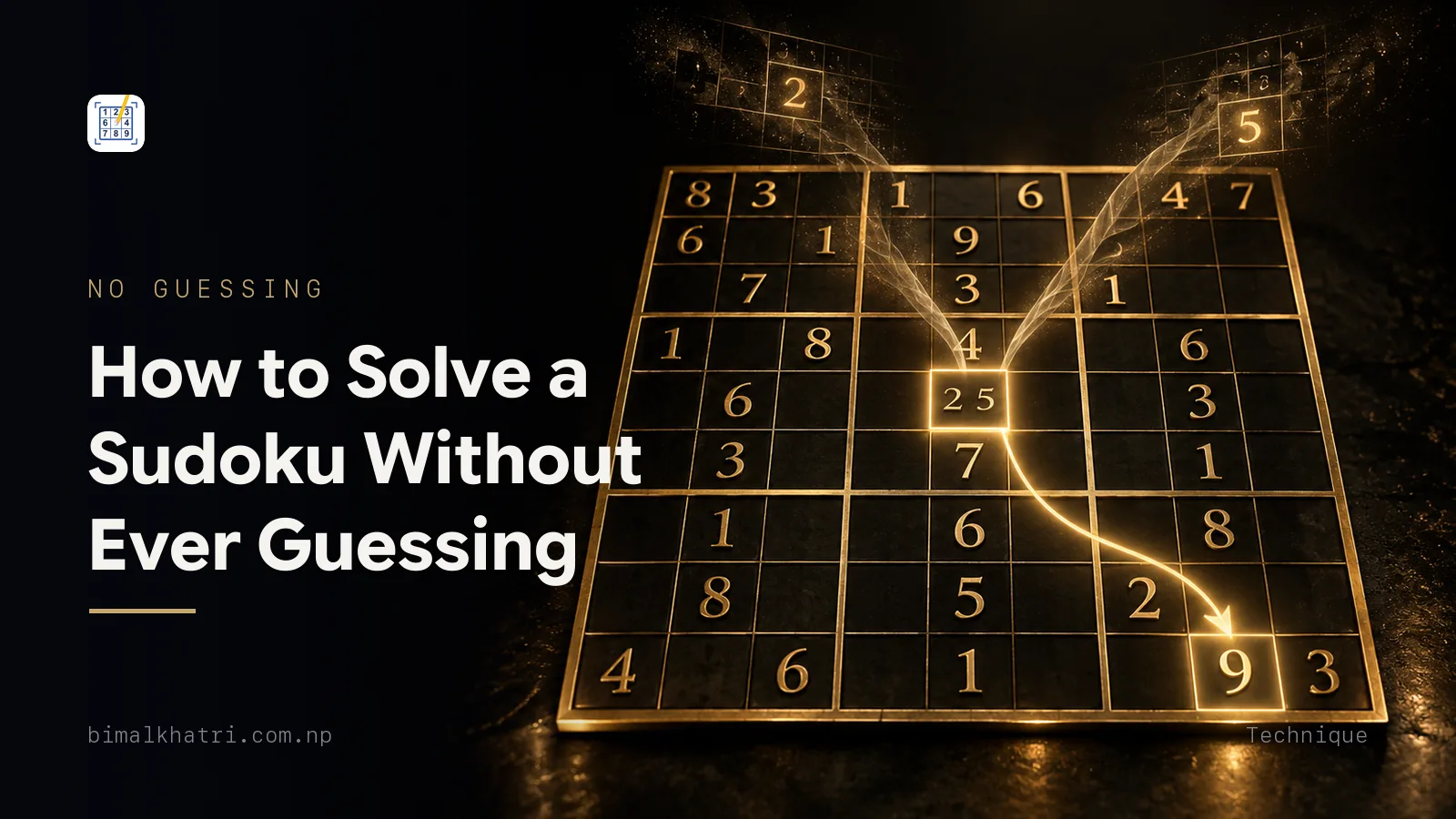
You never have to guess. A properly made Sudoku has exactly one solution, and every digit in it is forced by the clues you were given. So when the grid stops and a guess looks like the only move left, one of three things is true: there is a move on the board you have not looked for, you wrote a wrong digit earlier, or the puzzle itself is broken.
Almost always it is the first one. Two real grids below make the point. On the first, eleven digits can be placed right now and not one cell has a single candidate. On the second, one pair of cells finishes the last twenty-one.
Worried you have already gone wrong? Sudoku Master ships every puzzle with its own solution, so a bad digit is caught in the cell you put it in rather than twelve moves downstream. Free, 4,000 graded puzzles, and no ads while you solve.
Why the answer is always reachable
The rule is that no digit repeats in a row, a column or a 3x3 box. Every cell has twenty peers under that rule: eight along its row, eight down its column, and four more in its box that the row and column did not already cover. Every move you will ever make is a statement about those twenty cells.
A proper puzzle has exactly one completion, and that is the guarantee doing the real work here. If only one finished grid fits the clues, then for every empty cell exactly one digit fits and eight do not, and the reason is already on the board. Nothing has to be assumed. Something has to be found.
One honest caveat. A single solution means every digit is forced; it does not promise that the forcing is easy to see. At the top of the difficulty range the argument can run through six or eight cells before it closes, and plenty of people would rather put the puzzle down than chase it. That is a fair place to stop. It is still not a guess.
Three reasons a grid stops
| What you are looking at | What it means | What to do |
|---|---|---|
| The grid is legal and you are out of ideas | A technique you have not run yet | Work the checklist below in order |
| A cell with no candidates left, or a digit with nowhere to go in some row, column or box | A wrong digit, placed earlier | Back up to the last placement you can justify |
| Two different completions both survive to the end | The puzzle is improper, not hard | No technique fixes it. Find a clean copy |
The middle row is the cruel one, because a wrong digit says nothing at the time. It was a legal candidate when you wrote it. The complaint arrives later, in a part of the grid you were not looking at.
The order that costs least
Run these in order and stop at the first one that gives you something. The order is about price, not prestige: each rung costs more attention than the one above it, so there is no sense reaching for a rectangle while a box still has a digit with one home.
- Cross-hatch each digit through the nine boxes.
- Hidden singles: one digit at a time, per row, column and box.
- Naked singles, once you have pencil marks worth trusting.
- Naked pairs, triples and quads in a single unit.
- Hidden pairs and triples.
- Pointing pairs and box-line reduction, where a box meets a line.
- X-Wing and XY-Wing.
- Colouring and chains.
Both grids on this page break inside the first four rungs. The full ladder has the worked version of each.
Stall one: eleven moves, and not one naked single
9..8..7..
.817.6...
....9.8.1
.7.4.8.13
...6.1289
....3..4.
.4....3.8
79.3.....
..81..97.
This grid has 32 givens and 49 empty cells. Go looking for a cell with one
candidate and you will not find one, because there isn't one. Seven cells hold
exactly two candidates. The tightest is r2c7, which is {4,5}, and that is
the cell people flip a coin on.
Ask the other question instead. Not what can this cell hold, but where can this digit go.
Take the 7 and look at box 6, the middle-right block. Three of its cells are
empty: r4c7, r6c7 and r6c9. Row 4 already has a 7 at r4c2, so r4c7 is
out. Column 7 already has a 7 at r1c7, so r6c7 is out. One cell survives, so
r6c9 is a 7, and nothing about that placement is a guess.
That is a hidden single, and this grid is full of them. Eleven digits can be placed by that argument alone before you write anything down. Better still, the puzzle never needs anything harder: all 49 cells go in as singles, 25 of them hidden and 24 of them naked, once the early placements open the grid up.
The lesson is narrow and it costs beginners more grids than anything else. A cell with two candidates is not a fork in the road. It is a cell you have not earned yet, and the digit that resolves it is usually somewhere else on the board. Naked and hidden singles are worth drilling until the second question comes as fast as the first.
Stall two: two cells that finish a puzzle
Here is a harder one, at 29 givens.
3749..18.
..8.4.2.6
.....8..7
51.......
.92..73..
8...3....
4...9.8..
..9...65.
1.58.....
Singles carry it a long way. Thirty-one cells go in on cross-hatching and hidden singles, and then it dies here.
374962185
958741236
261358..7
513..47..
6925.73..
847.395..
4.6.9587.
7894.365.
1.5876...
Twenty-one cells left and no single of either kind available. This is exactly the moment people start writing digits they cannot defend. Instead, write out one column. Column 9 is the emptiest, so start there.
| Cell | Candidates |
|---|---|
r4c9 | {2,8,9} |
r5c9 | {1,4,8} |
r6c9 | {1,2} |
r7c9 | {1,2,3} |
r8c9 | {1,2} |
r9c9 | {2,3,4,9} |
Two cells in that list read the same: r6c9 and r8c9 are both {1,2}. You
cannot tell which way round they go, and you do not need to. One of them is the
1 and the other is the 2, so between them they have used up both digits for the
whole column. Every other cell in column 9 can drop them.
| Cell | Before | After |
|---|---|---|
r4c9 | {2,8,9} | {8,9} |
r5c9 | {1,4,8} | {4,8} |
r7c9 | {1,2,3} | {3} |
r9c9 | {2,3,4,9} | {3,4,9} |
Look at row three of that table. r7c9 had three candidates and now has one, so
it is a 3. Place it, and the whole grid comes apart: the remaining twenty-one
cells are singles, one after another, with no further technique of any kind.
374962185
958741236
261358497
513284769
692517348
847639512
426195873
789423651
135876924
That was a naked pair, and it took about
thirty seconds to find because it was in the first column anyone would look at.
There was also a second door. The 1 of column 8 fits only r5c8 or r6c8, and
both of those sit in box 6, so box 6 spends its 1 inside column 8. That knocks
the 1 out of r5c9 and r6c9, which makes r6c9 a 2 on the spot. That one is
box-line reduction. A stall usually has
more than one way out. You only need one of them.
What a guess actually costs, measured on that grid
At that stall the twenty-one empty cells carry fifty-one candidates between them. Twenty-one of those are the answer. Thirty are not. Pick a pencil mark at random and write it in, and you are wrong about three times in five.
Being wrong is not the expensive part. Not knowing when is. Here is what three different wrong digits do to that same grid.
| The guess | How far it gets | Where it dies |
|---|---|---|
1 in r6c9 | Nowhere | Immediately: box 6 then leaves column 8 with no room for its 1 |
1 in r7c9 | One more cell | r8c9 runs out of candidates |
9 in r9c9 | Twelve more cells, across five rows | Row 8 discovers it has nowhere to put a 2 |
The third line is the one to be afraid of. Twelve cells go in cleanly, each of them a legitimate single given the digit above it, and the grid looks like it is being solved right up to the moment it isn't. The complaint lands in row 8, a row you never touched. On a screen that costs you an undo. On paper it costs an eraser and an exact memory of which thirteen cells came after the guess, which nobody has.
Trial and error is not guessing, if you write it down
There is a real technique that looks like guessing and is not. Assume a candidate, follow the consequences, and if they end in a contradiction, that candidate is false and you rub it out. The elimination is sound, because a contradiction proves the assumption wrong. Under various names, Nishio and forcing chains among them, this is what the top of the ladder is made of.
What separates it from guessing is what you keep.
- Pick a cell with two candidates, never three. Two branches means refuting one settles the cell.
- Write the branch somewhere other than the grid. A margin, a second sheet, the back of the newspaper.
- Accept only a contradiction as a result. A branch that runs on happily proves nothing at all.
- When it does contradict, erase every cell the assumption touched, then make the one elimination you earned.
Skip step 2 and you have not done logic, you have done damage. The whole risk is in the bookkeeping, which is why this belongs at the end of the checklist rather than the middle.
Worth knowing: the solver app on your phone works this way, without the squeamishness. It picks a cell, tries a digit, and unwinds the moment the grid breaks. That is backtracking, and a machine can unwind a million branches while you are still finding your eraser. The technique is not beneath you. The bookkeeping is just beyond what a human hand can do at speed.
Finding the wrong digit you already wrote
The grid tells you that a mistake exists. It does not tell you where. Three symptoms, in rising order of how much they cost you:
- The same digit twice in a row, column or box. The cheapest failure, and the easiest to find. Scan the offending unit and one of the two is wrong.
- An empty cell with no candidates. Something in its twenty peers is wrong.
- A digit with no home in a unit. Every cell in that row, column or box is either filled or blocked for the digit. The culprit can be anywhere.
The uncomfortable part is that a wrong digit was a legal candidate when you wrote it, so checking the rules again will not catch it. What works is re-deriving. Start from the givens and ask of each digit you added why it went there. The first one you cannot answer for is either the mistake or standing next to it. If you are solving on a phone, undo is faster than any of this, and a mistake counter faster still.
This is the practical reason not to guess, quite apart from purity. A grid built entirely from moves you can justify can be audited. A grid with one unjustified digit in it cannot, and one bad digit poisons everything downstream of it. Keeping pencil marks clean is part of the same discipline, because a stale mark will hand you a wrong answer with a justification attached.
When the puzzle is genuinely broken
It happens, and it is not always the setter's fault. A puzzle can be printed with a typo. A grid can be copied into a notebook with two digits swapped. A photo of a folded newspaper can be read wrong. All three produce the same thing: a grid with no solution, or one with several, and both feel exactly like being stuck.
The tell for a broken puzzle is a solution you can reach two different ways. If you finish a grid and find that swapping a pair of digits also finishes it, the puzzle was improper. Sixteen clues is not enough for a single answer under any arrangement, and the smallest proper puzzles carry seventeen, but clue count is not the usual culprit. A mistranscribed digit is.
I built Sudoku Master, and this is the failure it spends most of its code on. The scanner reads a printed grid with Google ML Kit on the device, so the photo never leaves your phone, and it does misread a creased page. That is why every scanned digit lands in an editor you can correct before anything is solved. The solver behind it is a backtracking routine: it returns the finished grid or it returns nothing. It will not walk you through the technique you missed, and I am not going to pretend otherwise. The nothing is still useful. If a solver cannot finish your grid, the grid is wrong, and you now know whether to hunt for your own mistake or go and find a better copy of the puzzle.
Questions people ask
How do I know if I have made a mistake in a Sudoku?
Three signs, and no others: a digit appearing twice in a row, column or box; an empty cell with no legal candidate; or a digit that has nowhere to go in a unit. Any of them means an earlier placement is wrong. The grid will not flag the wrong cell, only the damage.
What should I do when a Sudoku has two possible answers?
Stop solving. A proper puzzle has exactly one solution, so two answers means the puzzle was made or copied wrong. Check your transcription first, since a single swapped digit is a much more common cause than a bad setter, then find another copy.
Is using a hint the same as guessing?
No. A hint hands you a digit that is genuinely forced, so nothing downstream of it is unsafe. A guess hands you a digit that might be wrong, and everything downstream is then suspect. The cost of a hint is that you skipped the argument, which is a different problem and a smaller one.
Do extreme puzzles ever need trial and error?
Some need reasoning that is easier to run as a contradiction test than as a named pattern, which is trial and error done on paper with the branch written down. The puzzle still does not need a guess. It needs a longer argument than the ones on the middle of the ladder.
Why does one of my cells have no possible digit left?
Because one of its twenty peers holds a wrong digit. That cell is the messenger, not the mistake. Work backwards through the placements you made since your last certain move and re-derive each one.
Do Sudoku solver apps guess?
Mine does, and it is the right design for a machine. Backtracking picks a cell, tries a digit, and reverses out the moment it hits a contradiction, at a speed no person can match. It is also why a solver's answer teaches you nothing about how a human would have got there.
Should I start over when I find a wrong digit?
Only if you cannot locate it. If you can name the reason for every digit you placed, rub out from the bad one forwards and keep the rest. If you were solving fast and cannot reconstruct the order, a fresh copy of the same puzzle is quicker than untangling a poisoned grid.
How long should I stare before deciding a puzzle is unfair?
Give it one full pass of the checklist first: every digit cross-hatched through every box, then hidden singles by unit. Most stalls that feel permanent are one digit away, and the digit is usually in the box you glanced at.
Keep reading
- The full Sudoku guide, the guide that runs from the rules to the advanced techniques
- Naked singles and hidden singles, with worked grids, the two moves that break most stalls
- Naked pairs, triples and quads, the technique that finished the second grid on this page
- Why some Sudoku puzzles feel impossible, for when the grid is hard rather than broken
- Advanced Sudoku techniques for extreme puzzles, where contradiction chains earn their place
- How a Sudoku solver works, and why a machine is allowed to do what you should not
Get it: Sudoku Master, free on iPhone and Android. The link sends you to whichever store your phone uses.