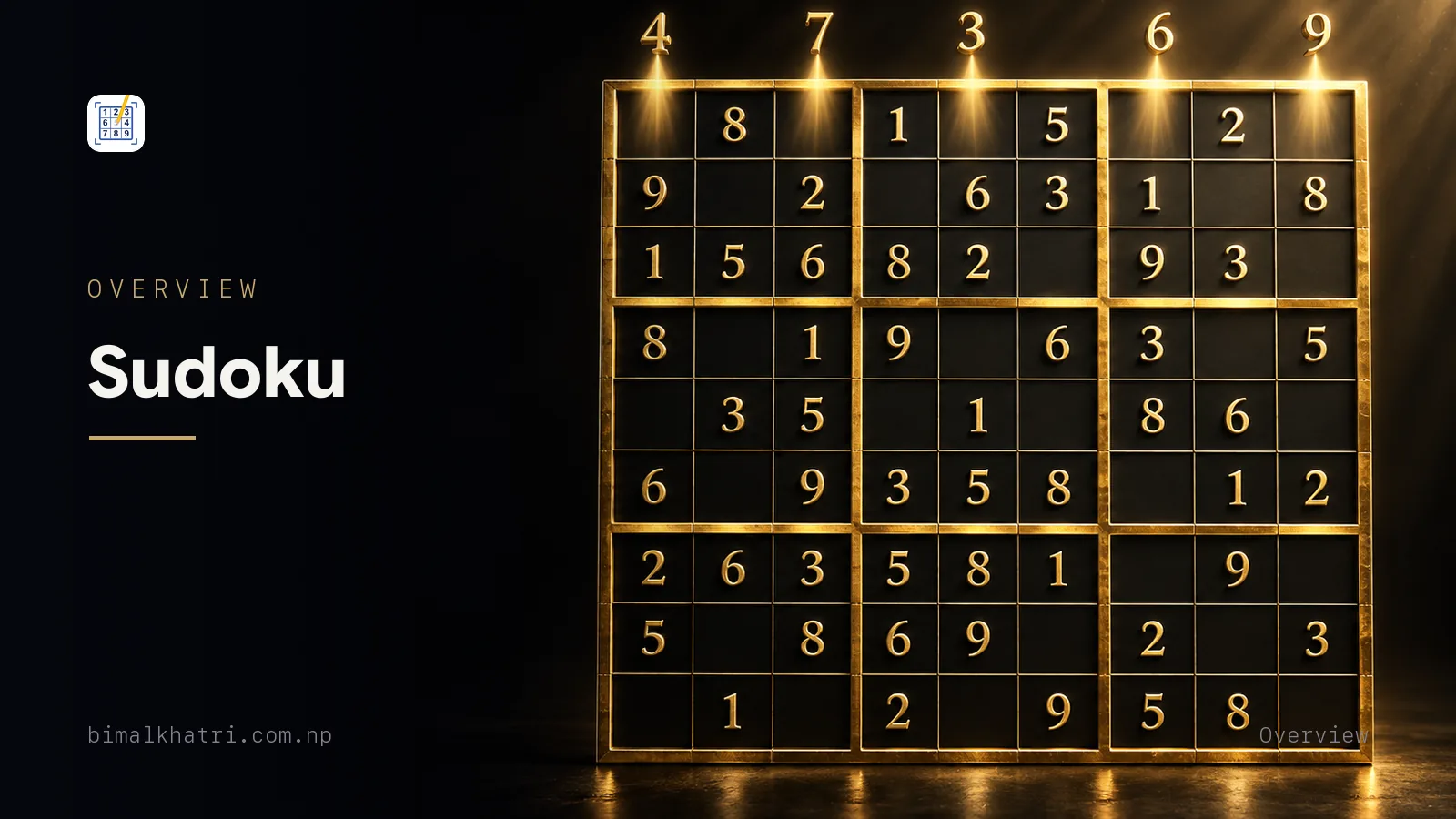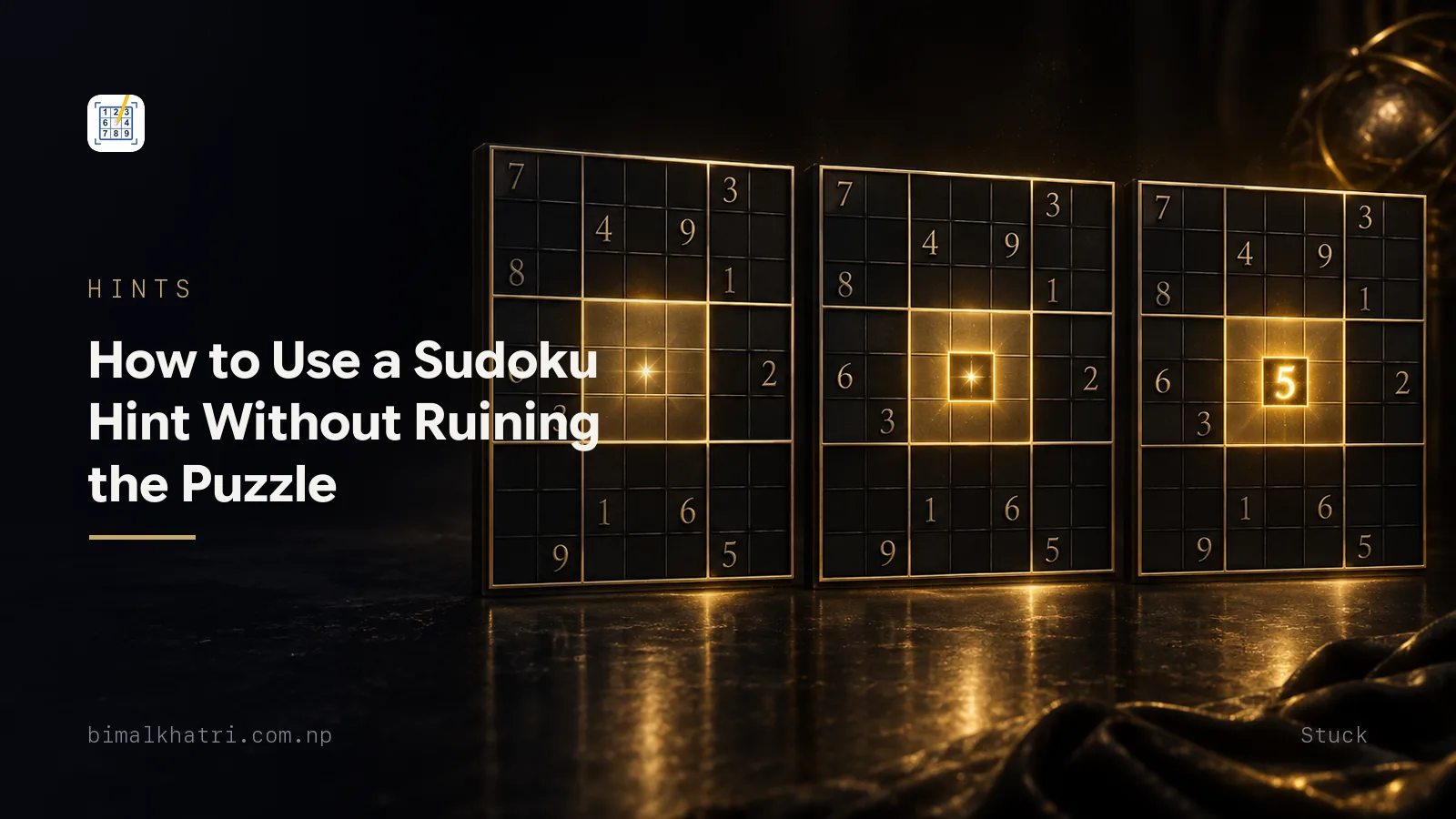
Ask for a hint when a full pass through the grid places nothing and you have already checked that the digits you wrote are correct. Then take the smallest hint on offer. A check first, a nudge towards one region second, and a revealed digit only if neither of those moved you.
The order matters because the button on the screen is usually the largest hint on the list. It reads the stored answer and writes one digit into a cell it chose for you. You get the digit and nothing else. On the grid worked through below, eleven of the twenty-nine open cells leave you stuck again the moment the hint lands.
So the real question is not whether to use a hint. It is which one, and when.
On a phone? Sudoku Master highlights the row, column and box of the cell you are in, which is the looking that a 'where should I look' hint does for you. 4,000 classic puzzles across four difficulties, free, and no ads while you solve.
Seven things get called a hint
They are not the same product, and they do not cost you the same thing.
| What you ask for | What comes back | What it costs you |
|---|---|---|
| Is my grid still right? | Yes, or no | Nothing. Take this one freely |
| Where is my mistake? | The cell that is wrong | Almost nothing. You still work out why |
| Where should I look? | A row, column or box that has a move in it | The search, not the reasoning |
| What pattern is this? | The name of the technique | The recognition |
| What can I rub out? | One candidate elimination | The deduction behind it |
| What goes in this cell? | A digit | The whole move |
| Show me the answer | The finished grid | The puzzle |
The two ends of that table are the ones usually on offer. The middle rows are rarer, and they are the ones that leave you a puzzle to solve. A hint that names a box hands you the search and keeps the reasoning. A hint that fills a cell keeps both.
Earn it first: the two-pass test
Before any hint, run this. It takes two minutes and it settles whether you are stuck or just tired.
- Cross-hatch every digit from 1 to 9 through all nine boxes and place what falls out.
- Do it again. Every digit that went in during the first pass reopens boxes you had already written off.
- If pencil marks are down, spend one more minute on the cheap eliminations: naked pairs, then hidden pairs, then pointing pairs.
Two clean passes that place nothing is the signal. That is also the signal to start pencil marks, and marks are worth trying before a hint, because most of the time they produce the move on their own. The longer version of this checklist is in stuck on a Sudoku.
Where the button actually gets pressed
Here is a real puzzle with 26 givens.
.9.5...4.
....7..3.
1..9.3685
.1.....9.
..8......
...1..25.
63.....2.
.57.2.3..
....8...9
Cross-hatching the boxes places 12 digits and then stops paying. Each box has been walked through with all nine digits and nothing new falls out. Here is what you are looking at.
.9.5.8.4.
.8..7.93.
1..9.3685
.1.8...9.
..8......
...1..258
639...82.
857.293..
..138.5.9
Forty-three cells still empty, the scan has gone quiet, and this is the moment the hint gets tapped. It is far too early. Plain singles place another fourteen digits from this position, with no new technique at all.
Start with r3c5. Row 3 is missing 2, 4 and 7. Column 5 already holds 7, 2 and
8. So r3c5 is a 4, and there was nothing clever about finding it: the box scan
simply never looked at the cell from the row and column side. That is the normal
gap between cross-hatching and singles, and it is worked through properly in
naked and hidden singles.
Fourteen placements later the grid looks like this.
396518742
.8..7.931
172943685
.1.8..49.
..8...1..
...1..258
639.5182.
857.2931.
..138.5.9
Twenty-nine cells empty. A hint bought at the previous grid would have cost you those fourteen digits and taught you nothing you did not already know.
The stall, and what is really on the board
This time the grid has genuinely stopped. Run everything a competent solver knows over it and here is the entire harvest.
r9c1andr9c2are both{2,4}. A naked pair in row 9, and it takes the 4 out ofr9c6.- Column 5 has three empty cells and they hold 3, 6 and 9 between them. All
three sit inside box 5, so 6 leaves
r4c6,r5c4,r5c6andr6c6. - There is an X-Wing on the digit 4 in rows 7 and 8, sitting in columns 4 and 9.
It takes the 4 out of
r5c4.
Six candidates gone. No digit placed. An X-Wing is the technique people spend a week learning, it is genuinely present here, and on this grid it removes one candidate and moves nothing. That is what the top of a difficulty ladder looks like from the inside, and it is a fair place to ask for help. The X-Wing is explained here if you want to see the pattern worked slowly.
Which cell you reveal decides the puzzle
Reveal one digit on that stalled grid and the rest of it falls to plain singles. Or it does not. It depends entirely on which of the twenty-nine cells the hint picked, and the spread is wider than anyone expects.
| One revealed digit at this stall | How many of the 29 cells |
|---|---|
| Finishes the whole puzzle by singles alone | 18 |
| Places between one and ten more digits, then stalls again | 9 |
| Places nothing whatsoever | 2 |
The two dead ones are r5c6 and r6c2. Look at what that means. r6c2 is down
to {4,6}, which is as constrained as a cell gets without being solved, and
being told which of the two it is buys you no further move at all. r9c1 is
also down to two candidates, {2,4}, and revealing that one finishes the
puzzle. Same shape on the page, opposite value.
There is a weak pattern in the numbers. The reveals that paid sat in boxes that
were closer to full, averaging four empty cells, and the ones that paid least
sat in boxes averaging closer to six. So if your app lets you select a cell
before asking, select one in the tidiest part of the grid rather than the
emptiest. Do not trust it further than that. r6c2 sits in a busy box and
r5c2, its neighbour, finishes the puzzle outright.
The practical version: a revealed digit is a lottery ticket, and the one hint that is never a lottery is the check.
Check before you reveal
A wrong digit does not make a Sudoku harder. It makes it impossible, and it does that silently. Every proper puzzle has exactly one solution, so the moment you write a digit that is not in it, the grid you are working on has none. The contradiction is already there. You just will not meet it for another twenty moves, by which point you will be hunting a technique for a puzzle that has stopped existing.
That is why the check is the cheapest hint in the list and the one to spend first. On a screen it is the check button, the mistake counter, or the moment the app refuses your digit. On paper it is the answer key with a card over it. Either way you are asking a different question from "what goes here", and it is the question that actually unblocks most stuck grids. More on that failure mode in why some puzzles feel impossible.
Check the givens too, not only your own digits. If you copied the puzzle into an app by hand, or photographed it, one misread given makes the whole thing unsolvable and every hint you buy will be wrong.
I built Sudoku Master, so I will be exact about what it does here. There is no technique-by-technique hint in it. The scanner reads a printed grid with recognition that runs on the device, you fix any digit it misread in the grid editor, and the solver hands back the finished answer. That is a checker and a last resort, not a teacher. Recognition on a folded newspaper is imperfect, and a 6 read as an 8 turns a valid puzzle into a dead one, which is exactly why the editor sits between the camera and the solve button. What that looks like in practice is covered in scanning a Sudoku with your phone.
The half of the hint most people skip
Placing the revealed digit is not the point. Reconstructing it is, and it takes about a minute.
Cover the new digit with a finger and ask three questions.
- Which unit forced it? Look at its row, then its column, then its box. Usually one of the three was down to a single home for that digit.
- What would have found it? Name the technique out loud. Hidden single in a column. Naked pair two boxes away. Pointing pair.
- What stopped me finding it? Almost always one of two things: a pencil mark you left alive after its digit was placed, or a unit you never counted by digit.
If you cannot reconstruct it in two minutes, that answer is useful as well. The puzzle is using something above the level you have learned, and the fix is a technique rather than another hint. The ladder, in order of difficulty, is in every Sudoku technique.
Decide your hint budget before the first digit
Apps price hints in four ways: unlimited and free, a fixed allowance per puzzle, one per advert watched, or bought with a currency you earn by playing. None of those is dishonest. All of them change how you behave, and not in the direction you would choose.
Free and unlimited encourages tapping through a puzzle you could have finished. A hard allowance encourages hoarding the hint long past the point where it would have taught you something. Watching an advert for one turns a cheap decision into an expensive one, so you make it later than you should.
Set your own rule while you are calm, because a rule set mid-puzzle is a rule set while annoyed. Mine has three lines.
- A check is free, any time, as often as I like.
- One revealed digit per puzzle, and only after the two-pass test.
- If the grid stalls again within five placements of that reveal, stop. Buying a second digit is buying the same lottery ticket twice. The thing I am missing is a technique, and it will still be missing tomorrow.
Then there is the bookkeeping question. If you track completions, times or a streak, decide what a hinted finish counts as and stay consistent. A puzzle I finished on a revealed digit is one I did not solve, and it goes in the same column as one I lost. That sounds severe. It is also the only reason the number means anything, and the same argument applies to how long a Sudoku should take.
Getting a hint on paper
Paper has no button, which turns out to be an advantage: every level of hint is available, and you choose the size.
The check. Most books and papers print the solution. Slide a card down the page so only one row of the key shows, compare it against the row you have filled, cover it again. You have used the answer to verify rather than to advance, which is the whole trick.
The region nudge. Pick the box with the fewest empty cells and give it two full minutes with all nine digits. This is the closest paper gets to "look here", and on a stuck grid it works more often than it has any right to.
The reveal. If you are going to take a digit from the key, choose the cell yourself, and choose it in the fullest box rather than the emptiest. Read one cell. Cover the rest of the page while you do it, because your eye will take three digits if you let it.
Tomorrow's paper carries today's answers, which is a slow check with an excellent side effect: you cannot spend it in the moment you are annoyed. There are faster options in checking a newspaper Sudoku answer.
When a hint is simply the right call
Nobody is marking this. There are situations where reaching for the answer is the correct move and not a failure of character.
- The puzzle is broken or you copied it wrong. A grid with no solution, or with two, cannot be finished by logic. Check the givens against the source before you blame yourself.
- The next move is above your level. If the grid needs a chain or a colouring and you have not learned either, you can spend the evening learning or you can finish the puzzle. Both are legitimate, and taking the digit now and the technique later is a real option.
- You are teaching someone. A hint that names the box is the best teaching tool in the game, because the learner still gets the find.
- Time is the constraint. A daily puzzle on a commute that ends in five minutes is not a training session. Take the digit.
What none of that covers is the reflex tap. That is the one worth breaking, and the two-pass test breaks it.
Common mistakes
Tapping hint before the second scan. The first pass through a grid always leaves digits behind, because each placement reopens boxes you have already checked. The example above had fourteen free digits sitting on it.
Using a reveal as a mistake check. If your grid already contains a wrong digit, a revealed digit lands in a puzzle that cannot be finished, and the app will cheerfully sell you another one. Check first, reveal second.
Buying a second hint straight after the first. One reveal that leads nowhere is information: it says the grid needs a technique, not a digit.
Revealing the cell you have been staring at. The cell you are stuck on is usually the one with the most candidates, which is why the logic reaches it last. The move is somewhere else.
Placing the hint and moving straight on. You paid for it. Spend the minute that works out why it was forced, or you will pay for the same hint on the next puzzle.
Treating the check as though it costs something. It does not. Verification is the one hint you can use as often as you like without taking anything away from the solve.
Guessing instead. A coin flip on a two-candidate cell feels less like cheating than a hint and is worse, because a wrong guess destroys the grid quietly. The case against it is made in full in solving without guessing.
Questions people ask
Is using a hint in Sudoku cheating?
There is nobody to cheat. A hint is a tool with a price, and the price is the part of the puzzle you were about to solve. Use it as a check freely and as a reveal rarely, and the only thing that changes is how much of the grid you did yourself.
Why does the hint fill in a cell I was not even looking at?
Because most hint engines read from the stored solution and pick a cell by their own rule, usually the one their solver would fill next, which is rarely the cell you were fighting. The cell you were fighting tends to be the least constrained one on the board, so it is the last one any solver reaches.
Why did the hint not help?
Because the cell it chose opened nothing up. On the worked grid above, two of the twenty-nine open cells place nothing at all when revealed, and nine more run out again within ten digits. A revealed digit only pays when it happens to complete a unit that was nearly finished.
Does a puzzle still count as solved if I used a hint?
That is your rule to set, and it is worth setting before you need it. Most apps count a hinted finish as a completion, so if the streak matters to you, keep the stricter number in your own head.
Why does my app say I have made a mistake when every digit looks legal?
Because legal and correct are different. A digit can break no rule at the moment you write it and still not be the one in the solution, and the grid will not contradict itself for another twenty moves. That is the whole reason a proper puzzle has exactly one solution, and it is covered in why some puzzles feel impossible.
How many hints should I allow myself on a hard puzzle?
One reveal, taken after two full passes that placed nothing, plus as many checks as you want. If one reveal is not enough, the puzzle is asking for a technique and a second digit will not supply it.
Can I get a hint on a printed Sudoku?
Yes, and you get to choose the size of it. Use the printed key as a check by covering all but one row, or read a single cell you have chosen yourself. Photographing the grid gives you the full answer, which is the bluntest version and hard to unsee.
Is it better to use a hint or to guess?
Take the hint. A guess that is wrong looks exactly like a guess that is right for the next twenty moves, and then it costs you the grid. A hint is at least true.
Keep reading
- Stuck on a Sudoku?, the full checklist to work before you spend anything
- Why some Sudoku puzzles feel impossible, which is usually a wrong digit rather than a hard one
- Every Sudoku technique, easiest first, for naming the thing the hint knew and you did not
- How a Sudoku solver works, and why it can give you an answer but not a reason
- How to check a newspaper Sudoku answer, the paper version of the check button
- Sudoku: the complete guide, for what to read before and after this one
Get it: Sudoku Master, free on iPhone and Android. The link sends you to whichever store your phone uses.