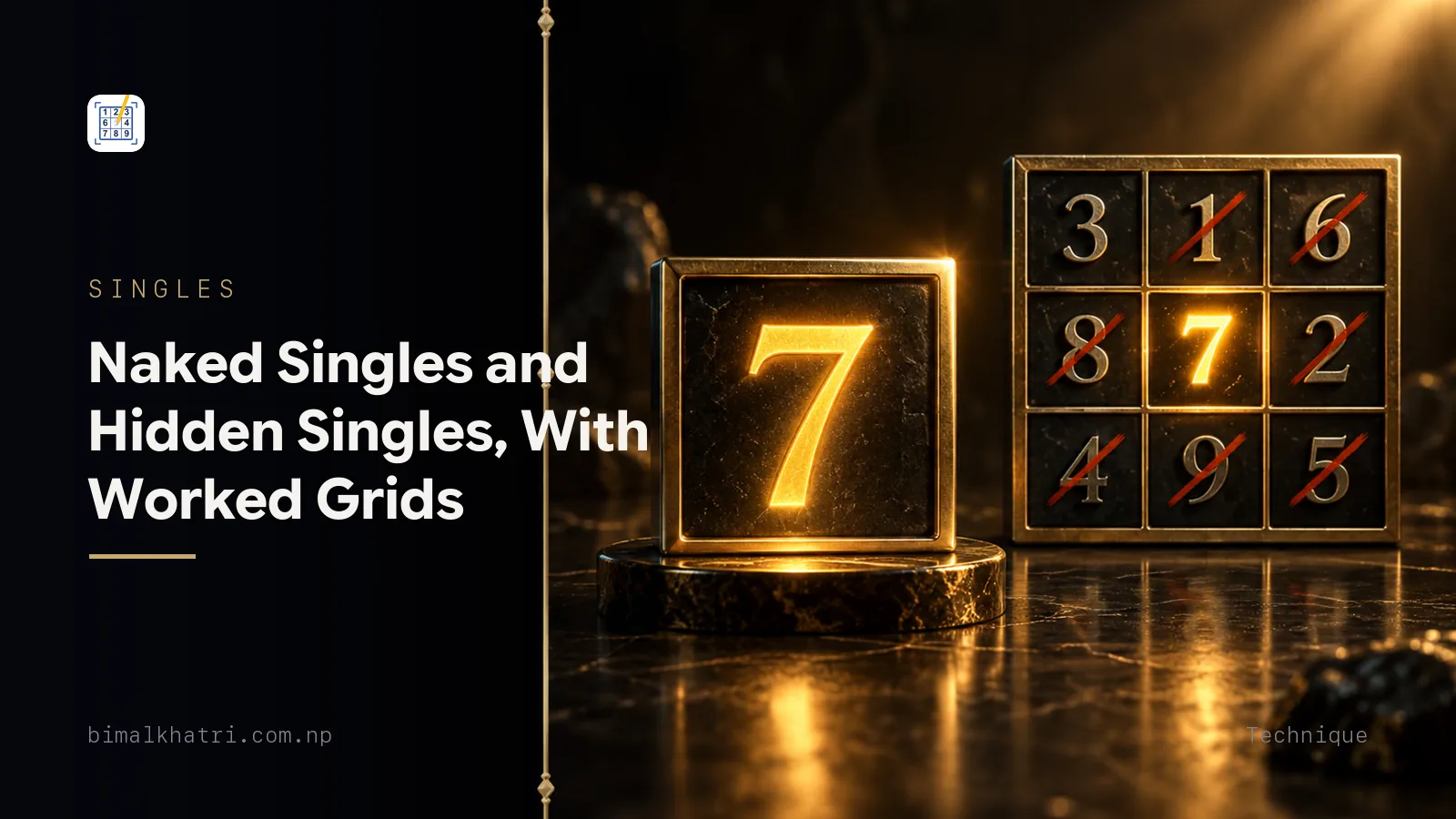
A naked single is a cell with one candidate left. You read the cell, you count what its twenty peers have already banned, and if exactly one digit survives, that digit goes in.
A hidden single is a digit with one home left in a row, column or box. You read the unit, not the cell. The cell can still hold four or five candidates and it does not matter. If the 3 has nowhere else to sit in that box, the 3 sits there.
Same word, opposite search. Naked means the cell gives itself away. Hidden means the digit was buried under other candidates the whole time, and only the unit around it can tell you.
Reading this with a puzzle open? Sudoku Master can light up every cell already holding the digit you tapped, which turns the sweep below into something you look at instead of something you trace. Free, 4,000 classic puzzles, and no ads while you solve.
Both grids below are real puzzles, one easy and one medium. Every step is checkable against the grid printed above it.
The difference, in one table
| Naked single | Hidden single | |
|---|---|---|
| What you look at | One cell | One unit: a row, a column or a box |
| The test | The cell has exactly one candidate left | The digit fits in exactly one cell of the unit |
| What the cell looks like | {7} | {1,3,4,7,9}, and the 3 is still forced |
| How you find it | Pencil marks, or a cell whose peers are nearly all filled | Cross-hatching: pick a digit, sweep a unit |
| When it shows up | Later, once the grid has filled in | Straight away, on the opening scan |
| What it costs you | Writing candidates first | Nothing. You can do it in your head |
Books disagree about the labels. A naked single also gets called a sole candidate or a forced cell, and hidden singles get several names too. Read the definition rather than the name and you will recognise the pattern whichever page you are on.
An easy grid, and the three singles hiding in it
This puzzle has 36 givens, which is a normal easy count.
.3687.5.1
5..236.89
.9.154...
...71.435
1.83...97
..3..5...
..1......
74.6.18..
.8......4
Forty-five cells are empty. Three of them are naked singles right now. Eleven of them are hidden singles. That ratio is the whole argument for learning the second pattern: even on an easy grid, hidden singles outnumber naked ones almost four to one, and the naked ones tend to be the ones you would have found anyway.
The easiest single of the lot
Look at box 2, the top middle: rows 1 to 3, columns 4 to 6. It reads 8, 7 and a
blank on the top row, then 2, 3, 6, then 1, 5, 4. Eight digits in, one cell
empty, and the only digit missing from the box is 9. So r1c6 is 9.
That is a naked single, and it is the trivial case. Some books call it a full house. You do not have to think about candidates at all: a unit with one empty cell can only want the one digit it is missing. Clear these first every time you place something, because they are free.
A naked single you have to work for
Now r2c7. Row 2 reads 5..236.89, so the cell is nowhere near the last one
standing. Take its three units in turn.
| Unit | Digits already in it | What that rules out |
|---|---|---|
| Row 2 | 5, 2, 3, 6, 8, 9 | 2, 3, 5, 6, 8, 9 |
| Column 7 | 5 at r1c7, 4 at r4c7, 8 at r8c7 | 4, and 5 and 8 again |
| Box 3 | 5, 1, 8, 9 | 1, and 5, 8, 9 again |
Put the three lists together and you have banned 1, 2, 3, 4, 5, 6, 8 and 9.
Eight digits, from three different directions. Only 7 is left, so r2c7 is 7.
Notice how the work is spread. The 1 comes only from the box, at r1c9. The 4
comes only from the column, at r4c7. Drop either unit from your check and the
cell still looks like it has two candidates. This is why beginners miss naked
singles: they check the row and the column, and their eye slides past the box.
And a hidden single on the same grid
Box 4 is rows 4 to 6, columns 1 to 3. It holds a 1 at r5c1, an 8 at r5c3 and
a 3 at r6c3, so six cells are empty. Ask where the 4 goes.
- Row 4 already has a 4, at
r4c7. That killsr4c1,r4c2andr4c3. - Column 2 already has a 4, at
r8c2. That killsr5c2andr6c2. r6c1survives. Nothing else does.
So r6c1 is 4. Now look at what that cell actually holds. Its row gives 3 and
5, its column gives 5, 1 and 7, its box gives 1, 8 and 3, so its candidates are
{2,4,6,9}. Four of them. Stare at that cell on its own for an hour and it will
never tell you anything. The box tells you in five seconds.
They really are two different patterns
It is tempting to assume every single is both, seen from two angles. It is not.
r2c7 above is a naked single with one candidate, 7. Is 7 a hidden single in
row 2? No. Row 2 has three empty cells: r2c2 holds {1,7}, r2c3 holds
{4,7} and r2c7 holds {7}. The digit 7 has three possible homes in that
row. The cell is forced, the digit is not.
The reverse case is on the next grid, where a cell with five candidates is forced to one of them. So run both searches. Finding one pattern does not tell you the other is not there.
A medium grid with no naked singles at all
Here is a medium puzzle, 31 givens.
...9..71.
.8..1..3.
.7.42.5.8
.5.6...8.
...2.1..3
.28...9..
31..4...7
765....41
.....7.2.
Fifty empty cells. Write out every candidate in every one of them and you will not find a single cell with only one digit left. Not one. A solver looking only for naked singles is stuck on move one.
Ten of those cells are hidden singles.
| Cell | Digit | The unit that forces it |
|---|---|---|
r1c2 | 3 | Column 2 |
r2c4 | 7 | Box 2 |
r4c3 | 3 | Box 4 |
r4c7 | 1 | Box 6 |
r5c5 | 8 | Box 5 |
r6c1 | 1 | Row 6 |
r7c3 | 2 | Box 7 |
r8c6 | 2 | Row 8 |
r9c1 | 8 | Box 7 |
r9c4 | 1 | Box 8 |
Three of them are worth walking through, because they show the same idea working in a box, a column and a row.
In a box: the 3 in box 4
Box 4 is rows 4 to 6, columns 1 to 3. It holds 5 at r4c2, 2 at r6c2 and 8 at
r6c3. Six empty cells. Where can the 3 go?
- Column 1 has a 3 at
r7c1, sor4c1,r5c1andr6c1are out. - Row 5 has a 3 at
r5c9, sor5c2andr5c3are out. r4c3is the only cell left. It is a 3.
Two givens, one in a column and one in a row, between them wipe out five of the
six cells. Now the punchline. The candidates in r4c3 are {1,3,4,7,9}. Five
digits. It is the least decided-looking cell in the box, and it is the one the
box has already decided.
Compare the other digits missing from that box and you can see why the 3 stands out.
| Digit | Cells in box 4 that could take it |
|---|---|
| 1 | r4c1, r4c3, r6c1 |
| 3 | r4c3 |
| 4 | r4c1, r4c3, r5c1, r5c2, r5c3, r6c1 |
| 6 | r5c1, r5c3, r6c1 |
| 7 | r4c3, r5c3 |
| 9 | r4c1, r4c3, r5c1, r5c2, r5c3, r6c1 |
One row of that table has one entry. That is the whole search, and it is why sweeping by digit finds things that staring at cells does not.
In a column: the 3 in column 2
Column 2 reads blank, 8, 7, 5, blank, 2, 1, 6, blank from the top. Three empty
cells: r1c2, r5c2 and r9c2. The column is missing 3, 4 and 9.
Row 5 has a 3 at r5c9, so r5c2 cannot take it. Box 7 has a 3 at r7c1, so
r9c2 cannot take it either. r1c2 is 3. Its own candidates were {3,4}, so
this one was close to naked. Not all of them are.
In a row: the 1 in row 6
Row 6 reads .28...9.., so it has six empty cells. Chase the 1 across it.
- Box 5 holds a 1 at
r5c6, which coversr6c4,r6c5andr6c6. - Column 8 holds a 1 at
r1c8, sor6c8is out. - Column 9 holds a 1 at
r8c9, sor6c9is out. r6c1is left, holding candidates{1,4,6}. It is a 1.
Place all ten and look again
Here is the grid with those ten digits in.
.3.9..71.
.8.71..3.
.7.42.5.8
.536..18.
...281..3
128...9..
312.4...7
765..2.41
8..1.7.2.
Forty cells still empty, and there is still not one naked single anywhere on the
board. There are nine more hidden singles. r3c3 is a 1 because box 1 has
nowhere else for it, and that cell holds {1,6,9}. r1c6 is an 8 with {5,6,8}
in it. And so on.
This grid does finish on singles alone. No naked pair, no pointing pair, no X-Wing, nothing off the harder end of the technique ladder. Fifty placements, two patterns. It is just that one of the two patterns does almost all of the early work, and it is the one most people never learn to look for.
The sweep that finds hidden singles
You do not need pencil marks for this, which is the practical reason to do it first. The search is a loop over digits, not cells.
- Pick the digit that appears most often on the grid. It has the most givens doing eliminations for you, so it pays best.
- Take each box that does not already contain it. Cover the rows and columns that already carry that digit and see how many cells are left inside the box.
- One cell left means you place the digit. Two or three means move on, and note that a digit confined to one line inside a box is a pointing pair even when it is not a single.
- When boxes stop giving, run the same sweep along rows and then columns. Row and column hidden singles are the ones people miss, because everyone cross-hatches boxes and stops.
- Place a digit and start the sweep again. Every placement changes twenty cells.
That third bullet is worth repeating. A digit down to one cell in a unit is a placement. A digit down to two or three cells is still information, and it is what the next few techniques are built on.
The full version of the sweep, with the eye movement that makes it fast, is in cross-hatching and scanning.
When naked singles start paying
Naked singles need one of two things: pencil marks, or a cell so hemmed in that you can count its peers by eye.
The eye version works when a cell sits where a busy row crosses a busy column inside a busy box. If eight of the twenty peers already show eight different digits, the cell is decided. In practice you spot these after a placement, because the digit you just wrote is one of the eight.
The marks version is the reliable one, and it changes the balance. Once you have written candidates into a region, naked singles arrive constantly, because each placement rubs a digit out of up to twenty cells and some of those drop to one. That is the cascade every solver knows: five placements in thirty seconds, then nothing for two minutes. The habits that stop marks becoming a swamp are in how to use pencil marks.
The order that wastes the least time on a fresh grid:
- Fill any unit with one empty cell.
- Sweep for hidden singles, boxes first, then rows and columns.
- Repeat 1 and 2 until nothing moves.
- Only then write pencil marks, and only in the region that is stuck.
- Take the naked singles the marks hand you, then sweep again.
I built Sudoku Master, and three of its settings map onto that loop exactly. The row, column and box highlight draws a cell's twenty peers, which is the naked single check with the counting done. The same-number highlight paints one digit across the board, which is the hidden single sweep. Auto-remove notes kills the stale mark that manufactures a confident wrong single. None of it needs a signal, because the whole catalogue sits in the download rather than on a server.
Five ways a single goes wrong
Calling a hidden single after checking three cells. The claim is that the digit fits nowhere else in the unit. Nowhere else means every empty cell in it. Six cells in a box, five ruled out, one left. Skip one and you will place a digit that had two homes.
Checking the row and the column and forgetting the box. The most common
naked single error, and r2c7 on the easy grid shows the cost. Without box 3
the cell still looks like it could be a 1 or a 7.
Trusting a mark you did not update. A cell reading {4} because you never
rubbed out the 7 is not a naked single. It is a wrong answer that arrives with
its own justification, which is why nothing about it feels wrong at the time.
Rub marks out at the moment you place, not at the end of the sweep.
Sweeping boxes only. Box hidden singles are the easiest to see, so they get found and the grid stalls. Half the singles in the medium grid above live in a row or a column.
Guessing when the sweep comes up empty. A proper puzzle has exactly one solution and every cell is reachable by logic, so an empty sweep means you missed something or you have moved past singles. It never means a guess is allowed. The checklist for that moment is in stuck on a Sudoku.
When the singles genuinely run out
On easy and most medium puzzles they do not. On a hard grid they will, and the next steps are small.
Two cells in one unit holding the same two candidates is a naked pair, and those two digits leave every other cell in that unit. Two digits that fit in only two cells of a unit is a hidden pair, which is the same idea as a hidden single with one more digit in it. Both usually hand you fresh singles a move later, which is the real reason to learn them.
That progression is worked through in naked pairs, triples and quads and hidden pairs and triples.
Questions people ask
Which should I look for first, hidden singles or naked singles?
Hidden singles, and it is not close. They need no pencil marks, they turn up on the opening scan, and on the medium grid above they are the only thing available for the first ten placements. Naked singles come to you once marks are down.
Can one cell be both at once?
Yes, and often is late in a grid, but neither implies the other. r2c7 on the
easy grid is a naked single whose digit has three possible homes in its row.
r4c3 on the medium grid is a hidden single in a cell holding five candidates.
Run both searches.
Do I need pencil marks to find singles?
Not for hidden singles. Pick a digit, cover the rows and columns that already carry it, and count the cells left in the box. That is a head-and-eyes job. Naked singles need marks unless the cell is nearly surrounded already.
What is a full house in Sudoku?
The last empty cell in a row, column or box. Only one digit is missing from the unit, so that digit goes in with no candidate work at all. It is the simplest naked single and it is worth clearing after every placement.
Why can I not find any singles in this puzzle?
Three likely reasons. You are sweeping boxes and not rows and columns. Your pencil marks are stale, so a real single is hidden behind a candidate that died two moves ago. Or the grid has genuinely moved past singles, which is normal on hard puzzles and means naked pairs are the next thing to try.
How many singles does a whole puzzle need?
It depends entirely on the grid. Both puzzles on this page finish on singles alone, 45 placements for the easy one and 50 for the medium one. A hard puzzle will still be mostly singles, with a handful of harder steps that open more of them.
Does a hidden single ever turn out to be wrong?
Not if the logic held. It fails when the check was incomplete, when an earlier digit was placed wrongly, or when you were working from marks you had not updated. If a placement later contradicts itself, the error is almost always several moves back, not in the single itself.
Is this the same as the last remaining cell rule?
That name usually means a hidden single: the digit has one remaining cell in the unit. Terminology drifted as the puzzle spread and the same pattern picked up several names. The two definitions at the top of this page are the ones to keep, whatever a given book calls them.
Keep reading
- Cross-hatching: how to read a Sudoku grid quickly, the sweep that finds hidden singles fastest
- Sudoku: rules, techniques and solving, the overview, with every technique in the order you meet them
- Naked pairs, triples and quads, the next step when the singles dry up
- Hidden pairs and triples, the hidden idea with two digits instead of one
- Every Sudoku technique, easiest to hardest, for where singles sit on the ladder
- Stuck on a Sudoku? Work this checklist in order, for the grid that has stopped moving
Get it: Sudoku Master, free on iPhone and Android. It works out which store your phone needs.