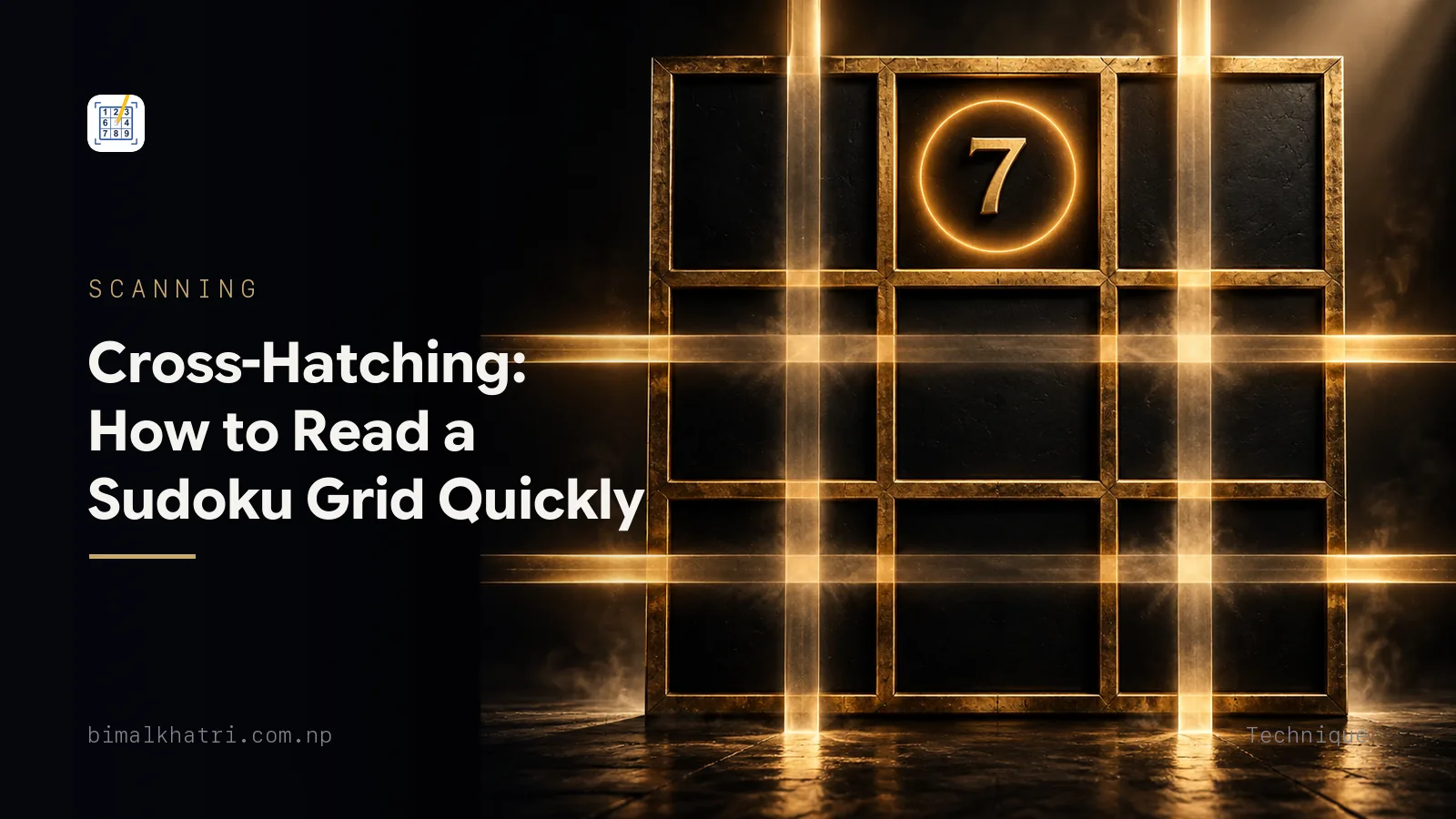
Cross-hatching is one move, repeated. Take a digit, take a box that does not hold it yet, and strike out every row and every column running through that box that already carries a copy of that digit. If one empty cell is left standing, the digit goes there.
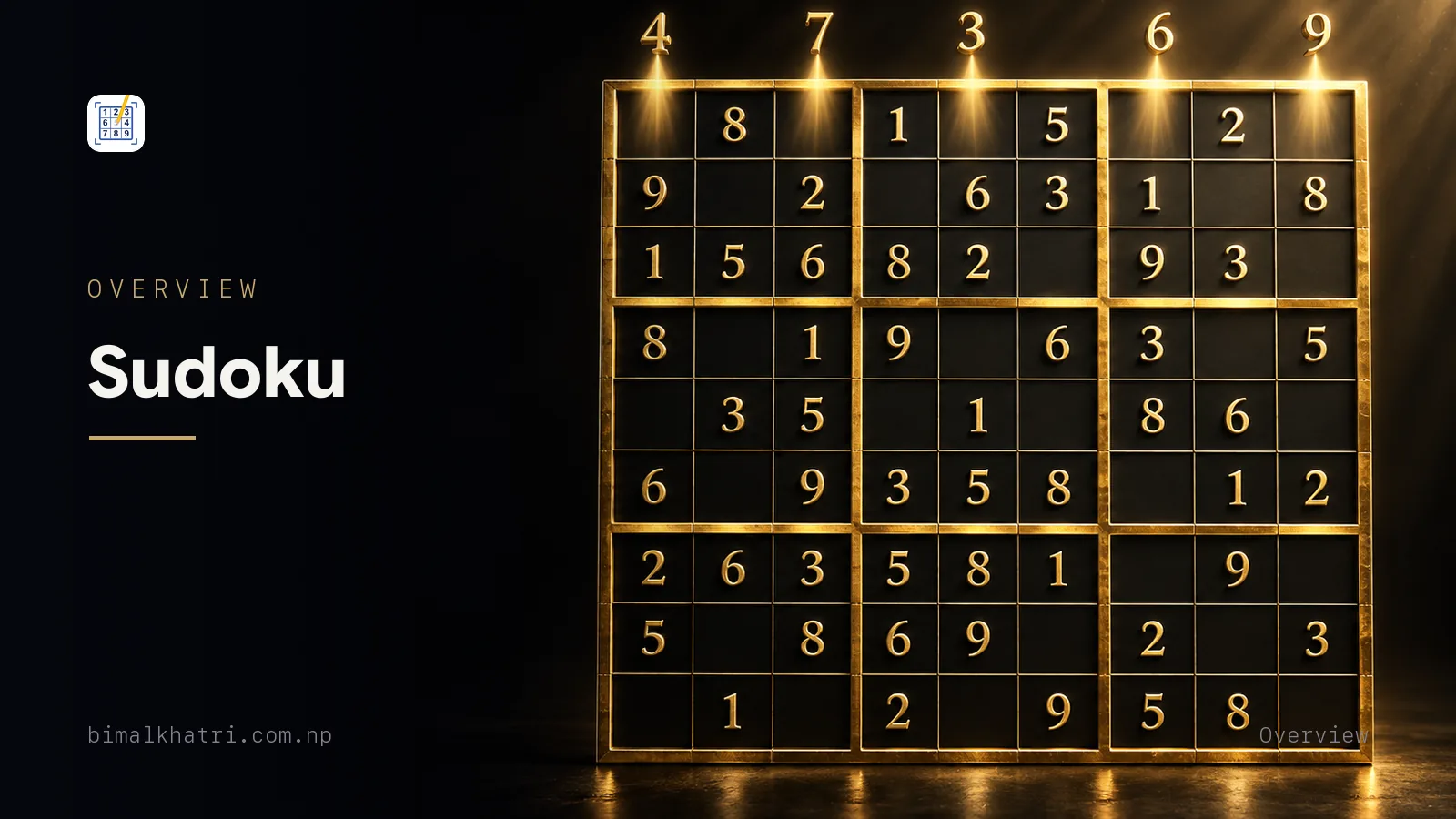
That is the whole method. On an easy puzzle it is the only technique you need, and on a hard one it is still the first thing you do. The grid on this page has 36 givens and 45 blanks, and cross-hatching alone fills every one of them without a single pencil mark.
Practising on a phone? Sudoku Master has 1,000 easy puzzles, and its highlight setting lights up the row, the column and the box of whatever cell you tap, which is exactly the cross you are drawing in your head. Free and offline.
Why crossing out lines works at all
Every cell has 20 peers: the 8 other cells in its row, the 8 in its column and the 8 in its box, less the 4 counted twice where the box overlaps the other two. Writing a digit bans it from all twenty.
Cross-hatching is that ban read backwards. Instead of asking what a cell is allowed to hold, you ask where a digit is still allowed to live, and you ask it of a box, which has only nine cells in it. Nine cells, three rows, three columns. That is a small enough question to answer without writing anything down, which is why the move works on paper, on a screen and on a folded newspaper on a bus.
The move, on one box
Here is the puzzle. A dot is an empty cell, and every example on this page comes off this grid.
3.9264...
.653..7..
2....83..
.5..7.8..
..69.3...
..4..5..6
...14768.
..7.8.1.4
.1.639.57
Start with the 4 in box 5, the middle box, rows 4 to 6 and columns 4 to 6. Pulled out on its own it reads:
. 7 .
9 . 3
. . 5
Five empty cells: r4c4, r4c6, r5c5, r6c4 and r6c5. Now find the 4s
already on the board and see which of them point into this box.
- Row 6 carries a 4 at
r6c3. No row repeats a digit, so the bottom line of the box is dead.r6c4andr6c5are out. - Column 5 carries a 4 at
r7c5. That killsr5c5. - Column 6 carries a 4 at
r1c6. That killsr4c6.
Four cells struck through, one standing. r4c4 is 4, and you can write it in
ink.
Notice what you never did. You never asked what r4c4 was allowed to hold. You
asked where the 4 could live and let the box answer. That reversal is the trick,
and it is the difference between a grid that moves and a grid you stare at.
A cross-hatch that lands has a proper name. It is a hidden single: the digit had exactly one home left in that box, even though the cell it landed in still had several digits available to it. The naming is worked through in naked singles and hidden singles.
One digit, three boxes
Cross-hatching pays best when you stay on one digit and walk it round the grid. Every copy already on the board is a line you get to strike, so the busiest digit is the cheapest to scan.
Here the 6 is the busiest. It sits at r1c5, r2c2, r5c3, r6c9, r7c7 and
r9c4. Six copies, in boxes 1, 2, 4, 6, 8 and 9. Three boxes still need one,
so there are exactly three questions to ask.
Box 3, top right. Row 1 has its 6 at r1c5, so the top line of the box is
dead. Row 2 has its 6 at r2c2, so the middle line goes too. Row 3 is clear,
and r3c7 is already a 3, so the choice is r3c8 or r3c9. Column 9 carries a
6 at r6c9. r3c8 is 6.
Box 5, the middle. Row 5 has its 6 at r5c3, row 6 has its 6 at r6c9, and
that leaves only row 4 alive inside the box. r4c5 is already 7, so it is
r4c4 or r4c6. Column 4 carries a 6 at r9c4. r4c6 is 6.
Box 7, bottom left. Row 7 has its 6 at r7c7 and row 9 has its 6 at r9c4,
leaving row 8. r8c3 is already a 7, so it is r8c1 or r8c2. Column 2
carries a 6 at r2c2. r8c1 is 6.
Three placements from one digit, and the same shape every time: two rows struck out, then one column to break the tie between the last two cells. The grid now reads:
3.9264...
.653..7..
2....836.
.5..768..
..69.3...
..4..5..6
...14768.
6.7.8.1.4
.1.639.57
Nothing was written down but answers. That is the point of scanning: it is the one technique that costs you no bookkeeping.
Cross-hatch a row, not just a box
Boxes are the natural target because they are compact, but the same move works on a row or a column. Only the lines you strike change. For a row, you strike columns and boxes.
Take the 5 in row 7. The row reads . . . 1 4 7 6 8 ., so four cells are empty:
r7c1, r7c2, r7c3 and r7c9.
- Column 2 has a 5 at
r4c2.r7c2is out. - Column 3 has a 5 at
r2c3.r7c3is out. r7c9sits in box 9, which already holds a 5 atr9c8. Out.
r7c1 is 5.
That third strike is the one people forget. A row scan still has to check the boxes, because a box is a constraint like any other. Skip it and you will declare a row unsolvable while the answer is sitting there.
When two cells survive
Most cross-hatches do not resolve. Two cells survive, or three, and the temptation is to shrug and move to the next digit. Take ten seconds first, because a near miss is often the thing that cracks the next box.
Try the 7 in box 1, top left. The 7s on the board sit at r2c7, r4c5, r7c6,
r8c3 and r9c9. Box 1 has four blanks: r1c2, r2c1, r3c2 and r3c3. Row
2 has that 7 at r2c7, so r2c1 dies. Column 3 has the 7 at r8c3, so r3c3
dies. Two cells survive: r1c2 and r3c2.
No placement. But look where they are. Both survivors sit in column 2, so wherever box 1 puts its 7, it is somewhere in column 2 and therefore nowhere else in that column. Every other empty cell in column 2 has just lost its 7, including cells three boxes away. That elimination is a pointing pair, and it is worked through in pointing pairs and box-line reduction.
Now do box 2 with the same digit. Its blanks are r2c5, r2c6, r3c4 and
r3c5. Row 2's 7 at r2c7 kills the first two. Column 5's 7 at r4c5 kills
r3c5. r3c4 is 7.
Go back to box 1. Row 3 now carries a 7 at r3c4, which kills r3c2 and leaves
r1c2 alone. r1c2 is 7.
One digit, two boxes, and the second box answered the first. This is the reason you do a second pass rather than deciding after one lap that the grid is stuck.
Which digit to scan first, and which box
Two cheap heuristics decide the order, and both are free to read off the board.
Count the copies. A digit already placed six times gives you six lines to strike. A digit placed twice gives you two, and two lines rarely narrow nine cells to one. On this grid:
| Digit | Copies on the board | Boxes still missing it |
|---|---|---|
| 6 | 6 | 3, 5, 7 |
| 3 | 5 | 4, 6, 7, 9 |
| 7 | 5 | 1, 2, 4, 6 |
| 4 | 4 | 1, 3, 5, 6, 7 |
| 5 | 4 | 2, 3, 6, 7, 8 |
| 8 | 4 | 1, 3, 4, 5, 7 |
| 1 | 3 | 1, 2, 3, 4, 5, 6 |
| 9 | 3 | 2, 3, 4, 6, 7, 9 |
| 2 | 2 | 3, 4, 5, 6, 7, 8, 9 |
The count is a bet, not a promise. The 3 sits on this board five times and the first sweep finds nothing for it, because its copies happen to be stacked where they block cells that are blocked already. Start with the busiest digit anyway. You will be right more often than not, and reading the table costs nothing.
Then take the fullest boxes. A box holding seven digits has two blanks and
two missing digits, which is usually one look rather than a scan. Box 8 here is
rows 7 to 9, columns 4 to 6. It reads 1 4 7, then . 8 ., then 6 3 9. The
missing digits are 2 and 5, and the blanks are r8c4 and r8c6. Column 4
already carries a 2 at r1c4, so r8c4 cannot take it. r8c4 is 5 and r8c6
is 2, both settled in the time it took to read the box.
What one full pass is worth
Sweep the digits 1 to 9 through all nine boxes once, writing in whatever falls out and using each new digit immediately. On this grid that single pass places ten:
| Digit | Placed |
|---|---|
| 2 | r8c6 |
| 4 | r4c4, r9c1 |
| 5 | r8c4 |
| 6 | r3c8, r4c6, r8c1 |
| 7 | r3c4 |
| 8 | r6c4, r9c3 |
The 1, the 3 and the 9 give nothing at all. That is normal, and it is not a sign the puzzle is hard. The grid after one pass:
3.9264...
.653..7..
2..7.836.
.5.4768..
..69.3...
..48.5..6
...14768.
6.75821.4
418639.57
Ten in, thirty-five to go, and the second pass is easier than the first because each digit you wrote is a fresh line to strike. Keep sweeping and this puzzle finishes on cross-hatching alone. It takes about eleven laps, and the last few are quick, because a nearly full box gives its remaining digits up almost for free.
When cross-hatching stops paying
On an easy grid it does not stop. On a medium or hard grid it will stall with half the cells still blank, and that stall is a signal to change tools rather than to stare harder. Two full passes that place nothing is the honest cut-off. One empty pass proves little, since a digit placed late in a pass can open three boxes behind you.
What comes next, in order:
- Naked singles. Pick a blank cell that looks tight and count what its 20 peers have already used. If eight of the nine digits are gone, the ninth is your answer. This is the cell-first question, and it is worth asking once scanning has filled enough of the board to make it cheap.
- Pencil marks, one region at a time. Write candidates in the box or line that looks most constrained, not across the whole grid. The method, and how to keep the marks from taking over, is in how to use pencil marks.
- Pairs, then the named patterns. Two cells in a unit holding the same two candidates lock that pair out of the rest of the unit, and from there the ladder runs up through pointing pairs to the fish. The full order is in every Sudoku technique from easiest to hardest.
None of that replaces scanning. It resumes it. After any technique frees a cell, the fastest next move is another cross-hatch, because you just added a line.
I built Sudoku Master, and the row, column and box highlight in it exists for this one move. Touch a cell and the app draws the three lines you would otherwise be holding in your head. Treat that as a scaffold rather than a feature. Once the lines start appearing without it, turn the highlight off in the settings and the same habit works on newsprint. The 4,000 puzzles ship inside the download, so a tunnel makes no difference to any of it.
Common mistakes
Hunting cell by cell. Asking "what goes here?" of every blank means checking 20 peers to get one answer. Asking "where does the 6 go in this box?" checks nine cells against three rows and three columns and often ends in a placement.
Striking rows and forgetting columns. The cross needs both arms. Half a cross-hatch leaves two or three cells standing and you conclude the box is stuck.
Forgetting the box when you scan a line. Row 7 above needed box 9 to rule
out r7c9. Columns alone would have left two cells alive.
Throwing away a near miss. Two survivors in the same row or column is an elimination you can use elsewhere, and it costs nothing to note which line they share.
Scanning a digit that is barely on the board. With two copies placed, you have two lines. Come back to that digit later, when other placements have given it more.
Stopping after one lap. Your own placements change the answers, so the second pass through the digits is worth as much as the first.
Writing a digit you cannot justify out loud. One wrong entry poisons every deduction built on top of it, and the complaint arrives in a corner of the grid you were not looking at. If the sentence "it goes here because" does not finish, do not write it.
Questions people ask
What is the fastest way to solve a Sudoku?
Sweep by digit rather than by cell, and start with the digit already placed most often. Cross-hatching one box for one digit is three rows and three columns to check, and none of it needs writing down. Speed comes from not writing, not from thinking faster.
Should I scan by number or by cell?
By number, at the start. A cell has 20 peers to check for one possible answer, while a digit in a box has nine cells to check and three rows and three columns doing the work for you. Switch to cell-first later, once the board is full enough that most blanks have only a digit or two left.
Why do I keep missing moves I should have seen?
Usually because you struck the rows and skipped the columns, or the reverse. The other common cause is not re-reading a box after placing a digit next to it. A placement changes three lines at once, and boxes you already dismissed become live again.
Do I need pencil marks for an easy Sudoku?
No, and on an easy grid they generally cost more time than they save. Easy puzzles are built to fall to scanning. Marks earn their place when a full sweep of all nine digits places nothing.
What do I do when a scan finds nothing?
Do one more full pass first, because your own placements have moved the lines. If the second pass is also empty, count peers on the tightest-looking blank cell, then pencil-mark one box or one line rather than the whole grid. There is a longer checklist in what to do when you are stuck.
How many passes should I do before switching techniques?
Two clean passes with nothing placed. One empty pass proves very little, since a digit written late in that pass can open boxes you already walked past.
Is scanning enough for a hard puzzle?
No. It will open a hard grid and then stop, often with thirty or forty cells still blank. What makes a puzzle hard is the hardest technique it forces you to use, and hard grids are built so that scanning runs out early. Scanning is still the right first move on every puzzle, at every level.
Does this work the same on paper as on a phone?
The logic is identical. Screens make the finding easier, since tapping a digit or a cell can highlight every copy of it and the three lines it sits on. Paper makes the striking easier, because you can draw the lines with a pencil and see the box narrow in front of you. Both beat scanning with your eyes alone.
Keep reading
- Naked singles and hidden singles, because every cross-hatch that lands is a hidden single and the name is worth having
- Pointing pairs and box-line reduction, which is what a two-cell near miss turns into
- How to use pencil marks without drowning in them, for the grid where scanning has stopped paying
- Stuck on a Sudoku? Work this checklist in order, when the second pass finds nothing either
- Every Sudoku technique, ordered from easiest to hardest, for what sits above this on the ladder
- The full Sudoku guide, for what to read before and after this one
Get it: Sudoku Master, free on iPhone and Android. One link, both stores, and no ads while you solve.