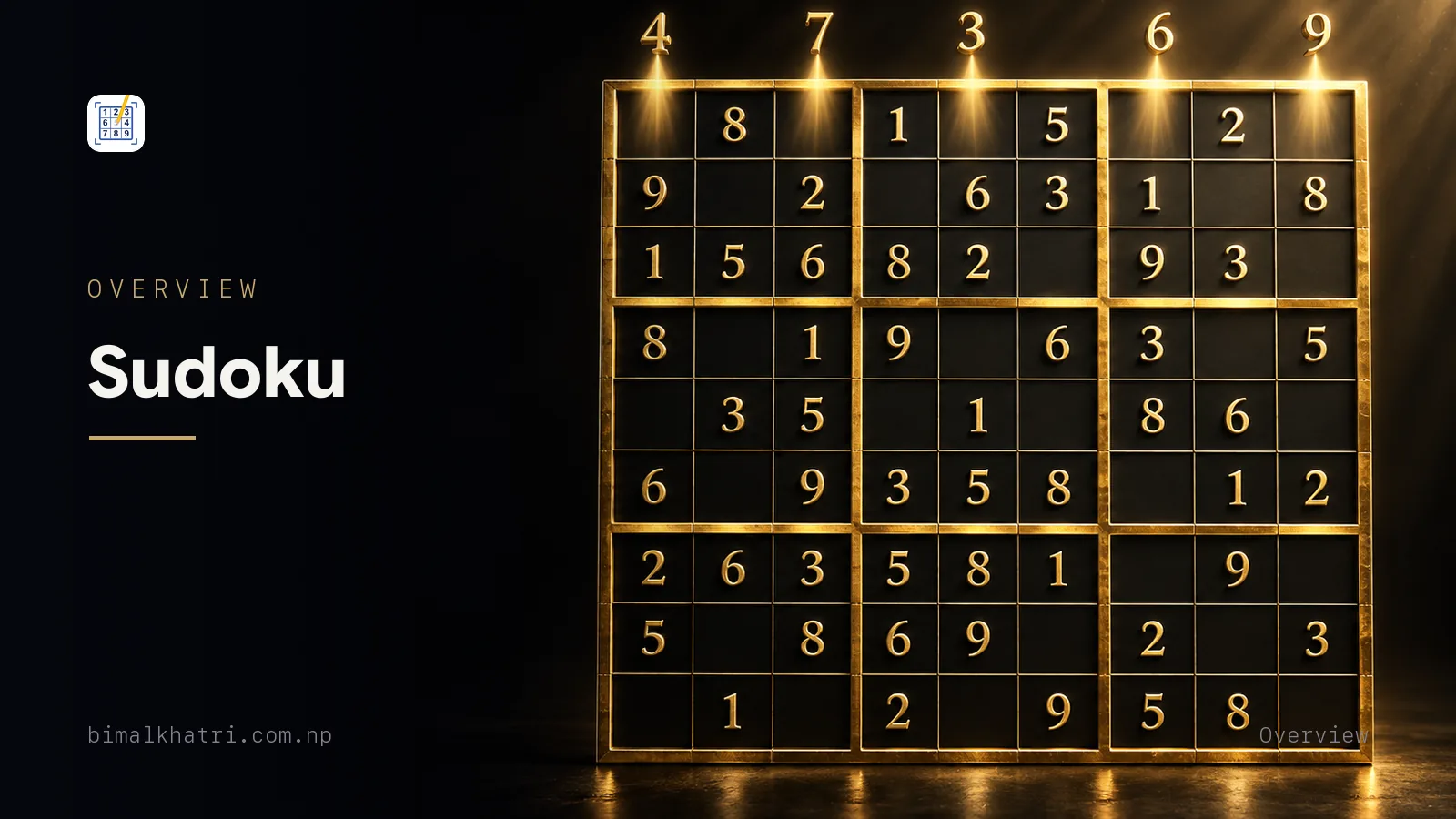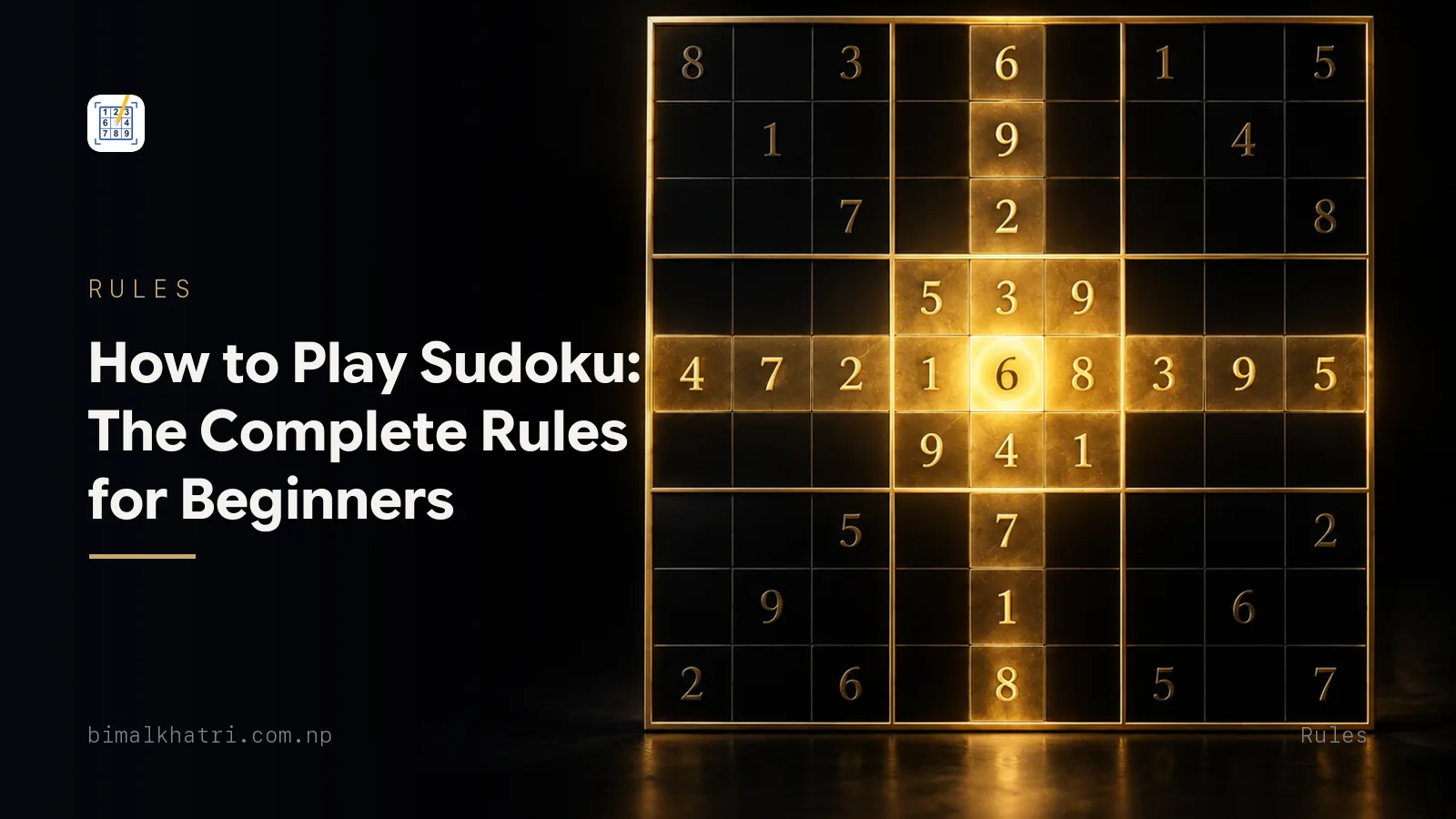
Sudoku has one rule. Fill every empty cell with a digit from 1 to 9 so that no digit repeats in any row, any column, or any 3x3 box.
That is the whole game. No arithmetic, no diagonals, no small print. If you can check three lines and one box for a repeat, you already know enough to finish an easy puzzle tonight. What takes practice is seeing which cell the rule has quietly decided for you, and that is what the rest of this page is for.
Learning on a phone? Sudoku Master has 1,000 easy puzzles and checks each digit against the stored answer as you place it, free and offline.
The board, and what to call each part
Nine rows across, nine columns down, and nine 3x3 boxes. Eighty-one cells in total, of which the puzzle fills in some for you and leaves the rest blank.
The words below are the ones every Sudoku page uses, including this one.
- Cell. One of the 81 squares. Written
r3c4, meaning row 3, column 4. Rows are numbered 1 to 9 from the top, columns 1 to 9 from the left. - Box. One of the nine 3x3 blocks. Numbered 1 to 9 reading left to right and then top to bottom, so box 1 is the top left and box 9 is the bottom right.
- Given, sometimes called a clue. A digit printed in the puzzle before you start. Givens never change, and a puzzle that asks you to change one is wrong.
- Candidate. A digit that is still legal in an empty cell. Written in
braces when you note it down:
{1,5,8}. - Peer. Any cell sharing a row, column or box with the cell you are looking at. Every cell has exactly 20 peers.
Here is a real puzzle. A dot is an empty cell, and every example on this page comes off this grid.
3.9264...
.653..7..
2....83..
.5..7.8..
..69.3...
..4..5..6
...14768.
..7.8.1.4
.1.639.57
Thirty-six digits are given, which is a normal count for an easy puzzle. The other forty-five are yours to work out. There is one answer and only one, and you can reach it without guessing once.
The rule, said three ways
Read it as three statements rather than one, because that is how you use it at the board.
- Each row holds 1 to 9, once each.
- Each column holds 1 to 9, once each.
- Each box holds 1 to 9, once each.
Every cell sits in exactly one row, one column and one box, so all three statements are pressing on it at the same time. That is the whole mechanism.
Now the number that matters more than any technique you will read about later. A cell has 8 other cells in its row, 8 in its column and 8 in its box. Four of those get counted twice, because the box overlaps the row in two cells and the column in two more. So 24 minus 4 leaves 20 peers. Place one digit and you have just banned it from twenty other cells.
Everything with a name (cross-hatching, naked singles, X-Wings) is a way of noticing what those twenty cells have already ruled out. Learn to see peers and the named techniques stop feeling like separate things to memorise. The vocabulary is collected in the Sudoku glossary if a word here is new.
What the rule does not say
Half of what makes beginners stall is an invented rule they are obeying without noticing. These are the common ones.
| People assume | What is actually true |
|---|---|
| The digits have to add up to something | Each line holds 1 to 9, so it sums to 45. That is arithmetic falling out of the rule, not a rule you use. You never add anything in classic Sudoku |
| The two diagonals must hold 1 to 9 | Not in classic Sudoku. That is Sudoku X, a variant with an extra rule bolted on |
| The digits are quantities | They are labels. Replace them with nine letters or nine colours and the puzzle is identical. No digit outranks another |
| The same digit cannot touch another copy of itself | Two cells that touch corner to corner may hold the same digit, provided they are in different boxes. In this puzzle's answer, r3c6 and r4c7 are both 8 |
| Fewer givens means a harder puzzle | No. A 30-clue puzzle can be harder than a 24-clue one. Difficulty is set by the hardest technique the grid forces you to use |
| Clues have to be placed symmetrically | That is a publishing convention, not a rule. Nikoli adopted it, along with a cap of 32 givens, to make the puzzles look like a craft object |
The variants are worth knowing about, but only after classic makes sense. There is a tour of them in types of Sudoku.
Three moves on the grid above
Descriptions of Sudoku are useless next to a placed digit, so here are the first three moves on that puzzle, with the reason for each.
Move 1. Finish the nearly full box. Box 8 is rows 7 to 9, columns 4 to 6.
Read it off the grid and it goes 1 4 7 on the top row, . 8 . in the middle,
6 3 9 at the bottom. Seven digits are in. The two missing are 2 and 5, and
there are exactly two empty cells: r8c4 and r8c6. Now look up column 4.
There is already a 2 sitting at r1c4, so r8c4 cannot take it. That settles
both cells at once. r8c4 is 5 and r8c6 is 2.
Move 2. Chase one digit through one box. Box 2 is rows 1 to 3, columns 4 to
6. It has 2, 6 and 4 across the top, a 3 at r2c4 and an 8 at r3c6, which
leaves four empty cells: r2c5, r2c6, r3c4 and r3c5. Where can the 7 go?
Row 2 already carries a 7 at r2c7, and no row may repeat, so r2c5 and
r2c6 are out. Column 5 already carries a 7 at r4c5, so r3c5 is out. One
cell survives. r3c4 is 7.
That move has a name, cross-hatching, and it is the one habit that carries a beginner through every easy puzzle they will ever open. It is worked through properly in cross-hatching and scanning.
Move 3. Let the peers do it. Look at r3c3. Eleven of its twenty peers are
now filled. Its row shows 2, 7, 8 and 3. Its column shows 9, 5, 6, 4 and 7. Its
box adds a 3 and a 6. Between them those eleven cells show eight different
digits: 2, 3, 4, 5, 6, 7, 8 and 9. Exactly one digit is left standing, so
r3c3 is 1, and you did not have to be clever to see it.
Four digits placed. The grid now reads:
3.9264...
.653..7..
2.17.83..
.5..7.8..
..69.3...
..4..5..6
...14768.
..75821.4
.1.639.57
A cell with only one candidate left, like r3c3, is called a naked single. A
digit with only one home left in its box, like the 7 in move 2, is called a
hidden single. Those two names cover most of what you will do for a long while,
and both are worked in naked and hidden
singles.
Where to start when nothing looks obvious
Open a fresh puzzle and the temptation is to stare at the emptiest corner. Do the opposite. Work in this order.
Start with the fullest boxes. A box holding seven digits often hands you the eighth for free, and each digit you place there tightens three rows and three columns for the next look.
Then pick a digit, not a cell. Count how often each digit already appears
and take the busiest one. In the grid above, 6 appears six times and 2 appears
only twice, so 6 is the digit to hunt. Try it in box 5, which is rows 4 to 6,
columns 4 to 6. Row 5 already has a 6 and row 6 already has a 6, so neither of
those rows can take another one inside the box. That leaves r4c4 and r4c6.
Column 4 has a 6 at r9c4. So r4c6 is 6, and notice that the cell itself
still had three candidates. The box decided it, not the cell.
Only then reach for pencil marks. They are a tool for when scanning stops paying, not a ritual to perform first.
I built Sudoku Master, and the setting I would switch on before anything else is the one that shades a tapped cell's row, its column and its box. It paints the twenty peers straight onto the grid, which is the picture this section keeps asking you to hold in your head. All 4,000 puzzles ship inside the app, so it works with no signal, and there are no ads while you solve.
Pencil marks, without drowning in them
A pencil mark is a candidate written small in an empty cell. r1c9 in the grid
above can only be 1, 5 or 8, so you would write {1,5,8} there.
Two habits keep this useful. Write marks for one region at a time rather than the whole grid, because a full grid of marks on an easy puzzle costs more time than it saves. And rub a digit out the moment a placement kills it. Stale marks are worse than none, since you will trust them.
The payoff arrives when two cells in the same row hold the same pair, say
{7,8} and {7,8}. Between them they have used up 7 and 8 for that whole row,
so both digits can be struck out everywhere else in it. That is a naked pair,
and it is the first technique that pencil marks buy you. The full method
is in how to use pencil marks.
One answer, so you never have to guess
A properly made Sudoku has exactly one solution. Not one that is prettiest, and not one you settle on. One.
This has a practical consequence people miss. If you are stuck, you are missing a technique, not a lucky guess. Guessing on a proper puzzle either lands on the answer or quietly ruins the grid twenty moves before you notice, and the second outcome is far more common. Put the pen down and rescan instead. There is a checklist for that moment in what to do when you are stuck, and the case against guessing is made properly in solving without guessing.
If a puzzle genuinely has two answers, it is broken rather than hard. That happens with badly generated puzzles and with newspaper misprints, and no amount of logic will finish it.
The other end of the same idea: a Sudoku needs at least 17 givens to have a single answer. That was settled in 2012 by McGuire, Tugemann and Civario, who searched every possible 16-clue arrangement by computer and found that none of them pins down one grid. It is a proof by exhaustion rather than a pencil-and- paper theorem, and it holds. The story is in seventeen clues.
The mistakes that make it harder than it is
Writing a digit you are not sure of. One wrong digit poisons every deduction after it, and you will find the damage half an hour later with no way back. If you cannot say the reason out loud, do not write it.
Marking up the whole grid before you have scanned it. Easy puzzles fall to scanning alone. Pencil marks are for the puzzle that has stopped moving.
Hunting cell by cell. Asking "what goes here?" of every blank cell is slow. Asking "where does the 6 go in this box?" is fast, because you are checking one digit against three rows and three columns at a time.
Obeying rules that do not exist. No diagonals, no sums, no ban on two copies of a digit touching at a corner.
Judging a grid by how empty it looks. A 26-given puzzle is not automatically brutal, and deciding it is talks you out of a grid you could have finished. What sets the level is in difficulty levels.
More of them, with the fixes, are in nine beginner mistakes.
Where these rules came from
The modern puzzle appeared as Number Place in Dell's Pencil Puzzles and Word Games in May 1979. It is credited to Howard Garns, a retired architect from Indianapolis, on the evidence that his name shows up in the contributor lists of the issues carrying the puzzle and not in others. Dell did not credit puzzles by name, so that is strong circumstantial attribution rather than a signed claim, and honest sources say "credited to" rather than "invented by". Garns died in 1989, before any of it became famous.
Japan is where it got its name and its craft. Nikoli published it in 1984 under a phrase meaning roughly "the digits must be single", shortened to sūdoku, and Nikoli's Maki Kaji is the person who named it. Nikoli also added the two conventions that make a puzzle feel handmade: at most 32 givens, and symmetric clue placement. Then Wayne Gould, a retired judge from New Zealand living in Hong Kong, saw one in a Tokyo bookshop in 1997, spent six years writing a program to generate them, and placed the puzzle in The Times of London on 12 November 2004. The global boom starts there.
Longer versions of both stories are in the history of Sudoku and what the word Sudoku means.
Questions people ask
Does Sudoku involve any maths?
No arithmetic at all. The digits are labels, not quantities, and you could replace them with nine letters or nine colours without changing a single move. What the puzzle asks for is logic: which cells the rule has already ruled out.
Can the same digit appear twice on a diagonal?
Yes, in classic Sudoku. Two cells touching corner to corner share no row and no
column, so if they also sit in different boxes the same digit is legal in both.
In the answer to the puzzle above, r3c6 and r4c7 are both 8. The variant
that does police the two main diagonals is Sudoku
X.
What is the 45 rule in Sudoku?
Each row, column and box holds 1 to 9 exactly once, and 1 through 9 add to 45. So every completed line totals 45. It is a consequence of the rule rather than a rule of its own, and in classic Sudoku you never need it. Sums do real work in Killer Sudoku, where cages carry totals.
Can a Sudoku puzzle have more than one answer?
A properly made one cannot. Exactly one solution is part of what makes a grid a Sudoku rather than a pattern of numbers. If you find two valid answers, the puzzle is broken, not difficult, and the fault is with whoever generated or printed it.
Do harder puzzles have fewer numbers to start with?
Not reliably, and this is the most common wrong belief about difficulty. What makes a puzzle hard is the hardest technique it forces you to use and how often it forces you to use it. A 30-clue grid needing an X-Wing beats a 24-clue grid that falls to scanning.
How few clues can a Sudoku have?
Seventeen. Puzzles with 17 givens and a single answer exist and are published; puzzles with 16 do not exist at all, which McGuire, Tugemann and Civario established in 2012 by exhaustively searching every 16-clue configuration by computer.
Is guessing ever the right move?
Not on a proper puzzle. Every cell is decidable by logic from what is on the grid, so a guess only means you have not found the step yet. It also costs more than it looks: a wrong guess stays invisible for a long time and then wrecks everything you wrote after it.
How long does it take to learn Sudoku?
The rules take two minutes, and you have read them. Move 2 above, scanning one box for one digit, is an afternoon of practice and it finishes easy grids on its own. Everything above that rung is optional and arrives over months. Pace is compared properly in how long a Sudoku should take.
Keep reading
- Your first Sudoku, solved one move at a time, which finishes a whole grid at this pace
- Cross-hatching: how to read a grid quickly, the habit behind move 2 above
- Naked singles and hidden singles, the two patterns that solve most easy puzzles
- Nine beginner mistakes, for the habits that quietly cost you grids
- Sudoku words: cell, box, peer, candidate, given, when a page uses a term nobody defined
- The complete guide to Sudoku, if you want the whole map at once
Get it: Sudoku Master, free on iPhone and Android. The link sends you to whichever store your phone uses.