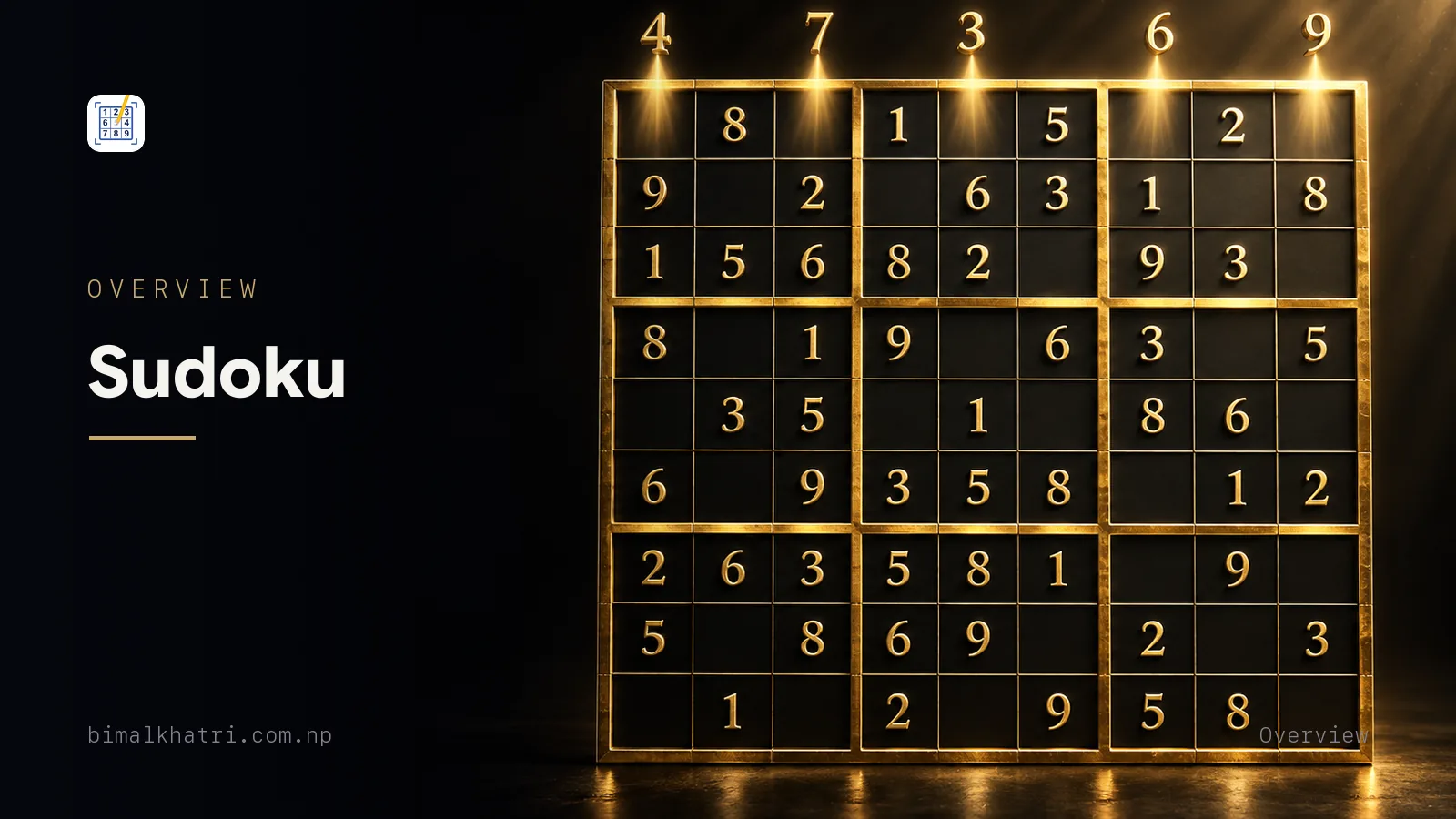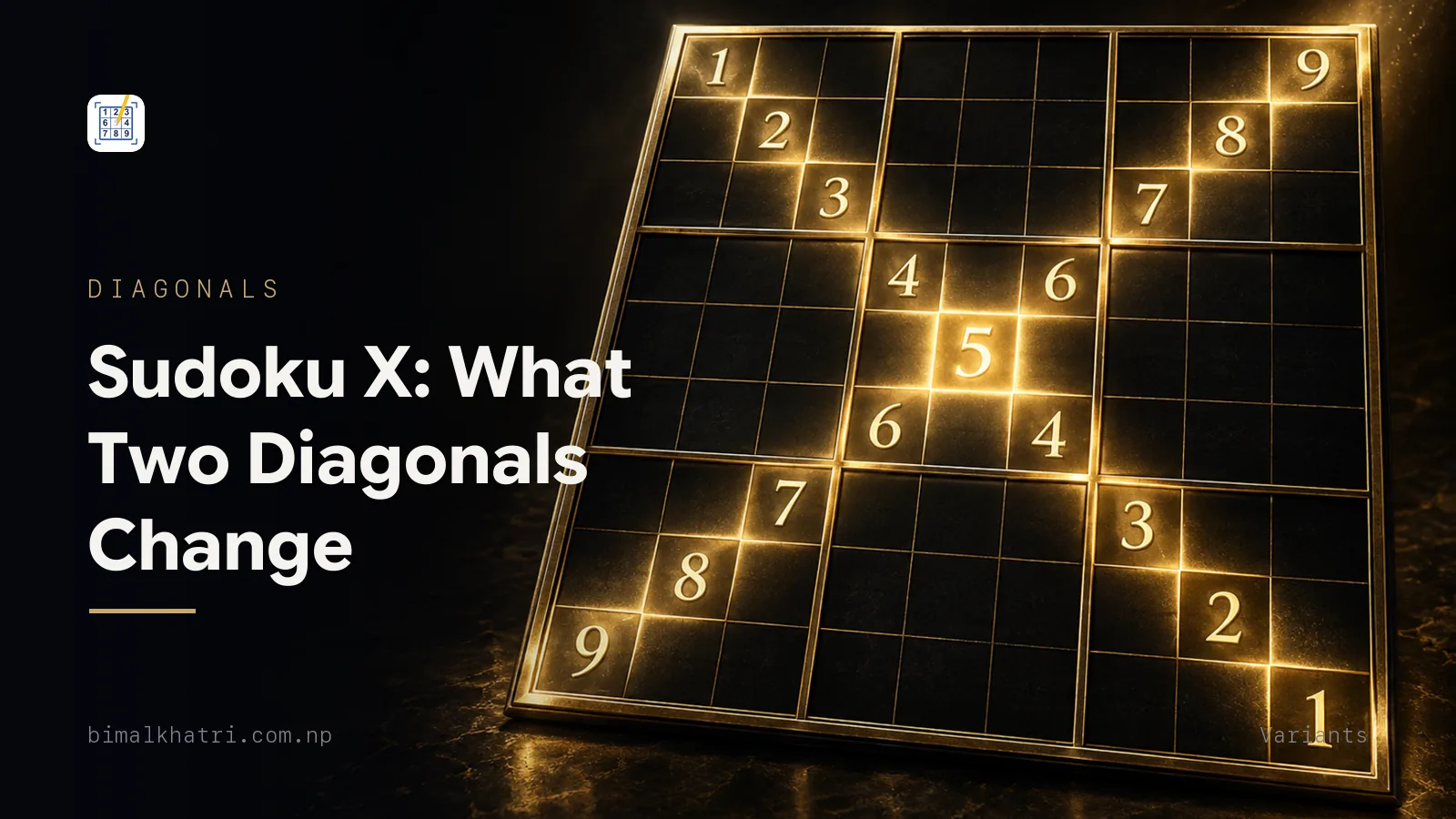
Sudoku X is the classic puzzle with one rule added. Both long diagonals, corner to corner, must also hold the digits 1 to 9 once each. Nothing is taken away. Rows, columns and boxes behave exactly as they always did.
That one addition gives the grid two more units to satisfy. Classic Sudoku has 27 of them: nine rows, nine columns and nine boxes. Sudoku X has 29. Seventeen of the 81 cells sit on a diagonal and answer to a fourth constraint, and the other 64 are ordinary Sudoku cells with nothing new to worry about.
The name is the shape. Draw both diagonals and they cross in the middle to make an X. Some papers shade the seventeen cells instead of drawing the lines, so if your puzzle has a tinted X across it, that shading is the rule and not decoration.
The classic grid, on your phone. Sudoku Master lights up every cell sharing a row, a column or a box with the one you are on, which is the habit this page asks you to extend to a diagonal. Free, and no ads while you solve.
The complete rule set
| Rule | What it means |
|---|---|
| Every row holds 1 to 9 | Unchanged from classic |
| Every column holds 1 to 9 | Unchanged |
| Every 3x3 box holds 1 to 9 | Unchanged |
| The main diagonal holds 1 to 9 | r1c1, r2c2, r3c3 and on down to r9c9, once each |
| The anti-diagonal holds 1 to 9 | r1c9, r2c8, r3c7 and on down to r9c1, once each |
| A proper puzzle has one solution | Same as classic. Two answers means broken, not hard |
Two things follow immediately. The middle cell r5c5 is on both diagonals, so
whatever you write there is banned from sixteen other cells at once. And the two
diagonals never meet anywhere else, so a digit can appear on both, just not in
the same square.
Everything else you know still applies. A digit still cannot repeat in a row. A box still holds each digit once. The diagonal is an extra unit stacked on top, in the same way a Killer cage is, and it is used the same way.
Where the two diagonals bite
Here are the seventeen cells, marked with an X.
X.......X
.X.....X.
..X...X..
...X.X...
....X....
...X.X...
..X...X..
.X.....X.
X.......X
Look at which boxes they fall in and the shape of the variant becomes obvious.
| Box | Diagonal cells it holds |
|---|---|
| 1 (top left) | 3, on the main diagonal |
| 3 (top right) | 3, on the anti-diagonal |
| 5 (middle) | 5, three from each diagonal sharing r5c5 |
| 7 (bottom left) | 3, on the anti-diagonal |
| 9 (bottom right) | 3, on the main diagonal |
| 2, 4, 6, 8 | None at all |
The four edge boxes are untouched. Solve them the way you solve any classic grid, because for those cells nothing has changed. The four corners and the middle are where the extra rule lives, and that is where you look first when the grid stops moving.
Count the peers and you get the same story in numbers. A peer is a cell that cannot hold the same digit as yours, and on a classic grid every cell has 20. The diagonal rule leaves most of them exactly where they were.
| Cell | Peers | Why |
|---|---|---|
An ordinary cell, say r1c2 | 20 | Row, column, box, as always |
A diagonal cell, say r2c2 | 26 | Six diagonal partners outside its own box |
The middle cell r5c5 | 32 | Twelve partners, six on each diagonal |
Thirty-two out of the other eighty cells. No square on a Sudoku X grid is harder to fill than the middle one, and none is more worth attacking first.
Every technique you know already works on a diagonal
This is the part people miss. A diagonal is a unit, exactly like a row, so every technique that works on a row works on a diagonal without any change.
Hidden singles. Nine cells, one home for each digit. If 3 has only one legal cell along the anti-diagonal, that cell is a 3, and it does not matter that the row, column and box all still have several places for their own 3.
Naked pairs, triples and quads. Two diagonal cells both reading {4,7} and
nothing else? Then 4 and 7 are gone from the other seven cells on that diagonal,
even though those cells are scattered across five different boxes.
Pointing, in both directions. This is the one that pays. A diagonal crosses a corner box in three cells, and that overlap works exactly like a row crossing a box.
- If a digit inside a corner box can only sit on that box's three diagonal cells, the digit is on the diagonal. Strike it from the other six diagonal cells.
- If a digit on a diagonal can only sit in one box's segment, the digit is in that box. Strike it from the rest of that box.
The second form is used in the worked grid below and it hands over a placement straight away.
Everything above that too. X-Wings, colouring and chains all treat the diagonal as another line to work with. If you can already run those on rows and columns, you already know how to run them here.
Three moves a classic solver cannot see
Read as an ordinary Sudoku, the grid below is not a complete puzzle. Fifty-one different completions satisfy these clues if you ignore the diagonals. Add the diagonal rule and exactly one survives, which is the whole point of the variant.
8..59.1..
34......9
.95.7..83
....4862.
.23..7...
...9.2.71
....64.3.
...7..4..
.....95..
Thirty digits are printed. Three moves are available that a classic solver cannot see, and all three come off the diagonals.
Move 1: the middle cell. Work r5c5 the ordinary way first. Row 5 holds 2,
3 and 7. Column 5 holds 9, 7, 4 and 6. Box 5 holds 4, 8, 7, 9 and 2. That leaves
{1,5} and a classic solver stops there.
Now read the main diagonal. It runs r1c1 = 8, r2c2 = 4, r3c3 = 5, and then
five empty cells before r9c9. There is already a 5 on it. So r5c5 cannot be
5, and r5c5 is 1.
Move 2: a hidden single on the anti-diagonal. The anti-diagonal has 8 at
r4c6 and 9 at r6c4, plus the 1 you just wrote at the middle. Ask where its 3
can go, cell by cell.
| Cell | Can it be 3? |
|---|---|
r1c9 | No. Column 9 already has a 3, at r3c9 |
r2c8 | No. Row 2 already has a 3, at r2c1 |
r3c7 | No. Row 3 already has a 3, at r3c9 |
r4c6 | Filled with 8 |
r5c5 | Filled with 1, from move 1 |
r6c4 | Filled with 9 |
r7c3 | No. Row 7 already has a 3, at r7c8 |
r8c2 | Yes. Nothing blocks it |
r9c1 | No. Column 1 already has a 3, at r2c1 |
Eight cells refused it, so r8c2 is a 3. Check the classic view of that same
cell and it reads {1,3,5,6,8}, five candidates and no way to choose between
them. The diagonal did all of the work.
Move 3: pointing from a diagonal into a box. Back to the main diagonal. It
now holds 8, 4, 5, 1 and 2, at r1c1, r2c2, r3c3, r5c5 and r6c6. Its
missing digits are 3, 6, 7 and 9, and its empty cells are r4c4, r7c7, r8c8
and r9c9.
Where can the 6 go?
r4c4cannot, because row 4 already has a 6 atr4c7.r7c7cannot, because row 7 already has a 6 atr7c5.r8c8andr9c9both can.
Both survivors sit in box 9. So box 9 holds the diagonal's 6, which means no
other cell in box 9 can be a 6. Strike it from r8c9 and r9c8.
That elimination finishes the job on its own. Before it, r9c8 read {1,6}.
After it, {1}. Write 1 into r9c8.
Three placements and a clean elimination, all from a rule most solvers treat as
scenery. From here the grid runs on ordinary singles: 5 into r2c8, 4 into
r3c4, 3 into r4c4, and the corners unravel one after another.
I built Sudoku Master. It plays classic 9x9 and there is no shaded X anywhere in it, so this page is theory rather than a pitch. What the app does train is the part a Sudoku X leaves alone: nine rows, nine columns, and the four edge boxes the new rule never reaches.
The finished grid, so you can check yours:
872593146
346821759
195476283
719348625
523617894
684952371
257164938
931785462
468239517
Read the main diagonal top to bottom: 8, 4, 5, 3, 1, 2, 9, 6, 7. Read the anti-diagonal: 6, 5, 2, 8, 1, 9, 7, 3, 4. Both hold every digit once, which is the only thing the variant ever asked for.
What the diagonals do to difficulty
More constraints means more information, and that catches people out. The diagonals rule out combinations that clues would otherwise have to rule out, so a Sudoku X can be printed with fewer clues and still have one answer. The grid above is exactly that: 30 clues, one answer with the diagonals, 51 without them. Fewer numbers on the page looks harder and often is not.
Three things worth knowing before you judge a grid by its clue count.
Clue count still is not difficulty. It is not in classic Sudoku either, and here it is worth even less. A thinly clued Sudoku X whose diagonals open in the first minute is gentler than a fat classic grid that will not move without an X-Wing. Read a puzzle for the technique it is going to demand, not for how many digits got printed.
The 17-clue result does not apply. The minimum for a classic puzzle with one solution is 17, proved by exhaustive computer search by McGuire, Tugemann and Civario in 2012. That result is about classic grids and says nothing about diagonal ones. Do not carry the number across.
Every Sudoku X answer is also a legal classic answer. The diagonal rule adds a condition rather than replacing one, so the set of finished Sudoku X grids is a subset of the 6,670,903,752,021,072,936,960 finished classic grids counted by Felgenhauer and Jarvis in 2005. Smaller pool, more clues doing double duty.
The practical effect on your solving is a rhythm change. On a classic grid you scan boxes for a digit with nowhere else to go. On a Sudoku X you do that too, then you check both diagonals as though they were rows, and the corners tend to crack before the middle of the board does.
Where a diagonal grid catches you out
Filling a diagonal cell without checking the diagonal. The commonest error by a distance. Row, column, box, place it, move on. Two minutes later the diagonal has two 7s in it and you cannot tell when it happened. Get into the habit of one extra glance on the seventeen marked cells.
Feeding a diagonal puzzle to a classic solver. It will answer, and the answer will usually be wrong. A classic solver ignores the shading, and a diagonal puzzle read as a classic one often has many completions. The grid above has 51 of them.
Assuming the shaded cells are a hint. Some papers shade the X, some print faint lines, some do nothing at all and only say "Sudoku X" in the corner. The shading marks the rule. It is never a clue about which digits go there.
Treating short diagonals as constrained. Only the two full-length diagonals carry the rule. The three-cell diagonal in a corner, or any wrap-around line, is just a set of unrelated cells. Nothing forbids a repeat along them.
Pencil-marking the whole grid before using the diagonals. Two rounds of diagonal eliminations first will save you writing several hundred candidates you would only have to rub out. The seventeen marked cells are the cheapest place in the grid to start.
Forgetting that the middle cell is on both. r5c5 answers to two diagonals,
a row, a column and a box. When it is stuck, it usually unsticks something else,
and when you place it, five units get cleaned at once.
Questions people ask
Is Sudoku X harder than a normal Sudoku?
Not by rule, only by habit. More constraints means more information, so the solver who reads the diagonals has the easier time. What makes it feel harder is the thin clue count. It is thin precisely because the diagonals are carrying the difference. Read a diagonal as a unit and the grade on the cover starts to mean what it says.
Where can I find a daily diagonal Sudoku?
Search both names. Puzzle sites and newspaper puzzle pages file the same variant under "Sudoku X", "Diagonal Sudoku" and sometimes "X Sudoku", and a site that returns nothing for one name often has a daily grid under another. In a printed book, look for the shaded X on the sample grid rather than trusting the title on the cover.
Why does my solver app give a different answer from the book?
Because it is solving a different puzzle. Most solvers implement classic rules, so they ignore the diagonals and return the first completion they find, which usually breaks one diagonal or both. If a solver has no diagonal setting, its answer to a Sudoku X is not worth checking against.
Does the middle square have a special rule?
No. It follows the same rule as every other cell, it just belongs to more units: a row, a column, a box and both diagonals. That is 32 peers rather than 20, which makes it the most constrained cell on the grid and usually the most useful one to solve early.
Can two diagonal cells hold the same digit?
Only if they are on different diagonals. The main diagonal holds each digit
once, the anti-diagonal holds each digit once, and they share exactly one cell.
So a 7 on the main diagonal and a 7 on the anti-diagonal is perfectly legal, as
long as neither one is sitting at r5c5.
Does a Sudoku X need fewer clues than a classic puzzle?
In practice yes, and the grid above is the demonstration. Thirty clues. Fifty-one legal finishes if you ignore the shading, exactly one if you do not. The two extra regions are doing work that another five or six givens would otherwise have to do. The classic minimum of 17 is a separate result and does not transfer.
Are Sudoku X, X Sudoku and Diagonal Sudoku the same puzzle?
Yes. Three names for one variant, and the rule is identical in all three: both main diagonals hold 1 to 9 once each. You will also see the two lines called the long diagonals or the corner-to-corner diagonals, which is the same seventeen cells under another label.
Do pencil marks work the same way?
Yes, with one addition. When you write candidates into a diagonal cell, run the diagonal as well as the row, the column and the box, then cross out what it kills. Doing that before you mark the rest of the grid saves the most work, because eliminations on the seventeen marked cells ripple into all five of the boxes those cells touch.
Keep reading
- How to play Sudoku: the complete rules, the base game that the diagonal rule is bolted onto
- Types of Sudoku, from classic to Samurai, for where the diagonal version sits among the other variants
- Sudoku: rules, techniques and solving, rules through to the hard patterns, in reading order
- Naked singles and hidden singles, with worked grids, the technique you run along a diagonal most often
- Killer Sudoku rules and the cage sums worth learning, the other variant that adds a unit rather than reshaping one
- Jigsaw Sudoku: when the boxes stop being squares, if you would rather bend the grid than draw on it
Get it: Sudoku Master, free on iPhone and Android. Classic grids, four grades, no account to make.