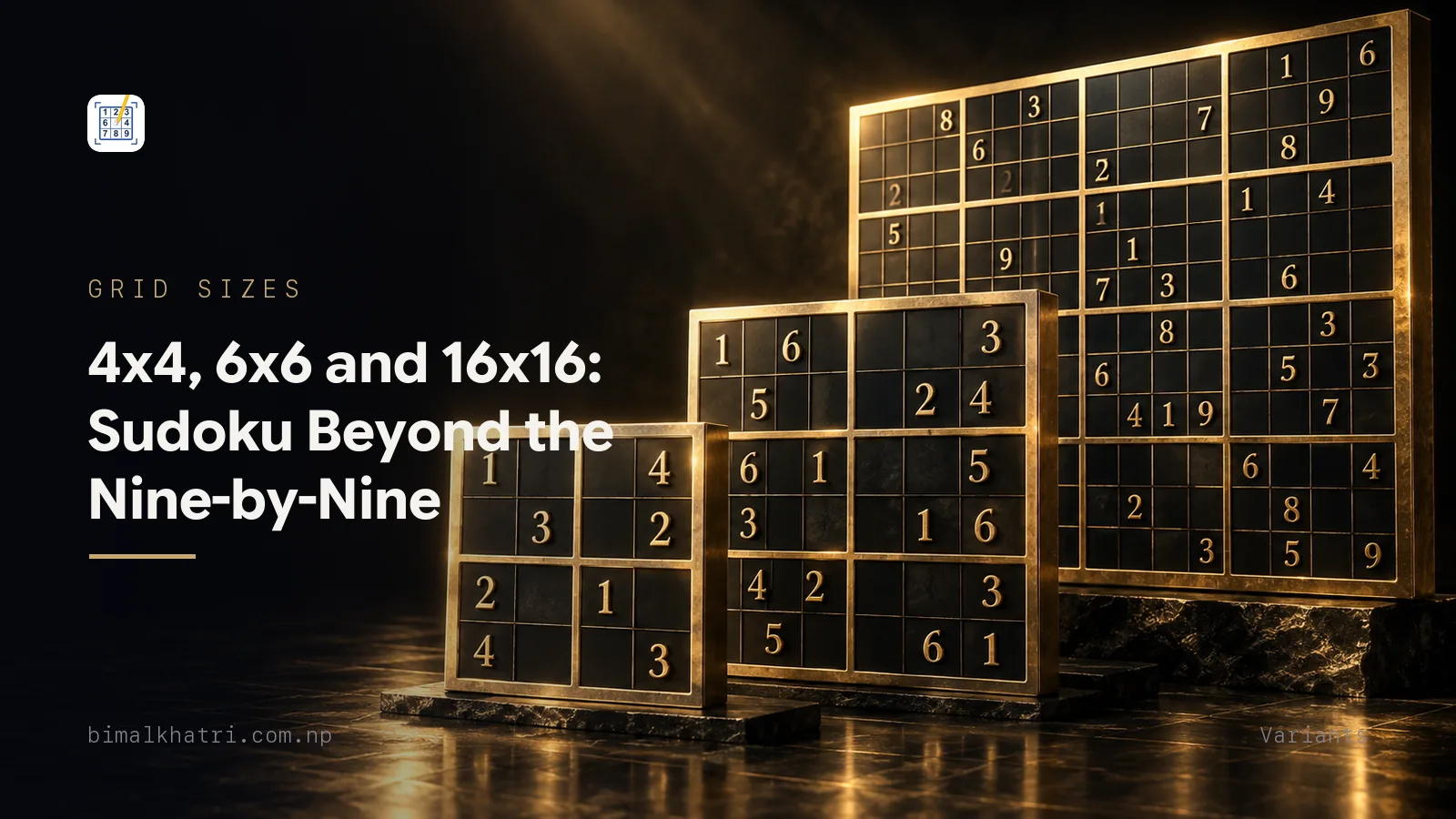
Every Sudoku is the same puzzle. Fill each row, each column and each box with the full set of symbols, once each, and never repeat one inside a unit. Change the size of the grid and that rule does not move. What moves is the shape of the box, how many symbols you are placing, and how many other cells each one has to agree with.
Three sizes cover nearly everything you will meet outside the standard grid. A 4x4, with two-by-two boxes and the digits 1 to 4. A 6x6, whose boxes are rectangles rather than squares, which is the detail that catches people. And a 16x16, which runs on 0 to 9 and then A to F.
The big one is the one people brace themselves for, and it is the wrong thing to brace for. A 16x16 is longer than a 9x9. It is not harder.
Staying on the standard grid? Sudoku Master is 9x9 and nothing else: 4,000 puzzles, a streak counter and an activity heatmap so you can see the habit forming, and no ads while you solve.
The sizes, side by side
| Grid | Box shape | Cells | Symbols | Peers per cell |
|---|---|---|---|---|
| 4x4 | 2 by 2 | 16 | 4 | 7 |
| 6x6 | 2 rows by 3 columns | 36 | 6 | 12 |
| 8x8 | 2 rows by 4 columns | 64 | 8 | 17 |
| 9x9 | 3 by 3 | 81 | 9 | 20 |
| 12x12 | 3 rows by 4 columns | 144 | 12 | 28 |
| 16x16 | 4 by 4 | 256 | 16 | 39 |
| 25x25 | 5 by 5 | 625 | 25 | 64 |
The last column is the one that tells you how the puzzle will feel. A cell's peers are the other cells that share its row, its column or its box. They are the only things in the game that can rule a symbol out, so the peer count is the amount of evidence available to you, and also the amount of looking you have to do.
Counting them is easy once you have seen it done. On a 9x9 your row gives you 8 other cells, your column another 8, your box another 8. That is 24, except the box overlaps: two of those box cells were already counted in your row and two in your column. Take off 4 and you get 20.
Run the same count on a 16x16. Row 15, column 15, box 15, so 45. Your box shares three cells with your row and three with your column, so take off 6. That leaves 39.
Now put the two next to each other. On a 9x9 each cell has 20 peers and 8 wrong answers to avoid. On a 16x16 it has 39 peers and 15 wrong answers to avoid. Divide one by the other: 2.5 peers per forbidden symbol on the small grid, 2.6 on the big one. The bigger grid is very slightly better constrained, not worse. That single number is why a 16x16 does not fight back the way its size suggests it will.
Why some sizes cannot exist
You will never see a 5x5 Sudoku, or a 7x7, and the reason is arithmetic rather than tradition.
The boxes have to tile the grid exactly, and each box has to hold the whole symbol set once. So a box on an N by N grid holds exactly N cells, laid out as m rows by n columns with m times n equal to N. A 5x5 grid would need boxes of five cells. The only way to make a rectangle of five cells is 1 by 5, which is a whole row or a whole column. A box that is just a row adds nothing the row rule was not already saying.
Prime numbers are therefore out. Every workable size is a number you can factor: 4, 6, 8, 9, 10, 12, 14, 15, 16, 25.
Two consequences follow, and both are practical.
Square sizes get square boxes. 4, 9, 16 and 25 are perfect squares, so their boxes are 2 by 2, 3 by 3, 4 by 4 and 5 by 5. Everything else gets a rectangle.
Some sizes have more than one legal shape. A 12x12 can be boxed as 3 rows by 4 columns or as 2 rows by 6 columns. Both are proper Sudoku, and they play differently: the 3 by 4 version gives each cell 28 peers, the 2 by 6 version gives it 27. Look at the printed lines before you start scanning, because your eye will otherwise invent a box shape and hunt in the wrong six cells for twenty minutes.
The 4x4 and the 6x6
A 4x4 is a real Sudoku with the technique removed. Four rows, four columns, four boxes in the corners, digits 1 to 4.
1 . 3 4
3 4 . .
. 3 4 .
4 . . 3
Seven peers means a cell has seven chances to be told what it cannot be, and only three wrong answers to eliminate. Almost every move on a grid this size is the same move: a unit with one empty cell left, or a digit with one place left to go. Naked pairs and pointing pairs technically exist here, but a four-cell unit with a naked pair in it has already solved itself, so they never earn their name. That is fine. The 4x4 is where a solver learns that the answer is already in the grid, and it does that job in about ninety seconds. Where it belongs is covered in Sudoku for kids.
The 6x6 is the first size that teaches something new, and what it teaches is geometry.
. . . 6 . .
2 . 1 5 . .
3 . . . . .
. . . 2 5 .
5 . . 3 4 .
6 . . . . 5
Twelve givens, and exactly one solution. Boxes here are two rows tall and three columns wide, numbered left to right then top to bottom, so box 1 is rows 1 and 2 across columns 1 to 3, and box 2 is rows 1 and 2 across columns 4 to 6.
Trace box 2 with a finger before reading on. Now find the 4 in it.
The empty cells of box 2 are r1c5, r1c6, r2c5 and r2c6. Column 5 already holds a 4, down at r5c5, so both the c5 cells are dead. The 4 in box 2 has to sit in column 6, at r1c6 or r2c6. You do not know which, and it does not matter. Whichever it is, no other cell of column 6 can hold a 4, so cross it off r3c6 and r4c6.
That elimination pays immediately. Before it, r3c6 could hold 1, 4 or 6. After
it, {1,6}. Its neighbour r3c5 was already {1,6}. Two cells in row 3 holding
the same two candidates is a naked pair, so 1 and 6 leave the rest of the row,
and r3c2 drops from five candidates to three.
Here is the part that only happens on a rectangular box. A row inside a 6x6 box covers 3 cells, so pointing along a row reaches the 3 cells outside it. A column inside that box covers only 2 cells, so pointing along a column reaches 4. On a 9x9 both directions reach 6 and you never think about it. On a 6x6, column pointing is worth a third more than row pointing, every time. Look down before you look across. The full technique is in pointing pairs and box-line reduction.
The 16x16, which is what most people came here for
Sixteen rows, sixteen columns, sixteen boxes of four by four. The symbol set is hexadecimal: 0, 1, 2, 3, 4, 5, 6, 7, 8, 9, A, B, C, D, E, F.
Three things about that set trip up first-timers.
Zero is a symbol. Starting at 1 would need a 10 through 16, and two-digit numerals do not fit in a cell you also want to pencil-mark. So the count starts at 0. A blank cell and a 0 then look alike in bad handwriting, which is worth a slashed zero.
Letters are not special. F obeys exactly the same rule as 7. Nothing is added, nothing is ordered, and A is not bigger than 9 in any sense the puzzle cares about. If letters bother you, relabel them in your head as 10 through 15 and nothing changes.
If your puzzle prints 1 to 16 instead, it is the same puzzle. Plain numbers read more easily and pencil-mark far worse, since every candidate takes two characters. Do not mix the two conventions inside one grid.
Cell references work the way they always do. Rows count 1 to 16 from the top, columns 1 to 16 from the left, so r4c3 is row 4, column 3. Boxes are numbered left to right then top to bottom, which makes box 1 the top left sixteen cells and box 16 the bottom right.
The real change is what you can hold in your head. On a 9x9 you can write every candidate into every empty cell and still read the page. On a 16x16 a cell can legitimately have 15 candidates, and eighty of those written out is not a set of pencil marks, it is a wall. So flip the question you ask.
Instead of "what can go in this cell", ask "where can this symbol go in this box". Carry one symbol, sweep it across the grid, place it wherever it has nowhere else to sit. That is hidden-single hunting, it needs no writing at all, and it scales because the load on your memory stays one symbol wide. Candidates come later, in the boxes the sweep has already dented. There is more on rationing them in pencil marks without drowning in them.
One bonus the big grid hands you: a band on a 16x16 is four boxes wide, so finding a symbol in a row eliminates it across four boxes at once instead of three. Each sweep does more work than the same sweep on a 9x9.
A move worked on a real 16x16
Here is a genuine puzzle. 105 given symbols, 256 cells, exactly one solution. Written without spaces so it fits a phone.
73E9...5C.DF8.21
5.A.FD.C.216....
.F..6.2...9....B
8..139E...B..F.D
.7.2.E...D..F.14
F.14.2....E.0.D.
0CD....F.9...5..
.5.E.A.....867..
A.0.1CF4..8.E...
EB.7..0A4....96.
..FC.8..E.......
.9.....E....41..
..534.CD1...9...
.28.....B....4.0
...6A.5.DC.4..8.
....2F......B..3
Work box 1, the top left corner. Zoomed in, it looks like this.
7 3 E 9
5 . A .
. F . .
8 . . 1
Box 1 holds 7, 3, E, 9, 5, A, F, 8 and 1. Seven cells are empty and seven symbols are missing: 0, 2, 4, 6, B, C and D.
Take the 2 first.
- Row 1 already has a 2, at r1c15. Its box 1 cells are full anyway.
- Row 2 has a 2 at r2c10. Row 2 is out.
- Row 3 has a 2 at r3c7. Row 3 is out.
- Row 4 has no 2 anywhere. So the 2 in box 1 lives in row 4.
Row 4 has two empty cells inside box 1: r4c2 and r4c3. Run one column down. Column 2 holds a 2 at r14c2, so r4c2 cannot be the one.
Place the 2 at r4c3.
Notice what that cell would accept if you had asked the other question. By row, column and box alone, r4c3 could still hold 4, 6, C or the 2. It is not a naked single and never becomes one. The 2 only lands because it has nowhere else in the box to go.
Now do a letter, in the same box, with the same method.
- Row 3 has a B at r3c16. Out.
- Row 4 has a B at r4c11. Out.
- Row 1's box 1 cells are all filled, so B must be in row 2, at r2c2 or r2c4.
- Column 2 has a B at r10c2.
Place the B at r2c4.
Two rows and one column, twice. That is cross-hatching, unmodified, on a grid with three times the cells of the one it was invented for. The method is worked at normal size in cross-hatching a grid, and nothing in it needs changing for sixteen symbols.
Bigger grids are longer, not harder
Size and difficulty are separate dials. One counts cells. The other counts how far down the technique ladder the grid makes you reach before it gives up a placement. A 16x16 can be built so that nothing beyond cross-hatching is ever needed, and it will still take you roughly three times as long as a 9x9, because 256 cells is roughly three times 81. Long and easy. Meanwhile a 9x9 marked extreme can stall you for an hour on a grid you can see all of.
The same warning applies to clue counts at every size. A grid that looks empty is not automatically hard, and a full-looking one is not automatically kind. What matters is which technique opens the next placement. There is a fuller account in what makes a Sudoku easy, medium, hard or extreme.
One thing genuinely does get harder as the grid grows, and it is not logic. It is bookkeeping. More cells means more chances to write a symbol in the wrong column, and a single misplaced entry on a 16x16 can hide for forty minutes before the contradiction surfaces. Check the row and the column out loud as you place, especially near the middle of the grid where you have no edge to count from.
What a bigger grid does not change
All of it. Every technique in the standard ladder is a statement about rows, columns and boxes, and every size has all three. An X-Wing wants two rows, two columns and one symbol; it does not care whether that symbol is a 7 or a D.
Two of them stretch rather than simply transfer, and both were on show above. Naked sets get longer: a 16x16 unit can hold a naked set of any size up to 15, which is a working technique on a big grid and a curiosity on a small one. And pointing changes its reach with the shape of the box, which is why a 6x6 pays you for looking down before you look across.
The adjustments you actually make are the two habits, not the techniques. Sweep by symbol rather than by cell. Check the printed box shape before you scan. If you want the ladder in order, it is laid out in every Sudoku technique from easiest to hardest.
I built Sudoku Master, and it stops at nine. Nine rows, nine columns, nine square boxes, digits 1 to 9, no other size in it. A 6x6 for a child or a 16x16 for a long evening is a paper job, or a job for an app written for that size. This page exists anyway because the sweep it teaches, one symbol at a time across every unit that could hold it, is the same sweep a 9x9 wants, and a 9x9 is where most people get the practice.
Mistakes on an unfamiliar size
Hunting for a square box on a 6x6 or a 12x12. Your eye will scan a square whether or not one is printed. Trace the box outline with a finger on the first puzzle of a new size.
Assuming a 16x16 needs advanced logic. A big grid built for casual solving needs nothing beyond cross-hatching. Start with a plain symbol sweep and see how far it gets before you reach for anything clever.
Writing full candidates on a big grid. Fifteen candidates do not fit in a printed cell and would not be readable if they did. Sweep by symbol until the lists are short enough to write.
Mixing 0 to F with 1 to 16 in one grid. Pick whichever convention the puzzle uses and stay in it. A 10 written where an A belongs is a mistake you will not see again for an hour.
Trusting a puzzle you found for free. A proper Sudoku of any size has exactly one solution. Print-it-yourself sites sometimes ship grids with two, and no amount of logic settles those. If two symbols both look legal and nothing on the page separates them, suspect the puzzle before you suspect yourself. There is a checklist in why some Sudoku puzzles feel impossible.
Questions people ask
What symbols does a 16x16 Sudoku use?
Hexadecimal: 0 to 9, then A, B, C, D, E and F. If yours prints 1 to 16 as plain numbers, that is the same puzzle with different labels. The letters exist so that every symbol takes one character, which is what makes pencil marks fit in a cell.
Is there such a thing as a 5x5 Sudoku?
Not with boxes. Five is prime, so the only rectangle of five cells is a single row or column, and a box shaped like a row tells you nothing the row rule was not already saying. If you meet a 5x5 puzzle, it is either a Latin square with no box rule at all, or an irregular grid with shaped regions instead of rectangles.
How long does a 16x16 Sudoku take?
Longer than a 9x9 in proportion to the cells, so budget around three times your usual pace for a puzzle of similar technique level. Most of that extra time is writing and checking rather than thinking. It is also a puzzle you can put down and pick up, which suits it better than being rushed.
Is a bigger Sudoku harder?
Not automatically, and the peer count says why. Each cell on a 16x16 has 39 peers policing 15 wrong answers, against 20 peers policing 8 on a 9x9. Per symbol you are slightly better informed on the big grid. What grows is the length, not the depth.
What is a 12x12 Sudoku called?
Usually just a 12x12. Labels like giant or super get attached to the larger grids and mean nothing precise, so read the printed box lines rather than the cover. A 12x12 may be boxed 3 rows by 4 columns or 2 rows by 6 columns, and both are legitimate.
Why is a 6x6 box a rectangle?
Because 6 does not have a square root that is a whole number. A box has to hold six cells and tile the grid, so 2 by 3 is the only sensible option. The same applies to 8x8 and 12x12. Square boxes only happen when the grid size is a perfect square: 4, 9, 16, 25.
Do the same techniques work on every grid size?
Yes, without exception. Every technique is a claim about rows, columns and boxes, and every size has all three. Naked sets get longer on a bigger grid and pointing sets change their reach when the box is a rectangle, but nothing has to be relearned.
What is the largest Sudoku you can make?
There is no ceiling in the rules. Any size that factors into two whole numbers works, so a 36x36 with 6 by 6 boxes is as legal as a 9x9, and so is a 100x100. The limit is patience and paper size, not logic.
Are 4x4 puzzles proper Sudoku?
Yes. Same rule, same guarantee of a single solution when the puzzle is made properly. What a 4x4 lacks is room for technique, since almost every move is a unit with one gap in it. That makes it a teaching grid rather than a puzzle for an adult.
Keep reading
- Sudoku for kids, for which small grid to start a child on and when to move them up
- Types of Sudoku, from classic to Samurai, for the variants that change the rules rather than the size
- Jigsaw Sudoku, the other way a box stops being a three-by-three square
- Cross-hatching, the scan used on the worked example above, at normal size
- Sudoku: the complete guide, everything in the series in one place
- How to play Sudoku: the complete rules, the base game every size is built on
Get it: Sudoku Master, free on iPhone and Android. Nine by nine, four grades, and it opens the same with no signal.