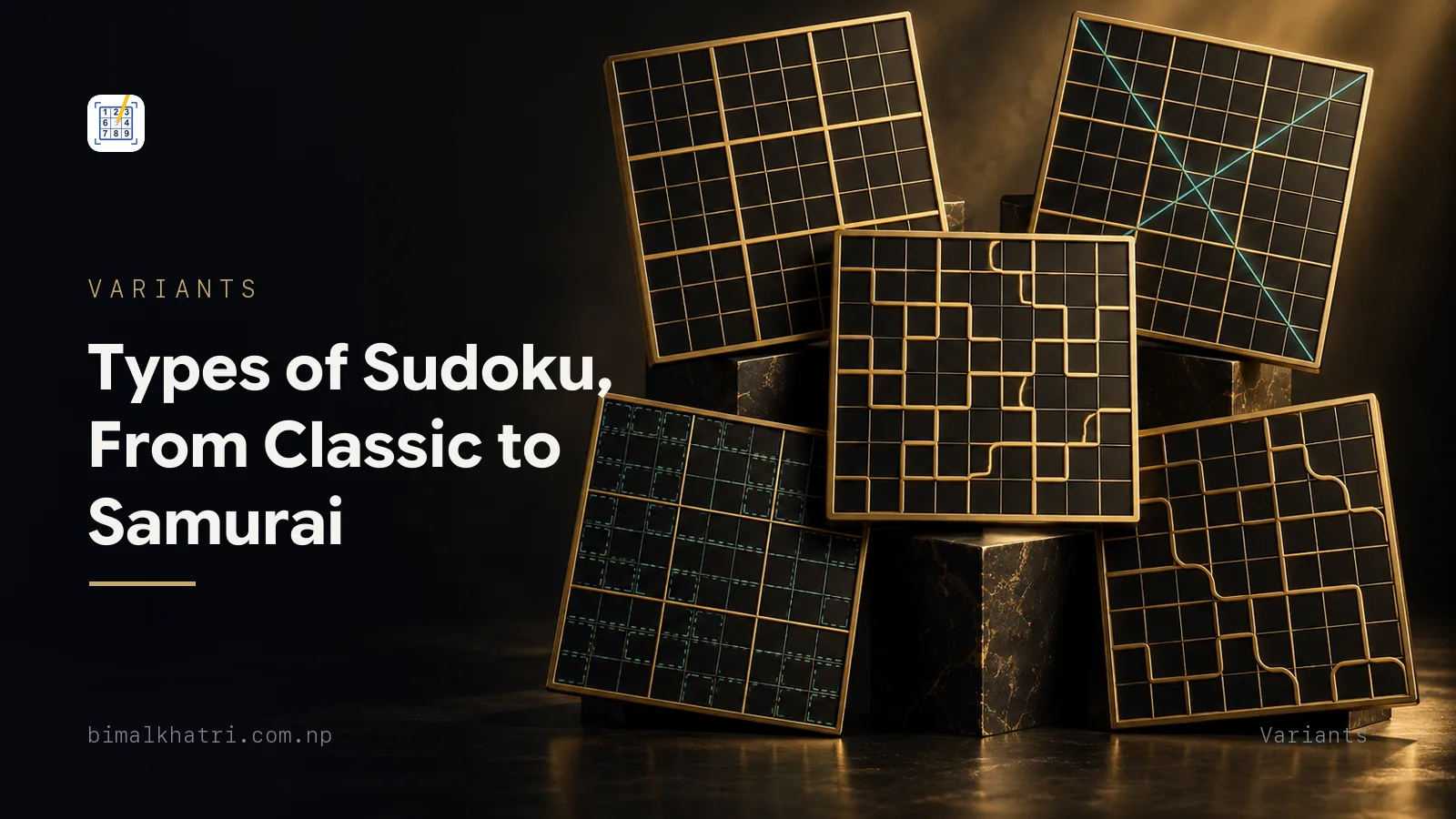
Classic Sudoku is the base, and every other type is one edit made to it. Jigsaw reshapes the nine boxes. Sudoku X adds the two diagonals. Killer bolts arithmetic on top. Samurai joins five grids at their corners. The small and large grids change how many digits you are placing and nothing else.
One rule survives all of them. A digit appears exactly once in every region, where a region is a row, a column, a box, or whatever else that particular puzzle has declared to be one. Read that sentence carefully and every grid below becomes something you already know how to start.
Your techniques travel too. Cross-hatching, naked singles, hidden singles, pairs and the X-Wing are all statements about a group of nine cells that has to hold 1 to 9 between them. Not one of them cares what shape the group is.
Classic, in your pocket. Sudoku Master grades its 4,000 puzzles easy to extreme and keeps daily, weekly and monthly challenges running at every grade. Free, and no ads while you solve.
The types on one screen
| Type | Grid | What changes | The new idea to learn |
|---|---|---|---|
| Classic | 9x9 | Nothing. Rows, columns, nine 3x3 boxes | None |
| Sudoku X | 9x9 | Both long diagonals must hold 1 to 9 as well | Two extra regions that cross in the middle |
| Jigsaw | 9x9 | The nine boxes become nine irregular shapes | A region can share more than three cells with a row |
| Killer | 9x9 | Dashed cages carry a sum, and no digit repeats inside a cage | Arithmetic, and usually no starting digits at all |
| Samurai | Five 9x9 grids | Five grids overlap on four corner boxes | Work done in one grid pays out in another |
| 4x4 and 6x6 | 4x4 and 6x6 | Fewer digits, smaller boxes | Nothing. These are the training grids |
| 16x16 | 16x16 | Digits 0 to 9 plus the letters A to F, 4x4 boxes | Bookkeeping |
Two things are worth reading off that table before anything else. Only Killer adds a rule that is not about repetition, so Killer is the only one that asks you to learn a genuinely new move. And only Samurai changes the size of the job. Everything else is the same puzzle wearing a different region map.
Classic: the shape the others edit
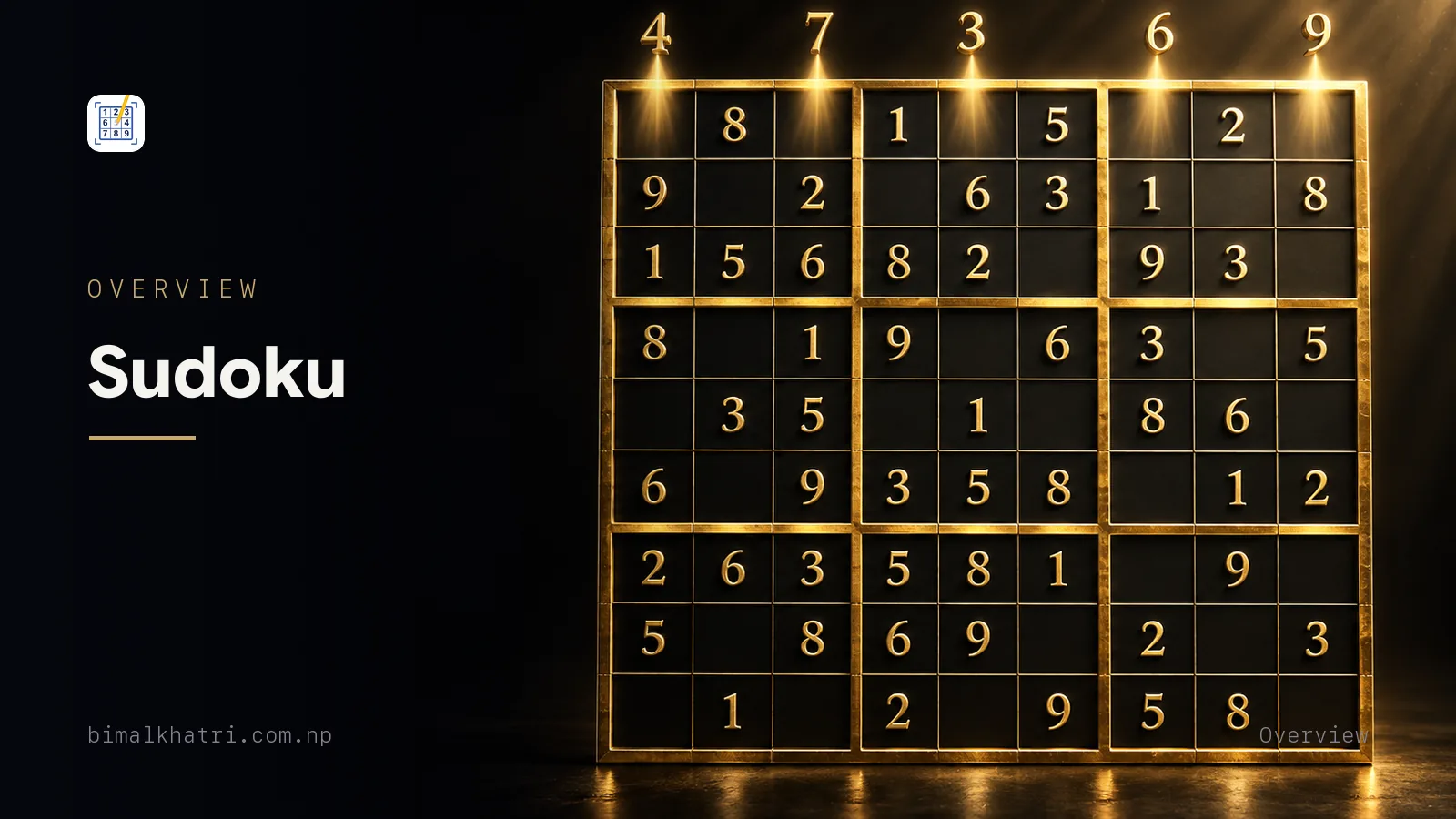
Nine rows, nine columns, nine 3x3 boxes, digits 1 to 9, no repeat in any of them. That is 27 regions, and there is no arithmetic and no diagonal anywhere in the rules. Here is the region map, one letter per box.
AAABBBCCC
AAABBBCCC
AAABBBCCC
DDDEEEFFF
DDDEEEFFF
DDDEEEFFF
GGGHHHIII
GGGHHHIII
GGGHHHIII
Those 27 regions hand every cell exactly 20 peers: the cells forbidden from copying it. Peers are the whole game. Every deduction on this page, in every type below, is a claim about somebody's peers. The rules in full covers the classic grid properly.
Hold on to the two numbers, 27 regions and 20 peers. Each variant below moves one or both of them, and that movement is the entire difference.
Sudoku X: two more regions, crossing in the middle
Sudoku X, also sold as diagonal Sudoku, keeps the grid exactly as it is and declares the two long diagonals to be regions as well. Each must hold 1 to 9 with no repeat, same as a row. Regions: 29 instead of 27.
Seventeen cells sit on a diagonal. The other 64 never feel the new rule, which is why an X grid looks so ordinary. Those seventeen answer to four regions instead of three, so they are the tightest cells on the page, and a setter builds the puzzle around them. Scan the two long lines before anything else.
Notice which boxes are affected. Only the four corners and the middle hold a diagonal cell at all. Boxes 2, 4, 6 and 8 hold none, so you solve them exactly as you always did, and the cell-by-cell arithmetic of the rest is in what two diagonals change.
Jigsaw: the boxes stop being squares
Jigsaw, also called irregular Sudoku, keeps 27 regions and 20 peers. What it changes is which 20. The nine boxes become nine connected shapes of nine cells, and one of them looks like this.
AAAAABBBB
AACCCBBBB
ADDDCCCCB
ADDCCEEEE
DDDDFFEEE
GGGGFFFEE
GGHHHFFFI
GHHHHIFII
GGHHIIIII
Read region B, the one in the top right. It holds r1c6 through r1c9, then
r2c6 through r2c9, then a single cell at r3c9. Four cells in row 1, four
in row 2, one in row 3.
That single fact is the whole of Jigsaw strategy. In classic Sudoku a box and a
row share exactly three cells, so placing a digit in a row kills at most three
cells of any box. Here, placing a 7 anywhere in row 1 outside region B kills
four of region B's nine cells at once. Region D does the same thing to row 5:
r5c1, r5c2, r5c3 and r5c4 all belong to D.
Cross-hatching is therefore stronger in Jigsaw, not weaker, once you stop looking for squares. Point it at the shape instead. The one habit to break is reading the grid in 3x3 chunks, which is exactly what years of classic solving have trained into you, and it is why a first Jigsaw feels harder than it is.
Killer: the same grid with sums on top
Killer keeps all 27 classic regions and adds cages: dotted outlines, each carrying a small total in its corner. Digits inside a cage sum to that total and never repeat. Most Killer puzzles have no starting digits at all, so the cage sums are the entire clue set.
The move that makes this tractable is that every region holds 1 to 9 once, so every row, column and box sums to 45. Now take one box carved into four cages, one letter each.
aab
ccb
cdb
Cage a covers two cells and totals 17. Cage b covers three and totals 6. Cage c covers three and totals 15. Cage d is the single cell left over. You can fill in the digit distribution of that entire box without a single given.
- 17 in two cells has one answer.
{8,9}, in some order. - 6 in three cells has one answer.
{1,2,3}. - The box sums to 45, and the three cages account for 17 plus 6 plus 15, which is 38. So cage d, the leftover cell, is a 7.
- The digits left for cage c are
{4,5,6}. They sum to 15, which is what the clue said, so the box checks out.
Four numbers on a page, and you now know that two cells hold 8 and 9, three hold 1, 2 and 3, three hold 4, 5 and 6, and one holds a 7. The unique sums are worth memorising because they carry the opening of most Killer puzzles: 3 in two cells is 1 and 2, 17 in two cells is 8 and 9, 6 in three cells is 1, 2 and 3, and 24 in three cells is 7, 8 and 9.
After the arithmetic runs out, Killer becomes ordinary Sudoku again. You solve the rest of the grid with singles and pairs, the same as any other puzzle.
Samurai: five grids sharing four boxes
Samurai is five full 9x9 puzzles overlapping in a plus shape. Each character below is one 3x3 box, and a star marks a box that belongs to two grids at once.
TTT.UUU
TTT.UUU
TT*C*UU
..CCC..
LL*C*RR
LLL.RRR
LLL.RRR
Count boxes rather than cells and the shape is easier to hold. Five grids own 45 boxes between them, four of those shared, so 41 boxes and 369 cells. Each of the five obeys ordinary Sudoku rules on its own, and nothing else is added.
The overlap is the point. A digit you place in the top left grid's bottom right box is also a digit in the central grid's top left box, which then constrains three rows and three columns of the central grid you had not touched. When a Samurai stalls, the answer is almost always in a different grid from the one you are staring at.
Practical consequence: do not solve one grid to the end and then start the next. Work the four corner boxes first, because those cells do double duty, and rotate through all five grids as each one gives you something.
Smaller and larger grids
The grid size changes the alphabet and the box shape. It changes nothing else.
| Grid | Digits | Box shape | Who it is for |
|---|---|---|---|
| 4x4 | 1 to 4 | 2x2 | Children, and anyone learning the one-per-region rule |
| 6x6 | 1 to 6 | 2 rows by 3 columns | The step up from 4x4, still finishable in minutes |
| 9x9 | 1 to 9 | 3x3 | The standard |
| 16x16 | 0 to 9 and A to F | 4x4 | Solvers who want volume rather than difficulty |
The 6x6 box is the one that surprises people, because it is not square. Six cells split into boxes of two rows by three columns, so the grid holds six boxes rather than nine. Here is that map.
AAABBB
AAABBB
CCCDDD
CCCDDD
EEEFFF
EEEFFF
A 16x16 is a bigger job, not a harder one. The genuinely new thing is the alphabet: sixteen symbols to a cell, and a handwritten A that could be a 4 will cost you more than any deduction on the page. If you want a child started, which grid size to begin on works through the 4x4 to 6x6 to 9x9 ladder.
What carries over, and what does not
This is the part that decides whether a variant is worth your evening. Almost everything you know already applies.
| Technique | Where it works |
|---|---|
| Cross-hatching | All of them. Point it at whatever the puzzle calls a region |
| Naked and hidden singles | All of them, unchanged |
| Naked and hidden pairs, triples | All of them. A pair is a claim about nine cells, not about a square |
| Pointing pairs and box-line reduction | All of them, and they bite harder in Jigsaw, where a region and a row can share four cells |
| X-Wing, Swordfish | All of them. Both are built from rows and columns, and no variant here removes those |
| Cage sums and the 45 rule | Killer only |
| Diagonal scanning | Sudoku X only |
| Cross-grid deduction | Samurai only |
So the honest answer to "which variant should I learn first" is that you have already learned most of each of them. The full ladder of techniques is the same ladder in every type.
Two habits do need adjusting. In Jigsaw, stop reading the grid in 3x3 chunks. In Samurai, stop finishing one grid before you look at the next. Both are muscle memory from classic play rather than reasoning, which is why they are hard to notice and easy to fix.
Which one to try next
Pick by what you want the evening to feel like.
- You want classic, but sharper. Sudoku X. Two extra regions to scan and nothing new to learn. Every extra region is another place to cross-hatch, which is why an X grid can carry fewer givens and still be fair.
- You want your scanning tested. Jigsaw. The rules are identical and your pattern recognition is the thing under attack.
- You like arithmetic. Killer. It is the only type on this page that gives you a genuinely different opening move.
- You want a long sitting. Samurai. Five puzzles that lean on each other, and the only one where a stall in one place is solved somewhere else.
- You are teaching someone. 4x4, then 6x6. The rule is the same and the grid is small enough to finish in a sitting.
I built Sudoku Master, so the disclosure belongs here: it plays classic 9x9 only. The types on this page are explained on this site rather than played in the app, so for a Killer or a Jigsaw tonight you want a variant book or a variant site, and the technique pages here will still apply to it.
One thing that does not vary. A properly made puzzle of any type has exactly one solution and a path of pure logic that reaches it. If a grid genuinely cannot be finished without a guess, it is broken rather than exotic, whatever shape its regions are.
What people get wrong about variants
Assuming a variant is harder because it looks stranger. Difficulty is set by the hardest technique the grid forces on you, not by the type. An easy Jigsaw is easier than a hard classic. What actually makes a puzzle hard works through the grading.
Reading a Jigsaw in 3x3 chunks. The regions are printed with heavy borders for a reason. Trace the shape before you scan it, every time, until it stops needing tracing.
Doing Killer arithmetic on cells that are already solved. Once cage sums have given you what they are going to give, switch to ordinary singles. People lose an hour adding numbers when a hidden single was sitting there.
Solving one Samurai grid to completion. The shared boxes are the cheapest cells in the puzzle. Work them first and take the overlap payments as they come.
Treating a 16x16 as an achievement. It is a 9x9 with more clerical load and a longer sitting. If you want harder, go up a grade rather than up a size.
Expecting variant puzzles to be graded like classic ones. There is no shared difficulty scale across publishers even within classic Sudoku, and there is certainly none across types. Calibrate against one source.
Questions people ask
Which type of Sudoku is the hardest?
The type does not set the difficulty, the setter does. Any of them can be built easy or brutal, and a gentle Killer is far easier than an extreme classic. The type only decides which techniques you will need, not how much work the grid makes you do.
Do Killer Sudoku puzzles have any starting numbers?
Most have none at all. The cage sums are the clues, which is why the unique sums matter so much: they are the only cells you can fill before any logic starts. A few published Killers do include a handful of givens.
Is Sudoku X the same thing as diagonal Sudoku?
Yes, the two names describe the same puzzle. Both diagonals must hold 1 to 9, in addition to every row, column and box. The X is what the two diagonals look like when they are drawn on the grid.
Can I use an X-Wing on a Jigsaw or a Killer puzzle?
Yes. An X-Wing is built entirely from two rows and two columns, and every type on this page keeps its rows and columns intact. The X-Wing, worked on real grids applies exactly as written.
How many cells are in a Samurai Sudoku?
- The five grids own 45 boxes between them, four of them shared, so 41 boxes of nine cells.
Does a 16x16 Sudoku use letters or numbers?
Both. The usual set is 0 to 9 plus A to F, which is sixteen symbols, and the boxes are 4x4. Some publishers use 1 to 16 instead, which is harder to read in a small cell and less common.
Do variant puzzles still have exactly one solution?
Yes, whenever the setter has done the job, and that holds for every type on this page. It is what makes a puzzle solvable by logic rather than by trial. If you find two answers that both fit, the puzzle was badly made or an earlier placement of yours was wrong.
What should a beginner start with?
A 4x4, then a 6x6, then an easy classic 9x9. The rule being learned is the same in all three, and a smaller grid gives you the whole loop of scanning, placing and rescanning in a couple of minutes. Cross-hatching, which is that loop, is the only skill needed for the first few.
Keep reading
- Killer Sudoku: the rules and the cage sums worth memorising, for the arithmetic in full
- Jigsaw Sudoku: when the boxes stop being squares, for the region-first scanning habit
- Samurai Sudoku: five grids, one puzzle, for how to work the overlaps in order
- Sudoku X: what two diagonals change, the smallest step away from classic
- 4x4, 6x6 and 16x16, for every grid that is not nine by nine
- Sudoku: the complete guide, where each of these pieces sits in the bigger picture
Get it: Sudoku Master, free on iPhone and Android. Classic 9x9, four grades, and one link that finds your store.