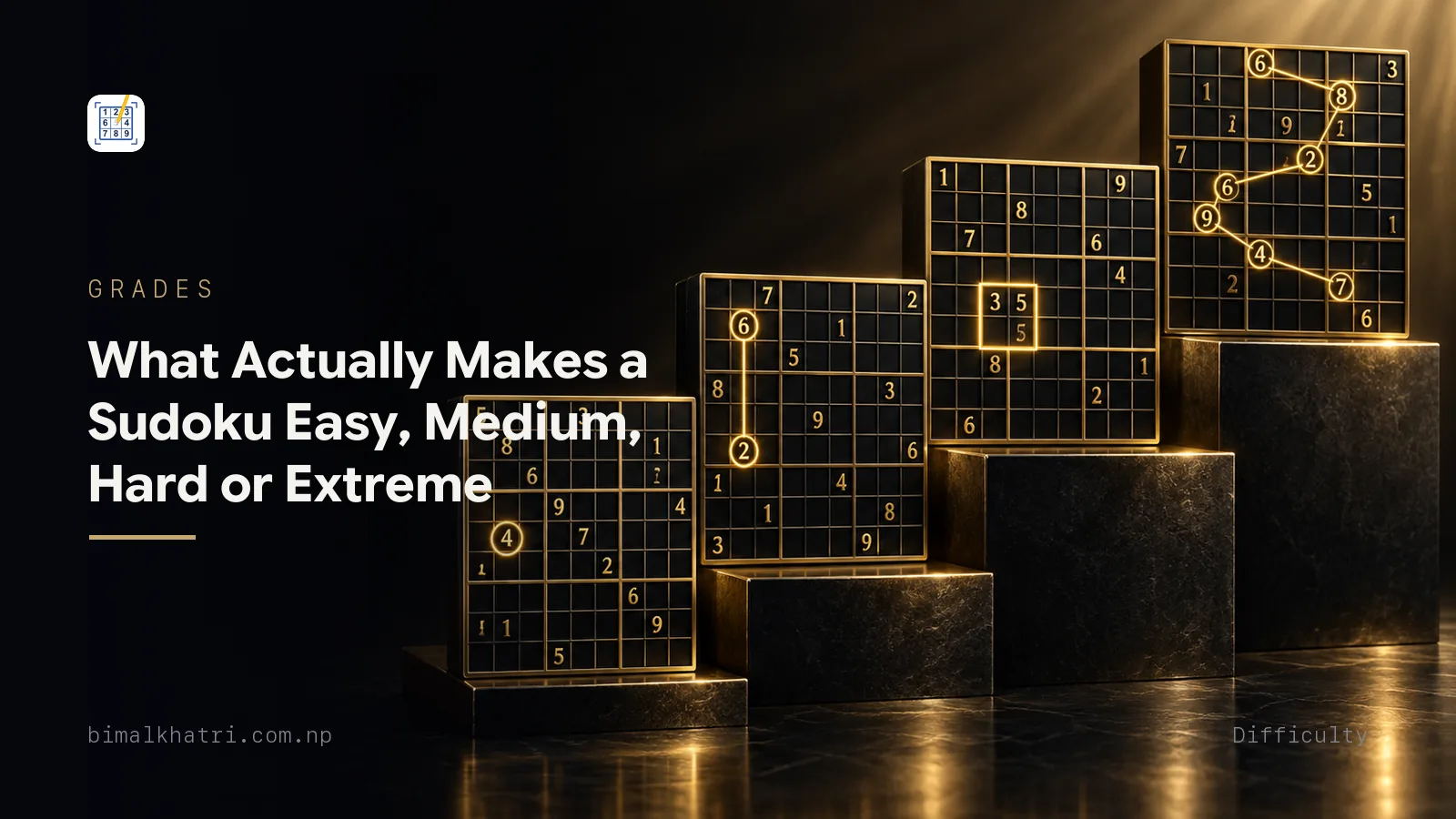
A Sudoku's grade comes from one thing: the hardest technique the grid forces on you, and how many times it forces it. Easy means you never need more than a scan. Extreme means the grid gives back one cell, then makes you find a pattern before it gives you another.
The clue count has almost nothing to do with it. A 31-clue puzzle can be far harder than a 26-clue one, and both grids are printed below so you can work them yourself.
In one line each. Easy asks for cross-hatching and singles, over and over. Medium asks for the same two moves with fewer of them showing at a time. Hard is the first grade where you have to write candidates down and use a pattern that spans a box and a line. Extreme is the grade where long stretches of the puzzle offer no placement at all.
Solving on a phone? Sudoku Master carries 4,000 classic puzzles split across the four grades on this page, all bundled in the app, and no ads while you solve.
The four grades, on one screen
| Grade | The hardest rung it forces | What solving it feels like | Where to start |
|---|---|---|---|
| Easy | Cross-hatching, naked and hidden singles | Every placement exposes the next one | Scan the digit that already appears most often |
| Medium | The same singles, with hidden ones doing more of the work | The scan pays, dries up, then pays again after one placement | Re-scan the digit you just placed |
| Hard | Naked and hidden pairs, pointing pairs, box-line reduction | Singles run out with half the grid still empty | Write candidates for the fullest unit only |
| Extreme | X-Wing and above: chains, colouring, uniqueness | A pattern buys one cell and the grid stops again | Full candidate marks, and patience |
Two things are worth reading off that table before anything else. The rung goes up by one step per grade, and only the first two rungs place digits. Everything from hard upwards deletes candidates, and the placements arrive later, from singles the deletions expose. The full ladder of techniques sets out all eight rungs in order.
The clue count is the wrong number
Count the givens on each of these two grids before you read on. Dots are empty
cells, rows run 1 to 9 from the top and columns 1 to 9 from the left, so r4c7
is row 4, column 7.
.3...4...
.65.7...1
.........
.1...87.4
..7..1..5
..329....
...45...8
64...2..7
598......
That is 26 clues, and row 3 is completely empty. It looks vicious. It is not. Eleven cells can be filled the moment you start scanning, and singles alone finish the whole puzzle: no pencil marks, no pairs, no patterns.
Now the other one.
...7.4...
8..91....
4258.6...
.12...74.
.38..2.9.
..417...3
....9..87
.815.....
2.....61.
That is 31 clues, five more than the grid above. Seven cells can be filled at the start. Singles then place ten and stop dead with forty cells empty. After that the puzzle needs a pointing pair, and after the pointing pair it needs something harder than anything on this page.
Five extra clues, and the harder puzzle. This is not a trick pair chosen to embarrass the clue count. It happens because a clue is only worth as much as it rules out, and a clue that repeats what its neighbours already say is worth nothing at all. Nine clues packed into two boxes constrain far less than nine clues spread over six. What sets difficulty is the pattern the clues make, not how many of them there are.
The clue count does have one hard floor. No puzzle with fewer than 17 clues has a unique solution, settled by exhaustive computer search in 2012, so a 16-given grid is not fiendish. It is faulty. Seventeen clues and the search that settled it is the longer story. Above that floor, the number tells you nothing.
The test that takes ninety seconds
Here is a grade check you can run on any grid before committing an evening to it. Count the cells you could fill right now, without writing a candidate anywhere. Naked singles you can see, and hidden singles you find by asking where a digit goes in a box.
That number is the width of the opening, and it tracks the grade closely. The 26-clue grid above offers eleven. The 31-clue grid offers seven. An easy grid usually offers a dozen or more, and an extreme one offers two or three and then nothing.
The width matters more than the total because of what happens next. Every placement rewrites twenty peer cells, so a wide opening cascades and a narrow one does not. On an easy grid the nineteenth placement is visible because the eighteenth happened. On an extreme grid you place two cells and the front closes behind you.
Easy: one technique, run until it stops
....21...
..2..69..
184.....5
3.924....
52...74..
.7.9..1..
84.5623..
..3..98.2
.97.8451.
That grid has 36 clues, and nineteen of its forty-five empty cells can be placed immediately. Here is one of them, done the way an easy puzzle wants to be done: pick a digit, pick a box, ask where the digit can go.
Box 2 is the top middle, rows 1 to 3 and columns 4 to 6. It has six empty cells:
r1c4, r2c4, r2c5, r3c4, r3c5 and r3c6. Where does its 9 go?
- Row 2 already holds a 9, at
r2c7. That killsr2c4andr2c5. - Column 4 already holds a 9, at
r6c4. That killsr1c4andr3c4. - Column 6 already holds a 9, at
r8c6. That killsr3c6.
One cell survives. Place a 9 at r3c5, and you did it without writing a
candidate anywhere on the page.
That is the whole of an easy puzzle. Run cross-hatching across all nine digits, take every single it exposes, and the grid falls apart in the order it was built. If a puzzle billed as easy makes you reach for pencil marks, either it is misgraded or you have written a wrong digit somewhere.
Medium: the same moves, fewer at a time
Medium changes the width, not the rung. Most medium grids still need nothing above a single, and the ones that need more need a naked pair once, near the end.
What changes is where the singles hide. On an easy grid they are mostly naked: the cell has one candidate and it looks obvious. On a medium grid more of them are hidden, meaning the digit has one home left in a unit while the cell itself still carries four or five possibilities. Nobody spots those by staring at cells. You find them by asking a unit a question. Both kinds of single, worked slowly is the drill for it.
The habit that carries a medium grid is small: after every placement, re-scan that digit. You just removed it from twenty cells, and one of those cells is usually the next placement. People stall on mediums by finishing their sweep of the 4s, moving on to the 5s, and never going back.
Hard: the grade where you start writing candidates
Take the 31-clue grid from earlier. Run every single it has, and it arrives here.
1..724...
8..915...
425836.7.
.12...74.
738..2.9.
..417...3
...291.87
.81567...
2.....61.
Ten placements, then nothing. No cell has one candidate. No digit has one home in any row, column or box. This is the moment that defines the hard grade, and it is where most solvers put the puzzle down.
The move that reopens it is a pointing pair, and it lives in box 1. That box has
four empty cells, r1c2, r1c3, r2c2 and r2c3, and it still needs 3, 6, 7
and 9.
Ask where its 3 goes. Column 2 already holds a 3 at r5c2, which rules out
r1c2 and r2c2. Only r1c3 and r2c3 are left, and both sit in column 3.
You do not know which of the two takes the 3. You do know that box 1 puts its 3
somewhere in column 3, and that is enough: every other cell in column 3 loses
the candidate. Column 3's other empty cells are r7c3, which was down to
{3,6}, and r9c3, which was {3,7,9}.
r7c3 is now a 6. Place it.
That is what the hard grade is really asking for. Not a cleverer way of placing a digit, but a deduction that deletes a candidate, followed by a single that only exists because of the deletion. The pointing pair and its mirror image, box-line reduction, are the two most common patterns on a hard newspaper grid, and both directions are worked out here.
A hard grade also changes what you write. Marking all 81 cells before you start costs ten minutes and places nothing, and then you own every one of those marks for the rest of the evening. Mark the fullest unit and leave the rest alone. Pencil marks without drowning in them covers the upkeep, which is where hard puzzles are actually lost.
Extreme: a pattern for every cell
Keep going on that same grid and the grade shows itself. After the pointing pair, everything else on the ladder together adds exactly two cells.
1..724...
8..915...
425836.7.
.12...74.
738..2.9.
..417...3
.46291.87
.81567...
2.....61.
Naked pairs, naked triples, hidden pairs, pointing pairs, box-line reduction:
all of them, and the grid gains r7c3 and r7c2. An X-Wing hunt across all
nine digits finds nothing to eliminate. Thirty-eight cells still empty, and the
next legal move is a chain.
That ratio is what extreme means. It is not that the techniques are exotic. It is that each one buys a single cell, and then you start again from the top. An extreme puzzle costs you time rather than cleverness, which is why it can be solved by anyone patient enough to keep re-scanning. Advanced techniques for extreme puzzles covers what comes after the X-Wing, and the X-Wing itself is the rung to learn first.
One warning specific to this grade. An extreme grid and a grid with a wrong digit in it feel identical from the inside: both stop giving placements, both resist every pattern you know. Before you go hunting for a chain, check that the grid is still legal. Why a puzzle feels impossible is the two-minute test for telling the two apart.
Why one paper's hard is another's medium
There is no shared difficulty scale in Sudoku. No standards body, no agreed ladder, no cross-publisher meaning for the word "hard". Every publisher grades with its own solver and its own thresholds, and then picks its own names for the tiers: hard, tough, expert, diabolical, evil, extreme, nightmare.
So a hard from one source can sit anywhere from a medium to an extreme somewhere else, and neither of them is lying to you. Two practical consequences.
First, calibrate per source rather than per word. Time yourself over five puzzles from one publisher and you will know what its hard means for you, which is worth more than any label. The NYT tiers and the syndicated newspaper puzzles each have their own character.
Second, never conclude you have got worse because a puzzle marked medium beat you. The label came from a different grader, and graders disagree most at the boundaries.
One thing does hold across every source. A properly made puzzle has exactly one solution and a chain of logic that reaches it, whatever the grade on top of the page. If a puzzle genuinely cannot be finished without a guess, it is broken rather than hard, and solving without guessing sets out how to tell.
How the four tiers in my app are cut
I built Sudoku Master, so I can tell you exactly where its lines fall rather than describing a grading system from the outside. Four tiers, 1,000 puzzles each, all bundled in the app so nothing downloads and nothing needs a signal.
| Tier | Puzzles | Clues | Estimated time |
|---|---|---|---|
| Easy | 1,000 | 36 | 6 minutes |
| Medium | 1,000 | 31 | 12 minutes |
| Hard | 1,000 | 26 to 28 | 22 minutes |
| Extreme | 1,000 | 21 to 27 | 35 minutes |
Look at the last two rows. The hard tier runs from 26 to 28 clues and the extreme tier from 21 to 27, so a puzzle in the harder tier can carry more clues than one in the tier below. That overlap is the same point the two grids at the top of this page make, sitting in the app's own puzzle files.
The times are estimates attached to the challenges rather than promises, and they are worth reading as ratios: the extreme tier costs about six times the easy one. What that buys is not six times the technique. It is the same techniques, applied one cell at a time.
One limit worth stating plainly. The solver in the app returns the finished grid, not a technique-by-technique walkthrough. It will settle an argument about an answer. It will not name the pointing pair you missed, which is what the pages linked from here are for.
Which grade should you be solving?
Pick the tier you finish about four times in five, with one that beats you. That sounds arbitrary. It is the point where you meet a pattern often enough to learn it and rarely enough to still enjoy the evening.
Signs you should move up: you finish without ever writing a candidate, you never stall, and the time is dropping because you scan faster rather than because you think better. Speed on an easy grid is a scanning skill, and it stops improving.
Signs you should move down: you are guessing, you are restarting, or you are finishing but cannot say which deduction made the puzzle fall. An extreme grid worked with a hard-grade toolkit teaches nothing except how it feels to lose an hour.
Two habits belong at every grade. Go back to scanning the moment any technique pays off, because grids unravel from below. And check the grid is legal before you decide it is hard, because the checklist for a stuck puzzle starts there for a reason.
Common mistakes
Reading the clue count as a grade. Where the clues sit decides the puzzle. Two grids at the top of this page settle it.
Comparing grades across publishers. No shared scale exists. A hard from one paper and a hard from another are two different claims.
Hunting for an X-Wing on a medium. If a hidden single is still unfound, the fancy pattern is not a better move, it is a slower one.
Assuming a stalled puzzle is extreme. A wrong digit twenty moves back produces the same symptoms. Check first, hunt second.
Marking all 81 cells at the start of a hard puzzle. Ten minutes of writing, a maintenance burden, and no placements. Mark one unit.
Treating a beaten grade as a verdict on you. Graders disagree most at the boundaries, which is exactly where a puzzle stops being predictable.
Questions people ask
How many clues does a hard Sudoku usually have?
There is no fixed number, and the honest answer is that it varies by publisher. Below 17 no puzzle has a unique solution at all. Above that the count tells you very little: the 26-clue grid on this page falls to singles alone, while the 31-clue one needs a chain.
Is a Sudoku with fewer clues always harder?
No. Fewer clues means more empty cells, which makes a puzzle look worse and does not make it resist logic. A grid with 24 well-spread clues can be easier than one with 30 clues bunched into three boxes.
Is an evil Sudoku harder than an expert one?
That depends entirely on who printed it. The tier names are chosen by each publisher and carry no shared meaning, so evil, diabolical, expert and extreme can all sit at different heights in different places. Compare within one source and ignore the word.
Should a hard puzzle take twice as long as a medium?
More than twice, usually. The tiers in the table above are estimated at 12 minutes for a medium and 22 for a hard, and the extra ten minutes do not go on writing digits. A hard grid asks for four or five more of those than a medium. The rest is searching, done while the grid sits still and gives you nothing. How long a Sudoku should take breaks the clock down phase by phase.
Do I need pencil marks for a medium puzzle?
Usually not. Medium grids are mostly singles with a narrower front, so the better habit is re-scanning after each placement. Start writing candidates when a sweep of all nine digits produces nothing, and write them for one unit rather than the whole grid.
Can a hard Sudoku have more than one solution?
A properly made one cannot. Exactly one solution is what makes a puzzle proper, and a grid with two is broken rather than difficult, since no amount of logic picks between them. If you find two answers, one of your earlier placements was wrong.
Should I practise on hard puzzles to improve faster?
Only just above your current level. A grade you finish four times in five gives you repeated exposure to one new pattern. A grade far above it gives you an hour of staring, and staring teaches nothing, which is why the techniques that move a hard grid are worth learning one at a time.
Keep reading
- Hard Sudoku: the techniques that actually move the grid, for the rung most stalled puzzles need
- Every Sudoku technique, easiest to hardest, the full ladder the grades are built from
- Seventeen clues: the smallest Sudoku that can exist, where the clue count does matter
- How long should a Sudoku take?, for calibrating a grade against your own times
- Why some Sudoku puzzles feel impossible, when the grade is not the problem
- The full Sudoku guide, everything in the series in one place
Get it: Sudoku Master, free on iPhone and Android. The link sends you to whichever store your phone uses.