Past the X-Wing and the XY-Wing, four patterns cover most of what an extreme grid will hand you: single-digit chains, the XYZ-Wing, the W-Wing, and the unique rectangle. Each one is worked below on a real puzzle, with the candidate it kills and what the grid does afterwards.
Set your expectations first, because this level is not like the last one. A naked pair clears four or five candidates and often places a digit within seconds. An advanced move usually buys you one candidate. Of the four moves below, two collapse their grid completely, one places a digit and runs out four cells later, and one removes a single candidate and changes nothing you can see. All of those are normal results.
Doing this on a phone? Sudoku Master will let you turn the three-mistake limit off, which matters here: a trial branch that ends your game is not a trial branch. Free, 4,000 puzzles on the device, and no ads while you solve.
Before you hunt for a chain, three checks
Every one of these costs less than the technique you are about to attempt, and one of them is usually the actual problem.
Check the grid, not your technique library. A single wrong digit produces exactly the feeling of a puzzle that needs a forcing chain: nothing works, everything nearly works. Look for a unit where some digit has no home at all, or a cell with no candidates left. Either one means the mistake is behind you, not in front of you.
Rebuild the marks in the unit you are staring at. Everything below counts homes: how many cells in this unit can still take this digit. One dead mark left standing changes that count, and a count that is wrong by one turns a chain into fiction while every link still looks sound.
Finish the cheap patterns first. Singles, naked and hidden subsets, pointing pairs, box-line reduction, then the fish and the XY-Wing. The full ladder is here. Everything below is what you reach for after those are dry.
| Pattern | What you look at | What it usually returns |
|---|---|---|
| Single-digit chain | One digit, and the units where it has exactly two homes | One to five candidates, and sometimes placements too |
| XYZ-Wing | A three-candidate cell and two bivalue cells that see it | One candidate |
| W-Wing | Two cells holding the same pair, plus a strong link between them | One or two candidates |
| Remote pairs | A chain of cells all holding the same two candidates | Both digits, from anything seeing both ends |
| Unique rectangle | Four cells, two rows, two columns, two boxes | A candidate or a placement, on a properly made puzzle |
| Forcing chain | One bivalue cell and some patience | Whatever the branch proves, slowly |
Single-digit chains, and the two rules that pay
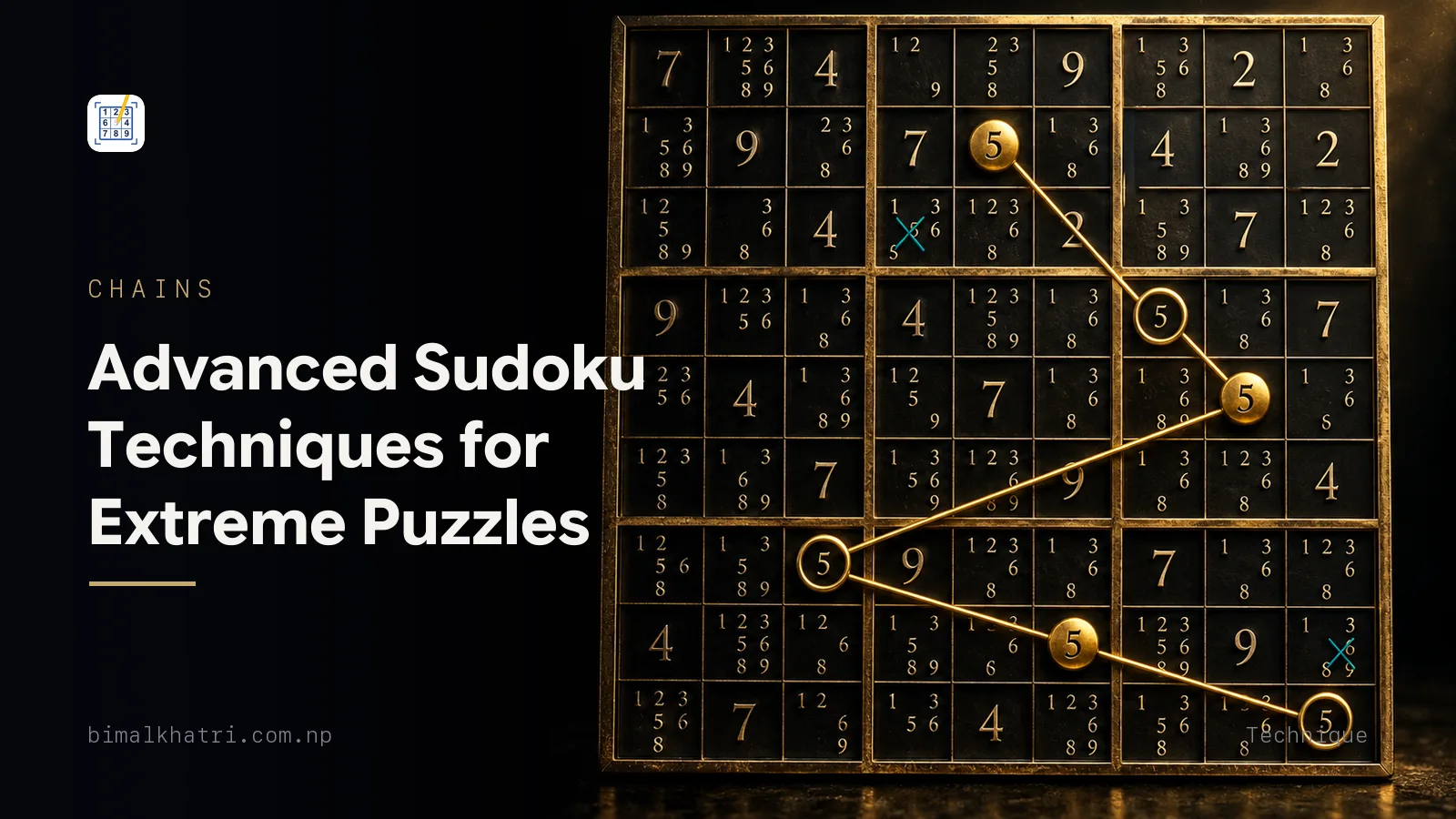
Pick one digit. Find every unit where it has exactly two possible cells. Each of those pairs is a strong link: one of the two cells holds the digit, and you do not know which. Join the links that share a cell and you have a chain.
Now tint the chain alternately, two colours. The colours are the two ways the whole chain can fall, and exactly one of them is true. Two rules follow.
- A colour that repeats in one unit is false. If two cells of the same tint sit in the same row, column or box, that tint would put the digit twice in one unit. Impossible, so every cell of that tint loses the digit, and every cell of the other tint gets it.
- A cell that sees both colours is false. One tint is true, so a cell outside the chain that can see a cell of each cannot hold the digit whichever way the chain falls.
The first rule is the one worth hunting, because it does not just remove candidates. It hands you placements.
The chain, on a grid that has stopped
Singles, subsets and box-line reduction are used up here. Thirty-one cells are still empty.
6...58231
.58213.6.
231....5.
.....1..3
563892174
1..3..6..
..5124386
342.86.1.
81673..42
Take the 5. It is already down at r1c5, r2c2, r3c8, r5c1 and r7c3, so
only four rows still need one. Write out where it can go and nothing else.
| Row | Where the 5 can still go |
|---|---|
| 4 | r4c4, r4c7 |
| 6 | r6c6, r6c9 |
| 8 | r8c4, r8c7, r8c9 |
| 9 | r9c6, r9c7 |
Nine cells. Now collect the units where exactly two of them appear, which is the whole search.
| Unit | The only two homes for the 5 |
|---|---|
| Row 4 | r4c4, r4c7 |
| Row 6 | r6c6, r6c9 |
| Row 9 | r9c6, r9c7 |
| Column 4 | r4c4, r8c4 |
| Column 6 | r6c6, r9c6 |
| Column 9 | r6c9, r8c9 |
| Box 5 | r4c4, r6c6 |
| Box 6 | r4c7, r6c9 |
| Box 8 | r8c4, r9c6 |
Row 8 is not on that list, and neither is column 7 or box 9. Each of those has three homes for the 5, so no cell in them is forced by another and there is no link to draw.
Start at r4c4 and tint it dark. Row 4 makes r4c7 light. Column 4 makes
r8c4 light. Box 5 makes r6c6 light, then row 6 makes r6c9 dark and column
6 makes r9c6 dark, and from r9c6 row 9 makes r9c7 light while column 9
makes r8c9 light. Every link checks out, so the chain is consistent.
| Tint | Cells |
|---|---|
| Dark | r4c4, r6c9, r9c6 |
| Light | r4c7, r6c6, r8c4, r8c9, r9c7 |
Read the light list again. r8c4 and r8c9 are both in row 8. If light were
the true tint, row 8 would hold two 5s, and no grid does that. Light is dead.
That is five candidates gone in one stroke, and better than that: dark is now
proved. Write a 5 into r4c4, r6c9 and r9c6. r6c6 was down to {5,7}, so
it becomes a 7, and the rest of this puzzle falls to singles from there. One
digit, nine cells, no full pencil marks anywhere on the grid.
The skyscraper is the same chain, cut short
Two of those five kills have a shorter name. Rows 4 and 9 each hold exactly two
5s, and both rows use column 7 for one of them: r4c7 and r9c7. The other
ends sit at r4c4 and r9c6, in different columns. That shape is a
skyscraper, and it says any cell seeing both of the non-aligned ends cannot
be a 5. r6c6 sees r4c4 through box 5 and r9c6 down column 6. r8c4 sees
r4c4 down column 4 and r9c6 through box 8. Two eliminations, and on this
particular grid those two are enough on their own.
The two-string kite is the same idea with a row and a column instead of two rows, joined by a box. Both are worth recognising because they are quick. Both are also just short chains, which is why learning the colouring version once is better value than memorising the shapes. If the two-line version reads more easily to you, the X-Wing page is the place to start, and swordfish is the three-line version of it.
The XYZ-Wing
The XY-Wing uses three cells of two candidates each. The XYZ-Wing swaps the middle one for a cell of three, and pays for it with a narrower target.
You need a pivot holding {x,y,z} and two pincers that both see it, one holding
{x,z} and one holding {y,z}. Between the three of them, z has to land
somewhere: if the pivot is not z it is x or y, and whichever it is, the matching
pincer is forced to z. So any cell that sees all three cannot be z. In an
XY-Wing the target only needs to see the two pincers. Here it must see the pivot
too, which is why the pattern usually produces one elimination and not three.
Here is a second extreme grid, again with everything cheap used up.
.23495..7
45721..3.
.91.7.542
16..3.7..
93......1
785..1..3
578.6...4
349152876
216...395
There is no X-Wing on this grid, no XY-Wing, no chain worth colouring and no unique rectangle. Two wings live on it and nothing else does.
| Cell | Candidates | How you get there |
|---|---|---|
r5c7 | {2,4,6} | Row 5 has 9, 3 and 1; column 7 has 5, 7, 8 and 3; box 6 has 7, 1 and 3 |
r5c3 | {2,4} | Column 3 and box 4 between them hold every digit except 2 and 4 |
r6c8 | {2,6} | Row 6, column 8 and box 6 leave nothing else |
r5c8 | {2,5,6,8} | The cell the wing is aimed at |
r5c7 is the pivot with {2,4,6}. r5c3 sees it along row 5 and holds
{2,4}. r6c8 sees it inside box 6 and holds {2,6}. The shared digit is 2.
Walk the three cases. If r5c7 is a 2, done. If r5c7 is a 4, then r5c3 has
to be a 2. If r5c7 is a 6, then r6c8 has to be a 2. One of those three cells
is a 2 in every version of this puzzle.
r5c8 sees all three: r5c7 and r5c3 along row 5, r6c8 down column 8. So
r5c8 is not a 2, and drops to {5,6,8}. Nothing places. The grid sits there
looking exactly as stuck as before, which is the honest experience of this
technique most of the time.
The W-Wing, and why it finishes that grid
Same puzzle, one more look, and this one ends it.
A W-Wing needs two cells holding the same pair {x,y}, not seeing each
other, plus a unit somewhere where x has exactly two homes, with one of those
homes seeing the first cell and the other seeing the second.
On the grid above, r5c3 and r6c5 both hold {2,4}. Different rows, different
columns, different boxes, so they cannot see each other. Now look at row 4:
16..3.7.., with r4c3 on {2,4}, r4c4 on {5,8,9}, r4c6 on {4,8,9},
r4c8 on {2,5,8} and r4c9 on {8,9}. Exactly two cells in that row can be
a 4, r4c3 and r4c6, and one of them is.
That is the whole engine. r4c3 sits above r5c3 in column 3. r4c6 shares
box 5 with r6c5.
- If
r4c3is the 4, thenr5c3cannot be, sor5c3is a 2. - If
r4c6is the 4, thenr6c5cannot be, sor6c5is a 2.
One of r5c3 and r6c5 is a 2, always. Anything seeing both loses the 2, and
r5c5 on {2,4,8} sees r5c3 along row 5 and r6c5 down column 5.
Strike it. Column 5 now has exactly one home left for its 2, which is r6c5, so
r6c5 is a 2. Then r6c8 is a 6, r6c4 is a 9, r6c7 is a 4, r5c7 is a 2,
r5c3 is a 4, and all thirty-one empty cells fill without another technique.
One candidate, removed by two cells that never touch each other.
Two habits make W-Wings findable. Write down which pairs repeat on your grid, since a pair appearing twice feeds this technique and remote pairs both. Remote pairs is the other thing a repeated pair buys you: a run of cells all holding the same two digits, each seeing the next, where the two ends sit an odd number of steps apart and so must differ. Anything seeing both ends loses both digits. Then, for each repeated pair, check its two digits for a unit with only two homes. That is a short list to walk, and tidy pencil marks are what make the repeats visible in the first place.
Uniqueness: the rectangle nobody is allowed to build
This family argues about the setter rather than the grid, and it is worth being straight about that before you use it.
Take four cells that sit at the corners of a rectangle: two rows, two columns,
and exactly two boxes. Suppose all four are down to the same two candidates,
{1,4}. Then the puzzle has two solutions, because you can swap the four
corners diagonally and everything else still fits. A properly made Sudoku has
exactly one solution, so that arrangement cannot happen. Something has to break
it.
The simplest version, type 1: three corners hold the pair and the fourth holds the pair plus extras. The fourth corner has to be one of its extras.
Third grid, again fully stuck under the basics.
546231897
2839576..
719468325
..2.9..78
.98.7.2..
4...82.6.
825749136
...813.52
.3..2..8.
Row 2 is missing only 1 and 4, so r2c8 and r2c9 are both {1,4}. Column 8
has 9, 2, 7, 6, 3, 5 and 8 in it, which leaves r5c8 on {1,4} as well.
r5c9 works out to {1,3,4}.
| Corner | Candidates |
|---|---|
r2c8 | {1,4} |
r2c9 | {1,4} |
r5c8 | {1,4} |
r5c9 | {1,3,4} |
Rows 2 and 5, columns 8 and 9, boxes 3 and 6. If the answer at r5c9 were a 1
or a 4, those four corners would hold nothing but 1s and 4s, and you could swap
them diagonally for a second answer that breaks no rule. This puzzle has one
answer. So r5c9 is the 3, and that is a placement rather than an elimination.
Three more cells follow it, then the grid stops again.
BUG+1 runs on the same logic and is easier to spot than it sounds. If your grid reaches a state where every unsolved cell holds exactly two candidates except one cell holding three, that cell has the answer in it: whichever of its three candidates appears three times in its row, column or box. Two candidates everywhere would mean every digit has two homes in every unit, which is the same deadly symmetry as the rectangle, so the extra candidate is what saves the puzzle from having two solutions.
Now the caveat, which matters more than the technique. Both arguments assume the puzzle was built properly, with exactly one solution. That is safe for a newspaper, a book or a generated app puzzle. It is not safe for a grid you typed in yourself, a photo you scanned and corrected by hand, or a puzzle somebody composed for fun. Those can genuinely have two answers, and against a grid with two answers this whole family argues for a digit that is not there. If you have any doubt about where the puzzle came from, solve it without them.
Forcing chains, and knowing when to stop
When the patterns are dry, the general method is always available: assume, then follow. Pick a cell with two candidates, take one of them as true, and push the consequences through the grid until you either reach a contradiction, which proves the other candidate, or reach the end.
Two rules keep this from wrecking your puzzle.
Write the trial in a different colour or on a copy, so undoing it is one action rather than an archaeology project. And keep the chain to one branch. Following two assumptions at once is where people lose track of what is proved and what is merely assumed, and it is the usual cause of a grid that stops making sense.
Nishio is the narrow version: assume one candidate, and only chase that same digit through the grid. Cheap to run, and it settles single-digit questions quickly.
An honest word about where this sits. A properly made puzzle has exactly one solution, so a move that feels like a guess is either a technique you have not met yet or a mistake further back, but a forcing chain is close enough to guessing that plenty of solvers stop enjoying the puzzle here. Stopping is a real answer, not a failure. Nobody is scoring you on whether you finished by logic you could name. More on that in solving without guessing.
I built Sudoku Master, so here is the honest boundary of what it does with any of this. Nothing on this page is in it. There is no chain finder, no colouring overlay, no move that arrives with a name attached: the solver is a backtracking search and what comes back is a completed grid. Where it helps is smaller. Marks are maintained for you, a tapped digit shows its peers, and the three-mistake limit is a setting rather than a rule, which is what makes running a contradiction test on a screen bearable.
What goes wrong at this level
Colouring from stale marks. The chain rule says a digit has exactly two homes in a unit. Miss one home because you never rubbed the mark out, and you will build a chain that is not there and eliminate a candidate that was true.
Calling three cells a strong link. Two homes, not three. Row 8 in the first grid above has three, and it is the reason there is no link to draw there. Miss that and the colouring becomes nonsense.
Using a uniqueness pattern on a puzzle of unknown origin. The argument is about the setter's promise, not about the digits in front of you.
Aiming an XYZ-Wing like an XY-Wing. The target has to see the pivot as well as both pincers. This is the single most common wrong elimination in the family.
Reaching for a chain on a newspaper puzzle. Very few daily puzzles need anything on this page, and the grade printed above the grid is no guide, because no two papers mean the same thing by it. If yours seems to want a chain, check your last five placements first.
Questions people ask
What is the hardest Sudoku technique?
There is no top of the list, which is the honest answer. Past chains you get forcing nets, almost-locked sets and other machinery that has no natural ceiling. In practice the hardest thing a published puzzle asks of you is a chain, and everything beyond that is solver territory rather than solving.
Do I need any of this for a newspaper Sudoku?
Almost never. Most daily puzzles, including ones marked hard, fall to scanning, singles, subsets and the box-line rules. Papers that go further usually say so. If a daily puzzle appears to need a W-Wing, the likeliest explanation by a wide margin is a wrong digit five moves back.
Is guessing ever necessary?
Not on a properly made puzzle, which has exactly one solution by definition. So a guess is a shortcut rather than a requirement. Two things get mistaken for a forced guess, and both are worth checking before you toss a coin: a puzzle with a genuine error in it, and a technique you have not met yet.
What is the difference between a skyscraper and an X-Wing?
Both use one digit and two lines with two homes each. In an X-Wing all four cells line up in the same two columns, and the digit leaves those columns everywhere else. In a skyscraper only one end lines up, and you eliminate from the cells that see both of the loose ends instead. The skyscraper is the weaker, commoner shape.
Are uniqueness techniques cheating?
They are sound on a puzzle that really has one solution, which is what a publisher is promising you. They are not sound on a grid whose origin you cannot vouch for, including one you typed in or scanned yourself. Some solvers avoid them because the argument is about the setter rather than the numbers, and that is a taste question, not a correctness one.
How do I get faster at spotting these?
Hunt one pattern for a week instead of all of them. Take five extreme puzzles and look only for repeated pairs, or only for digits with two homes in a unit. The patterns become visible in the order you practise them, and a scattered search finds nothing at all.
Do I have to pencil in every candidate first?
For the wings and the rectangles, yes, at least in the region you are searching. Single-digit chains are the exception and that is their great advantage: you need to know where one digit can go, which is a scan rather than a full marking. That is the technique to reach for when your grid is too messy to mark.
How long should an extreme puzzle take?
Longer than you think, and the timer is a poor guide at this level. A grid that needs three advanced moves can absorb an hour, most of it spent looking rather than writing. Times across difficulty bands are collected in how long a Sudoku should take.
Keep reading
- The XY-Wing, explained slowly, the wing to learn before the two on this page
- The X-Wing, with real grids, the single-digit rectangle that the chains generalise
- Swordfish, the three-line fish and the usual next step after the X-Wing
- Hard Sudoku strategy, for choosing between these under time pressure rather than learning them all
- Sudoku, from the rules up, for how all of this fits together
- Solving without guessing, on the line between a contradiction test and a coin flip
Get it: Sudoku Master, free on iPhone and Android. Classic 9x9, 4,000 puzzles, and it works with no signal.