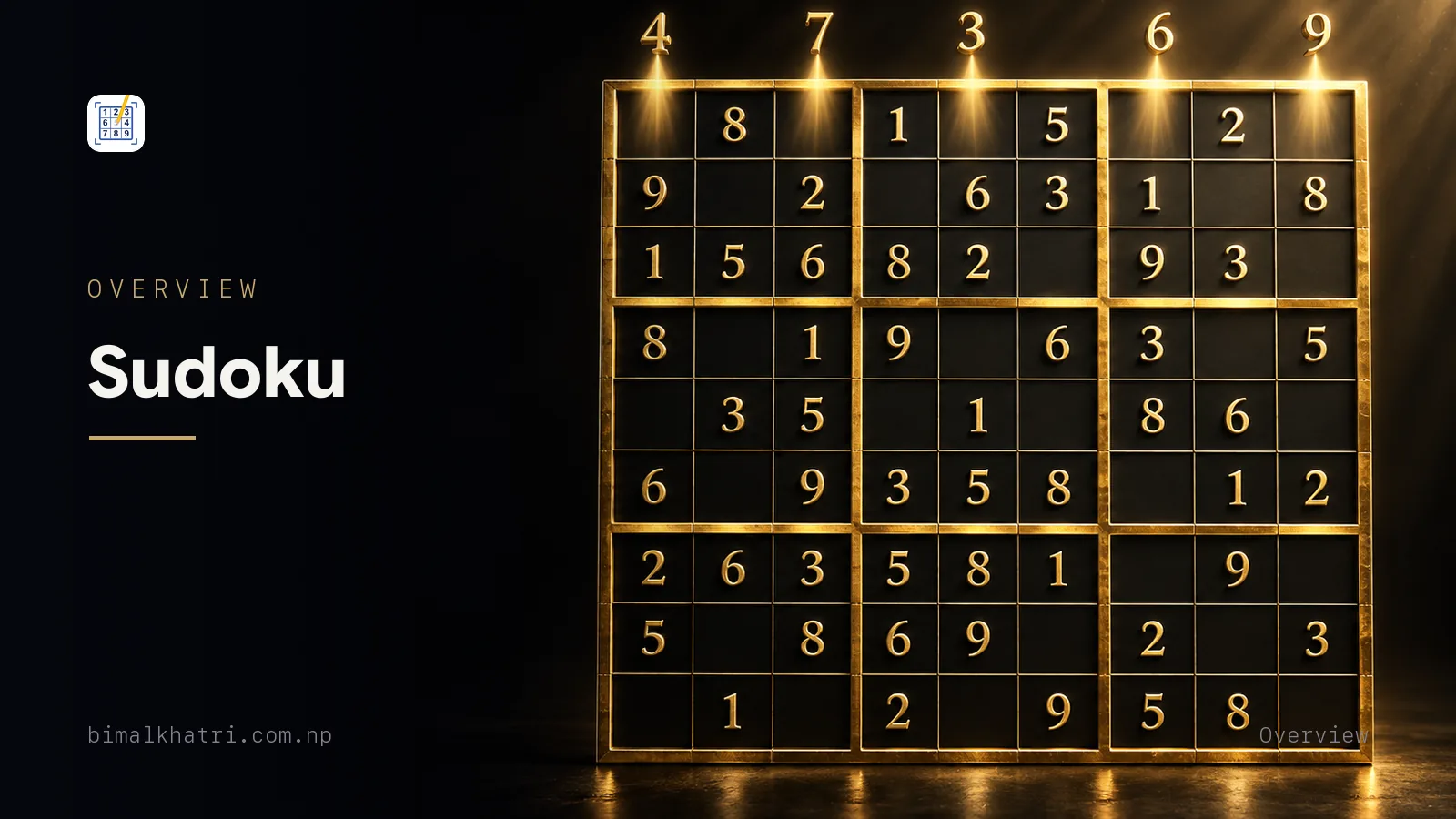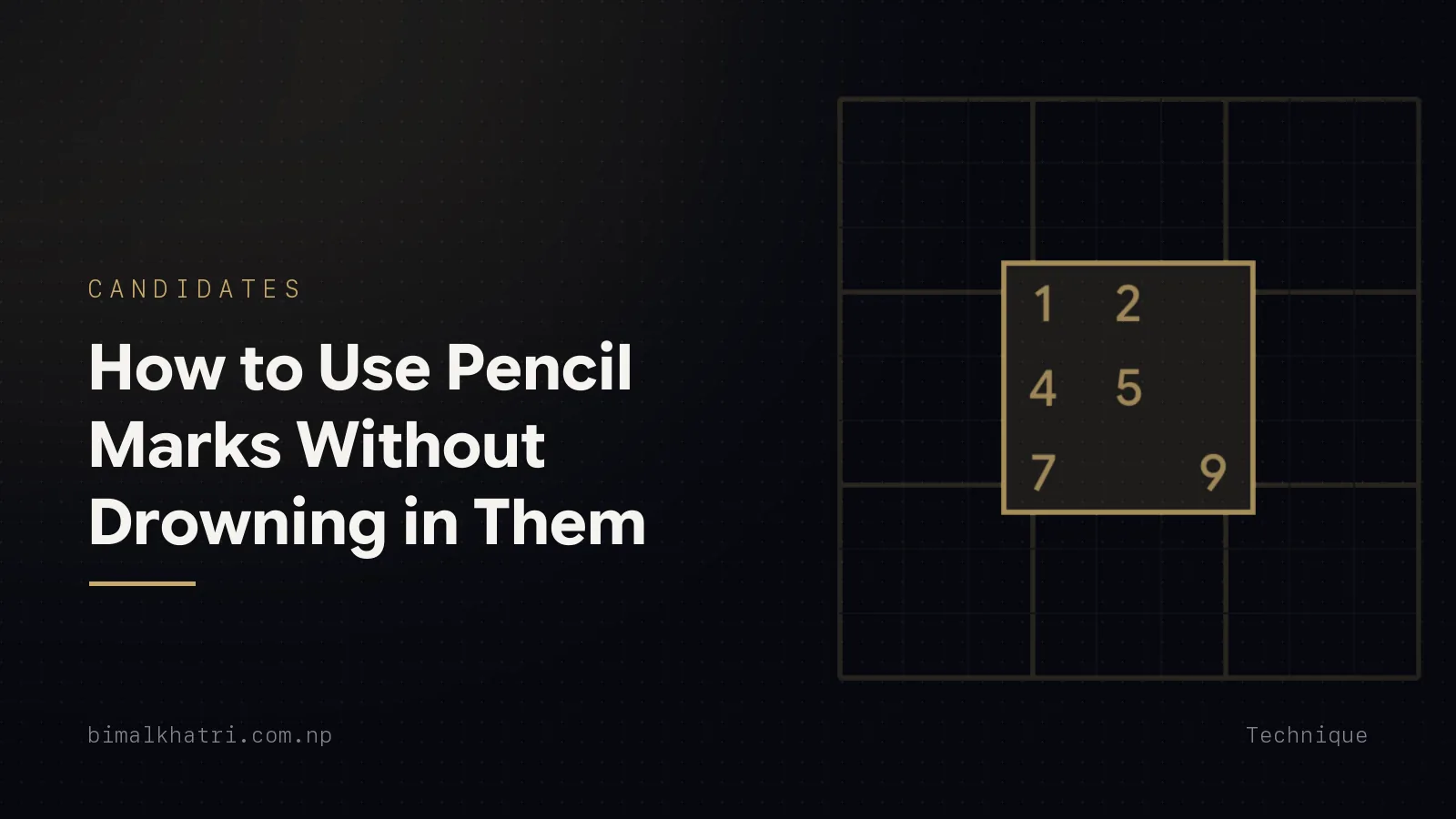
Do not pencil in every candidate before you start. Scan first, place everything the scan hands you, and pick up the pencil only when a full pass through all nine digits places nothing. Then mark one unit at a time, and rub a mark out the second a placement kills it.
That is the whole discipline. The rest of this page is how to write marks so the grid stays readable, which of the four notations to use, and what to look for once they are down.
The trap is not the writing. A full set of marks on a stuck grid runs to about seventy small digits, and every digit you place after that kills several of them. Marks you do not maintain stop describing the puzzle in front of you, and they are convincing while they do it.
On a phone? Sudoku Master keeps the notes and clears the dead ones for you the moment you place a digit, which is the half of this that paper cannot do. Free, four difficulty tiers, and no ads while you solve.
Scan until scanning stops paying
Here is a real puzzle with 26 givens.
7 . . . . 1 . . .
5 . 6 9 . . . . 3
. . 4 . . 7 . . .
. 5 . . . . 9 . .
3 . . . . . 1 . 5
. . . . 1 8 4 . .
. . 9 3 . . . 5 .
2 . . 8 . . . . 4
6 4 5 . . . . . 7
Plain cross-hatching gets 28 digits into that grid without a single pencil mark. Pick a digit, walk it through the boxes, and place it wherever only one cell survives. Then repeat, because each placement reopens the boxes you already looked at. The method is worked through properly in cross-hatching.
Twenty-eight placements later, it stops.
7 . . . . 1 . 4 .
5 . 6 9 . . 7 1 3
1 . 4 . . 7 . . .
4 5 1 7 . 3 9 . 8
3 . . 4 . . 1 7 5
9 . 7 5 1 8 4 3 .
8 7 9 3 . . 2 5 1
2 1 3 8 7 5 6 9 4
6 4 5 1 . . 3 8 7
Twenty-seven cells are still empty. Run the digits 1 to 9 through the boxes one more time and nothing falls out. No cell is down to a single option, and no digit has exactly one home left in any row, column or box. Two clean passes with nothing placed is the signal. From here the next move has to come off the page, which is what pencil marks are for.
Marking earlier than this is the common waste. Those 28 placements fill more than half the empty grid on their own, and every one of them would have been rubbing out marks you had only just written.
What a full set of marks actually costs
Count it on the grid above rather than guessing.
| On this stuck grid | Number |
|---|---|
| Empty cells | 27 |
| Candidate digits in full notation | 70 |
| Cells already down to two candidates | 17 |
| Cells with three candidates | 6 |
| Cells with four | 2 |
| Cells with five | 2 |
| Marks the same grid needs in Snyder notation | 34 |
Seventy small digits into 27 cells. Writing them takes a few minutes. The cost that hurts arrives afterwards, because one placement can kill a mark in twenty different cells at once, and every one of those has to go.
Notice the shape of that table. Ten cells carry three or more candidates and between them account for 36 of the 70 marks. Those ten are the cells you will rewrite most often, and they are the least useful ones to have written, because a cell with five candidates tells you almost nothing today.
Four notations, and when each is right
| Notation | What you write | Best for |
|---|---|---|
| Full notation | Every candidate in every empty cell | A stuck grid you mean to finish with subsets and fish |
| Snyder | Inside each box, only the digits that fit in exactly two cells | Everyday marking, and the default worth learning |
| One digit at a time | Every cell one chosen digit could still take, across the whole grid | An open grid, or hunting a digit that is nearly placed |
| Corner and centre | Corner marks say where a digit can go in a box, centre marks list a cell's own candidates | Screens, which give you both layers for free |
Full notation is complete and slow. Most technique articles assume you are in it, because a swordfish is hard to see any other way. It is the right state for the last twenty cells of an extreme puzzle and the wrong state for a newspaper medium.
Snyder notation marks a digit only where it has exactly two homes inside a box. Everything else stays blank. It is fast, it keeps the grid legible, and the worked example below shows what it buys.
One digit at a time suits a grid that is still open. On the stuck grid
above, the digit 3 fits in only four cells anywhere: r1c2, r1c5, r3c2 and
r3c5. That is four small numbers for the entire puzzle, and it took a minute
to find.
Corner and centre marks are a digital convention that has leaked back onto paper. They are two independent layers, and mixing them up is the usual cause of a solver trusting a mark that meant something else.
Marking one box, two ways
Box 1 is the top left. On the stuck grid it has four empty cells.
Full notation, twelve marks:
r1c2is{2,3,8,9}r1c3is{2,8}r2c2is{2,8}r3c2is{2,3,8,9}
Now read it. r1c3 and r2c2 hold the same two candidates and share a box.
Between them they will use up 2 and 8, in some order, so no other cell in box 1
can have either. Strike them out and r1c2 and r3c2 both become {3,9}. That
is a naked pair, and it cost twelve marks to find.
Snyder notation, four marks. Ask which digits fit in exactly two cells of box 1.
The answer is 3, which fits only in r1c2 and r3c2, and 9, which fits only in
the same two cells. Write those four small digits and stop.
The conclusion is already on the page. Two digits, two cells, so those cells hold 3 and 9 between them and nothing else can live there. That is the hidden pair, which is the same fact as the naked pair read from the other end. Snyder wrote it down directly. Full notation made you find it.
A third of the writing, and the pattern arrives already spotted. That is the argument for Snyder in one box.
Its limit is real and worth stating. Snyder looks inside boxes only, so a pair that lives along a row or a column and straddles two boxes is invisible to it. When Snyder stops producing anything, switch the remaining cells to full notation rather than starting over.
The mark that broke this grid
Look at column 4 on the stuck grid. It has two empty cells, r1c4 and r3c4.
The seven digits already sitting in that column are 1, 3, 4, 5, 7, 8 and 9. So
those two cells hold 2 and 6 between them, and you did not have to mark anything
to know it. A unit with two empty cells is a free pair, every time.
Here is the part that pays. Both cells sit in box 2. So 2 and 6 are spoken for inside box 2, and every other cell in that box loses both.
| Cell in box 2 | Before | After |
|---|---|---|
r1c5 | {2,3,5,6,8} | {3,5,8} |
r2c5 | {2,4,8} | {4,8} |
r2c6 | {2,4} | 4 |
r3c5 | {2,3,5,6,8} | {3,5,8} |
r2c6 has one candidate left. Write the 4 in.
Then the scan restarts on its own. The 4 in r2c6 takes 4 out of column 6, and
r7c6 was {4,6}, so r7c6 is a 6. That fills every cell of row 7 except
r7c5, and row 7 is missing a 4, so r7c5 is the 4. Three digits placed, off
the back of two marks in one column.
That is the honest shape of pencil marks on a hard puzzle. They rarely solve it. They produce one placement, the placement restarts the cheap scanning you were doing before, and you get several cells for the price of one deduction. The patterns that do the producing are covered in naked pairs, triples and quads and hidden pairs and triples.
Keeping the marks alive
Rub out the dead marks in the same second you place the digit. Not at the end of the line of thought, and not when you next look at that region. You know exactly which twenty cells to check while the placement is still in your hand, and five minutes later you will have to work it out again.
The two failure directions are not symmetrical, and this is the part people get backwards.
A mark too many is slow. If a candidate should have gone and you left it there, everything you deduce is still true, because the right answer is somewhere inside the list you kept. Stale marks hide patterns and waste your time. They do not make you write a wrong digit.
A mark too few is fatal. A candidate you never wrote down, or erased by accident, can manufacture a naked single that does not exist. You place a wrong digit with complete confidence, and the grid keeps agreeing with you for a long while afterwards. So when you tidy, remove only what a digit actually on the grid has killed, and never what you think you remember.
I built Sudoku Master, and auto-remove notes is the setting I would turn on first. Place a value and every matching note in that row, column and box goes with it, which is the one piece of bookkeeping a screen genuinely does better than paper. On paper the same job needs an eraser and the habit of using it immediately.
Writing them so you can read them
Fix the position of each digit. Treat every cell as a tiny 3x3 and always write 1 in the top left, 2 top middle, on to 9 in the bottom right. After a few puzzles you read a cell by where the marks sit rather than by squinting at them, and a missing candidate becomes a gap you can see.
Keep marks and answers visibly different. Smaller, lighter, cornered, whatever you like, as long as no glance ever mistakes one for the other. Writing an answer at mark size is how a guess becomes permanent.
Enlarge the grid before you mark a newspaper. Printed cells are sized for one answer, not for four small digits and an eraser afterwards. A photocopy at 150 per cent saves the whole page from turning grey. There is more on printing them usably in printable Sudoku.
Use a pencil you can erase cleanly. Newsprint tears, and a mark you cannot remove properly is a mark you will keep half-reading.
Reading the marks, in order
Once the marks are down, run this list from the top every time. Each step is cheaper than the one below it, and hunting an X-Wing on a grid that still has a naked single in it is wasted effort.
- A cell with one mark. Place it.
- A digit with one home in a unit. Place it.
- Two cells in one unit with the same two marks. Naked pair. Both digits leave the rest of that unit.
- Two digits in one unit that live in the same two cells. Hidden pair. Every other mark in those two cells goes.
- A digit that, inside one box, sits only in one row or column. Pointing pair. It leaves the rest of that line.
- A digit that, inside one line, sits only in the three cells that line shares with a box. Box-line reduction. It leaves the rest of the box.
- Only now, look for X-Wings and the rest.
Steps 1 and 2 are worked through in naked and hidden singles, and steps 5 and 6 in pointing pairs and box-line reduction.
One more habit is worth adding to the list. In any unit, count the homes each digit still has. Marks are cell-shaped, so a solver reads them cell by cell and misses the digit that quietly dropped to two places. Counting by digit is how hidden pairs get found, and it is the reading Snyder notation does for you automatically.
When to rub them all out
Two lines of reasoning that contradict each other mean a mark is wrong somewhere. Do not audit them. Rebuild them.
The digits placed on the grid are the only thing you actually have. Every mark is derived from them, so clearing the lot and re-deriving from scratch takes a few minutes and is far more reliable than hunting one stale 7 through 27 cells. If the rebuilt marks still contradict each other, the error is a placed digit rather than a mark, which is a bigger problem and a different one. That case is covered in why some puzzles feel impossible.
Common mistakes
Marking the whole grid before the scan is finished. Every placement you were about to make rubs out marks you have just written. Scan until two full passes place nothing.
Leaving a mark alive after its digit is placed. The cheapest error to avoid and the most common one to make. Clear the row, the column and the box now.
Erasing a mark you have not proved. The dangerous direction. Only a digit sitting on the grid can kill a candidate.
Writing marks at answer size. In a week you will not remember which of them you meant.
Treating a two-candidate cell as a coin flip. {3,9} is not a fifty-fifty.
It is two candidates you have not finished eliminating, and a proper puzzle will
settle it with logic. The case against guessing is made in full in
solving without guessing.
Marking everything on an easy puzzle. Easy grids are built to fall to scanning. Full notation on one takes longer than the puzzle does and teaches you nothing you will use on a hard grid.
Questions people ask
What is Snyder notation in Sudoku?
Marking a digit only where it has exactly two possible cells inside a box, and leaving everything else blank. A digit with two homes in a box is one step away from being placed, so those are the marks that pay their way. Skipping every other mark is what keeps the grid readable.
What is the difference between corner marks and centre marks?
They answer different questions. A corner mark says where a digit can go inside a box, so it is a note about the digit. A centre mark lists everything a particular cell could still be, so it is a note about the cell. Most apps give you both, and confusing the two is a reliable way to draw a wrong conclusion.
Do expert solvers write pencil marks?
Yes, on hard puzzles. What separates them is how few they write and how fast they clear them. Fast solvers stay on scanning far longer than beginners expect, then mark a small part of the grid rather than all of it.
Can I finish a hard Sudoku without writing anything down?
Sometimes, and it gets harder the further up the difficulty range you go. A grade where the solution needs a naked pair or a pointing pair is asking you to hold several candidate lists in your head at once. Writing them down is not a lesser way to solve. It is the same logic, stored somewhere reliable.
Why do my pencil marks lead to two different answers?
Almost always a stale mark, or a candidate you removed without proof. A properly made puzzle has exactly one solution, so two answers means the marks stopped matching the grid. Clear every mark and rebuild them from the digits you have placed. If the contradiction survives that, one of those placed digits is wrong.
How do I fit nine numbers into one small square?
Usually you do not have to, because a cell with nine candidates has nothing to tell you yet. On the grid worked through above, the busiest cell holds five. If you genuinely need full notation on a newspaper puzzle, photocopy it larger first.
Do notes in an app work the same as pencil marks on paper?
The logic is identical and the bookkeeping is not. An app can delete every note a placement kills, which is the job people fail at on paper, and it will not let you smudge one. What you lose is the freedom to invent your own shorthand, since you get whatever note layers the app offers.
What does it mean if a cell has no candidates left?
You have made a mistake earlier in the grid. Every empty cell in a valid position has at least one legal digit, so an empty candidate list is proof that a placed digit is wrong. Rebuild the marks first, since a badly maintained set can fake it. If the cell is still empty after a clean rebuild, work back through your recent placements.
Keep reading
- Naked and hidden singles, with worked grids, the two things you look for first once the marks are down
- Naked pairs, triples and quads, the first real pattern pencil marks buy you
- Hidden pairs and triples, the same fact read from the other end, and what Snyder notation finds directly
- Cross-hatching and scanning, the work to finish before you write a single mark
- Stuck on a Sudoku?, the checklist to run when the marks are down and nothing is moving
- Sudoku: the complete guide, the short version of everything in the series
Get it: Sudoku Master, free on iPhone and Android. The link sends you to whichever store your phone uses.