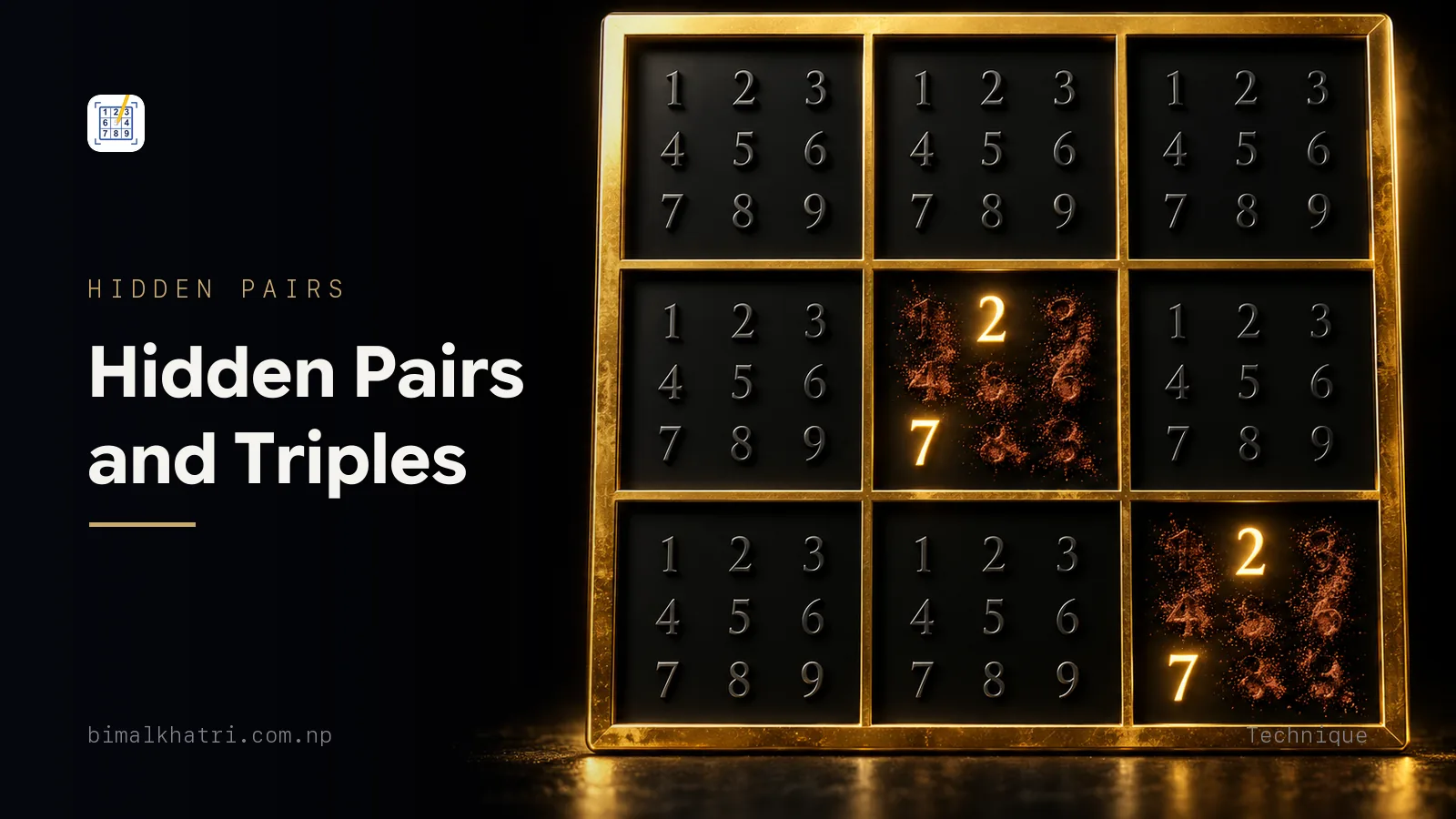
A hidden pair is two digits that fit in only the same two cells of one row, column or box. Those two cells are spoken for, so every other candidate written in them is dead. Each cell can be carrying six pencil marks and still be half of a hidden pair, which is the whole reason nobody sees it.
A hidden triple is the same sentence with three digits and three cells. The three digits do not each need to fit in all three cells. They only need to have nowhere else in the unit to go.
So the technique is easy and the looking is hard. A hidden subset is invisible from inside a cell. You find it by asking where each digit can still go in a unit, then noticing that two digits gave the same answer.
Counting digits on a phone? Sudoku Master rubs out the notes a placement kills, which is the one piece of bookkeeping this technique cannot survive you getting wrong. Free, 4,000 graded puzzles, and no ads while you solve.
What the pair is actually claiming
A unit holds nine cells and nine digits, one of each. Nothing else fits.
Say the 1 and the 6 in one box can only land in r4c6 or r5c5. Two digits,
two cells, and each digit has to go somewhere. One of those cells takes the 1
and the other takes the 6. There is no third arrangement and no room left over.
Whatever else you had pencilled into those two cells is now impossible.
Read the direction carefully, because half the wrong eliminations in this technique come from getting it backwards.
- A naked pair removes its two digits from the other cells of the unit.
- A hidden pair removes the other digits from its own two cells.
The hidden pair gives you nothing outside those two cells, and it never could. The digits already had nowhere else to go. That was the finding.
A hidden pair, worked
Here is a hard grid with the singles used up. No cell has one candidate left and no digit has one home in any unit, so scanning is finished and the grid has stopped moving.
. 8 3 . . 5 9 4 .
. . . 4 . . . 2 .
. 2 . . . . . 6 3
. . . . 4 . . . .
. 4 . . . 8 . . .
2 6 . . . . 1 8 4
. . . 1 . . 2 3 5
. . 2 8 5 . . 1 .
. 5 1 6 . . . . 8
Look at box 5, the middle box. Two digits are already down, the 4 at r4c5 and
the 8 at r5c6, so seven cells are empty and seven digits are missing: 1, 2, 3,
5, 6, 7 and 9.
| Cell | Candidates |
|---|---|
r4c4 | {2,3,5,7,9} |
r4c6 | {1,2,3,6,7,9} |
r5c4 | {2,3,5,7,9} |
r5c5 | {1,2,3,6,7,9} |
r6c4 | {3,5,7,9} |
r6c5 | {3,7,9} |
r6c6 | {3,7,9} |
Nothing there looks like a pair. Two cells hold six candidates each. Now stop reading the cells and count the digits instead.
| Missing digit | Cells in box 5 that can still take it |
|---|---|
| 1 | r4c6, r5c5 |
| 2 | r4c4, r4c6, r5c4, r5c5 |
| 3 | all seven |
| 5 | r4c4, r5c4, r6c4 |
| 6 | r4c6, r5c5 |
| 7 | all seven |
| 9 | all seven |
The 1 and the 6 name the same two cells. That is a hidden pair, and you can check both confinements against the printed grid in about ten seconds.
The 1. There is a 1 at r7c4, which kills the whole of column 4 inside the
box: r4c4, r5c4 and r6c4 are out. There is a 1 at r6c7, which kills the
rest of row 6: r6c5 and r6c6 are out. Five cells gone, two left.
The 6. There is a 6 at r9c4, so column 4 is out again. There is a 6 at
r6c2, so row 6 is out again. The same two cells survive.
Between them r4c6 and r5c5 must hold the 1 and the 6. So the 2, the 3, the 7
and the 9 come out of both.
| Cell | Before | After |
|---|---|---|
r4c6 | {1,2,3,6,7,9} | {1,6} |
r5c5 | {1,2,3,6,7,9} | {1,6} |
Eight candidates gone from one look, and one of them pays immediately. Column 6
had exactly two homes for its 2: r4c6 and r9c6. The 2 has just left r4c6.
So r9c6 is a 2, and you have a digit on the board from a technique that never
looked at row 9 at all.
Why you could not see it from inside the cell
Naked and hidden subsets are the same fact read from opposite ends. A naked subset says these cells own these digits. A hidden subset says these digits own these cells.
| Naked pair | Hidden pair | |
|---|---|---|
| What you look at | Two cells | Two digits |
| The test | Both cells hold only the same two candidates | Both digits fit in only the same two cells |
| What it removes | Those two digits, from the rest of the unit | Every other candidate, from those two cells |
| How it looks on paper | Obvious. Two short lists that match | Invisible. The cells can be the fullest in the unit |
Now the part that explains why the technique exists at all. In a unit with n
empty cells, a hidden subset of k digits is the same fact as a naked subset of
the other n - k cells. They are complements, and only one of them is worth
hunting.
Box 5 above had seven empty cells. The hidden pair on two of them is the exact
complement of a naked subset across the other five: r4c4, r5c4, r6c4,
r6c5 and r6c6 between them hold {2,3,5,7,9} and nothing else. Five cells,
five digits, a perfectly valid deduction, and a shape no human is going to spot
on a Tuesday morning. The two-digit version says the same thing and takes a
count of two.
That gives you a rule for when hidden subsets are worth your time. Hunt them when the subset is smaller than its complement, which means a unit with more empty cells than twice the subset size.
| Empty cells in the unit | Hidden pair is worth hunting | Hidden triple is worth hunting |
|---|---|---|
| 4 | No. Its complement is a naked pair, easier to see | No |
| 5 | Yes | No. Its complement is a naked pair |
| 6 | Yes | No. Its complement is a naked triple, a coin flip |
| 7 or more | Yes | Yes |
Which is why a wide open unit is the right place to look, and a nearly finished one is not. Most solvers do the opposite by instinct.
How to hunt them
Pick one unit and answer one question for each digit still missing from it: where can this digit go? You are building the digit table above, and you can do it in your head for six or seven digits.
Then read the answers, not the cells.
- Cross off any digit with three or more homes. It cannot be in a pair.
- Note every digit with exactly two homes.
- Two of those naming the identical pair of cells is a hidden pair.
- For a triple, take three digits with two or three homes each and pool their cells. If the pool has exactly three cells, it is a hidden triple.
Step 4 is the only fiddly one, and there is a shortcut: a digit with three homes can only join a triple whose three cells are exactly its three. Start from that digit and you have already fixed the shape.
Two habits make the sweep pay. Mark the digits that fit in exactly two cells of a box as you scan, which is what Snyder notation is for, and hidden pairs then fall out of notes you were writing anyway. That method is in how to use pencil marks. And sweep the units where you have just placed something, because a placement is what turns a digit with three homes into a digit with two.
One warning about the sweep. To say "this digit fits in only these two cells" you must have checked every empty cell in the unit, not only the ones you had already pencilled. A half-marked grid produces confident hidden pairs that are not true, and there is no way to tell from the marks themselves.
A hidden triple, worked
Same idea, one digit wider, and the payoff is bigger because you are clearing three cells rather than two. Another hard grid with the singles exhausted.
2 . . . . 6 . . .
3 . 8 2 4 . . . 6
4 7 6 3 . 8 . . .
5 . . 4 6 . . . .
. . . . . 2 . . 4
. 4 2 . . 3 1 . 5
. . 4 6 2 . 8 . .
9 2 . 8 3 . . . 7
. . . . . . . 1 .
Row 1 has the 2 at r1c1 and the 6 at r1c6. Seven cells empty, seven digits
missing: 1, 3, 4, 5, 7, 8 and 9.
| Cell | Candidates |
|---|---|
r1c2 | {1,5,9} |
r1c3 | {1,5,9} |
r1c4 | {1,5,7,9} |
r1c5 | {1,5,7,9} |
r1c7 | {3,4,5,7,9} |
r1c8 | {3,4,5,7,8,9} |
r1c9 | {1,3,8,9} |
Count the digits again.
| Missing digit | Cells in row 1 that can still take it |
|---|---|
| 1 | r1c2, r1c3, r1c4, r1c5, r1c9 |
| 3 | r1c7, r1c8, r1c9 |
| 4 | r1c7, r1c8 |
| 5 | six cells |
| 7 | r1c4, r1c5, r1c7, r1c8 |
| 8 | r1c8, r1c9 |
| 9 | seven cells |
Take the 3, the 4 and the 8. Pool their cells: r1c7, r1c8, r1c9, and that
is all of them. Three digits, three cells, so those three cells hold the 3, the
4 and the 8 in some order. Everything else in them goes.
| Cell | Before | After |
|---|---|---|
r1c7 | {3,4,5,7,9} | {3,4} |
r1c8 | {3,4,5,7,8,9} | {3,4,8} |
r1c9 | {1,3,8,9} | {3,8} |
Eight candidates removed, and again one of them pays at once. Column 9 had two
homes for its 1, r1c9 and r3c9. The 1 has just left r1c9, so r3c9 is a
1.
Notice the shape of that triple, because it is the normal one. The 4 fits in only two of the three cells and the 8 fits in only two, and neither cell holds all three digits. A hidden triple does not need any cell to carry the full set. It needs the three digits to have three homes between them.
The complement here is a naked quad. Row 1 had seven empty cells, so the hidden
triple on three of them mirrors a four-cell naked subset: r1c2, r1c3, r1c4
and r1c5 share {1,5,7,9} and nothing else. That deduction is equally true
and nobody finds it. Three digits are easier to count than four cells are to
compare.
The mistake that breaks the grid
There is one wrong move here and it is expensive, because it removes a candidate that was correct and the puzzle then stops making sense twenty moves later.
Look again at row 1 above. The 4 has two homes, r1c7 and r1c8. The 8 has two
homes, r1c8 and r1c9. Two digits, two homes each, and it is tempting.
It is not a pair. Pool the cells and you get three, not two. If you called it a
pair on r1c7 and r1c8 you would strike the 3 out of r1c7, and the answer
to this puzzle has a 3 in r1c7. The grid would not complain for a long time.
So the test is the pool, never the count. Two digits with two homes each make a hidden pair only when the two homes are the identical two cells. Three digits make a triple only when their cells pool to exactly three.
Two smaller traps worth naming.
Stale pencil marks. Every row of the digit table above is a claim that a digit has nowhere else to go. A mark left standing after its digit was placed adds a home that does not exist, and the error runs one way: it invents pairs rather than hiding them. Clear the marks around a placement before you build the table, not after.
Confusing it with a pointing pair. They sound alike and do different jobs. A pointing pair is one digit inside a box confined to a single row or column, which lets you delete that digit from the rest of the line. A hidden pair is two digits inside any unit confined to two cells. One digit and a line versus two digits and two cells. The line version is worked through in pointing pairs and box-line reduction.
Where this sits, and how far to take it
Hidden pairs and triples come one rung above naked pairs and triples on the usual ladder, and one rung below the box and line techniques. That order is about how hard the pattern is to see, not how hard the logic is. The logic is a counting argument either way.
Hidden quads exist. They are rarely worth hunting, and the complement rule says why: a quad only beats its complement in a unit with nine empty cells, which means an untouched unit, and in an untouched unit you have better things to do. The same reasoning caps the family. Pairs and triples are where the return is.
Two honest notes on when you will meet one. Plenty of puzzles graded hard never need a hidden subset at all: something cheaper reaches the same cell first, and you never notice the pair you walked past. And a fat candidate list has nothing to do with how few clues were printed. A 32-clue grid can be the one that makes you count digits, because what grades a puzzle is the hardest move it forces, not how much of it was filled in for you.
I built Sudoku Master, and the solver in it is a backtracking routine. Ask it and you get the answer, which settles an argument and teaches nothing, and it will never point at the two cells you should have counted. Where the app earns its place on a technique like this one is smaller and duller: the notes are rubbed out for you when a placement kills them, so the digit tables you build are read off marks that still describe the board in front of you.
Questions people ask
Is a hidden double the same thing as a hidden pair?
Yes. Double, pair and locked set are three names for the same idea, and which one you meet depends on which book or app you learned from. Hidden double and hidden pair are interchangeable. The technique is the same either way: two digits, two cells, everything else in those cells goes.
Should I look for naked pairs or hidden pairs first?
Naked pairs, always. They are visible in the candidate lists you already have, so they cost nothing to find. Turn to hidden subsets when the naked sweep is dry, and start with the units that still have five or more empty cells.
Do I have to write in every candidate first?
For the cells of the unit you are searching, yes. A hidden pair is a claim that a digit has nowhere else to go in that unit, and you cannot make that claim from a partly marked row. You do not need the whole grid marked, though. One unit at a time is enough, and that is the cheap way to do it on paper.
Can a hidden pair be in a row and a box at the same time?
Yes, when both cells sit in the same box, and it is worth checking both. The two cells being confined in the row does not automatically confine them in the box, because the box contains six cells the row does not. If the pair holds in both, the eliminations are the same ones. The value is that a pair holding in the box often shows up before the row is anywhere near finished.
How often do hard puzzles actually need one?
Less often than the technique lists suggest. Most puzzles graded hard fall to scanning, singles, naked subsets and the box and line rules. Hidden subsets earn their place on grids where the candidate lists have gone fat, which tends to be the extreme end rather than the middle.
Why did my hidden pair break the puzzle?
Almost always one of two things. Either the digits had two homes each but not the same two homes, so it was never a pair, or the pencil marks it was read from were out of date and a digit had a home you had stopped writing down. Rebuild the candidates for that one unit from the placed digits and the pair either survives or was never there.
What is a hidden quad, and should I learn it?
Four digits confined to four cells of one unit, clearing every other candidate from those four. It is legal and it is real, and it is also the point where finding the pattern costs more than the eliminations return. Learn pairs, learn triples, then spend the effort on the box and line techniques instead.
Keep reading
- Naked pairs, triples and quads, the other half of the subset family and the sweep to run before this one
- How to use pencil marks, because a hidden subset is only as trustworthy as the notes you read it from
- Naked and hidden singles, the one-digit version of the same look, and the move to exhaust first
- Pointing pairs and box-line reduction, the technique most often mistaken for this one
- Every Sudoku technique in order, if you want to know what comes next when hidden subsets run out
- Sudoku, from the rules up, the whole series in one page, if you want the map before the detail
Get it: Sudoku Master, free on iPhone and Android. Classic 9x9, four graded tiers, and nothing to sign up for.