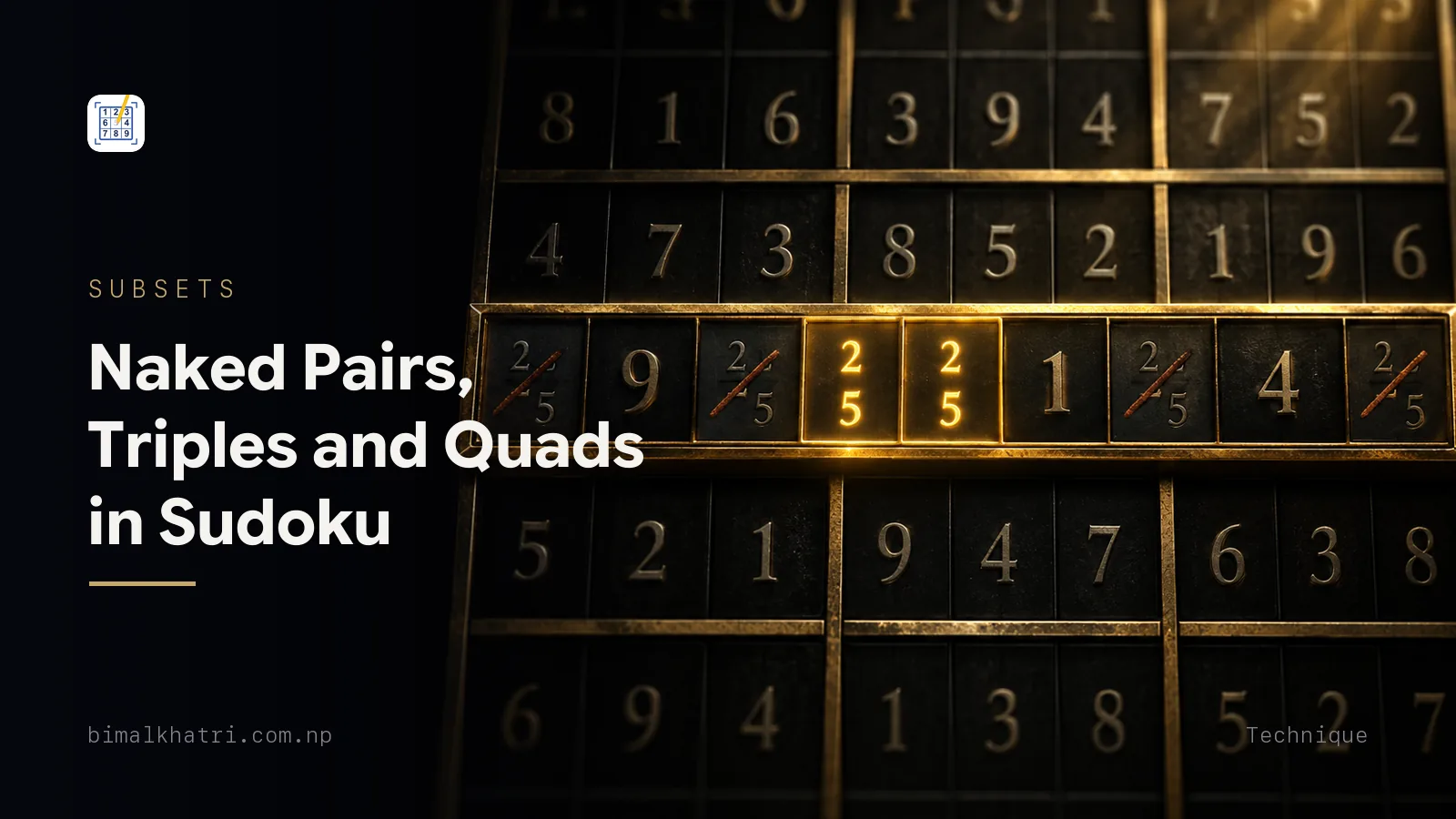
A naked pair is two cells in the same row, column or box holding the same two candidates and nothing else. Between them they will use both of those digits, so both digits come out of every other cell in that unit.
Triples and quads are the same move with more cells. Three cells that hold three digits between them own those three digits. Four cells holding four digits own those four. Nothing else in the unit can have any of them.
That is the whole family, and it is the cheapest source of eliminations in a hard puzzle. The logic takes four seconds. The finding is the work.
On your phone? Sudoku Master grades its 4,000 puzzles in four tiers, and the hard and extreme ones are where subsets stop being optional. Free, and no ads while you solve.
The one rule underneath all of them
Take any unit: a row, a column or a box. If n cells in that unit hold exactly n different candidates between them, those n cells will use up those n digits. Every other cell in the unit loses all of them.
- n of 1 is a naked single. One cell, one candidate, write it in.
- n of 2 is a naked pair.
- n of 3 is a naked triple, n of 4 a naked quad.
Three things trip people up on the first reading.
The cells do not need matching candidate lists. Only the pair looks like
twins. A triple is three cells whose candidates, added up, come to three digits.
{2,5}, {5,9} and {2,9} is a good triple on 2, 5 and 9, and not one of those
cells holds all three.
You never learn which cell gets which digit. A naked pair on 4 and 7 places nothing. It says only that the 4 and the 7 of that unit live in those two cells. Every gain is somewhere else in the unit.
Naked means you found it by looking at cells. You read the candidate lists and the answer was sitting in them. A hidden pair is the same fact approached from the unit instead, and it hides behind extra candidates in the cells that carry it.
The grid these examples use
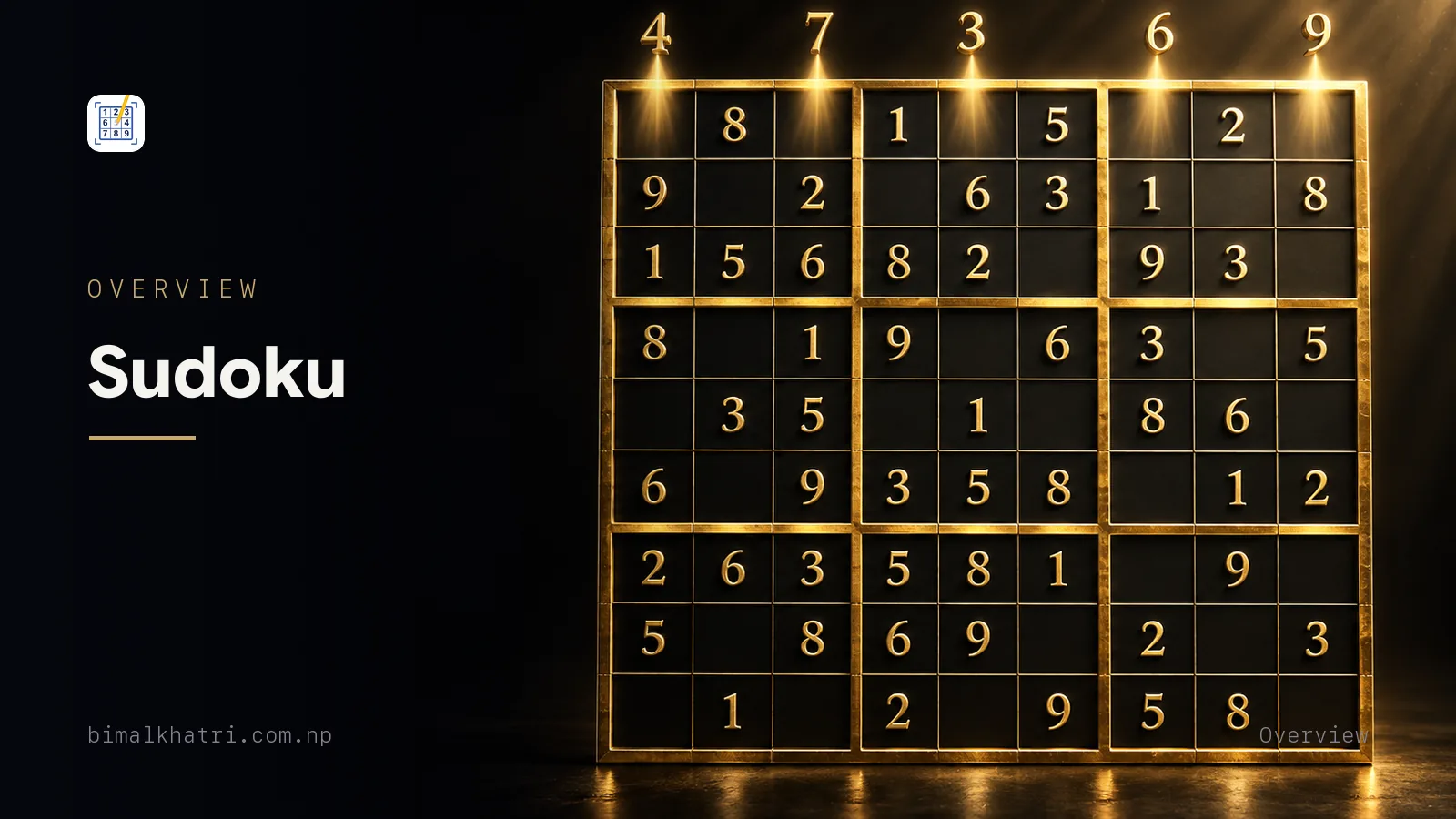
Here is an ordinary 30-clue puzzle. Nothing exotic about it.
. . 9 . . . 4 1 .
4 . . . 6 . . 2 8
. . 1 . . . 7 . 6
. 9 . 5 . 7 . . .
. . . . . 9 . . 7
. . . 3 2 6 1 5 9
. 2 . . . 8 5 . .
. . . . 3 . . 8 .
6 5 . . 1 2 . . .
Scanning and singles take it a long way. Then they stop, here:
. 6 9 . 7 3 4 1 5
4 7 5 9 6 1 3 2 8
. . 1 . 5 4 7 9 6
1 9 . 5 . 7 . . .
5 . . 1 . 9 . . 7
. . . 3 2 6 1 5 9
. 2 . . 9 8 5 . 1
9 1 . . 3 5 . 8 .
6 5 8 . 1 2 9 . .
Twenty-nine cells empty, and there is no naked single and no hidden single left anywhere in the grid. This is the position where a lot of people decide the puzzle is unfair and start guessing. Two subsets finish it.
A naked pair in column 3
Column 3, read top to bottom, with the candidates for the empty cells:
r1c3is 9r2c3is 5r3c3is 1r4c3is{2,3,4,6}r5c3is{2,3,4,6}r6c3is{4,7}r7c3is{3,4,7}r8c3is{4,7}r9c3is 8
r6c3 and r8c3 both read {4,7}. One of them is the 4 and the other is the 7.
Which is which stays unknown, and it does not matter. Column 3 has exactly one 4
and one 7, and both are now spoken for.
So sweep the rest of the column:
r4c3{2,3,4,6}loses the 4 and becomes{2,3,6}r5c3{2,3,4,6}loses the 4 and becomes{2,3,6}r7c3{3,4,7}loses both and becomes{3}
r7c3 is a 3. Place it.
Notice what this pair is not. r6c3 sits in box 4 and r8c3 sits in box 7, so
they share only the column. The box gets nothing out of it. A pair pays out once
per unit both cells belong to, and these two belong to one.
A naked triple in box 4
Box 4 is the middle-left block, rows 4 to 6 and columns 1 to 3. After that 3 goes
into r7c3, its empty cells read:
r4c3is{2,4,6}r5c2is{3,4,8}r5c3is{2,4,6}r6c1is{7,8}r6c2is{4,8}r6c3is{4,7}
Look at the bottom three. {7,8}, {4,8}, {4,7}. Three cells, two candidates
each, and between them exactly three digits: 4, 7 and 8. No cell holds all three,
which is why this shape is the one people walk past.
Work it through if you want to see it bite. Say r6c1 is the 7. Then r6c3 has
to be the 4, which forces r6c2 to be the 8. Say instead r6c1 is the 8. Then
r6c2 is the 4 and r6c3 is the 7. Both branches spend the 4, the 7 and the 8
of box 4 on those three cells, so:
r4c3{2,4,6}becomes{2,6}r5c2{3,4,8}becomes{3}r5c3{2,4,6}becomes{2,6}
r5c2 is a 3. And the two cells left over now read {2,6} and {2,6}, which is
a fresh naked pair sitting in the same box and the same column.
From those two placements the puzzle falls over. Ordinary singles finish every remaining cell with no further technique. One pair and one triple were the entire difference between stuck and solved, which is the honest reason to learn them before anything with a fish in its name.
The three shapes a triple comes in
A triple needs three cells, three digits, and every cell a subset of those three. That allows exactly three arrangements, and they are not equally easy to see.
| Shape | Candidates | How it reads |
|---|---|---|
| Three full sets | {4,7,8}, {4,7,8}, {4,7,8} | Obvious. Also the rarest of the three |
| Mixed | {4,7,8}, {4,8}, {4,7} | Common. The full cell gives the game away |
| Three pairs | {7,8}, {4,8}, {4,7} | The one you miss. Nothing on the page contains three digits |
The third row is the box 4 example above. When a triple hides as three pairs, the number three appears nowhere in your notes. You have to take the union yourself. That habit, taking the union of three short lists in one unit, is most of what separates a solver who finds triples from one who does not.
Quads have five shapes and the same warning applies twice as hard.
A pair that works in two units at once
Two cells can share a row and a box, or a column and a box. When that happens the same pair pays twice. Here is a different puzzle, again stuck after the singles:
5 . . . 7 . 3 8 .
. 4 . 8 5 3 6 2 .
. . 3 9 . 1 . 5 .
3 1 8 . . . 5 . 2
. 5 2 3 1 . 8 4 6
4 . . 2 8 5 . 1 3
. . 5 1 . . . 3 .
1 3 4 . . 8 2 . 5
2 7 9 5 3 4 1 6 8
r3c7 is {4,7} and r3c9 is {4,7}. Both sit in row 3, and both sit in box 3,
the top-right block. So run the eliminations twice.
Box 3 first. Its other empty cells are r1c9 {1,4,9} and r2c9 {1,7,9}. The
first loses the 4, the second loses the 7. Both come out as {1,9}.
Now row 3. Its other empty cells are r3c1 {6,7,8}, r3c2 {2,6,8} and r3c5
{2,4,6}. The 7 leaves r3c1, giving {6,8}. The 4 leaves r3c5, giving
{2,6}. The middle one held neither digit, so it is untouched.
Four eliminations from one pair, and then a bonus. r1c9 and r2c9 both read
{1,9} now, which is a new naked pair in column 9. It knocks the 9 out of
r7c9 {4,7,9}, leaving {4,7}.
That is the pattern worth internalising. Subsets breed. Every elimination shortens a candidate list, and short candidate lists are what pairs are made of, so the unit you just worked is the first place to look again.
Naked quads, and why you rarely need one
Quads are real and they are uncommon in practice. Here is one, in column 9 of a hard puzzle after the singles dried up:
r1c9is{1,5,6,7,8}r2c9is{2,5,8}r3c9is{7,8}r4c9is{5,7,8,9}r5c9is{5,7,8}r6c9is 3r7c9is 4r8c9is{1,2,6,7,9}r9c9is{5,7,9}
Four cells, r3c9, r4c9, r5c9 and r9c9, hold {5,7,8,9} between them and
nothing outside it. So 5, 7, 8 and 9 leave the rest of the column:
r1c9{1,5,6,7,8}becomes{1,6}r2c9{2,5,8}becomes{2}r8c9{1,2,6,7,9}becomes{1,2,6}
r2c9 is a 2.
Now the reason quads stay rare. Count the empty cells in that column: seven. The
quad covers four of them, which leaves three, and the digits nobody else can use
are 1, 2 and 6. Check them and they appear only in r1c9, r2c9 and r8c9.
That is a hidden triple, and it says exactly the same thing.
That pairing is not a coincidence. Every naked subset has a hidden twin covering the cells it leaves behind, and the smaller of the two is the one a person actually spots. A quad is nearly always the larger half. So when you find one, something easier was sitting in the same unit the whole time. The arithmetic, and a table of which half to hunt in which unit, is in hidden pairs and triples.
How to find them without staring
- Start with the emptiest-looking unit that has the fewest blanks. A unit with four or five empty cells is where a subset does the most damage per second of searching.
- Collect the two-candidate cells. They are the raw material for every pair and most triples. On paper, some solvers circle them.
- For a suspected pair, say the two digits and sweep. "Four and seven" while your finger runs down the column is faster than reading every list twice.
- For triples, take unions in threes. Pick three short lists in one unit and add them up. If the total is three digits, you have it. If a cell holds a digit outside the set, drop it and try the next cell.
- Re-check the unit you just changed. Every elimination can create the next subset, as it did in both examples above.
- Fix your notes first. All of this runs on pencil marks, and a stale mark turns a valid triple into a wrong deduction. There is more on keeping them honest in how to use pencil marks.
Where these go wrong
Deleting the digits from the pair itself. The pair cells keep both candidates. They are the reason for the eliminations, not a target of them. This is the single most common way people break a grid with a technique they understood correctly.
Cells that are not in one unit. r2c4 and r5c7 can read {3,8} all day
and mean nothing to each other. They share no row, no column and no box. A subset
lives inside a unit or it does not exist.
Counting a cell whose candidates leave the set. {4,7}, {4,7} and {2,9}
is not a triple. Three cells, but four digits between them. The union has to come
out at exactly the number of cells.
Believing a pair that did nothing. More on that in a second, because it is worth its own paragraph.
When a naked pair does nothing
Go back to the first grid. Row 1 reads . 6 9 . 7 3 4 1 5, and its two empty
cells are r1c1 {2,8} and r1c4 {2,8}. That is a textbook naked pair, and it
is worth nothing at all. The other seven cells of row 1 are already filled, so
there is nothing to remove.
Two empty cells in a unit always show the same two candidates. It is not a discovery, it is arithmetic. The same goes for three empty cells and three digits, which is a triple that tells you nothing.
A subset is worth exactly as much as the unit around it is crowded. A pair in a row with seven blanks can strip a dozen candidates. A pair in a row with two blanks is a restatement of what you already knew. Check the size of the prize before you spend a minute on the search.
I built Sudoku Master because the puzzles I wanted were printed on paper I had no way to check. It ships 4,000 classic puzzles graded easy to extreme, and its notes behave the way this technique needs: turn on the auto-remove setting and placing a digit clears the notes it kills, which is the bookkeeping that quietly ruins hand-solved grids. One limit, stated plainly. Its solver runs a backtracking search and returns the finished grid. It will not tell you that a naked triple in box 4 was the move.
Questions people ask
Naked pair or hidden pair: how do I tell them apart?
A naked pair is two cells that hold only two candidates. A hidden pair is two digits that fit in only two cells of a unit, while those cells also carry other candidates. Naked is a fact about cells, hidden is a fact about digits. In a unit with four empty cells they are the same discovery seen from either end.
Does a naked pair have to be in the same box?
No. It has to be in the same unit, and a row or a column counts. The column 3 example above spans two different boxes and works fine. What matters is that both cells sit in one row, one column or one box, because that is what guarantees the two digits are used up.
Why did my naked pair not remove anything?
Usually the unit had nothing left to remove, as in the row 1 case above. Two empty cells in a unit always match, so that pair is free and useless. The other possibility is that the two digits simply do not appear in any other candidate list in that unit, which happens and costs you nothing but the look.
Why is a pointing pair not a naked pair?
Because it is about a digit, not about cells. Everything on this page starts by reading candidate lists and finding cells that match. A pointing pair starts by picking one digit and asking where in a box it can still live, and the two cells it lands on may share nothing else at all. Same word, different search, different payout: pointing pairs and box-line reduction has it worked out.
Do I need full pencil marks to find naked pairs?
For pairs, no. Marking only the cells with two obvious candidates finds most of them, and many solvers never write more than that. For triples in the three-pairs shape, you do need the candidates written down, because the deduction is a union of three lists and no one holds three lists in their head reliably.
What is a locked set?
The formal name for all of this. A locked set is n cells in one unit holding exactly n candidates between them, which is the definition at the top of this page. Naked pair, naked triple and naked quad are the cases where n is 2, 3 and 4. Some solving software reports them under the locked-set label instead.
Should I look for naked or hidden subsets first?
Naked, because they are easier to see and they need less bookkeeping. Scan for cells with two candidates before you start counting where each digit can go. If the naked search comes up empty in a unit, switch and count digits, which is the hidden search. The full technique order puts both in their place on the ladder.
Keep reading
- Hidden pairs and triples, the same logic read from the digits instead of the cells
- Naked and hidden singles, the n of 1 case these techniques are built on
- How to use pencil marks, because every subset above depends on your notes being right
- Pointing pairs and box-line reduction, the next technique up when subsets run out
- Every Sudoku technique in order, if you want to know what comes after this
- The complete Sudoku guide, where each of these pieces sits in the bigger picture
Get it: Sudoku Master, free on iPhone and Android. One link for both platforms, no account to make.