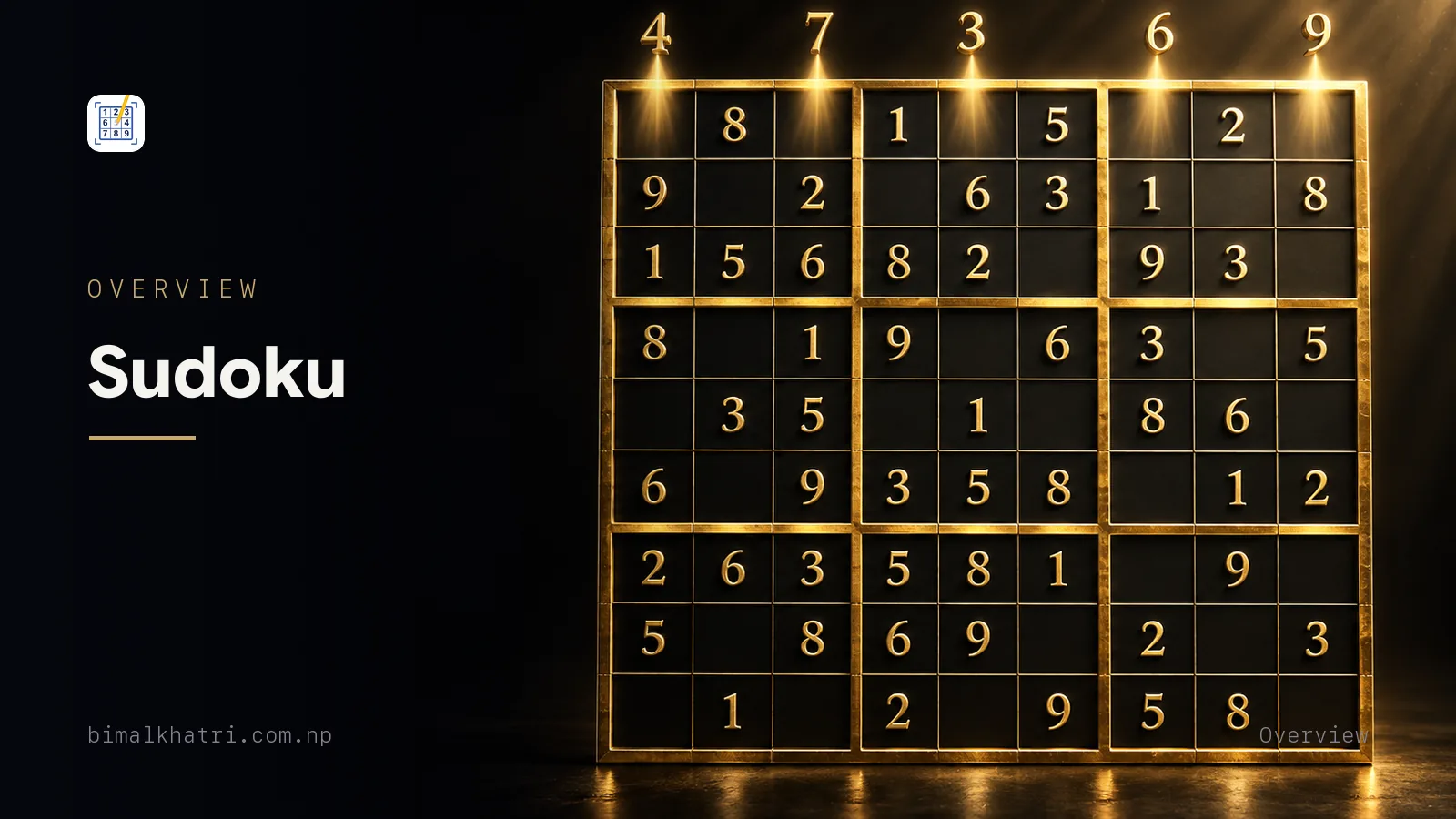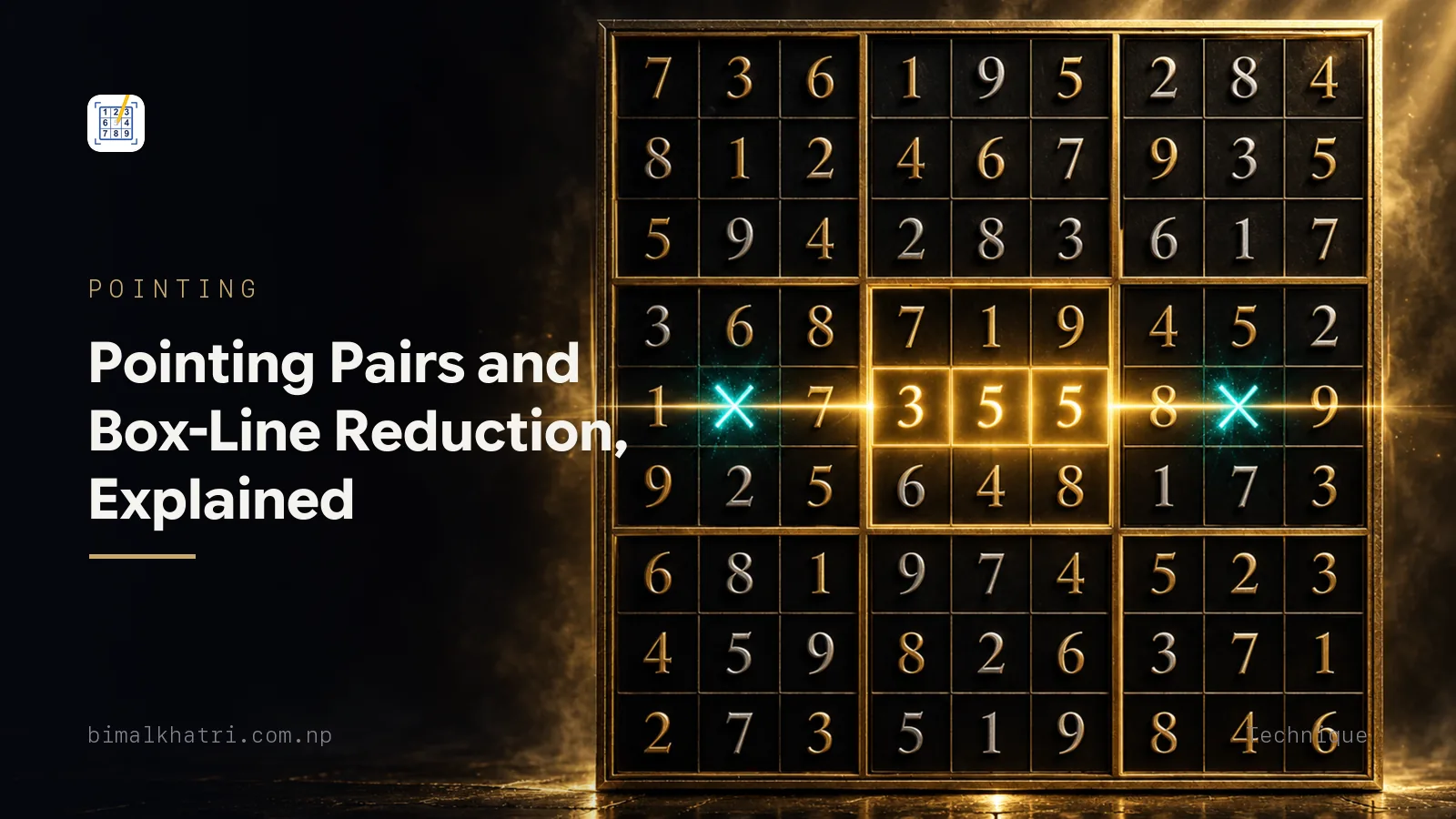
A pointing pair is one digit trapped in one line inside a box. If the only two cells in box 4 that can still hold a 9 both sit in row 6, then row 6's 9 is somewhere in box 4, and every other cell in row 6 loses its 9.
Nothing gets placed. You take a candidate off cells three boxes away, and on the grid below one of those candidates was the only thing holding the puzzle shut.
Box-line reduction is the same overlap read from the other end. If the only cells in row 2 that can hold a 2 both sit in box 3, then box 3's 2 is in row 2, and the rest of box 3 loses its 2. Same three cells, opposite direction. Both go under the name intersection removal, and you will also see them called locked candidates.
Working a grid on your phone? Sudoku Master highlights every copy of the digit you tap, plus the row, column and box you are standing in, which is how you find these two cells without writing a single pencil mark. Free, and all 4,000 puzzles sit on the device.
The three cells that do the work
Take any box. It lies across three rows and three columns. Where the box meets
one of those rows, exactly three cells overlap. Box 4 and row 6 share r6c1,
r6c2 and r6c3, and nothing else.
Those three cells answer to two masters. They are in the box, so they obey the box. They are in the row, so they obey the row. Pin a digit anywhere inside that overlap and it is banned from the other six cells of the box and the other six cells of the row, twelve cells in total, most of which you were not even looking at.
The direction you argue in is the only difference between the two techniques.
- Pin the digit with the box, because its only homes in the box lie on one line. Now clear the rest of the line. That is a pointing pair.
- Pin it with the line, because its only homes in the line lie in one box. Now clear the rest of the box. That is box-line reduction.
Neither writes a digit into the grid. Both hand you a shorter candidate list, and the digit usually falls out a move later.
The grid
Every example on this page comes off this puzzle. A dot is an empty cell.
.1.82.4..
634...8..
..8.1..76
..218....
.75.4....
.....2.6.
9....87..
....6.9..
....5.63.
Twenty-eight givens. Cross-hatch it, take whatever singles fall out, and you get
six placements: 3 at r7c5, 6 at r1c6, 3 at r1c9, 6 at r4c2, 6 at r5c4
and 6 at r7c3. Then it stops dead.
.1.8264.3
634...8..
..8.1..76
.6218....
.7564....
.....2.6.
9.6.387..
....6.9..
....5.63.
Forty-seven cells still blank. No naked single anywhere on the board, and no hidden single in any row, column or box. This is the position the technique exists for. Not a grid that looks hard, a grid where the easy moves have genuinely run out.
A pointing pair, worked
Count the 9s already placed. There are two, at r7c1 and r8c7. That is a thin
digit, and normally a reason to scan something else. Watch what two 9s do here.
Box 4 is rows 4 to 6, columns 1 to 3. Pulled out on its own it reads:
. 6 2
. 7 5
. . .
Five blanks: r4c1, r5c1, r6c1, r6c2 and r6c3. Now strike. Column 1
carries a 9 at r7c1, and no column repeats a digit, so the whole left-hand
column of the box dies. r4c1, r5c1 and r6c1 are out.
Two cells survive, r6c2 and r6c3, and they share a row.
Box 4 has to put its 9 somewhere. The only two places left are both in row 6, so row 6's 9 is inside box 4 whichever of the two it turns out to be. Every other cell in row 6 can stop hoping for one.
Row 6 reads . . . . . 2 . 6 .. Outside box 4 the blanks are r6c4, r6c5,
r6c7 and r6c9, and three of them were still carrying a 9. Strike it from
r6c4, r6c5 and r6c9. (r6c7 had already lost its 9 to the one at r8c7,
which is normal: a good share of the eliminations you find are ones the grid had
made already.)
Now read column 5. It holds 2, 1, 8, 4, 3, 6 and 5, so two cells are blank,
r2c5 and r6c5, and two digits are missing, 7 and 9. Both cells were {7,9}.
The pointing pair has just taken the 9 out of one of them.
r6c5 is 7. Which makes r2c5 a 9.
One strike, three candidates removed, two digits placed. And the grid comes apart from there: with that 9 gone, this puzzle finishes on singles alone.
Box-line reduction, worked
Same grid, other direction. Take row 2 and the digit 2.
Row 2 reads 6 3 4 . . . 8 . ., so five cells are blank: r2c4, r2c5,
r2c6, r2c8 and r2c9.
The first three sit in box 2, and box 2 already holds a 2, at r1c5. They are
out. That leaves r2c8 and r2c9, and both of them are in box 3.
Row 2 must have a 2 somewhere, and it can only be in box 3. So box 3's 2 lives in row 2, and the rest of box 3 loses it.
Box 3's other blanks are r1c8 and r3c7. r1c8 was {5,9} and never wanted
a 2. r3c7 was {2,5}.
r3c7 is 5.
Notice what the strike was. Not a 2 sitting in a row or a column, but a 2 sitting in a neighbouring box. Box constraints are what make box-line reduction findable, and they are the ones solvers forget to check when they scan a line.
Two names, one overlap
The two techniques are close enough that the same grid will often hand you an elimination twice.
Go back to box 1, which reads:
. 1 .
6 3 4
. . 8
Four blanks: r1c1, r1c3, r3c1 and r3c2. Row 1 has a 2 at r1c5, which
kills r1c1 and r1c3 in one stroke. (Column 3's 2 at r4c3 would have killed
r1c3 on its own.) The survivors are r3c1 and r3c2, both in row 3.
Box 1's 2 is in row 3. So the rest of row 3 loses its 2, and the only cell out
there still holding one is r3c7.
r3c7 is 5, for the second time, by a different route. You needed one of those
two arguments and not both. That is worth knowing, because it means a search
that finds nothing in one direction is not proof of anything until you have
looked in the other.
| Pointing pair | Box-line reduction | |
|---|---|---|
| Where the digit gets pinned | Inside one box | Inside one line |
| What pins it | Its only homes in the box lie on one line | Its only homes in the line lie in one box |
| What you then clear | The rest of that line | The rest of that box |
| Cells you can clear | Up to 6 | Up to 6 |
| Easiest to spot when | A cross-hatch leaves two cells in a row | A line's candidates cluster at one end |
Three cells count too
The pattern does not care whether two cells survive or three, only that they all sit on one line. Three cells is a pointing triple, and it works identically.
Here is a different puzzle, at the point where singles have run out:
672159...
.4.....1.
.19234.76
7...9..6.
26.....8.
.94..5..7
..7...6..
93..4.7..
426...3..
Box 2 is rows 1 to 3, columns 4 to 6. It reads 1 5 9, then three blanks, then
2 3 4. It is missing 6, 7 and 8, and its only empty cells are r2c4, r2c5
and r2c6, all in row 2.
So all three missing digits are pinned in row 2. Every other blank in row 2
loses 6, 7 and 8 at once: r2c1, r2c3, r2c7 and r2c9. Only the 8 was
actually sitting in any of them, and that is enough. Box 1's blanks are r2c1,
r2c3 and r3c1, and with the first two stripped of their 8s, box 1 has one
home left for it.
r3c1 is 8.
A box down to three blanks in a single line is the easiest version of this to see, and it is worth checking for on every nearly-full box.
Now the honest half. Triples are common and mostly worthless. The main grid on
this page carries four of them: box 2's 7 across r2c4, r2c5 and r2c6; box
6's 2 across r5c7, r5c8 and r5c9; box 6's 3 down r4c7, r5c7 and
r6c7; and box 8's 2 down r7c4, r8c4 and r9c4. Not one of them removes a
single candidate, because nothing out along those lines wanted the digit in the
first place. Finding the pattern and gaining something are two different events.
Finding them without pencilling in the whole grid
You do not need a full candidate grid. You need the habit of finishing a cross-hatch properly.
When you scan a digit into a box and one cell survives, you place it. When two or three survive, most people shrug and move on. Take the extra second and ask whether the survivors share a row or a column. If they do, you have a pointing pair, and the eliminations run out along that line into boxes you were not looking at.
The reverse search is just as cheap. Scan a digit along a row or a column instead of a box, and if every surviving cell falls inside one box, that is box-line reduction and the rest of the box loses the digit.
Where to look, in rough order of payoff:
- Boxes with three or four blanks. Fewer cells to eliminate, so a single strike often collapses the survivors onto one line.
- Digits placed two or three times, not seven. This surprises people. A busy digit tends to resolve to one cell, which is a placement rather than a pointing pair. The 9 above had exactly two copies on the board.
- A box whose blanks already lie mostly in one band. Look at the shape before you check any digit at all.
- Lines that run through a box holding the digit already. That box is dead for the digit, which does two thirds of your striking for free.
Skip any box that already contains the digit. There is nothing to pin.
And re-scan after every placement. A digit you write changes three units at once, so a box you cleared two minutes ago can turn into a pointing pair while your back is turned.
What these are actually worth
Five intersection eliminations exist on the main grid at the stall. Three of them finish the puzzle on their own, and two remove candidates that no later move ever needed. Here is one of the two, because it is the more typical result.
Row 7 reads 9 . 6 . 3 8 7 . ., so the blanks are r7c2, r7c4, r7c8 and
r7c9. Column 2 has a 1 at r1c2, which kills r7c2. Column 4 has a 1 at
r4c4, which kills r7c4. The survivors, r7c8 and r7c9, are both in box 9,
so box 9's other blanks lose their 1s: r8c8, r8c9 and r9c9.
Three candidates gone. Nothing placed. Nothing that follows needs them.
That is the normal outcome and it is not a failure. Intersection removal is bookkeeping that pays off later, and you cannot tell in advance which of the five will be the one that matters. What you can do is stop expecting a digit every time.
On the standard difficulty ladder these two sit at about the fifth rung, above naked and hidden pairs and below the X-Wing. A puzzle is rated by the hardest technique it forces you to use, so a grid that needs a pointing pair and nothing harder is a solid medium or an easy hard, whatever the clue count says.
I built Sudoku Master, and the honest account of what it does for a move like
the one above is: not much, on purpose. It holds 4,000 graded puzzles on the
device, there are no ads while you solve, and the solver inside it is a
backtracking search that hands back a finished grid. It can tell you r3c7 is a
5. It cannot tell you that box 1 was the reason, which is what this page is
for.
Common mistakes
Confusing a pointing pair with a naked pair. A naked pair is two cells
holding the same two candidates. A pointing pair is one digit sitting in two
cells that may otherwise have nothing in common. Above, r6c2 was {4,8,9} and
r6c3 was {1,3,9}. They share the 9 and nothing else, and the technique only
ever cared about the 9.
Eliminating inside the overlap. The two or three pinned cells keep every candidate they had. It is the rest of the line, or the rest of the box, that loses the digit. Rubbing out the pair itself is how people break a grid.
Writing the digit into one of the two cells. You have proved where it is not. You have not proved which of the pair it is, and the grid will keep agreeing with you for a while before it stops.
Scanning a line and skipping the boxes. Box-line reduction depends on box constraints. Row 2's 2 was pinned by a 2 in box 2, not by anything in row 2 at all.
Throwing away a three-cell survivor. Three cells on one line eliminate exactly as well as two. They just do it less often.
Hunting for the pattern instead of finishing the scan. Every pointing pair you find is a cross-hatch that did not quite land. Do the scan properly and the pattern shows up on its own.
Stopping once the elimination is written. The point of an elimination is the move it enables. Re-read the line and the box you just changed before you go looking for the next pattern.
Questions people ask
What is the difference between a pointing pair and a naked pair?
A naked pair is about cells: two cells in one unit hold exactly the same two candidates, so those two digits belong to them and leave the rest of the unit. A pointing pair is about one digit: it can only live in two cells of a box, and those cells happen to share a line. The cells themselves may hold five other candidates each and it changes nothing.
Is intersection removal the same thing as a pointing pair?
Intersection removal is the umbrella. It covers both directions across the same three-cell overlap, so a pointing pair and a box-line reduction are both intersection removals. Some books split them as pointing and claiming instead, which is the same pair of moves under different labels.
What are locked candidates?
Another name for the same family. A candidate is locked when it has been proved to live inside the overlap of a box and a line, which is exactly the state both techniques create. Type 1 usually means pointing, type 2 usually means box-line, but the numbering is not consistent between sources, so check what a given site means before you trust the label.
Do these techniques ever place a digit by themselves?
No. They only remove candidates. The placement always comes from a single that appears afterwards, which is why the move to make right after an elimination is to re-read the affected line and box rather than hunt for another pattern.
Can I find these without marking up the grid?
No, and it is often faster without. A pointing pair is a cross-hatch whose survivors share a line, so you can find one with the same scan you were already doing. Marks help for the reverse direction, where you are checking whether a line's candidates for one digit all fall in a single box.
Why can I not find a single pointing pair in my grid?
Usually because the grid does not have one yet, and the fix is a different technique rather than a harder look. Also check that you are not searching boxes that already contain the digit, that you are checking columns as well as rows, and that you are looking at thin digits with two or three copies on the board rather than only the busy ones.
What do I try when the elimination changes nothing?
Take it anyway and move on. Write the elimination down, scan the next digit, and expect most of them to pay nothing. If several in a row give you no progress at all, the grid probably needs the next rung up, and the checklist in stuck on a Sudoku is the order to work through.
How hard is a puzzle that needs box-line reduction?
Middling. It sits above naked and hidden pairs and below the fish patterns, so a puzzle whose hardest required move is an intersection removal is a comfortable medium in most newspapers. Difficulty tracks the hardest technique a grid forces on you, not the number of givens, and publishers do not share a scale anyway.
Keep reading
- Cross-hatching: how to read a Sudoku grid quickly, because every pointing pair starts as a scan with two cells left standing
- Naked pairs, triples and quads, the cell-based pattern this one gets confused with most often
- Naked singles and hidden singles, which is where the digit actually gets placed after the elimination
- The X-Wing, explained with real grids, the next rung up when intersection removal stops paying
- Every Sudoku technique, ordered from easiest to hardest, for the full ladder and where these two sit on it
- The full Sudoku guide, the overview this page sits inside
Get it: Sudoku Master, free on iPhone and Android. The link sends you to whichever store your phone uses.