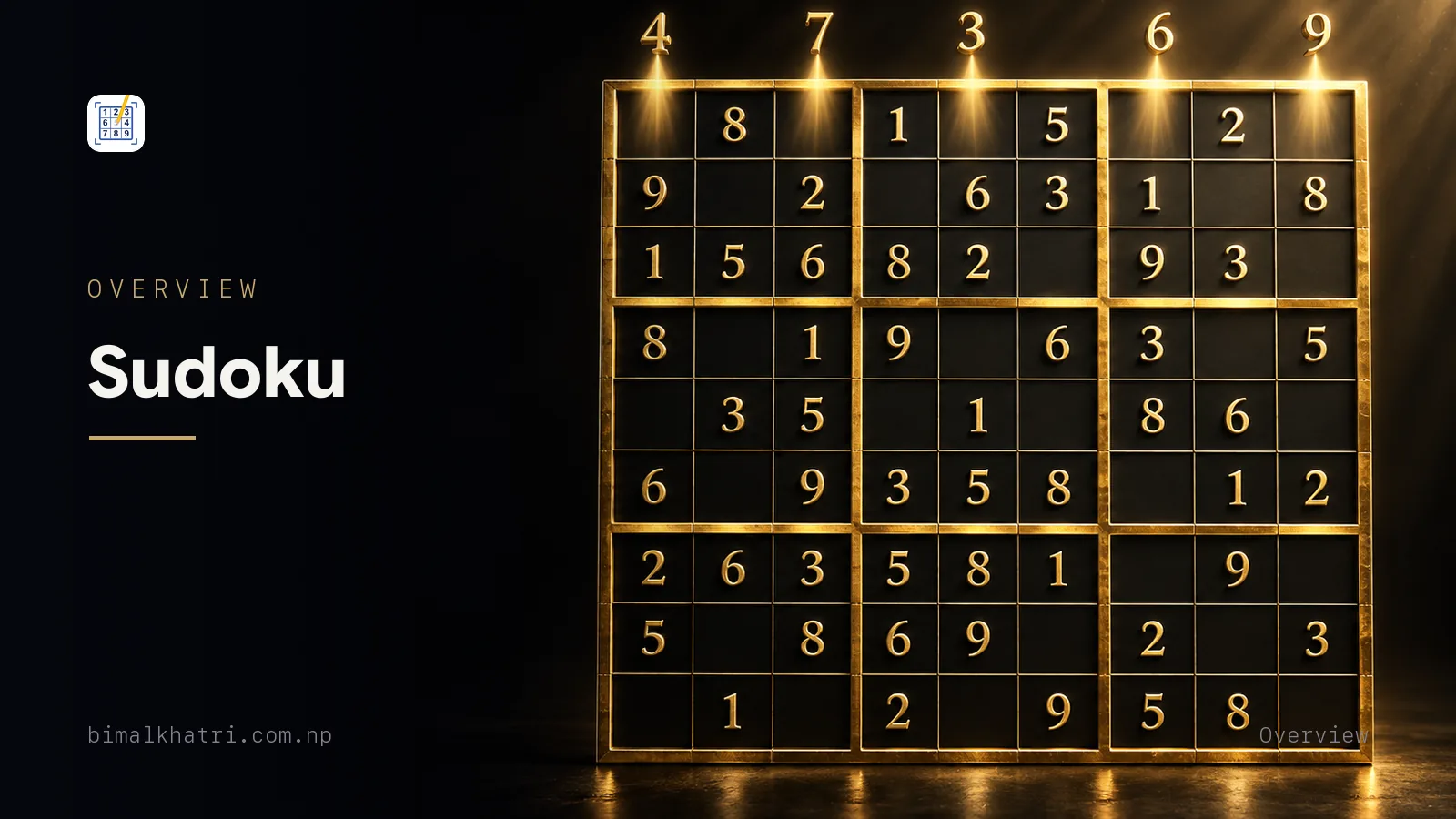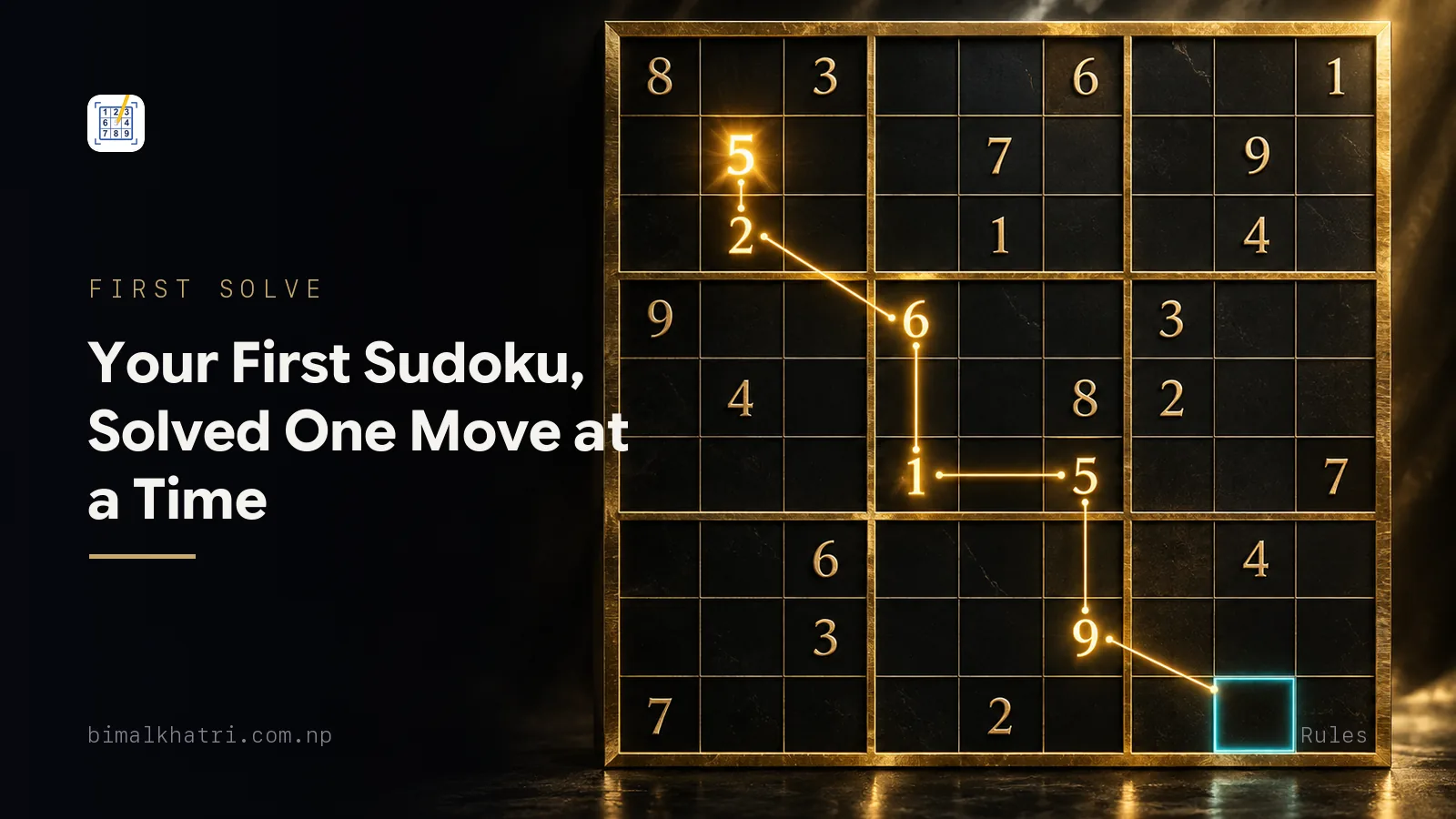
An easy Sudoku comes apart under one question, asked over and over: in this box, where can this digit go? Pick a digit. Look at one box. Cross off the cells that the digit's own row and column already rule out. If exactly one cell survives, write the digit in and ask again somewhere else.
Below is a real puzzle with 36 clues, solved from the first empty cell to the last, with a reason for every digit that you can check against the grid. That is 45 placements. Nearly all of them come from looking at one box and asking about one digit. The two the box scan cannot reach get a section of their own.
Two bits of notation first, because the rest of the page depends on them. Rows are numbered 1 to 9 from the top and columns 1 to 9 from the left, so r4c7 is row 4, column 7. The nine 3x3 blocks are called boxes, numbered left to right and then top to bottom: box 1 is top left, box 5 is the middle, box 9 is bottom right.
Here is the puzzle. A dot is an empty cell.
.3....748
4.8...19.
..2..8..5
...8.5.1.
.75.6.8.4
.2.7..9.3
.8..72...
26...34.1
..3.8627.
Solving on a phone? Sudoku Master holds your notes, lights up the row, column and box you are working in, and shows no ads while you solve.
The only rule you need
Every row holds 1 to 9 once. Every column holds 1 to 9 once. Every box holds 1 to 9 once. That is the whole ruleset. There is no arithmetic in it and no diagonal to worry about, whatever the puzzle's difficulty label says.
One word shortens everything that follows. A cell's peers are the twenty cells that share its row, its column or its box. A digit sitting in any peer cannot go in that cell. Every move on this page is that one sentence, pointed at somewhere specific.
Move 1: the 7 in box 1
Box 1 is the top left block. It holds 3, 4, 8 and 2, so it has five empty cells, r1c1, r1c3, r2c2, r3c1 and r3c2, waiting for 1, 5, 6, 7 and 9.
Take the 7 and ask where in this box it can live.
Row 1 already has a 7, at r1c7. A row cannot hold two, so r1c1 and r1c3 are out. Column 2 already has a 7, at r5c2. So r2c2 and r3c2 are out.
Four cells gone. One left. The 7 goes in r3c1, and nothing objects: neither row 3 nor column 1 holds a 7 anywhere.
That move is cross-hatching, and it is most of an easy puzzle. You are drawing two lines in your head, one along a row and one down a column, until a single cell is left standing in the box.
Move 2: the same digit, the next box
Do not change digits yet. You still have the 7 in your hand, and the grid has just changed underneath you.
Box 2, the top middle block, holds only an 8 at r3c6. Eight empty cells, and the 7 has to be in one of them.
Row 1's 7 at r1c7 rules out the top row of the box: r1c4, r1c5, r1c6. Row 3 now has a 7 as well, the one you wrote thirty seconds ago at r3c1, and that rules out r3c4 and r3c5. Column 4 has a 7 at r6c4, which takes r2c4. Column 5 has a 7 at r7c5, which takes r2c5.
r2c6 = 7, by elimination of the other seven cells.
Look at what carried that move. Your own placement did the work in row 3. Every digit you write changes the answer to a question you already asked, which is why going back over the boxes after each placement beats any technique with a name.
Finish a digit before you change digits
Two more boxes are missing a 7, and both fall the same way.
Box 6, middle right, has four gaps: r4c7, r4c9, r5c8, r6c8. Column 7 has a 7 at r1c7, so r4c7 is dead. Column 8 has a 7 at r9c8, which kills r5c8 and r6c8 in one stroke. r4c9 = 7.
Box 7, bottom left, has five gaps. Row 7 has a 7 at r7c5, so r7c1 and r7c3 go. Row 9 has a 7 at r9c8, so r9c1 and r9c2 go. r8c3 = 7.
The puzzle gave you five 7s. You have written four. The digit is complete, and you never have to think about it again.
Pick the digit with the most work left in it
The standard advice is to start with the digit that appears most often. That is nearly right, and the near miss costs beginners a lot of time. Count what this puzzle handed you, then count what a scan of that digit alone actually places.
| Digit | Already on the grid | Cells a scan of that digit fills |
|---|---|---|
| 8 | 7 | 2 |
| 7 | 5 | 4 |
| 2 | 5 | 4 |
| 3 | 4 | 0 |
| 4 | 4 | 0 |
| 5 | 3 | 2 |
| 1 | 3 | 0 |
| 6 | 3 | 0 |
| 9 | 2 | 0 |
The 8 is the commonest digit on the board and close to the worst place to start, because seven of the nine are down already and only two remain to find. The 9 is the emptiest and gives nothing, because two placed 9s block almost nothing.
What you want is a digit with enough copies placed to do the blocking and enough missing to make the scan worth the walk. Here that is the 7 and the 2, five of each. So do the 2s next.
The 2s, in four moves
Box 3, top right, has three gaps: r2c9, r3c7, r3c8. Row 3 has a 2 at r3c3, which kills both of the row 3 cells at once. r2c9 = 2.
Box 6 is down to r4c7, r5c8 and r6c8. Column 7 holds a 2 at r9c7, so r4c7 is out. Row 6 holds one at r6c2, so r6c8 is out. r5c8 = 2.
Box 5, the middle, has five gaps. Row 5 now has a 2 at r5c8, killing r5c4 and r5c6. Row 6 has one at r6c2, killing r6c5 and r6c6. r4c5 = 2.
Box 2 has seven gaps, which sounds hopeless and is not. Row 2's new 2 at r2c9 takes r2c4 and r2c5. Row 3's 2 at r3c3 takes r3c4 and r3c5. Column 5's brand new 2 at r4c5 takes r1c5, and column 6's 2 at r7c6 takes r1c6. r1c4 = 2.
Nine 2s on the board. Second digit closed, and you have not written a single pencil mark. Here is where you are, 44 cells filled.
.3.2..748
4.8..7192
7.2..8..5
...825.17
.75.6.824
.2.7..9.3
.8..72...
267..34.1
..3.8627.
The other kind of single
Everything so far has been the same move: look at a box, look at a digit, find the one cell it fits. That is a hidden single, so called because the digit is hiding among the candidates of several cells and only the box scan flushes it out.
There is a second move, and it looks at the grid from the opposite end. Go back to r5c8, the cell where you put a 2. Here is another way to see it, one that never mentions the digit 2 at all.
List what its peers hold. Row 5 has 7, 5, 6, 8 and 4. Column 8 has 4, 9, 1 and 7. Box 6 has 1, 8, 4, 9 and 3.
Collect them: 1, 3, 4, 5, 6, 7, 8, 9. Eight distinct digits, all barred from
that cell. One candidate survives, {2}, so the 2 is forced.
That is a naked single: one cell, one digit left standing. Both kinds are certainties, and neither is a guess. Most people find hidden singles faster, because scanning a box for one digit is less work than auditing twenty peers of one cell. The naked single has one form everybody spots without being taught, though. A row with eight digits in it and a single gap.
Fifteen more, and the grid starts giving them away
Back to the boxes. Box 4, middle left, has six gaps and no 8 in it. Row 4's 8 at r4c4 removes r4c1, r4c2 and r4c3. Row 5's 8 at r5c7 removes r5c1. Column 3's 8 at r2c3 removes r6c3. r6c1 = 8, and that is five cells eliminated by three digits.
From here the puzzle accelerates, because every placement narrows two or three boxes at once. The next fourteen, in order, with the reason for each.
| Cell | Digit | Why it is forced |
|---|---|---|
| r5c4 | 3 | Column 6's 3 at r8c6 and row 6's at r6c9 close every other gap in box 5 |
| r4c1 | 3 | r1c2 and r9c3 block the rest of box 4, and your new 3 at r5c4 blocks r5c1 |
| r5c6 | 9 | Row 6's 9 at r6c7 rules out both remaining cells in the bottom row of box 5 |
| r6c8 | 5 | Box 6 is down to two gaps and row 4 already holds a 5 at r4c6 |
| r4c7 | 6 | The last empty cell in box 6, and 6 is the last missing digit |
| r3c8 | 6 | Your 6 at r4c7 sits in column 7 and kills r3c7, leaving one cell in box 3 |
| r2c4 | 6 | Row 3's new 6 at r3c8 and column 5's 6 at r5c5 shrink box 2 to one cell |
| r3c7 | 3 | Box 3's last gap |
| r2c5 | 3 | Row 1's 3 at r1c2, plus the 3 you just placed at r3c7, leave r2c5 |
| r1c5 | 5 | Column 6's 5 at r4c6 blocks r1c6, and row 3's 5 at r3c9 blocks the rest |
| r2c2 | 5 | Row 2 now has eight digits and one hole |
| r6c3 | 6 | The 6s at r4c7, r8c2 and r5c5 close every other gap in box 4 |
| r1c1 | 6 | Column 3's new 6 at r6c3 kills r1c3, and r3c8 and r8c2 kill r3c2 |
| r5c1 | 1 | Row 5's only remaining gap |
Fifty-nine cells filled, and none of it needed anything you have not already done twice.
63.25.748
458637192
7.2..8365
3..825617
175369824
8267..953
.8..72...
267..34.1
..3.8627.
The bottom band comes out in one pass
The lower three boxes have barely moved so far, and now they collapse.
Box 9, bottom right, is missing 3, 5, 6, 8 and 9. Column 7's 3 at r3c7, row 6's 3 at r6c9 and column 3's 3 at r9c3 leave r7c8 as the only home for it, so r7c8 = 3. Then the 5: r3c9 blocks the column 9 cells and your new 5 at r6c8 blocks r8c8, so r7c7 = 5.
Once r7c7 holds a 5, box 7 has nowhere else to put its own 5 and r9c1 = 5 follows. Box 8's 5 lands at r8c4 for the same reason, since r7c7 rules out r7c4, r1c5 rules out r8c5, and r9c1 rules out r9c4.
Then box 9 finishes itself: r7c9 = 6, then r8c8 = 8, then r9c9 = 9, each one the last cell that can take that digit.
The one move a box cannot find
Now the exception. Row 1 currently reads 6 3 . 2 5 . 7 4 8, so it is missing 1
and 9, in cells r1c3 and r1c6. Box 1 is also missing 1 and 9, in cells r1c3 and
r3c2.
Scan box 1 for the 9 and you get nothing. Both of its gaps will accept a 9, so the box cannot tell you which. This is the one place in the puzzle where a box scan fails, and it is worth sitting with for a second, because it is the moment most beginners decide they are stuck.
Scan the row instead. Row 1 needs a 9 in either r1c3 or r1c6. Column 6 already holds a 9, at r5c6. So r1c6 cannot take it, and r1c3 = 9.
The rest falls out. Row 1's other gap takes the 1, so r1c6 = 1, and box 1's other gap takes the 1 as well: r3c2 = 1.
Rows and columns are units exactly like boxes, and the same two questions work on them. Beginners scan boxes because boxes are visually obvious. When a box scan dries up, run the same scan along a row and then down a column before you reach for anything harder.
The last twelve
Every remaining box now has one or two gaps, and gaps come in pairs that resolve each other.
Box 4 has two, r4c2 and r4c3, needing 9 and 4. Column 3 holds a 9 at r1c3, the one you just found, so r4c3 cannot be the 9. r4c2 = 9 and r4c3 = 4.
Box 5 has two, r6c5 and r6c6, needing 1 and 4. Column 6 holds a 1 at r1c6, so r6c5 = 1 and r6c6 = 4.
Box 7 has three. Column 1's 1 at r5c1 and column 2's 1 at r3c2 force r7c3 = 1, then r9c2 = 4 and r7c1 = 9 are the only digits their rows will take.
Box 8 has three. r9c4 = 1, because r7c3 blocks r7c4 and r6c5 blocks r8c5. Then r7c4 = 4, and box 2 clears with r3c5 = 4 and r3c4 = 9. The last empty cell on the board is r8c5, and the only digit left is 9.
639251748
458637192
712948365
394825617
175369824
826714953
981472536
267593481
543186279
Check it before you believe it
A finished grid that breaks a rule is worse than an unfinished one, because you will never find the error by staring at the last cell you wrote.
Read each row and tick off 1 to 9. Then each column. Then each box. A quick arithmetic shortcut helps here even though the rules contain no arithmetic: a row holding 1 to 9 once sums to 45, so a row that sums to anything else has a repeat or a gap. It catches most mistakes in about a minute.
If a row is wrong, the mistake is usually not in that row. It is in whichever cell you filled on a hunch, twenty moves earlier.
What actually made this fast
Five habits, and none of them are techniques.
One digit at a time. Take a digit, walk all nine boxes with it, and finish it before you pick up another. Jumping between digits means re-reading the grid constantly.
Go back after every placement. A new digit changes the answer in two or three boxes you already looked at. That is where the next move usually is.
Count before you commit. Digits with five or six copies placed pay for the scan. Digits with two do not.
No pencil marks on an easy grid. Writing candidates into 45 cells takes longer than solving this puzzle did. Save them for the puzzle that stalls, and even then only fill the cells in the unit you are stuck on.
Write nothing you cannot justify out loud. "It looks like a 6" is how a grid becomes unsolvable four moves later, with no way back.
I built Sudoku Master around the last two of those. Notes clear themselves when you place a digit, so pencil marks stop rotting, and the row, column and box you are sitting in are highlighted, so a cross-hatch is one glance instead of three. Its easy tier ships at 36 givens, the same count as the puzzle above.
Questions people ask
Do I need pencil marks on an easy Sudoku?
No, and starting with them will slow you down. The puzzle above was solved with none. Pencil marks earn their place when box, row and column scans all come back empty, which is a hard-puzzle problem rather than a beginner one.
What should I do when no digit will go anywhere?
Change the unit before you change the technique. Most people scan boxes and stop there. Run the same scan along each row and each column, then look for a cell whose peers already hold eight different digits. That covers both kinds of single, and on anything below hard it is nearly always enough.
Does it matter which digit I start with?
Only for speed. Any order reaches the same grid, but a digit with five or six copies already down gives every scan something to bite on. The table above is the evidence: on this puzzle the 7 placed four cells and the 9 placed none.
What happens if I write a digit in the wrong cell?
Everything after it is contaminated, and you usually notice several moves later when two cells in a row both need the same digit. On paper the honest repair is to rub back to the most recent digit you can still give a reason for. On screen, undo. A grid carrying a bad digit cannot be finished, however long you stare at it.
Does a puzzle with more clues mean an easier puzzle?
Not reliably. The grid above opened with 36 and never asked for anything harder than a hidden single. Another grid can open with 30, hand you a dozen easy placements, then sit there until you find an X-Wing. The clue count tells you how long the opening scan runs, not where the puzzle stops being gentle.
How many easy puzzles before I try a medium one?
Until the scan above runs without you thinking about it, which is somewhere between five and twenty grids for most people. The signal is not the clock. It is finishing an easy puzzle without once stopping to work out what to look at next.
Is it cheating to check the answer partway through?
No, and an early check beats a late one. If you have gone wrong, every minute after the error is spent on a grid that can no longer be finished. Ways to check a printed puzzle without reading the whole solution are in checking a newspaper Sudoku.
Should I be timing myself?
Not while the scan is still new. A clock pushes you into writing digits you have not proved, which is the one habit that ruins a grid. Start timing later, and compare yourself with your own earlier runs rather than with a number somebody posted.
Keep reading
- How to play Sudoku: the complete rules, if you want the ruleset stated properly before the techniques.
- Cross-hatching and scanning, which is move 1 above turned into a repeatable routine.
- Naked singles and hidden singles, with more worked grids for both kinds.
- Nine beginner mistakes that make an easy puzzle feel like a hard one.
- Sudoku, from the rules up, start there if you would rather see the whole picture in order
- Stuck on a Sudoku? The checklist to run in order before you look up an answer.
Get it: Sudoku Master, free on iPhone and Android. It plays classic 9x9 across four difficulties, works with no signal, and the link sends you to whichever store your phone uses.