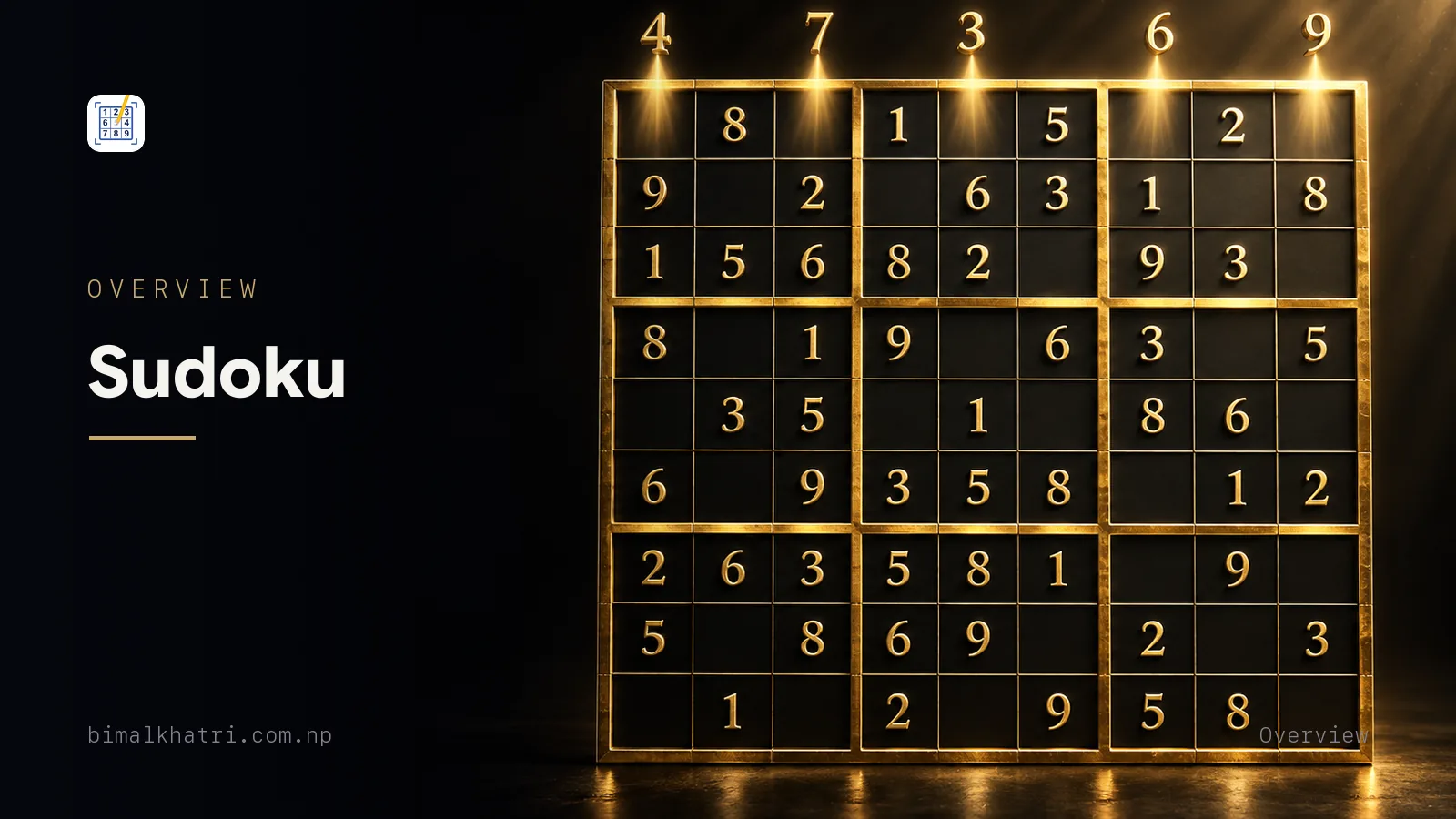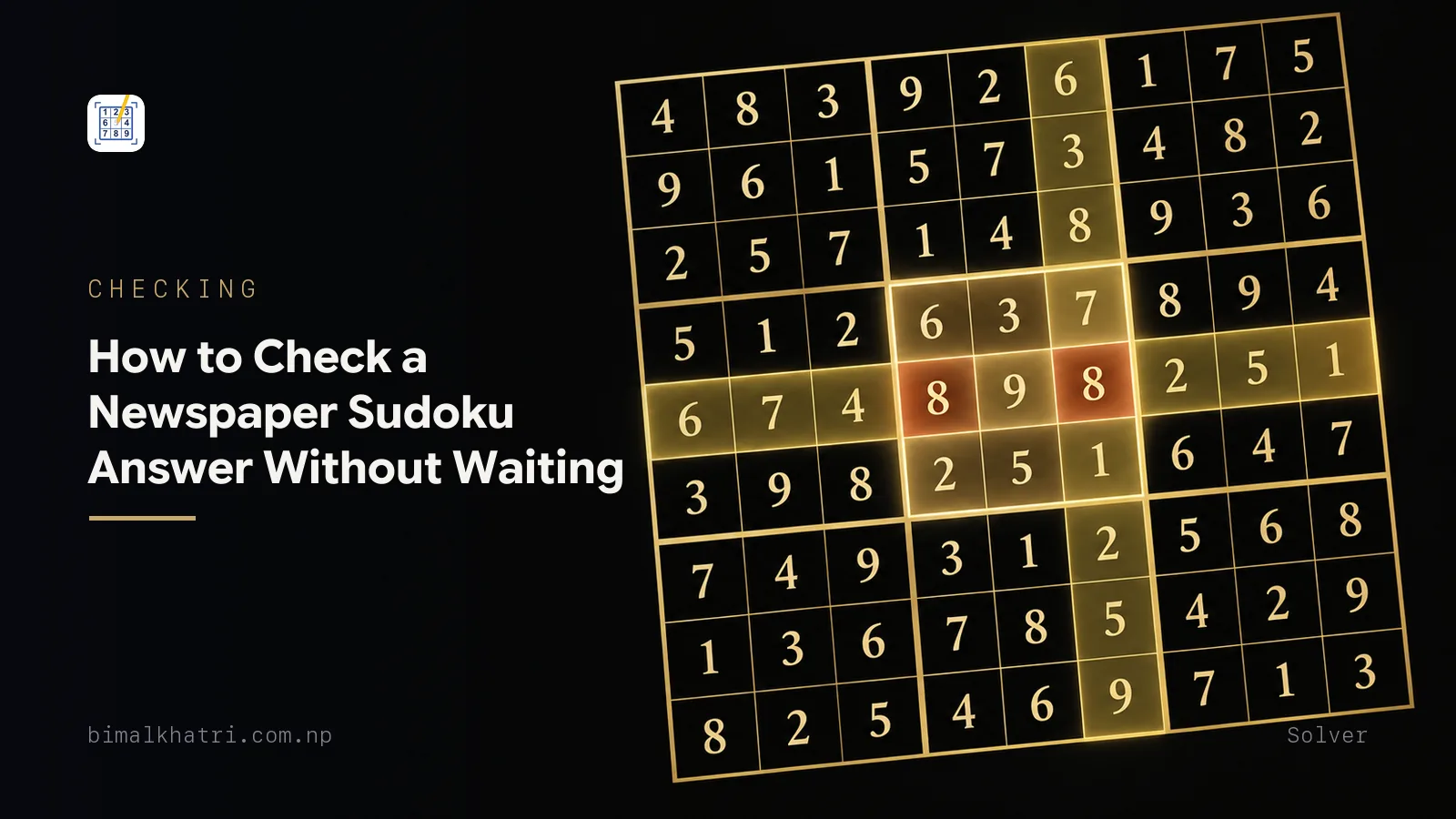
You do not need tomorrow's paper. A finished Sudoku carries its own key: if every row, every column and every box holds 1 to 9 exactly once, and every printed clue is still sitting where the paper put it, your grid is the answer.
Not probably the answer. The answer. A properly made Sudoku has exactly one solution, so once your grid is legal everywhere and still respects the clues, there is no second grid left for the newspaper to print.
The check is 27 small tests and it takes about a minute. What follows is how to run it quickly, the one kind of wrong that survives two thirds of it, and what to do on the morning the printed key disagrees with you.
Want the check without the pen work? Sudoku Master ships every puzzle with its solution, so it checks an answer with no signal and no waiting. Free.
The check is 27 groups, not 81 cells
Nine rows, nine columns, nine boxes. That is the entire ruleset of classic Sudoku, and it is also the entire test.
Do not try to confirm that a group contains a 7. Hunt instead for a group that contains two 7s. Nine filled cells with no digit repeated has to be 1 to 9, because nine digits is all there are, and a repeat is far easier to spot than an absence. In a completely filled grid, a repeat is the only failure available.
So the sweep is four passes:
- The nine rows, left to right. Read the nine digits and stop the moment one arrives twice.
- The nine columns, top to bottom. Slower, because your eye has no line to follow. A finger down the column fixes that.
- The nine boxes, each read as three short rows of three.
- The printed clues. Every given still where the paper printed it.
That fourth pass is the one nearly everybody skips, and it is not optional. A grid can be perfectly legal in all 27 groups and still answer a puzzle nobody printed, because you rubbed out a clue at some point and put a different digit back. Circling the givens before you start the puzzle costs ten seconds and retires the problem for good.
Why a legal grid has to be the right one
Uniqueness is doing the heavy lifting here, so it is worth being exact about it.
A properly formed Sudoku has exactly one solution. That is what separates a puzzle from a grid with some digits scattered on it. If a published puzzle had two solutions it would be broken rather than hard, and the setter would have shipped a puzzle no logic can finish.
Put those two facts together. Your finished grid carries every printed clue, unchanged. It breaks no row, column or box. Then it is a solution to the puzzle the paper printed, and the puzzle has only one solution, so it is the solution the paper will print tomorrow. Nothing about that argument depends on your confidence, your handwriting or how the puzzle felt.
The key adds nothing. It is the same grid, printed a day later.
A worked check, on a real grid
Here is a puzzle as it comes off the page. Twenty-six clues.
.9.5.....
.7.91.85.
....6..3.
1.3...7..
...2.6...
..2...5.9
.1..8....
.67.35.4.
.....4.6.
And here is a finished grid, handed back with a fair amount of confidence.
391528674
476913852
825467931
153149726
789256413
642378589
514682397
967135248
238794165
Run the row pass. Row 1 reads 3, 9, 1, 5, 2, 8, 6, 7, 4. Nine digits, no repeat, move on. Rows 2 and 3 are clean. Row 4 is not:
153149726Two 1s, at r4c1 and r4c4. Now look at the puzzle: the paper printed that 1
at r4c1. The clue is not in question, so r4c4 is yours and it is wrong.
Which digit belongs there? Row 4 holds 1, 2, 3, 4, 5, 6, 7 and 9. The digit it
is missing is 8, and a row with one duplicate is always missing exactly one
digit. So r4c4 is an 8.
Keep sweeping. Row 6 fails too:
642378589Two 8s, and this time no clue is involved. Row 6 is missing a 1. You have a row
short of an 8 holding a spare 1, and a row short of a 1 holding a spare 8, which
is the fingerprint of a transposition: two digits written into each other's
cells. Set r4c4 to 8 and r6c6 to 1.
The column pass then agrees with all of that. Column 4 carries two 1s, column 6 carries two 8s, and both point at the cells you have already fixed. Every box was clean throughout. Repair those two cells and the grid passes all 27 groups with the clues intact, which makes it the answer.
Two wrong cells, one minute, no key.
The grid that passes every row and every column
Now the case that explains why boxes are on the list at all.
391528674
476913852
825467931
153842796
789256413
642371589
514689327
967135248
238794165
Every row holds 1 to 9. Check them. Every column holds 1 to 9. Check those too. All 26 clues from the puzzle are present and correct. The grid is wrong.
Look at box 6, the one covering rows 4 to 6 and columns 7 to 9:
796
413
589
Two 9s and no 2. Boxes 5, 8 and 9 are broken too.
Here is what happened. In row 4 a 9 and a 2 changed places, and in row 7 a 2 and a 9 changed places, at the same two columns. A row survives that, because it still holds the same nine digits in a different order. A column survives it too: column 6 gave up a 9 in row 4 and got one back in row 7. The boxes do not survive it, because those two columns live in different boxes, so one box loses a 2 and gains a second 9.
That grid is a Latin square, the older and weaker object that Sudoku is built on top of. Rows and columns clean, boxes ignored. All eighteen row and column checks wave it through.
The pattern behind both examples is worth keeping:
| Cells wrong | Hides from the row pass? | Caught by |
|---|---|---|
| 1 | No. One changed cell repeats a digit in its row, its column and its box | Any pass |
| 2, in different rows | No. Both rows break, as they did above | Rows |
| 2, swapped within one row | Yes, and from the box pass too if they share a box | Columns only |
| 4 | Yes. Two swaps across two box columns leave every row and column intact | Boxes only |
You cannot make a finished Sudoku wrong in fewer than four cells without breaking a row or a column somewhere. You can do it in exactly four. That is the whole argument for running all 27 checks instead of the 18 that feel like enough.
The 45 trick, and where it lies to you
Every group holds 1 to 9, and 1 through 9 add up to 45. So every row, every column and every box in a correct grid sums to 45, and adding nine digits is faster for most people than tracking which ones they have seen.
On the first example the sums find the damage immediately: row 4 comes to 38 and row 6 to 52, while the other seven rows come to 45. On the second example every row sums to 45 and every column sums to 45. Only the box sums move, to 38, 52, 52 and 38.
The catch is that 45 is necessary and not sufficient. This row sums to 45:
223456788Two 2s, two 8s, no 1 and no 9. A sum test passes it.
Use the arithmetic to find the group worth looking at, then look at the digits to decide. Sums are a search tool, not a verdict.
Checking a grid you have not finished
A half-filled grid cannot be checked this way, and it is worth knowing why before you go hunting for reassurance.
Duplicates still tell you something. If a digit appears twice in a row, column or box, you have already gone wrong, and the sooner you find it the less you rub out. But no duplicates proves nothing at all. A partly filled grid can be completely legal and completely dead, with a cell somewhere out in the empty space that now has no digit left to take. Emptiness carries no contradiction until you reach it.
Three practical routes, in the order they cost you the least:
- Check one cell, not the grid. You are stuck on one square and you want to know whether your hunch is right before building twenty moves on it. Cover everything else. Looking at a single cell leaves the puzzle alive, which the whole answer does not.
- Check a box the moment it fills. Nine cells, one glance, and any mistake is caught within a few moves of being made rather than forty minutes later.
- Photograph the puzzle before you write on it. A clean picture of the printed grid is a free rollback. Once your own pencil marks are on the page, a camera reads them as part of the puzzle, which is covered in scanning a Sudoku with a phone camera.
If a partial grid is legal and you still cannot move, the problem is usually a technique you have not reached rather than a mistake you have made. The checklist in stuck on a Sudoku is the cheaper thing to try first, and why some puzzles feel impossible covers the grids that are genuinely doing something unusual.
When the printed answer disagrees with yours
This happens, and the order of investigation matters, because the usual cause is dull and the interesting causes are rare.
Start with the boring possibilities. Some puzzle pages carry two Sudokus, and the key for one sits next to the key for the other. Keys are also dated, and a paper you picked up on Thursday may be Wednesday's. Confirm you are holding the key for the grid in front of you before you conclude anything.
Then check your clues again, on the paper, not from memory. A misread given is the most common way to produce a legal grid that is not the published solution: you have solved a real puzzle, just not the printed one.
If both of those pass, the logic is fixed and it points somewhere specific. Your grid contains every printed clue and breaks no row, column or box, so it is a solution to the puzzle as printed. The puzzle has one solution. If the key shows a different grid, then either the key belongs to a different puzzle, or the puzzle as printed carries a wrong clue and is not the puzzle the setter made.
Run the same 27 checks on the key before you write to the paper. If the printed solution repeats a digit somewhere, you have your answer, and it is not your mistake.
Where the key actually lives
If you would rather look it up than check, three places are worth trying before a search engine: the puzzle page itself, which often carries the previous day's solution, the next edition, and the paper's own puzzles section online.
Searching for today's Sudoku answers is the slow route, and the reason is arithmetic rather than bad luck. Hundreds of papers print a Sudoku, most of them different grids, and a photograph of a solution tells you nothing about which puzzle it belongs to unless you check it against your clues. By the time you have identified the right key you could have swept your own grid twice.
There is also the difficulty label to ignore while you are at it. Publishers do not share a scale, so one paper's hard is another paper's medium, and neither label tells you anything about whether your answer is right.
Doing the check on a phone
I built Sudoku Master around a rule that made checking cheap: every one of its 4,000 puzzles is stored next to its own finished grid. Checking an answer is therefore a comparison between two things already on the handset, which is why it works with the signal off and why there is nothing to sign into.
A puzzle out of a newspaper has no stored answer, so that route goes through the camera instead, and the solver at the end of it backtracks. It returns a finished grid. It will not tell you which technique you missed, and any app promising that from a backtracking search is describing a program it has not written.
The ads, plainly: banners on the home, statistics and scanner screens, an interstitial on the way out of the scanner, and none anywhere on the board you play on.
Common mistakes
Checking the boxes and stopping. Boxes alone miss the two-cell transposition. Rows and columns alone miss the four-cell swap. The set of 27 is the smallest complete test.
Never checking the clues. A legal grid that has overwritten a given is a correct answer to a puzzle that was never printed. Circle the givens first.
Treating a sum of 45 as proof. It is a filter. A row of two 2s, two 8s and no 1 or 9 sums to 45 and is wrong.
Rubbing out the whole grid after one duplicate. A duplicate names two cells, and the digit the group is missing usually names the fix. Repair, then re-sweep.
Assuming the printed key wins. It is a grid like yours and it can be checked like yours. Run the 27.
Trying to prove a half-finished grid is right. No contradiction is not the same as no mistake. Check a single cell, or check each box as it fills.
Guessing early and checking late. A guess that survives twenty moves costs twenty moves to undo. Placing only what you can prove, covered in solving without guessing, removes most of the need to check anything.
Questions people ask
Where do newspapers print the Sudoku solution?
It varies by paper, so look in three places before searching. The puzzle page often carries yesterday's answer next to today's grid. Failing that, the next edition, and the paper's own puzzles pages online. Papers that syndicate a puzzle usually publish the key on the syndicator's timetable rather than their own.
Can a Sudoku have two correct answers?
A properly made one cannot. Exactly one solution is part of what makes a grid a puzzle. If yours genuinely has two, it was made badly, and no amount of logic will settle which one the paper meant.
How do I find where I went wrong without starting again?
Find the duplicate, then look at what its group is missing. A row with two 1s and no 8 has two candidate cells and a known replacement digit. If one of the two cells holds a printed clue, the other one is your error. If several groups break at once, work backwards to the earliest cell you cannot justify and erase from there.
Does every row really have to add up to 45?
Yes, and so does every column and every box. It is a fast way to find a bad group. It is not proof that a group is good, because different digits can reach the same total.
What if my grid is legal but different from the printed answer?
Check that the key belongs to your puzzle and your edition, then re-read the clues on the paper. If your grid carries every clue and breaks no group, it is a solution to the printed puzzle, and since there is only one solution, either the key is for a different grid or a clue was misprinted.
Can I check a Sudoku answer with no internet connection?
Yes. The check is reading 27 groups, and a pen does it. An app can do it offline too if it stores the solutions rather than fetching them, which is worth testing by turning the connection off.
Is checking the answer cheating?
Nobody is scoring your newspaper. A finished grid has nothing left to teach you, so confirming it costs you nothing at all. The move that does cost something is uncovering a full solution while cells are still empty, and that is why a single cell is nearly always the better trade.
Does this check work for Killer or Jigsaw Sudoku?
Partly. Rows and columns work the same in both. In a jigsaw puzzle you check the nine irregular shapes instead of nine square boxes. Killer keeps all 27 groups and adds the cages, so every cage has to reach its printed total with no digit repeated inside it.
Keep reading
- Scan a Sudoku with your phone camera and get the answer, for getting a printed grid into a checker without typing 81 cells
- How a Sudoku solver works, and when you should use one, because a solver that returns one answer is a checking tool and not a teacher
- How to use a Sudoku hint without ruining the puzzle, for the times you want one cell rather than the whole grid
- Why some Sudoku puzzles feel impossible, for the grid that is legal, finished and still refusing to make sense
- Newspaper Sudoku: USA Today, LA Times and the Washington Post, on how the dailies differ and what their difficulty labels are worth
- Sudoku, from the rules up, rules through to the hard patterns, in reading order
Get it: Sudoku Master, free on iPhone and Android. The link sends you to whichever store your phone uses.