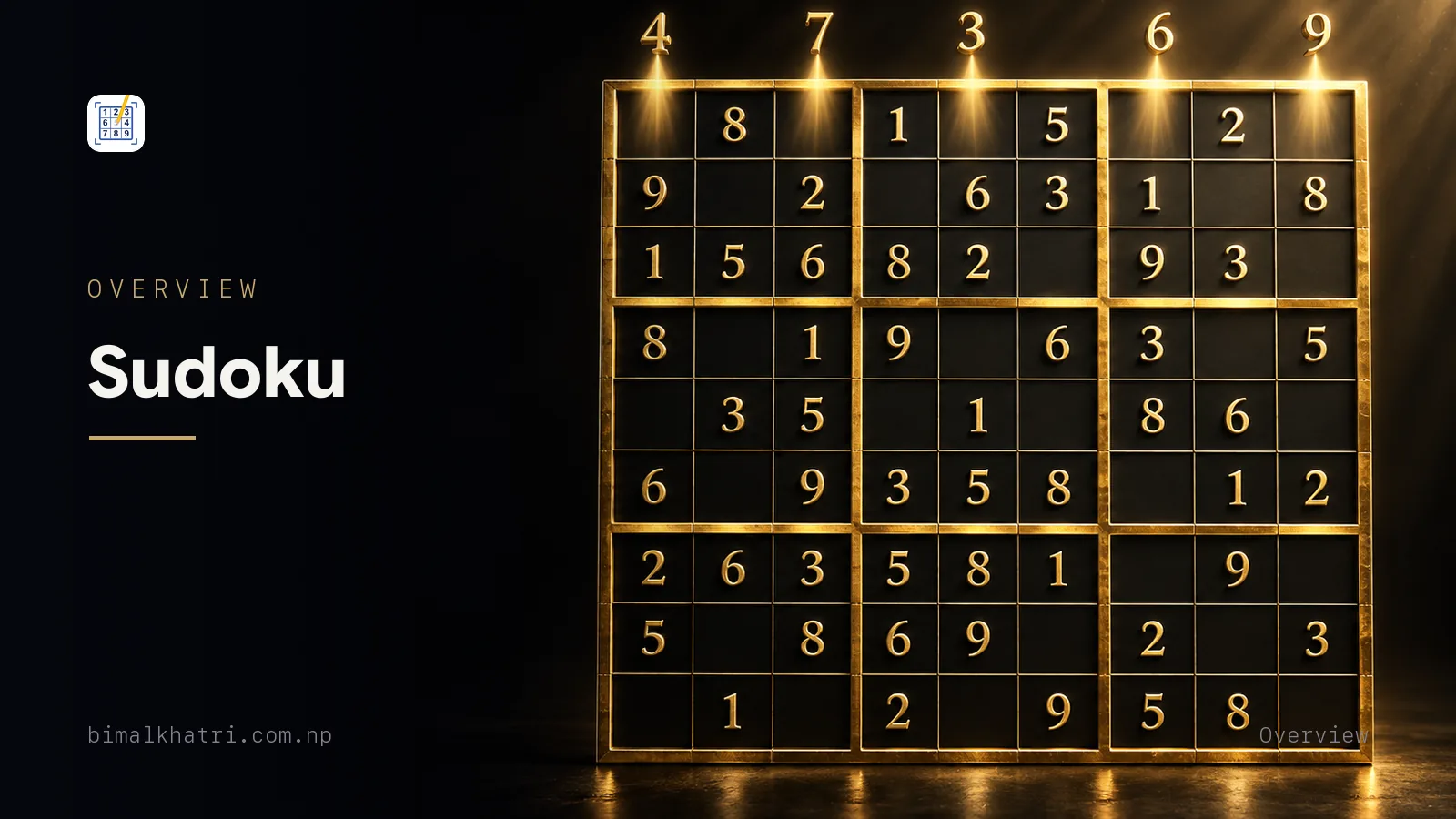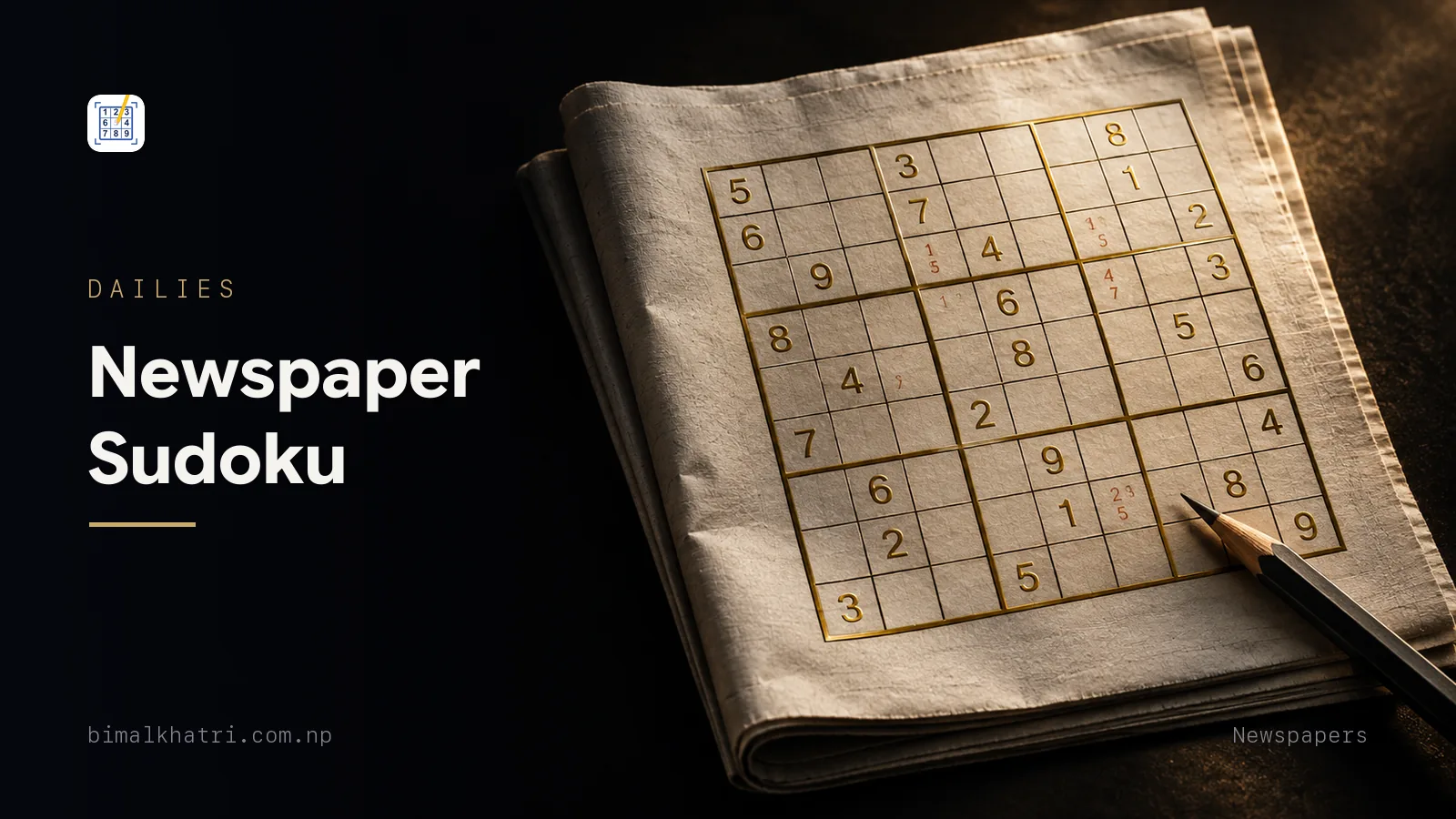
The grade printed above a newspaper Sudoku is a house label. Sudoku has no shared difficulty scale, so one paper's hard sits anywhere between another paper's medium and its extreme, and neither paper is being dishonest with you.
The grid is the part that carries information. Ninety seconds of scanning tells you what you are holding, and it tells you before you have spent forty minutes finding out. Below are two puzzles with 28 clues each. One of them comes apart in the first sweep. The other gives up a single digit and then asks you to make a move that places nothing at all.
Want the same puzzle without the newsprint? Sudoku Master carries 4,000 graded puzzles that work with no signal. Free.
What the label above the grid is actually telling you
There is no standards body for Sudoku difficulty. No agreed ladder, no shared thresholds, no meaning for the word "hard" that survives a trip from one masthead to the next. Each publisher grades with its own solver and picks its own names for the tiers, which is why the words on the puzzle pages of any three papers do not line up: hard, tough, expert, diabolical, evil, extreme.
So the label is close to useless between papers, and genuinely useful inside one. A paper that grades consistently is telling you something real about how today's grid compares with last Tuesday's in the same paper. That is worth having. It is just not transferable, and a reader who concludes they have got worse because a puzzle marked medium beat them has drawn the wrong conclusion from a word written by a different grader.
Two things follow, and they are both cheap.
- Calibrate to the paper, not the word. Time five puzzles from one source and you know what its "hard" costs you, which is more than the word will ever tell you. A daily habit is what makes five comparable times exist in the first place.
- Read the grid before you trust the grade. The sweep below takes less time than finding a pen.
The ninety-second sweep
Cross-hatching is the whole test. Pick the digit that appears most often among the clues, take it through the nine boxes one at a time, and ask where it can go in each. A clue rules the digit out of its entire row, its entire column and its entire box. When exactly one cell in a box survives, that is where the digit goes. The full method, with the eye habits that make it fast, is in cross-hatching.
Run your top two or three digits and then stop and count what you placed.
| Placed in the first sweep | What you are holding |
|---|---|
| 6 or more | Scanning will probably carry the whole grid. Pencil marks optional. |
| 3 to 5 | A middle grade. Expect to write candidates somewhere in the last third. |
| 1 or 2 | Candidates from the start, and at least one move that removes rather than places. |
| 0 | Either the top of that paper's range, or you missed one. Sweep again before you believe it. |
The counts are a rule of thumb rather than a law. What makes them worth ninety seconds is that they come from the grid, and the grid is the thing that is actually going to fight you.
Two puzzles, 28 clues each
Here is the first one, as it would sit on a puzzle page.
74...9.6.
638.7....
..2......
.8...45..
.56...47.
..76...1.
......1..
....5.639
.1.4...87
28 clues. Start with 7, which is printed five times, more than any other digit.
Box 3 covers rows 1 to 3 and columns 7 to 9. Row 1 already holds a 7 at r1c1
and row 2 holds one at r2c5, so neither of those rows can take another. That
leaves row 3 inside the box: r3c7, r3c8, r3c9. Column 8 has a 7 at r5c8
and column 9 has one at r9c9. Both gone. Write 7 in r3c7.
Box 5, the middle. Rows 5 and 6 already carry a 7, at r5c8 and r6c3, so only
row 4 is live: r4c4 and r4c5. Column 5 holds the 7 at r2c5, which takes
r4c5 out. Write 7 in r4c4.
Now 6, also printed five times. In box 6, rows 5 and 6 are blocked by the 6s at
r5c3 and r6c4, and column 8 is blocked by r1c8, which leaves r4c9. In
box 7, row 8 is blocked by the 6 at r8c7, column 1 by r2c1 and column 3 by
r5c3, which leaves r7c2.
Two more digits and the sweep is not finished. The 4s give you r3c5 and
r6c1. The 5s give you r6c6. Seven cells filled, no candidate lists, no
rubbing out. Put those seven in and the next pass hands you a 6 at r3c6, a 7
at r7c6 and a 7 at r8c2, and that pattern holds to the last cell. This
puzzle never asks for anything harder than a single.
Now the second grid.
.2.3..5..
..92.7...
.3..19...
39.7....8
..6...7..
1....8.54
...87..6.
...5.24..
..3..4.8.
Same 28 clues. Same rotational symmetry. It would look at home under the same word as the puzzle above, in the same paper, on the same page.
The most common digits here are 3, 7 and 8, four clues each. Sweep the 8s
through all nine boxes and nothing comes out. Sweep the 3s: nothing. The 7s:
nothing. In the entire grid there is exactly one cell that cross-hatching can
fill, and it is a 5 in box 2. Row 1 holds a 5 at r1c7, which kills r1c5 and
r1c6; column 4 holds one at r8c4, which kills r3c4. That leaves r2c5.
One placement from the sweep against seven. Write out candidates and the grid
gives up five more cells to naked singles, at r1c5, r1c6, r3c4, r6c2 and
r6c3. Six digits in total, and then it stops.
.2.3865..
..9257...
.3.419...
39.7....8
..6...7..
172..8.54
...87..6.
...5.24..
..3..4.8.
No cell is down to one candidate. No digit has a single home left in any row, column or box. The cheapest move on the board is in box 6, and it writes nothing into the grid.
Box 6 covers rows 4 to 6 and columns 7 to 9, and it owes the grid a 6. Ask where
that 6 can live and the answer is two cells: r4c7, reading {1,2,6}, and
r6c7, reading {3,6,9}. Both sit in column 7. So column 7 has already spent
its 6 inside box 6, and the rest of the column can stop carrying the digit
around. r2c7 drops from {1,3,6,8} to {1,3,8}. r3c7 drops from {2,6,8}
to {2,8}.
Two candidates gone. No digit placed. That move is a pointing pair, and it is the rung where a newspaper's harder puzzles begin to live, described in full in pointing pairs and box-line reduction.
That is the real difference between the two grids, and it is not the clue count and not the word on the page. One of them lets you make progress by writing digits. The other makes you spend moves on deletions first.
Twenty-eight clues, twice
Both grids carry 28. The count is the easiest number to read off a page and one of the least useful, and treating it as difficulty is the most common mistake in Sudoku writing.
The floor is 17. McGuire, Tugemann and Civario settled it in 2012 by searching every 16-clue arrangement and finding none with a unique solution, so a 16-clue Sudoku is not hard, it is impossible. That is a computer proof by exhaustion rather than a pencil-and-paper theorem, and it is accepted. Seventeen-clue puzzles do exist, and what they look like is worth a look. At the other end, Nikoli, the Japanese publisher that gave the puzzle its name, holds its own puzzles to at most 32 givens.
A newspaper grid therefore lives inside a fairly narrow band, and inside that band the count predicts very little. A 30-clue puzzle can beat a 24-clue one comfortably. What decides it is which rung of the ladder the grid sends you up, and how many times it sends you. The four grades and what separates them are worked through in Sudoku difficulty levels.
The paper is not a screen, and it shows
Newsprint changes the job in ways nobody mentions until you are halfway down a column with a blunt pencil.
The grid is small, and candidates do not fit. Nine pencil marks in a printed cell is not a plan. Three options that do work: write marks only in cells you have already cut to two candidates, keep the marks in the corners so a real digit can be written over the top, or copy the puzzle onto a larger grid before you start. Pencil marks covers which cells earn them, and printing your own covers the sizes that leave room to write.
Use a pencil. A wrong digit in ink ends a newspaper Sudoku, because the cell is too small to write a second digit next to a crossed-out one.
Circle the clues before your first move. Ten seconds, and it retires an entire class of problem: a finished grid that is legal everywhere but has quietly overwritten one of the printed digits.
Photograph the grid before you write on it. A clean picture is a free undo, and it is also the only version a phone camera can read properly later. Once your own pencil marks are on the page, a scanner treats them as part of the puzzle, which is covered in scanning a Sudoku with a phone camera.
Turn the paper upside down. If the pattern of clues lands back on itself, the setter kept Nikoli's symmetry convention, the same one that turned Number Place into a craft puzzle. Both grids printed above pass that test, and they are the two grids in this article that behave least alike. Symmetry is a courtesy the setter pays the page. It predicts nothing about your evening.
Same puzzle, two papers
A grid that feels familiar sometimes is familiar. Two papers can carry the same puzzle on the same day under two different labels, and the same puzzle can reach you a week apart in two places.
Do not settle it by the label or by how it felt. Read the top row of each grid as a string of digits and dots and compare, then do the same with the bottom row. Ten seconds, and it is exact. Clue positions are the puzzle's fingerprint, which is also how you check whether the grid in the print edition is the one on the paper's own puzzles page.
When the printed grid refuses to finish
Work the causes in order of how likely they are, because the dull ones win almost every time.
- Your own grid. A digit written in the wrong cell forty moves ago is overwhelmingly the usual answer. Sweep for a repeat in any row, column or box.
- A misread clue. A 6 read as a 5, or a clue lost under a fold. Re-read the printed digits off the paper rather than from memory. You may have solved a real puzzle that nobody printed.
- The print itself. Rare, and it does happen. Ink drops a digit, or a correction lands in the wrong cell.
The logic that decides between them is fixed. A properly formed Sudoku has exactly one solution, so if the grid in front of you can genuinely be finished two different ways, it is broken rather than hard, and no technique will settle which one the paper meant. If you can finish it exactly one way and the key disagrees, check that the key belongs to your puzzle and your edition before you write to anyone. The full argument, and the check that runs without the next day's paper, is in checking a newspaper Sudoku answer. If instead you are stuck and convinced a guess is the only way forward, solving without guessing is usually the faster read, because a proper puzzle never needs one.
Why there is a Sudoku in the paper at all
The puzzle is older than the boom and younger than most people assume.
It appeared as Number Place in Dell Pencil Puzzles and Word Games in May 1979, credited to Howard Garns, a retired architect from Indianapolis. Credited rather than signed: Dell did not name its contributors, and the attribution rests on his name appearing in the issues that carried the puzzle and not in the ones that did not. He died in 1989, before any of this.
Nikoli picked it up in Japan in 1984, shortened its long Japanese name to sudoku, and added the two conventions that made it a craft object: symmetric clues and a cap on the givens. Then Wayne Gould, a retired judge from New Zealand living in Hong Kong, found it in a Tokyo bookshop in 1997, spent six years writing a program to generate puzzles, and placed one in The Times of London on 12 November 2004. That page is where the newspaper boom starts. The longer version is in the history of Sudoku.
Paper, the paper's site, or a phone
Each of the three is good at something different, and most people who solve daily end up using two.
| Where you solve | What it is good at | What it costs you |
|---|---|---|
| The print edition | One puzzle a day, no screen, no next button | Small cells, no undo, the answer arrives tomorrow |
| The paper's own puzzles page | The same grid with a check button | You are on a browser, next to everything else on a browser |
| An app | Undo, notes that fit, a grade you can pick, no signal needed | It will happily give you a second puzzle, and a third |
I built Sudoku Master, and the part of it that belongs on a page about newsprint is the scanner. It lifts the grid off the paper, through the camera or from a photo already in the gallery, with a crop step first. Recognition is Google ML Kit, running on the phone. Your photograph of the paper never leaves it. Every digit it reads can be corrected before it solves anything, and that editor is not a nicety: a fold, a shadow or a thinly printed 6 will beat any reader eventually. What comes back is a completed grid. The solver is a backtracking search rather than a tutor, so it will not walk you through the pointing pair you missed.
The ads sit around that and not inside it. Banners on the home and statistics screens and on the scanner, one interstitial on the way back out of the scanner, and nothing whatever on the board: no ads while you solve.
Questions people ask
Do newspaper Sudoku puzzles get harder later in the week?
Some papers rotate grades on a fixed weekly pattern and some print the same grade every day. Nothing about Sudoku requires either. Write down the label and your time for two weeks and your own paper will tell you which it does, which beats any general claim about newspapers.
Is the puzzle in the paper the same one on the paper's website?
Often, and syndication means the online one can also be last week's or next week's. The fingerprint check above settles it in ten seconds. What the two pages call the puzzle is not evidence either way, because the label travels separately from the grid.
Should I use pen or pencil on a newspaper Sudoku?
Pencil, and not because you expect to be wrong. A printed cell has room for one character, so a correction in ink leaves you reading a cell with two digits in it for the rest of the puzzle.
Where does the paper print the answer?
Usually one of three places: beside today's grid as yesterday's answer, in the next edition, or on the paper's own puzzles pages online. Searching for it is the slow route, because hundreds of papers print a Sudoku and a photograph of somebody's solution says nothing about which grid it belongs to. Your own finished grid proves itself in about a minute. The check is 27 groups.
Can a newspaper Sudoku be wrong?
Yes, and it is rarer than the number of people who conclude it. A dropped or smudged clue produces a grid with more than one solution, which is broken rather than hard. Rule out your own duplicate digit and a misread clue first, in that order.
Are newspaper Sudokus harder than app puzzles?
Neither is harder as a category, because both are graded by whoever made them. The real difference is the tools. On paper you get one grid, no undo and no room for notes, so the same logic costs more care.
The grid is too small to write in. What can I do?
Copy it onto a bigger one before you start, or print a larger version, or hold your marks to the corners of cells you have already cut to two candidates. A puzzle that needs full candidate lists needs a grid that can hold them.
Can I photograph the newspaper puzzle instead of typing it in?
Yes, and photograph it before you write on it. Recognition works from the printed digits, so pencil marks and half-solved cells read as part of the puzzle. Flatten the fold, get even light and shoot square to the page.
Keep reading
- NYT Sudoku: how easy, medium and hard really compare, for the one daily whose grades people compare most often
- How to check a newspaper Sudoku answer without waiting a day, for the 27-group sweep that replaces tomorrow's key
- What actually makes a Sudoku easy, medium, hard or extreme, for what a grader is measuring when it picks the word
- The full Sudoku guide, the overview, with every technique in the order you meet them
- Printable Sudoku: how to print them so they are actually usable, for when the newspaper cell is simply too small
- A daily Sudoku habit that sticks, for turning one paper's grid into the two weeks of times that calibrate it
Get it: Sudoku Master, free on iPhone and Android. The link sends you to whichever store your phone uses.