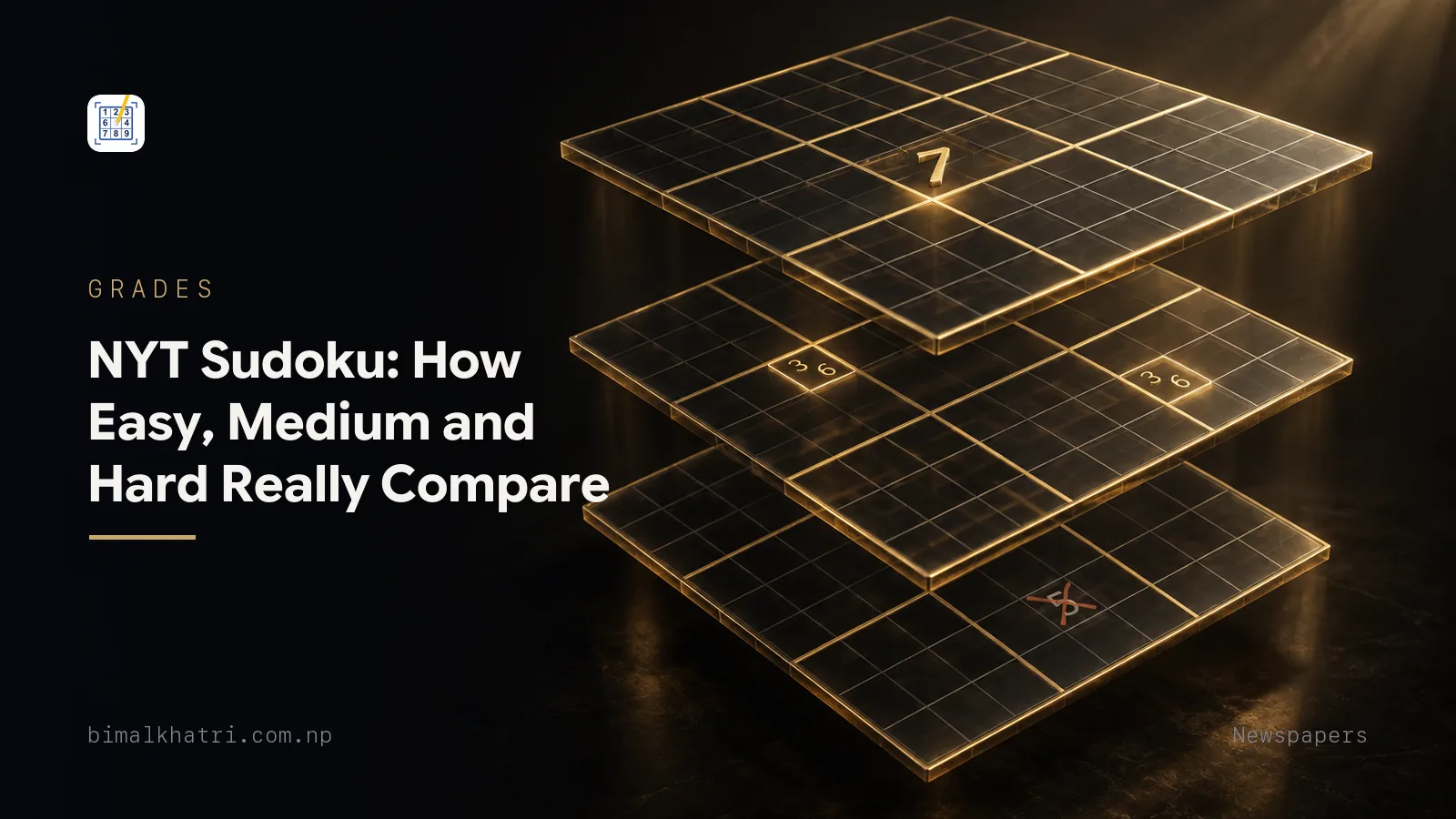
The three New York Times grids differ by one thing: the hardest move each one forces you to make. Easy never asks for more than a digit you can see. Medium makes you write candidates down. Hard makes you delete a candidate before any cell will hand you a digit.
Clue count is not the difference. Time is a symptom rather than a cause. And the step from Medium to Hard is much bigger than the step from Easy to Medium, which is why so many solvers park on Medium for years and assume Hard is for other people.
Want the same three steps to practise on? Sudoku Master carries 1,000 puzzles at each of four grades and times them separately, so you can drill the tier you keep stalling on. Free, works with no signal, and no ads while you solve.
What each label forces you to do
The Times runs three Sudoku a day, one at each label. The crossword gets harder from Monday to Saturday. The Sudoku does not work that way: all three grades appear every day, and the labels stay where they are.
Underneath the labels is a ladder of techniques, and a grade is a claim about how far up the ladder the grid will push you.
| Label | The hardest move it forces | What you need to know |
|---|---|---|
| Easy | Find a digit with one home left | Cross-hatching, hidden singles |
| Medium | Find two cells that own two digits between them | Pencil marks, naked and hidden pairs |
| Hard | Remove a candidate from a cell you still cannot fill | Pointing pairs, box-line reduction, sometimes an X-Wing |
Read the right-hand column as a shopping list. Nothing in it is hard to learn. The reason Hard stops people is not that a pointing pair is difficult, it is that a pointing pair places no digit, and every habit you built on Easy is about placing digits.
Clue count is the wrong thing to count
The first thing most people do with a Hard is count the givens, decide there are too few, and feel doomed. The count barely matters.
My own puzzle set shows the trap plainly. Its easy grids all carry 36 givens and its hard grids carry 26 to 28. Ten fewer clues, so the hard ones must be harder. Except 213 of those 1,000 hard puzzles finish on singles alone, with no pencil marks and no eliminations. By the measure that counts, the hardest move the grid forces out of you, they are easier than the mediums that stall.
The number only says something at the very bottom of its range. Seventeen clues is the floor for a grid with one answer, and puzzles built that thin are collector's items rather than dailies, which 17-clue Sudoku goes into. Anywhere above that floor, the count and the difficulty stop moving together.
Count the clues if you like the ritual. Then ignore the number.
Easy: one idea at a time, all the way down
Here is an easy grid, 36 givens.
.26.41.5.
95.8..3..
7......6.
....6.83.
.75....96
638.1974.
.6..94...
.8..2.67.
3.2..7..4
Take the 3 in box 1, the top left. Row 2 already holds a 3 at r2c7, so the
middle row of the box is out. Column 1 holds one at r9c1 and column 2 holds
one at r6c2, so both of those columns are out. What survives is r1c3 and
r3c3, and r1c3 already holds a 6. Write 3 at r3c3.
That is cross-hatching, and on an Easy it never stops working. You pick a digit, you look at a box, you strike out the rows and columns that already contain it, and either one cell is left or none is. No candidate lists, nothing to remember between one placement and the next.
I ran a solver over all 1,000 easy puzzles in my set. Singles alone finish 999 of them. If an Easy has you stuck, the technique is not the problem, the order is: you are sweeping digits you have already exhausted instead of the ones with seven or eight copies already on the board.
Medium: the pencil marks start earning their keep
A medium grid, 31 givens.
..128.7..
.5...92.8
82...5.4.
....73..2
..25...87
....4....
.7..9..36
4.935..2.
.15......
Cross-hatching works here too, for a while. It places 16 digits, and then the grid goes quiet.
..128.7..
.5...92.8
82...5.49
....73..2
..25...87
....42...
278.9.536
469357821
315628974
Forty-seven cells filled and 34 to go. Sweep every digit again and nothing has one home left. No cell anywhere has a single candidate. This is the moment the label is really about.
Write the candidates for row 5. Two of them are already down to two digits:
r5c1is{1,6,9}r5c5is{1,6}r5c6is{1,6}r5c7is{1,3,4,6}
Look at r5c5 and r5c6. Between them they hold 1 and 6, in some order, and
nothing else. Which one gets which does not matter. Those two cells have used up
both digits for the whole of row 5, so no other cell in the row can be a 1 or a
6. That is a naked pair.
Strike the 1 and the 6 out of r5c1 and it becomes {9}. Write 9 there. Do the
same to r5c7 and it drops to {3,4}. The 9 restarts the cascade, and singles
alone place the remaining 34 cells with no further thinking.
One deduction, four pencil marks deleted, and the puzzle collapses. That shape is what a Medium is: a long easy stretch, one stall, one small piece of reasoning, and then a long easy stretch again.
Hard: the move that places no digit at all
Now a hard grid, 26 givens.
216....94
.9.....3.
5......6.
.81.96...
.5.......
4.3..27..
........1
.7.4.5..6
.2..38...
The same opening sweep places 9 digits and stops.
216....94
89.....3.
53.....6.
781.96...
952...6..
463..27.9
.4......1
.7.4.5..6
.2..38...
Thirty-five cells filled, 46 empty. The Medium stalled with two thirds of the board done. This one stalls with more than half of it still blank, and that gap is most of what the label means.
There is no single anywhere. There is no naked pair that removes anything useful. What there is sits in box 3, the top right, and it is about one digit.
Mark the candidates for that box and the 7 can only go in two cells, r2c9 and
r3c9. Both of them are in column 9. You do not know which of the two holds the
7, and you do not need to. Box 3 has to contain a 7 somewhere, both of its
homes are in column 9, so column 9's 7 is inside box 3. Every other cell in
column 9 loses it.
That is a pointing pair, and here it deletes exactly one pencil mark. r9c9 was
{5,7}. Now it is {5}.
Write 5 at r9c9 and the grid falls over. Singles alone place all 46 remaining
cells from there.
Read what just happened, because it is the whole difference between Medium and Hard. The move that broke the puzzle put no digit on the board. It removed a candidate from a cell in a completely different box. Everything you learned solving Easy grids trained you to look for cells you can fill, and on a Hard the first useful thing on the board is usually a cell you cannot.
The labels are looser than they look
I built Sudoku Master, so I have 4,000 graded puzzles sitting in a text file and a reason to be honest about them. Grading them meant writing a second solver, one that never shipped: it applies singles first, then pairs, then pointing pairs and box-line reduction, then triples, quads and the X-Wing. The app's own solver does none of that, and hands back a finished grid rather than a lesson. Running the grading one over all 4,000 gives two numbers per grade:
| Grade | Finish on singles alone | Cells filled when singles run out |
|---|---|---|
| Easy | 999 of 1,000 | 62 |
| Medium | 926 of 1,000 | 51 |
| Hard | 213 of 1,000 | 36 |
| Extreme | 0 of 1,000 | 28 |
The right-hand column is the honest picture of a grade. Easy grids barely stall. Medium grids stall late, with two thirds of the board already filled and the remaining cells heavily constrained. Hard grids stall at 36, which is early enough that the stall feels like a wall rather than a pause.
The left-hand column is the part worth arguing about. One in five puzzles labelled hard in my set never needs a technique above a hidden single. That is not a bug in the grading so much as the nature of it: a generator makes a grid, a solver grades it, and any two solvers rank the same puzzle differently depending on which techniques they carry.
The outlier is better than the average as an illustration. One puzzle out of the 1,000 labelled easy stalls with 19 cells empty and stays stalled through pairs, hidden pairs, pointing pairs, box-line reduction, triples, quads and the X-Wing. It is labelled easy. It is not easy. Every set has a few of those, and mine is no exception.
Put two publishers side by side and the spread gets wider still, because every set is graded by whatever solver its maker happened to write. The Times grades against the Times. My four grades are graded against each other. Neither scale knows the other is there, which is why newspaper labels disagree so freely.
Why yesterday's Medium beat today's Hard
Four things cause that, and only one of them is you having a bad day.
Spread inside a grade. The table above is the answer. A grade is a range, not a value, and the ranges overlap at the edges. An easy Hard and a hard Medium are the same puzzle wearing different labels.
Where the stall lands. Two Hard grids can both need one pointing pair. If the first stalls at 55 filled and the second at 30, they feel nothing alike. The second one leaves you staring at a mostly blank board.
How many times the grid asks. Needing one elimination is a different evening from needing five, and the label does not distinguish them.
You changed. Once pointing pairs are automatic, every Hard drops a grade, permanently. This is the good news buried in the complaint. People who find Hard easy this month were not born that way.
Climbing from one label to the next
The move from Easy to Medium is a habit, and the move from Medium to Hard is a different habit. Neither takes long.
If Medium is where you stall, the missing piece is pencil marks. Not all of them. At the stall, mark only the row, the column and the box with the fewest empty cells, then look for two cells sharing two digits or a digit that fits in only two places. The medium grid above needed marks in a single row.
If Hard is where you stall, the missing piece is the elimination. At the stall, stop hunting for a cell to fill and start hunting for a digit with two homes in a box. Ask where those homes sit. Same row, or same column, and the rest of that row or column loses the digit. That one question is the entire pointing pair, and it does more work on a Hard grid than any other single idea.
Two practical notes. Do not mark all 81 cells: a full markup on a stalled Hard runs to well over a hundred candidates, and most of them say nothing. And keep the digit that broke the stall in mind, because on a Hard grid the same digit is usually involved twice.
How long each should take
The challenge clock in my app expects 6 minutes for an easy, 12 for a medium, 22 for a hard, 35 for an extreme. Landing within a few minutes of any of them is ordinary.
The clock grows roughly six times from the first grade to the last while the number of digits you write goes up by about a quarter. That gap is the search, not the writing, and on a hard grid most of the search happens while the pen is not moving.
Those numbers came out of one set of puzzles and they stay there. A stranger's time on a different paper's Hard is not a target. It is a different puzzle.
Questions people ask
Does the New York Times Sudoku get harder later in the week?
No. All three grades run every day, so Saturday's Easy is graded the same way as Monday's. The Monday-to-Saturday ramp belongs to the crossword. Any week-to-week variation you feel in the Sudoku is the spread inside a grade rather than a schedule.
Do I need pencil marks to finish a Medium?
Usually, at one point in the grid. Most Mediums run on scanning until they stall, and the stall needs candidates written into a handful of cells rather than all of them. If you are marking every empty cell on a Medium, you are doing several minutes of extra work for one deduction.
Can a Hard Sudoku need a guess?
No. A grid with exactly one answer can be reached by logic alone, and every published puzzle has exactly one answer. What a Hard needs at its stall is an elimination, which is easy to mistake for a dead end, because making one writes nothing into the grid. Tapping digits to see which stick is not a shortcut past that. It is a way of losing the position you already had.
What is a good time for a Hard?
Anywhere from 15 to 30 minutes is ordinary. A month of your own times, all from one source, is a real measurement of you. A screenshot from a stranger solving something else is a measurement of their puzzle.
Why do I stall in the same place on every Hard?
Because the stall is not random. Singles run out at a predictable point, around 36 filled cells in my own hard set, and everything past it needs candidates. The place you stop is the place your technique list ends, so the fix is one new technique rather than more staring.
Is there anything harder than Hard?
Yes. Puzzle sets that go up to expert, extreme or evil ask for chains, colouring and forcing nets, and they stall almost immediately. Every one of the 1,000 extreme puzzles in my set stalls, on average with 28 cells filled, which is barely past the givens.
Does checking a cell ruin the puzzle?
Checking one cell costs you far less than revealing the grid. The useful distinction is between a check that confirms a digit you already reasoned out and a hint that hands you a digit you had not earned. The first keeps the puzzle alive.
Keep reading
- What actually makes a Sudoku easy, medium, hard or extreme, for the grading question underneath every publisher's labels
- Cross-hatching: how to read a Sudoku grid quickly, which is the whole of the Easy tier and the first half of every other one
- Pointing pairs and box-line reduction, explained, the two moves that turn a Hard into a Medium
- Sudoku, from the rules up, for what to read before and after this one
- How long should a Sudoku take?, for where the minutes actually go on a hard grid
- Newspaper Sudoku: USA Today, LA Times and the Washington Post, if you solve more than one paper's grid and want to know why the labels disagree
Get it: Sudoku Master, free on iPhone and Android. Four grades, timed apart, so you can watch a tier stop being hard.