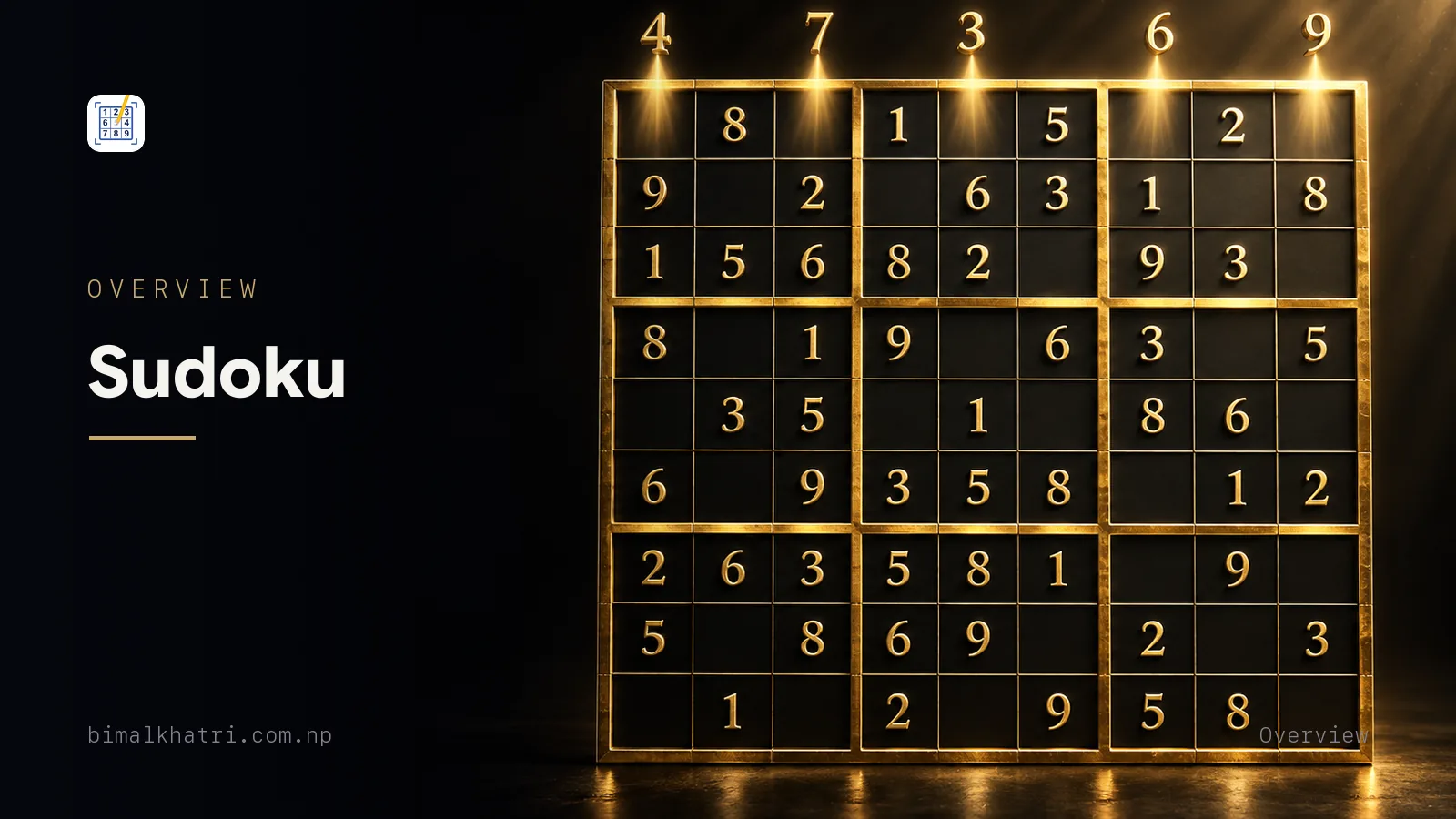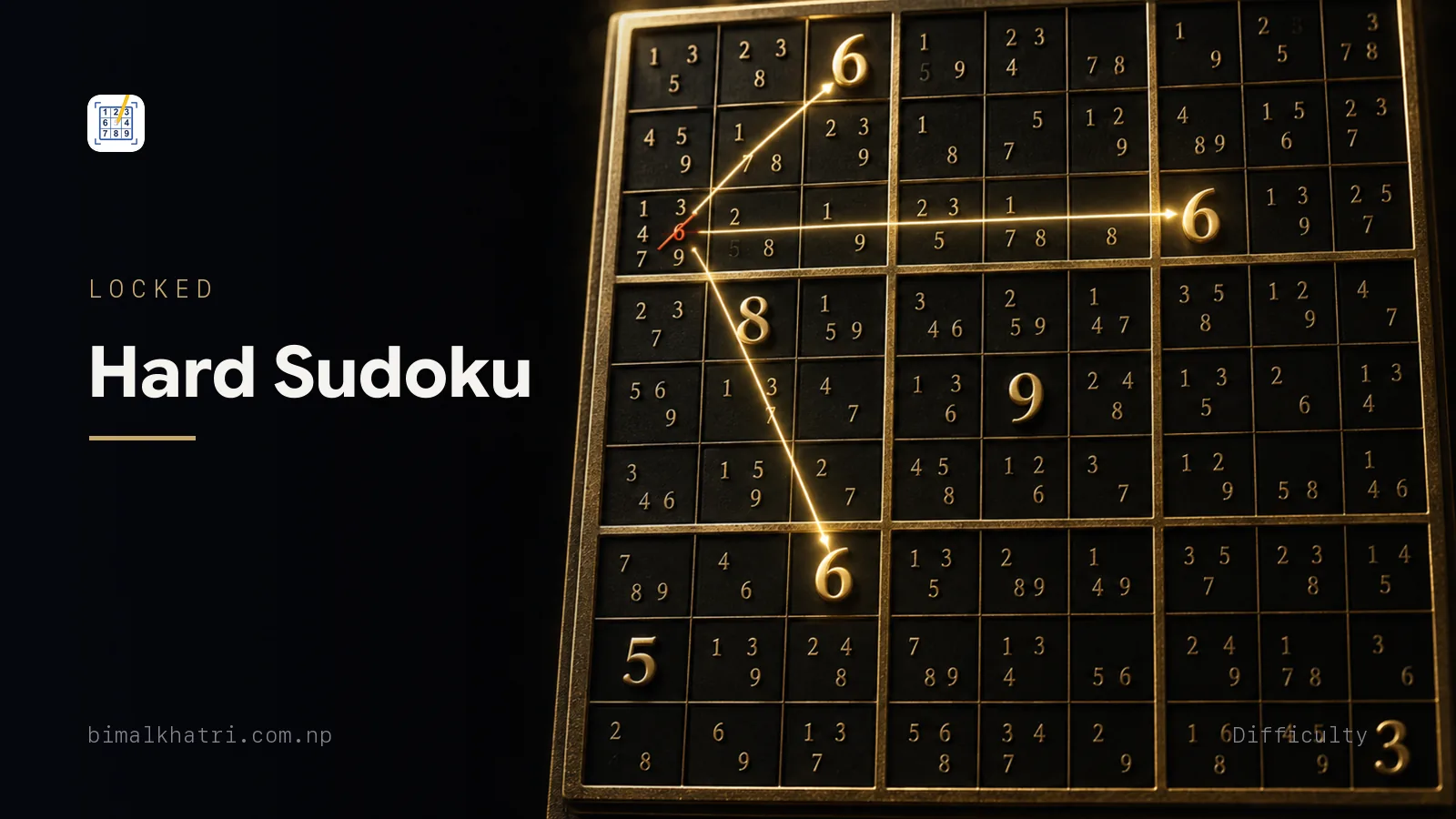
Three moves do almost all the work on a hard Sudoku: the hidden single you walked past, locked candidates, and the naked or hidden pair. The X-Wing is the famous one. On a puzzle graded hard it is rarely the move that matters.
So the useful question is not which technique to learn next. It is where to look, and how much to write down before you look there. A hard grid does not hide cleverer techniques. It hides ordinary ones further apart.
That is the whole difference in one sentence. On an easy puzzle a placement opens two more in the same box, and you ride the chain. On a hard puzzle you place a digit and the board goes quiet, so every new cell costs a fresh scan of all nine rows, all nine columns and all nine boxes. Vocabulary does not fix that. Method does.
Two real stalled grids run below. Each one is opened by a single elimination, and both eliminations come from asking where one digit can live inside one box.
Solving on a phone? Sudoku Master keeps the bookkeeping for you: tap a digit and its row, column and box light up, and placing a value clears the notes it kills. Free, 4,000 classic puzzles, and no ads while you solve.
The clue count will not tell you which move you need
Counting the givens is the first thing most people do with a stalled grid. It answers nothing. A clue is worth exactly what it rules out, so nine of them crowded into two boxes are worth less than five spread over six, and a 30-clue puzzle can demand more than a 24-clue one.
I built Sudoku Master, and its own puzzle files show the problem: the hard band runs 26 to 28 givens and the extreme band runs 21 to 27. The ranges cross. Hold a 27-clue grid and the number on the page cannot tell you which of the two you are holding. What the grades are actually measuring takes that apart properly.
The word above the grid is no better a guide. Papers grade with their own generators, and the same paper drifts week to week. Read "hard" as a warning that the grid will go quiet on you, not as a promise about which technique will restart it.
Work the cheapest move that still produces something
The order below is not a ranking of power. It is a ranking of price. Each step costs more than the one above it, so a hard puzzle is worked top down, and you go back to the top every time something lands.
| Move | What it costs | What it returns |
|---|---|---|
| Prove the grid is still legal | 30 seconds | A mistake, before it eats another hour |
| Sweep all nine digits for hidden singles | 2 minutes | Placements, more often than you expect |
| Mark the emptiest unit, and only that one | 1 minute | The material for everything below |
| Read each box against its rows and columns | 2 minutes | Eliminations along a line |
| Find a pair of candidates that repeats | 1 minute | Eliminations inside a unit |
| Scan one digit across all nine rows | 2 minutes | A fish, when one exists |
| Wings and chains | As long as you have | One candidate, usually |
Most solvers who get stuck on hard puzzles are stuck three rows down that table while reading about the bottom row. The full technique ladder is worth learning in order, but knowing all of it is not what finishes a hard grid. Searching in price order is.
Grid one: three blanks in a box, and the whole puzzle
Here is a hard puzzle at a genuine stop. Every single has been taken, naked and hidden, and 26 cells are still empty.
5976..481
361489275
4287153..
.45..1637
.325761..
71634....
683.5471.
179......
2541.7...
Do not mark all 26 cells. Start at the box with the fewest blanks, because that box has the shortest list of possibilities anywhere on the grid.
Box 5 is the middle one, rows 4 to 6 and columns 4 to 6. It already holds 1, 3, 4, 5, 6 and 7. Three cells are empty and three digits are missing: 2, 8 and 9.
| Cell | Can it be the 9? |
|---|---|
r4c4 | Yes |
r4c5 | Yes |
r6c6 | No. Column 6 already has a 9 at r2c6 |
So the 9 of box 5 lives at r4c4 or r4c5, and you do not need to know which.
Both sit in row 4. That is a pointing pair, and it says something about the rest
of the row rather than about the box.
Row 4 reads .45..1637. Its blanks are r4c1, r4c4 and r4c5, and it is
missing 2, 8 and 9. Column 1 already carries the 2, so r4c1 is {8,9}. Box 5
has just claimed the row's 9. Strike it.
r4c1 is an 8.
Now watch what one digit does to a grid that had nothing in it a minute ago.
Column 1 was down to two blanks needing 8 and 9, so r5c1 is the 9. Row 5 then
has two blanks and two digits left: r5c8 was {4,9} and the 9 has gone, so it
takes the 4, and r5c9 takes the 8. Row 6 now has one home left for its 8, at
r6c6. The grid keeps going. All 26 empty cells fill by singles alone, and not
one of them needs a second technique.
That is the shape of a hard puzzle. Long flat stretch, one elimination, collapse.
The same grid had two other doors
Worth knowing, because solvers waste real time hunting for the intended move as though the setter left exactly one.
Column 8 holds {6,9} twice, at r3c8 and r9c8. Those two cells own the 6 and
the 9 between them, so no other cell in the column can be either. r5c8 was
{4,9}, which makes it a 4.
The 9 of row 6 is also confined to r6c7, r6c8 and r6c9, all inside box 6.
So box 6 spends its 9 on row 6, and r5c8 loses the 9 again. Same cell, same 4,
third route.
Three doors, one room. Take whichever one you can see and stop looking for the elegant version.
Mark the unit, not the grid
Twenty-six empty cells is well over sixty candidate digits if you write them all in. On a hard grid you will pay that cost more than once, because half of what you wrote goes stale the moment a placement lands and you will trust it anyway.
Full marks are not wrong. They are expensive, and they are almost never what finds the first move. Three cheaper habits do:
- Mark one unit at a time, starting with the row, column or box that has the fewest blanks. Box 5 above needed three cells written out. That was the entire cost of solving the puzzle.
- Scan a single digit across the whole grid with no marks at all. Where can the 9 go in each box, in each row? That question found the move above and it finds the fish below.
- Rub out as you go. A mark you forgot to clear will invent a pattern that is not there, and the grid will not complain about it for another twenty moves.
The full case for restraint, and the three notations worth using, is in pencil marks without drowning in them.
Grid two: when the cheap moves really are dry
Sometimes they are. It is worth seeing what genuinely dry looks like, because the far commoner case is a grid that only looks dry because the sweep was sloppy.
Thirty-five cells empty here. No naked or hidden single anywhere. No box that points along a line. No pair or triple that removes a single candidate.
461..978.
359768.1.
8721....9
9......78
6..87....
728.9154.
584.3....
23791.8..
196.8..2.
The cheapest thing left is a single-digit scan, and it needs no pencil marks. Pick a digit and write down where it can still go, one row at a time. Take the 3.
| Row | Where the 3 can still go |
|---|---|
| 1 | r1c4, r1c9 |
| 3 | r3c6, r3c7, r3c8 |
| 4 | r4c3, r4c4, r4c6, r4c7 |
| 5 | r5c3, r5c6, r5c7, r5c8, r5c9 |
| 6 | r6c4, r6c9 |
| 9 | r9c7, r9c9 |
Rows 2, 7 and 8 already have their 3. Six rows to write out, and the answer is sitting in the first and the sixth.
Rows 1 and 6 have two homes each, and they are the same two columns: 4 and 9. That is an X-Wing. One of those rows puts its 3 in column 4 and the other puts its 3 in column 9, and you cannot tell which way round. It does not matter. Between them, rows 1 and 6 use up the 3 of column 4 and the 3 of column 9. No other cell in either column can hold one.
Three cells lose the candidate: r4c4, r5c9 and r9c9.
Now read row 9 again. Its 3 could go at r9c7 or r9c9, and r9c9 has just
been ruled out. r9c7 is a 3.
One placement. That is the honest return on an advanced move, and it is also the whole point of making one: the fish did not solve the puzzle, it restarted the cheap moves. From there locked candidates and singles take the last thirty-four cells without a second fish anywhere.
The X-Wing gets a page of its own, with more grids, in the X-Wing explained. What belongs here is the trigger. You go looking for one when the ordinary moves are exhausted and some digit has exactly two homes in two different rows. Not before.
Using a solver on a hard puzzle
People search for a solver at two very different moments, and the tool is right for one of them.
A solver answers what, never how. Feed it a grid and it works by backtracking: try a digit, push on, and reverse out of every dead end until the whole board fits. That is a search, not an explanation. It will not tell you that box 5 was pointing at row 4, because it never noticed.
The one I wrote for the app is exactly that, and its most useful answer is the empty one. Hand it a grid and get nothing back, and the digits on your page no longer fit together, which means the mistake is behind you and no technique in front of you will help. That check costs a photo and settles the question that wastes the most time on hard puzzles.
Revealing a cell is the other use, and it is the one that quietly costs you the puzzle. A revealed digit removes the move you were about to find and teaches you nothing about how to find the next one. If you want the grid to keep going, take the smallest hint available: check the cells you have already written rather than filling a new one. There is more on that trade in how to use a hint without ruining the puzzle.
What goes wrong on hard grids
Reaching for a technique when the problem is a scan. The commonest cause of a stuck hard grid is a hidden single nobody swept for. Two minutes on all nine digits before anything else.
Marking everything, then trusting it. Sixty candidates written at a stop are sixty things to maintain. Write the unit you are working, use it, clear it.
Hunting the fish first. An X-Wing is a fine move and it is near the bottom of the price list for a reason. On grid one above it was not needed at all, and looking for it would have cost twenty minutes on a puzzle that had a three-cell box waiting.
Grinding a grid that is already broken. A wrong digit written twenty moves ago produces exactly the feeling of a hard puzzle: nothing works, everything nearly works. Look for a unit where some digit has no home left, or a cell with no candidates at all. Either one means stop. The full stuck checklist runs those checks in order.
Believing the label. Hard is a publisher's word, not a measurement. Solve the grid in front of you, not the one the header promised.
Questions people ask
Why can I finish medium puzzles but not hard ones?
Because medium grids let you ride chains and hard grids do not. On a medium puzzle a placement usually opens the next one nearby, so scanning the same region keeps paying. On a hard puzzle each move is isolated, and the habit that worked before now feels like staring. Change what you do at a stop: sweep all nine digits, then mark the emptiest unit, then read the boxes against the lines.
What are locked candidates?
Two shapes of the same idea. If every home for a digit inside one box sits in one row, that row loses the digit everywhere outside the box. If every home for a digit inside one row sits in one box, the box loses it everywhere outside the row. The first form opened grid one above, and both are worked through in pointing pairs and box-line reduction.
Do I need to learn the X-Wing to solve hard puzzles?
No, not for most of them. Locked candidates and subsets carry the majority of hard grids, and they are cheaper to spot. Learn the X-Wing when your grids regularly go dry after those, which is the point where it starts earning its search cost.
Should I use a solver on a hard Sudoku?
To check, yes. To be told the answer, only when you have stopped enjoying the puzzle, which is a legitimate place to stop. A solver returns a finished grid and no method, so it settles whether your grid is still legal and teaches you nothing about the move you missed. How a solver actually works covers what it can and cannot do.
How long should a hard puzzle take?
Longer than it feels like it should, and most of that time is spent looking rather than writing. A hard grid with three stops in it can absorb half an hour without anything being wrong. Timings by difficulty are collected in how long a Sudoku should take.
Is one newspaper's hard the same as another's?
No, and there is no standard to appeal to. Publishers grade with their own generators and their own words, so hard in one paper can be easier than medium in another. Judge a puzzle by the hardest move it forces on you, not by the heading.
What do I do when I have checked everything and nothing moves?
Assume the grid is wrong before you assume it is hard. Check that every digit still has a home in every row, column and box, and that no cell has run out of candidates. If the grid is legal, rebuild the marks in one unit from scratch rather than trusting what is on the page. Stale marks and a wrong digit account for most dead stops that survive a full sweep.
Keep reading
- Pointing pairs and box-line reduction, the technique that opened grid one and does most of the work on hard puzzles
- Every technique in order, so you can search by price rather than by fame
- The X-Wing with real grids, the move behind grid two, at proper length
- The complete Sudoku guide, if you would rather see the whole ladder at once
- Advanced techniques for extreme puzzles, for the grids that survive everything on this page
- What makes a Sudoku easy, medium or hard, if you want to know what the grading is measuring
Get it: Sudoku Master, free on iPhone and Android. Classic 9x9, 4,000 puzzles, and it works with no signal.