One puzzle a day, at a fixed point in a day you already have, on a grade you can finish inside the time that point gives you. That is the whole recipe. The grade is the part people get wrong, and it is why most daily Sudoku habits die in the second week.
The failure has a shape. You decide on a hard puzzle every morning, because easy feels like cheating. Day one is fine. Day four you have eleven minutes before you leave the house, the grid stalls after eight digits, and you either guess or walk away from it. Two of those in a row and the habit is finished. Discipline did not run out. The puzzle did not fit the slot.
So pick the slot first, and let it choose the puzzle.
Want the day's grid already waiting? Sudoku Master posts a daily challenge at each of the four grades, keeps the streak, and works with no signal. Free, and no ads while you solve.
Pick the slot, then pick the grade
Find the gap you already have every day. Not the gap you would like to have. The kettle boiling, the train between two stations, the first ten minutes of lunch, the quarter hour before bed. Measure it honestly, then match a grade to it.
These are the estimates I put on the timed challenges in my own app, alongside the clue counts from the puzzle files:
| Time you really have | Grade | Givens | Estimate |
|---|---|---|---|
| Under 10 minutes | Easy | 36 | 6 minutes |
| 10 to 15 minutes | Medium | 31 | 12 minutes |
| 20 to 30 minutes | Hard | 26 to 28 | 22 minutes |
| Half an hour or more | Extreme | 21 to 27 | 35 minutes |
Two warnings about that table. The numbers describe one app's puzzles and do not travel, because a paper printing "medium" above its grid is using a scale of its own, which newspaper grades gets into. And an estimate is a middle. Any grade can hand you a grid that runs twice as long, so size the slot for the bad version.
Which is the argument for choosing one grade below the one you think you deserve. A daily habit runs on finishing. The morning you close a completed grid is the morning you come back tomorrow, and an easy puzzle finished beats a hard one abandoned every time.
The anchor does more work than the intention
"I will do a Sudoku every day" is not a plan, because it names no moment. Attach the puzzle to something that already happens at the same time whether you think about it or not. The kettle. The train doors closing. Sitting down with lunch.
Then put the puzzle where the anchor is. The book and the pencil live next to the kettle, not in a drawer in another room. The app sits on the first home screen, not in a folder three swipes away. Every second between the cue and the first digit is a place the habit leaks out.
One more leak worth plugging: choosing. Deciding which puzzle, at which grade, from which source, costs more willpower than solving does. Fix the source and fix the grade in advance, so the only decision left in the morning is the first digit. A daily challenge does that for you by existing. So does a book with a bookmark in it.
Run the same opening every day
A routine is not only when you solve. It is how you start. Here is an easy grid, 36 givens, and the three steps I run on every puzzle regardless of grade.
63.2..7.8
...6371.2
..2...3.5
3....5.1.
.7...9.2.
.2.71.9.3
98.4..5.6
2675.....
5.31.....
Step one: start with the crowded digits. Count what is already on the board. This grid holds six 2s and six 3s, five 5s and 7s, and a single 4. Begin with the crowded ones. A digit already on the board six times has almost nowhere left to hide, and the sixth copy is far quicker to find than the second.
Take the 2s into box 5, the middle box, rows 4 to 6 and columns 4 to 6. Five of
its cells are empty: r4c4, r4c5, r5c4, r5c5 and r6c6. Column 4 already
holds a 2 at r1c4, which kills r4c4 and r5c4. Row 5 has a 2 at r5c8 and
row 6 has one at r6c2, which kills r5c5 and r6c6. One cell survives. Write
2 at r4c5, with no candidates written anywhere.
Same digit, bottom right. Box 9 has a 2 barred out of row 8 by r8c1, out of
column 8 by r5c8, and out of column 9 by r2c9. That leaves r9c7.
Step two: work the tightest box, whatever digit it wants. Frequency is a
default, not a law. The lonely 4 in this grid gives up a cell straight away,
because box 7 in the bottom left has only two empty cells, r7c3 and r9c2, and
row 7 already carries a 4 at r7c4. So r9c2 is a 4. A box with two blanks is a
one-second job. A box with six is a project. Count blanks before you choose where
to spend attention.
Step three: stop when the pass stops paying. Take the digits 1 to 9 through all nine boxes and this grid gives up 11 cells. Do it again and it gives 8. The third pass gives 2, the fourth gives nothing at all. That fourth pass is the one to skip, and skipping it is worth a minute every single day.
When the boxes dry up, stop reading digits and start reading cells. Go to an empty cell, check its row, its column and its box, and see whether only one digit is left for it. On this grid that clears the remaining 24 cells without a single pencil mark.
Three steps. On an easy grid they finish the puzzle. On a hard one they walk you to the wall in four minutes instead of twelve, and the wall is where the real solving starts.
The day it will not fall
Two rules keep a bad grid from taking the habit down with it.
No guessing, ever. A properly made Sudoku has exactly one solution and can be finished by logic alone. If you feel you need a guess, either the puzzle is broken or you are one technique short of it, and a guess makes both worse. A wrong digit stays legal for a long time. It can survive ten more placements before the grid dies on it, and by then you cannot tell which digit lied.
Keep the hard stop. The slot has a length. When you reach it, save the grid and go, finished or not. A puzzle does not expire, and ten minutes away from it does more than ten more minutes of staring, because you stop re-reading the same four cells. Parking a grid is a normal move. Abandoning the routine because a grid beat you is not.
Streaks, and the day you miss one
A streak counter is good at exactly one job: getting you to open the thing on a day you cannot be bothered. That is a real job and worth something.
It has a cost, and it arrives on the worst possible day. You have four minutes, the grid is hard, and the number on the screen is asking you to protect it. That is the moment people start tapping digits to see which ones stick, or looking up the answer to a puzzle they wanted to solve. The streak has quietly replaced the reason you were doing this.
Three rules keep it on your side.
- Count days you played, not puzzles you finished. Twelve minutes on a hard grid you parked is a day you did the habit.
- Never miss two in a row. One miss is weather. Two is a new habit forming, and it is not the one you wanted.
- If keeping the streak would make you guess, break the streak. It is a counter. The puzzle is the point.
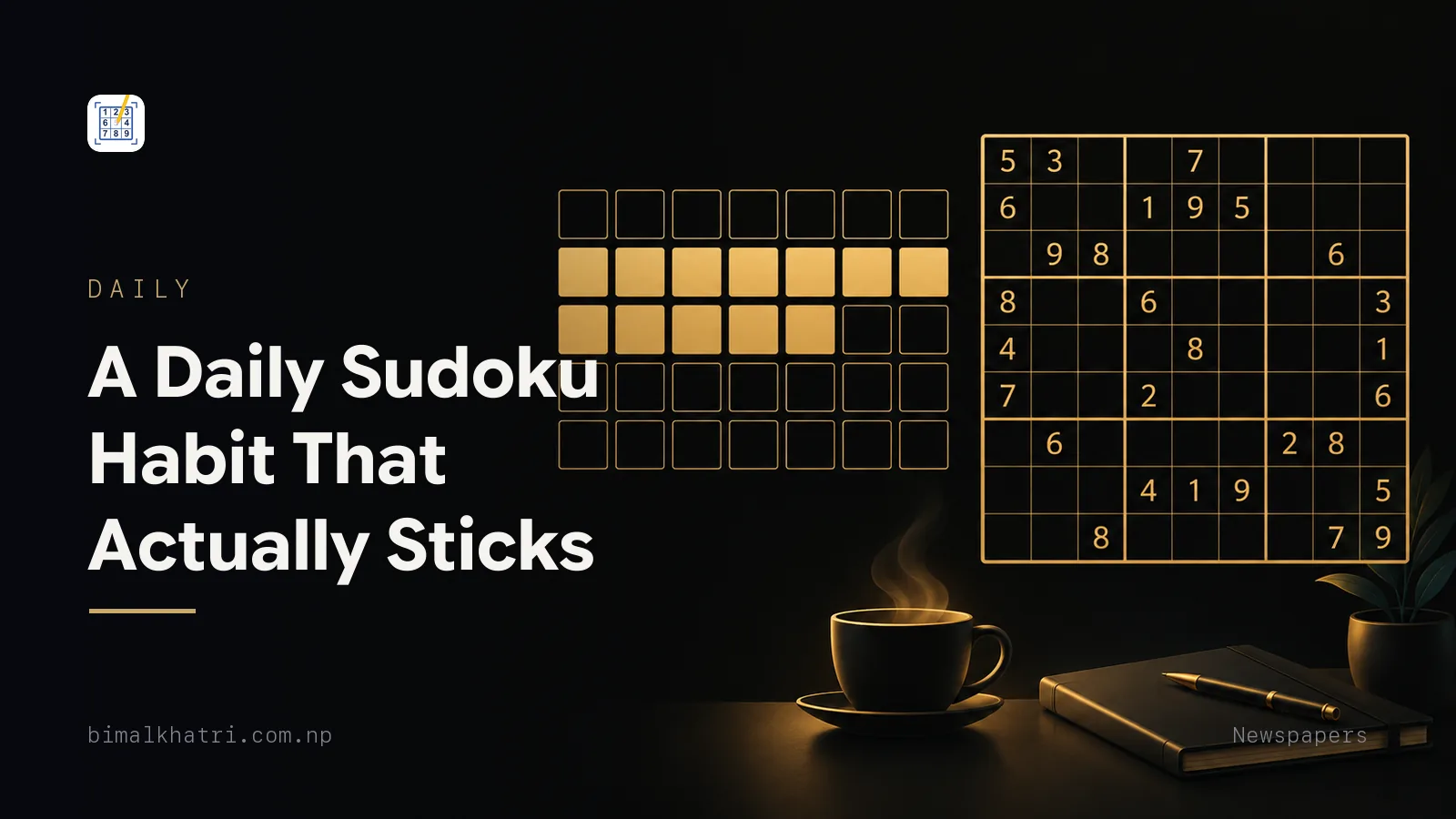
An activity heatmap is a kinder record than a streak, because it shows a month as a shape rather than a number that drops to zero over one bad Tuesday.
Where the daily puzzle comes from
| Source | What you get | What to watch |
|---|---|---|
| Printed newspaper | One grid a day, at whatever grade that paper prints | You get their grade, not yours, and the answer prints tomorrow |
| A paper's website | Often the same grid, sometimes two or three grades | Free access varies, and some sites time you whether you asked or not |
| App daily challenge | One per grade, so the slot picks the puzzle | Most reset on a schedule, so a missed day is usually gone |
| Puzzle book | You choose the grade and the pace, and nothing resets | No check button, so mistakes surface late |
| Printed sheets | Whatever you pick, at whatever size prints well | You have to remember to print them |
Any of these builds a habit. The difference is friction. The best source is the one that is already open at the moment your anchor fires, which is why the newspaper works for people who already buy a newspaper and does nothing for anybody else.
If you solve on paper, settle the checking question on day one. Waiting for tomorrow's answer grid is how a wrong digit stays a mystery for twenty-four hours, and checking the grid yourself takes about a minute.
Why do it daily, honestly
People start a daily Sudoku for their brain, and the evidence is more modest than the headlines that sold it.
The largest relevant work is the PROTECT study from the University of Exeter and King's College London, published in 2019. More than 19,000 adults aged 50 to 93 reported how often they did puzzles and then took tests of attention, reasoning and memory. The regular number-puzzle group scored better, by a margin the authors compared to several years of age-related decline.
It is observational. It shows an association, and an association is not a cause. It cannot separate "puzzles sharpened these people" from "sharp people enjoy puzzles", and the authors said as much themselves. The stronger headline version, that a daily grid protects you against dementia or Alzheimer's, has not been shown at all.
Transfer is narrow too. Practising Sudoku daily reliably makes you better at Sudoku. Evidence that it lifts unrelated mental tasks is weak, and that gap between "better at the trained thing" and "better in general" is the long-running problem in brain-training research.
What survives the scepticism is enough. It is absorbing. It is ten quiet minutes of sustained attention on something that has a right answer, which almost nothing else in a day offers. And it is a screen you can pick up that does not scroll and does not want anything from you. None of that needs a citation, because it is experience rather than science.
What I built, and what it will not do for you
I built Sudoku Master, and the daily machinery is the part that belongs here. Four challenges are generated every day, one at each grade, so the slot picks the puzzle rather than your mood. Weekly and monthly ones run alongside, three and five per grade, for anybody whose real unit is longer than a day. Each id carries its own window, so a finished daily disappears with the day. All 4,000 puzzles ship inside the download, each with its solution. No account, and no waiting on a train.
The record it keeps is the part a habit actually uses. Games completed and games lost per grade, best time, average time, lowest mistake count, the streak, and the activity heatmap.
Two settings do more for a routine than they look like they should. Game over at 3 mistakes can be switched off, which turns a rushed morning into a slow solve rather than a dead one. The timer can be hidden. Both are captured when the round starts and travel with the saved game, so a grid you park at the bus stop resumes on the settings you parked it with.
What it will not do: no sync between phones, no technique-by-technique hint engine, and classic 9x9 and nothing else. The solver hands back a finished grid, not a lesson. It is free and it carries ads, on the home and statistics screens and around the scanner, plus one interstitial on the way out of the scanner. The board itself carries none: no ads while you solve.
Moving up a grade without losing the habit
Move up when the current grade has stopped being interesting, not when a clock tells you to. The signal is boredom, not speed.
Then expect a bad fortnight. Your times get worse, your completion rate drops, and that is what learning a new technique looks like from inside. The habit is most fragile here, so protect it: keep the old grade available as the version you do on four hours of sleep. A routine with only one difficulty setting has no answer for a bad day, and bad days are the ones that decide whether a habit survives.
Learn one new technique at a time, and learn it away from the daily puzzle. Ten minutes with a naked pair on a Sunday is worth more than three ruined mornings.
Common mistakes
Doing three puzzles because you happen to have an hour. The session that builds a habit is the one you do on the day you do not have time. An hour on a Sunday buys nothing on Wednesday.
Reading one slow session as a verdict on you. It is far more often a verdict on one grid, or on the fact that it is eleven at night.
Marking up an easy grid out of habit. Writing candidates into 45 cells that would have fallen to plain scanning is four minutes spent to save none.
Questions people ask
Is it bad to do Sudoku every day?
No. There is no known downside to a daily puzzle beyond the time it takes, and the time is the point. The only thing worth watching is frustration: a grid that regularly leaves you annoyed is a grade too high, not a character flaw.
How many puzzles a day is enough?
One, on a grade that stretches you slightly. Doing six easy grids is more typing than thinking, and the technique you are missing only appears on the puzzles that need it. Volume helps speed. Difficulty helps everything else.
What time of day is best for a Sudoku?
The time you can repeat. Morning suits most people because nothing has gone wrong yet and the slot is predictable, but a puzzle at eleven at night that you actually do beats a morning one you keep missing. Consistency of the hour matters more than which hour it is.
Where can I get a free daily Sudoku?
Most newspaper sites post one a day free, puzzle sites usually post several grades, and app daily challenges are free in nearly every case. Pick whichever one is already open when your anchor fires, and stop shopping around. The switching is what kills the routine.
When does the daily puzzle reset?
It depends on the source, and it is worth checking on day one so you do not lose a day to a timezone. Newspapers roll over with the edition. Apps roll over on their own window, and in mine each challenge id carries its period, so a completed daily disappears when the day does.
Does doing Sudoku every day improve your memory?
Nobody can promise that. People who do number puzzles regularly test better on memory and reasoning, in the PROTECT study among others, but that research is observational and cannot say which way the arrow points. What is certain is that you get better at Sudoku.
What should I do if I miss a day?
Do the next one, and do not do two to make up for it. Doubling up treats the habit as a debt, and debts get abandoned. The only rule worth enforcing is never missing two days in a row.
Should I do the same difficulty every day?
Mostly yes, because a fixed grade removes a decision and makes your times comparable to each other. Keep an easier grade for short or bad days, and try one above your usual every week or two to test whether you have outgrown it.
Keep reading
- How long should a Sudoku take?, for realistic times per grade before you size your slot
- What actually makes a Sudoku easy, medium, hard or extreme, for what the label on your daily grid is really measuring
- Sudoku: rules, techniques and solving, the short version of everything in the series
- Cross-hatching: how to read a Sudoku grid quickly, the scan behind the three-step opening above
- Is Sudoku good for your brain?, for what the studies actually found
- Newspaper Sudoku: USA Today, LA Times and the Washington Post, if your daily grid comes off paper
Get it: Sudoku Master, free on iPhone and Android. Daily, weekly and monthly challenges at four grades, 4,000 classic puzzles that work offline, and no ads while you solve.