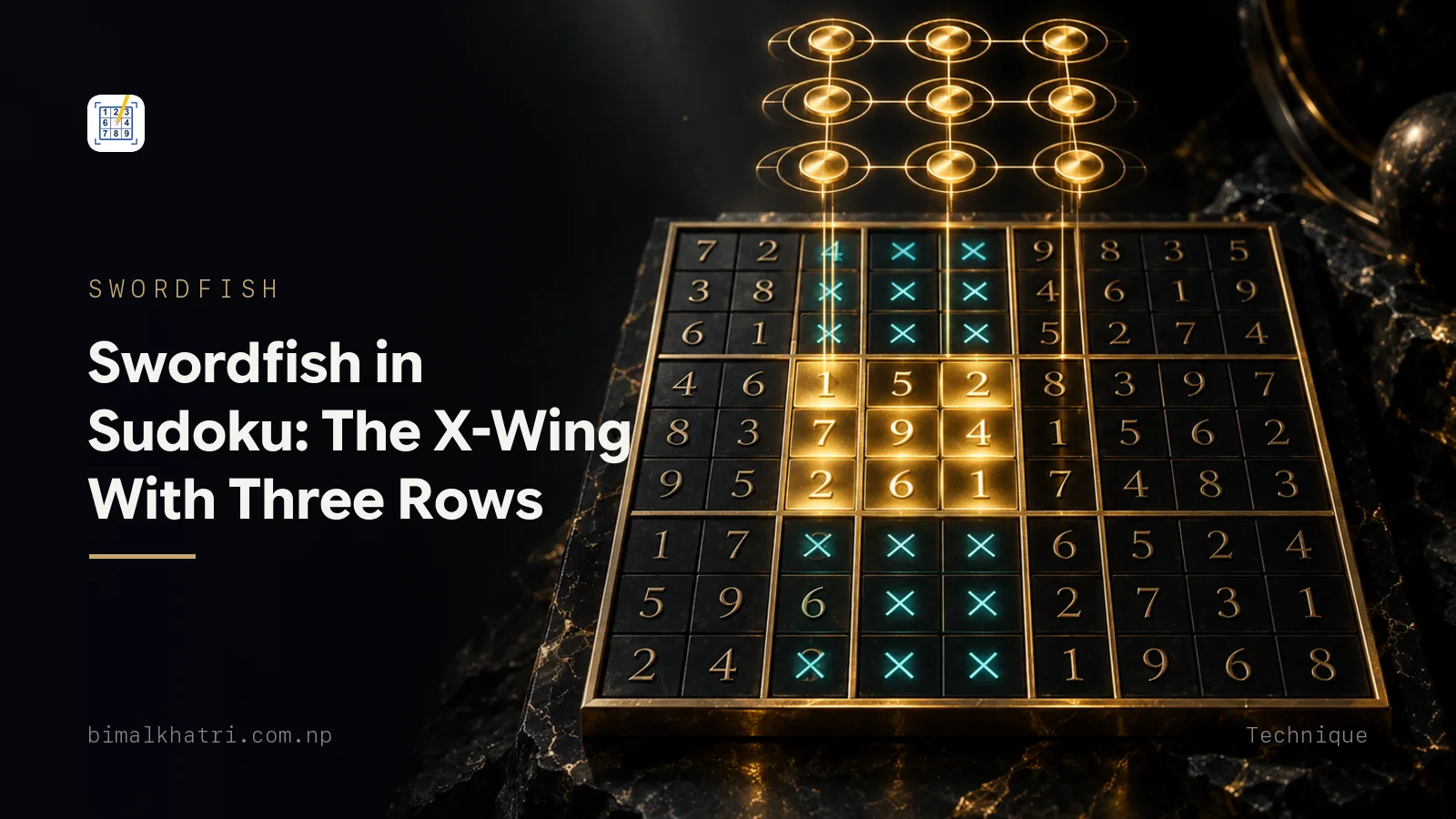
A Swordfish is an X-Wing with three rows instead of two. Pick one digit. If three rows can only take that digit inside the same three columns, those three columns are already spoken for, and the digit comes out of every other cell in them.
That is the whole technique. The part almost everyone gets wrong is the shape: the three rows do not each need three candidate cells. Two or three cells per row is fine, and the corners can be missing. The number that has to be exactly three is how many different columns the three rows use between them.
The proof is one sentence. Each of those three rows needs the digit somewhere, all three are trapped inside the same three columns, and no column takes the digit twice, so the three rows use up the three columns one each. Nobody else in those columns gets a look in.
Reading this mid-puzzle? Sudoku Master paints one digit across the whole board at a tap, which is the map a Swordfish lives inside. Free, nothing to sign up for, and no ads while you solve.
Both grids below are real and both are caught mid-solve. Work the named cells against the board printed above them and the eliminations hold.
The fish family, on one screen
Swordfish belongs to a family of patterns built on the same idea at different sizes. The names are conventions and none of them look like the animal.
| X-Wing | Swordfish | Jellyfish | |
|---|---|---|---|
| Rows in the pattern | 2 | 3 | 4 |
| Columns they may use, in total | 2 | 3 | 4 |
| Candidate cells allowed per row | 2 | 2 or 3 | 2, 3 or 4 |
| Cells in the whole pattern | 4 | 6 to 9 | 8 to 16 |
| What you delete | that digit from the 2 columns, in every other row | that digit from the 3 columns, in every other row | that digit from the 4 columns, in every other row |
Swap the words row and column and every line still reads true. Three columns that confine a digit to three rows delete it from those three rows everywhere else. Same pattern, read the other way round.
One digit at a time, always. A Swordfish never mixes digits, which is what separates it from a naked triple.
A Swordfish on the 1s
Here is an extreme puzzle fifteen moves in. Thirty-three cells are filled.
..38.....
........8
8.4.7.13.
..8.3..5.
932658.1.
756..138.
6.....82.
..79...63
3......9.
Singles have run out. So have pointing pairs and box-line reduction, and no
X-Wing on the grid deletes anything. Four naked subsets are still sitting there,
including the pair {1,4} in row 4, and not one of them places a digit. This is
the position where most people put the pencil down.
The 1s are already in three cells: r3c7, r5c8 and r6c6. Six rows still
need one. Mark every cell where a 1 can still go, using X for a live candidate
and a dot for everything else.
XX..X....
XXXXX....
.........
XX.......
.........
.........
.XXXX...X
XX..X....
.XXXX...X
Now read it as a list.
| Row | Columns a 1 can still take | Cells |
|---|---|---|
| 1 | 1, 2, 5 | 3 |
| 2 | 1, 2, 3, 4, 5 | 5 |
| 4 | 1, 2 | 2 |
| 7 | 2, 3, 4, 5, 9 | 5 |
| 8 | 1, 2, 5 | 3 |
| 9 | 2, 3, 4, 5, 9 | 5 |
Three of the six rows are down to two or three cells: rows 1, 4 and 8. Those are the only rows that can be part of a Swordfish, so there is exactly one trio to test. Put their columns together.
Row 1 uses columns 1, 2 and 5. Row 4 uses 1 and 2. Row 8 uses 1, 2 and 5. Three rows, and between them they touch three columns. That is a Swordfish on the 1s in rows 1, 4 and 8, covering columns 1, 2 and 5.
Row 4 holds two cells, not three. It changes nothing. The three 1s in rows 1, 4 and 8 have to land in columns 1, 2 and 5, one per column, whatever order they end up in.
What it deletes
Every other cell in columns 1, 2 and 5 loses its 1. Columns first, rows 2, 7 and 9 are the ones left over.
| Cell | Candidates before | The 1 goes because |
|---|---|---|
r2c1 | {1,2,5} | column 1 belongs to the fish |
r2c2 | {1,2,6,7,9} | column 2 |
r2c5 | {1,2,4,6,9} | column 5 |
r7c2 | {1,4,9} | column 2 |
r7c5 | {1,4} | column 5 |
r9c2 | {1,2,4,8} | column 2 |
r9c5 | {1,2,4,6,8} | column 5 |
Seven candidates, in one move. Column 1 only gives up one of them because
r7c1 and r9c1 are already filled, with a 6 and a 3.
What it opens
Look at r7c5. It held {1,4} and now it holds a 4, so write the 4 in. That
kills the 4 in r7c2, which was {1,4,9} and has just lost its 1 as well, so
r7c2 is a 9.
The grid does not stop there. From those two placements it runs on singles alone, seventeen cells in total, before it stalls again.
..38.4.75
5791.3.48
8.4.7.13.
..8.3..5.
932658.1.
7564.138.
69.34.82.
.8791..63
3...86.9.
Thirty-one cells left, and the whole cascade came out of seven crossed-out candidates. That is what a Swordfish is worth when it lands: not the deletions, the singles they hand back.
The same idea down the columns
Nothing about the pattern cares which way the grid runs. Here is a medium puzzle, mid-solve, with 44 cells filled.
284735916
6..84172.
71.9..8..
9423..5.1
35..19...
17.45..39
.2719.3..
8.......2
.6.....9.
No single anywhere on it. A naked pair in box 7 and a pointing pair in box 5 both exist, and neither one places a digit.
The 6s are down in three cells: r1c9, r2c1 and r9c2. Chase the rest of
them by column this time.
| Column | Rows a 6 can still take | Cells |
|---|---|---|
| 3 | 5, 6 | 2 |
| 4 | 5, 8 | 2 |
| 5 | 3, 4, 8 | 3 |
| 6 | 3, 4, 6, 7, 8 | 5 |
| 7 | 5, 6, 8 | 3 |
| 8 | 4, 5, 7, 8 | 4 |
Columns 3, 4 and 7 are the trio. Column 3 uses rows 5 and 6, column 4 uses rows 5 and 8, column 7 uses rows 5, 6 and 8. Three columns, three rows between them, so the 6s in those columns own rows 5, 6 and 8. Two of the three base columns hold only two cells each, which is the normal case rather than a special one.
The 6 now leaves every other cell in rows 5, 6 and 8: r5c8, r6c6, r8c5,
r8c6 and r8c8.
r8c5 was {6,7}. It is a 7. Then the 7s cascade: a hidden single at r4c6 in
column 6, another at r5c8 in column 8, another at r9c9 in row 9. A pattern
about 6s and the first four digits it gives you are all 7s. Eliminations do not
have to pay out in their own digit, and people miss the payoff because they
carry on staring at the digit they were hunting.
Every Swordfish has a twin
Look back at the second grid. Rows 3, 4 and 7 confine the 6 to columns 5, 6 and 8, which is a Swordfish in rows. It deletes exactly the same five candidates as the column one. That is not luck.
The digit has been placed three times, so six rows and six columns still need it, and in the finished grid each of those rows uses one of those columns. If three rows take three columns, the other three rows must take the other three. Whichever direction you spot first, the twin is already there, and the twin deletes the same cells. Finding one is finding both.
The twin has a size, and the size is a search rule worth more than the pattern itself. Count how many times the digit is already on the grid, take that from 9, and subtract 3.
| The digit is already placed | Lines still needing it | The twin is a |
|---|---|---|
| 2 times | 7 | Jellyfish, harder than what you found |
| 3 times | 6 | Swordfish, the mirror of yours |
| 4 times | 5 | X-Wing |
| 5 times | 4 | hidden single |
Read the bottom two rows again. If the digit already sits in four or more cells, any Swordfish it forms comes with an X-Wing or a hidden single that deletes the same candidates. Hunting the Swordfish there is work you did not need to do. So the search has a filter before it starts: only chase this pattern on digits that appear three times or fewer.
How to hunt one without losing an hour
The search is a loop over digits, and most digits fail it in about four seconds.
- Count the digit on the grid. Four or more copies, skip it. Three or fewer, carry on.
- List the rows that still need it, with the columns it can take in each. You need candidates you trust for this, which is the one real cost of the technique.
- Throw away every row with four or more cells. They cannot be in a three-row pattern. On the first grid above that left three rows out of six.
- If two or three rows survive, look at the columns. Two rows over two columns is an X-Wing, take it. Three rows over three columns is a Swordfish.
- Delete the digit from those columns in every row outside the pattern. Then stop and look for singles, because that is where the value is.
- Nothing? Run the same five steps down the columns. In practice the twin rule above means you rarely need to, but the shape is often easier to see one way than the other.
Step 3 is what makes this quick. A row with four candidate cells cannot be in a Swordfish, so a digit scattered across the grid is dismissed without any real thought.
The three ways it goes wrong
Demanding nine cells. The tidy picture in most books shows three rows with three cells each, and that shape is the rarest version. Rows of two are normal. Insist on the picture and you walk past most Swordfishes on the board.
Counting cells instead of columns. Three rows holding eight candidate cells between them prove nothing. The test is how many distinct columns those cells sit in. Three, and the pattern holds. Four, and there is nothing to say.
Deleting from the wrong place. The base rows keep all of their candidates. You delete from the covering columns, in the rows outside the pattern. Rubbing a candidate out of a base row is the one error here that breaks the puzzle, and it breaks it silently.
There is a fourth, quieter mistake: reaching for this at all when something simpler is live. A Swordfish sits above X-Wing on the technique ladder, and below it are naked pairs and triples, hidden pairs and pointing pairs. Clear all of those first. Both grids on this page were stuck on every one of them, which is the only honest reason to be looking at a fish.
Two of the three base rows covering only two columns between them is a Swordfish that is really an X-Wing wearing a hat. Take the X-Wing instead. It deletes the digit from those two columns in the third row too, which leaves that row one cell for the digit, which is a hidden single. The simpler pattern was strictly the better find.
I built Sudoku Master, and I will be straight about which half of this it helps with. Tapping a digit lights up every copy of it, which is most of step 1 and step 2 above, and highlighting the row, column and box of a cell keeps the column arithmetic honest. What it does not do is name the technique for you. The solver runs backtracking and returns a finished grid, so it will tell you the answer and it will never tell you that there was a Swordfish in rows 1, 4 and 8. That part stays yours.
Is it worth learning at all
Honest answer: it depends where you play. Easy and medium puzzles finish on singles, and most hard ones finish on singles, subsets and intersections. A Swordfish earns its place on the small set of grids that stall above X-Wing, and on those grids it is often the only thing on the board.
Learn it after X-Wing and around the same time as the XY-Wing, which turns up more often. Both are on the list of things to try when a hard puzzle stops moving. Neither is a licence to guess. A properly made puzzle has exactly one solution and a logical path to it, so a stall means a pattern you have not spotted yet, not a coin to flip. That argument is worked through in solving without guessing.
Questions people ask
Does a Swordfish need nine candidate cells?
No, and this is the single most common misreading. Six is enough: three rows with two cells each, as long as those cells sit in only three columns between them. Anything from six to nine cells works. The count that matters is columns, not cells.
Is a Swordfish the same as a naked triple?
No. A naked triple is three digits sharing three cells inside one row, column or box. A Swordfish is one digit spread across three rows and three columns, and the cells are nowhere near each other. They both end in the number three and that is the whole resemblance.
What is a Jellyfish?
The same pattern with four rows and four columns. Four rows that can only take a digit inside four columns delete it from those columns everywhere else. It is genuinely hard to see by eye, and by the time a grid needs one you are usually into colouring and chains instead.
What is a finned Swordfish?
A Swordfish with one extra candidate cell that spoils the pattern. The fin limits the damage: eliminations still hold for cells that share a box with the fin, because either the fin is the digit or the clean fish is. Sashimi is the same idea with a corner missing. Both are worth knowing after the plain version is automatic, not before.
Can I spot a Swordfish without marking the grid?
Yes, for that digit at least. You cannot count the columns a digit can use in a row without knowing where it can go. You do not need full marks in every cell: one digit at a time, marked across the grid, is enough, and it is faster. Pencil mark discipline matters more here than anywhere, because a stale candidate invents a pattern that is not there.
Can a Swordfish ever be wrong?
The logic cannot be. The reading of it often is. Every failure comes from a bad input: a candidate you forgot to rub out, a row with four cells counted as three, or a digit placed wrongly ten moves ago. If a Swordfish leads to a contradiction, the error is upstream.
Why is it called a Swordfish?
Nothing about the shape. The fish family names are conventions that stuck, and different books use different ones. Some call this a 3-fish, which describes it better. Read the definition rather than the name, because the pattern is the same whatever a given page calls it.
How often does a Swordfish actually turn up?
Rarely, in the sense that most puzzles never need one. Difficulty is set by the hardest technique a grid forces you into, so a puzzle that needs a Swordfish is sitting near the top of what a human solves by pattern alone. More on how that scale works in what makes a Sudoku hard.
Keep reading
- The X-Wing in Sudoku, explained with real grids, the two-row version and the one to learn first
- The XY-Wing, explained slowly, the other pattern at this level, and the one you will use more
- Advanced Sudoku techniques for extreme puzzles, for the grids that stall above a Swordfish
- Hard Sudoku: the techniques that actually move the grid, for the order to try things in
- Sudoku: the complete guide, rules through to the hard patterns, in reading order
- Every Sudoku technique, easiest to hardest, for where the fish sit on the ladder
Get it: Sudoku Master, free on iPhone and Android. The same link works on either platform.