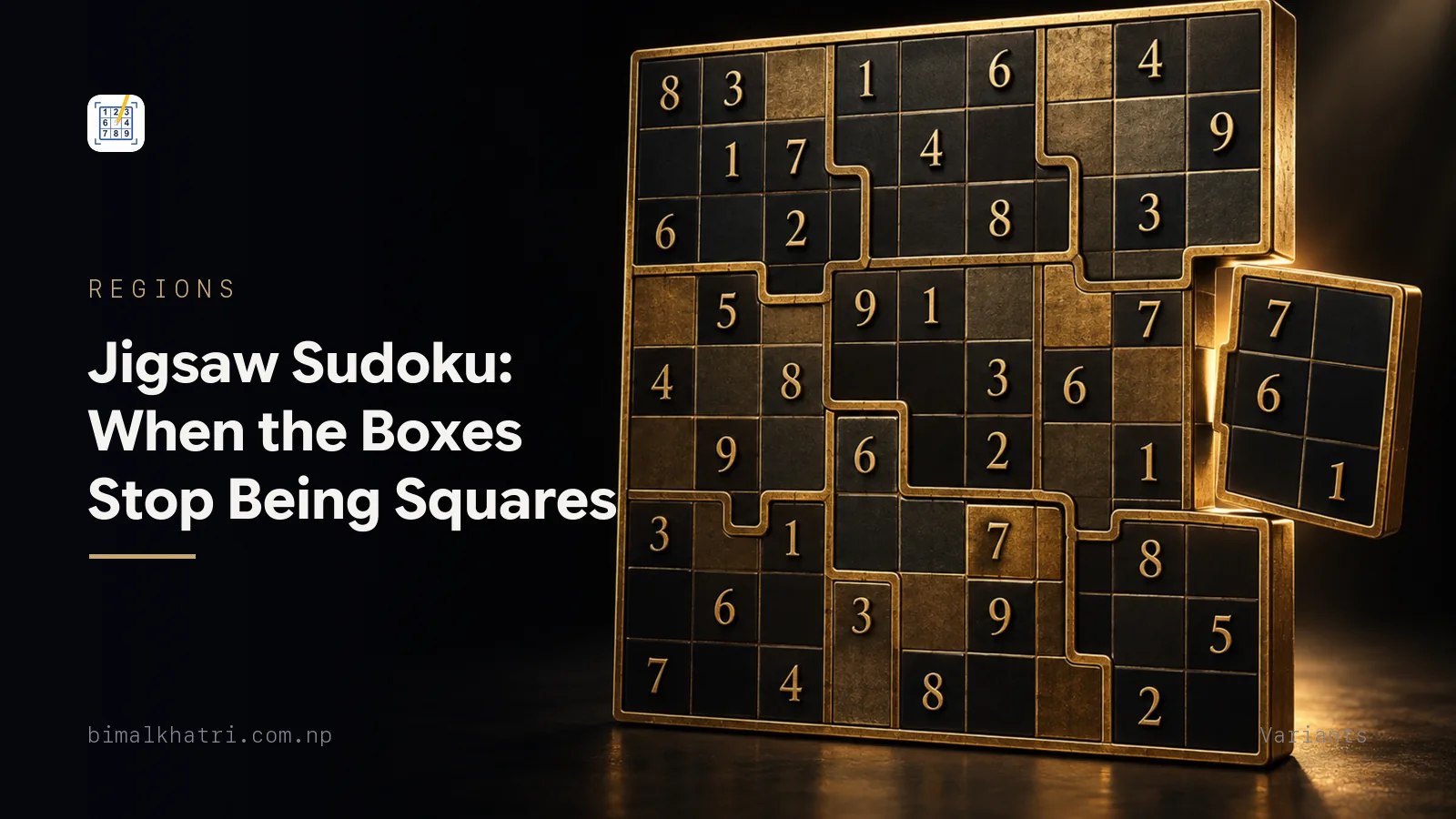
Jigsaw Sudoku changes one rule. The nine 3x3 boxes are replaced by nine irregular shapes of nine cells each, and every shape still has to hold 1 to 9 exactly once. Rows and columns are untouched.
That is the entire difference. No arithmetic, no diagonals, no extra digits. Every technique you already use still works, and the grid hands you one extra technique that a normal Sudoku cannot give you. It is called the law of leftovers and it is worked through further down this page.
The problem is that your eye is trained on a square. A region here can be four rows tall, or five columns wide, or shaped like a staircase. So the scan you run by reflex on a normal grid gives the wrong answer until you look at the shape first.
Want a grid in your pocket? Sudoku Master is free, keeps your best and average time at each of its four grades, and shows no ads while you solve. It plays classic 9x9, so treat this page as the theory.
Classic against jigsaw
| Part of the puzzle | Classic | Jigsaw |
|---|---|---|
| Rows | 1 to 9 once | Identical |
| Columns | 1 to 9 once | Identical |
| The third unit | Nine 3x3 boxes | Nine irregular shapes of nine cells |
| Cells a region shares with one row | Always 3 | Anywhere from 1 to 9 |
| Rows a region touches | Always 3 | Usually 3 or 4 |
| Bands and stacks | Three boxes in a row | They do not exist |
| Number of solutions | Exactly one | Exactly one |
| Arithmetic | None | None |
The row about shared cells is the one that matters. In a normal grid every box meets every row it touches in exactly three cells, so cross-hatching has a fixed rhythm and you stop thinking about it. Here a region might have four cells in one row and a single cell in the next. A digit placed in that row wipes out four candidates or one, and you cannot tell which without looking.
Jigsaw is also sold as irregular Sudoku. Same puzzle, same rules.
The grid on this page
Here are the nine regions. Each letter marks which region a cell belongs to.
A A A B B C C C C
A A A B B B C C C
A A D B B B B C C
A D D E E E F F F
D D D E E E F F F
D D D E E H H F F
G G G E H H H I F
G G H H H I I I I
G G G G H I I I I
Count any letter and you get nine of it. Region A is the square in the top left
with one cell bitten out at r3c3 and one added underneath at r4c1. Region H is
the awkward one: it wanders across rows 6 to 9 and columns 3 to 7, and it meets
row 9 in a single cell.
And here is the puzzle, on those regions. It has 30 clues.
. 9 . . . 1 7 4 .
1 5 . . . . . . 9
. 6 8 . . 9 1 . .
. . . . 9 4 . 7 .
9 3 . . . 6 4 . .
. 2 . 7 . 8 3 9 6
. . 9 . 7 . . 1 .
. . . . . . . . .
5 . . 1 . . . . 4
Both grids use one space between cells so they line up column for column. Put one above the other and you can read a cell's region off the letter directly above its digit. On paper, draw the region borders in before you start. Every mistake in a jigsaw puzzle traces back to somebody solving a shape they thought was there.
Row 8 is completely empty. That happens in jigsaw far more often than in classic, and it is not a misprint.
Reading a region: two moves
The 6 that only fits in one place
Take region D. Its cells are r3c3, r4c2, r4c3, r5c1, r5c2, r5c3,
r6c1, r6c2 and r6c3. Four rows tall, three columns wide, with a single cell
poking up into row 3.
D already holds 8 at r3c3, 9 at r5c1, 3 at r5c2 and 2 at r6c2. Five cells
are empty. Ask where the 6 can go.
| Empty cell in D | Blocked by |
|---|---|
r4c2 | Column 2 already has a 6, at r3c2 |
r4c3 | Nothing |
r5c3 | Row 5 already has a 6, at r5c6 |
r6c1 | Row 6 already has a 6, at r6c9 |
r6c3 | Row 6 again |
One survivor. Write 6 at r4c3.
Nothing there is new. What is new is the counting. Row 6 knocked out two cells of D at once because D has three cells in row 6, and row 3 was irrelevant because D's only cell there was full already. In a 3x3 box every row you scan removes up to three. Here it was three, then two, then one, depending on the row.
The 9 that one digit decides
Region H is the wiggly one: r6c6, r6c7, r7c5, r7c6, r7c7, r8c3,
r8c4, r8c5 and r9c5. It holds 8, 3 and 7 so far, leaving six empty cells.
Now look at the 9 at r7c3. That cell is not in region H. It is not even next to
most of it. But region H reaches into row 7 and into column 3, so that single 9
blocks r7c6 and r7c7 along the row, and r8c3 down the column. Three of the
six gone, from one given.
Column 5 finishes the job. Its 9 sits at r4c5, which rules out r8c5 and
r9c5. Only r8c4 is left, so 9 goes there.
That is the jigsaw scan in one move. A region that stretches across five columns is exposed to five columns, and a digit sitting outside it in the right place can do more damage than any digit inside it.
Where the singles stop
Keep going with nothing but naked and hidden singles and the grid gets a long way. Twenty-three placements later, this is where it dies.
. 9 . 6 . 1 7 4 .
1 5 4 . . 7 . . 9
7 6 8 4 . 9 1 . .
. 1 6 . 9 4 . 7 .
9 3 7 . . 6 4 . 1
4 2 5 7 1 8 3 9 6
6 4 9 . 7 . . 1 .
. 8 1 9 4 . . . 7
5 7 . 1 6 . 9 8 4
Fifty-three cells placed, twenty-eight to go, and no single anywhere. Look at what is missing from each region and you can see why.
| Region | Digits it still needs |
|---|---|
| A | 2, 3, 8 |
| B | 2, 3, 5, 8 |
| C | 2, 3, 5, 6, 8 |
| D | Complete |
| E | 2, 3, 5, 8 |
| F | 2, 3, 5, 8 |
| G | 2, 3 |
| H | 2, 5 |
| I | 2, 3, 5, 6 |
Almost the whole grid is waiting on the same four digits: 2, 3, 5 and 8. No digit
is rare in any unit, so no hidden single exists, and no cell is down to one
candidate. r4c1 holds {2,3,8} and will not narrow.
The law of leftovers
This is the technique jigsaw gives you and classic does not. It takes two lines of arithmetic and it can crack a grid the way an X-Wing does, except that you can find it before you place a single digit.
Take rows 1, 2 and 3 together. That is 27 cells, and between them they hold each digit exactly three times, once per row. Now take regions A, B and C together. Also 27 cells, also each digit exactly three times, once per region.
Two collections of cells, identical digit counts. So throw away the cells they have in common. Whatever is left on each side still has to carry the same digits as whatever is left on the other.
On this layout the overlap is nearly total. Rows 1 to 3 contain all of B and all
of C, and all of A except r4c1, which sits one row lower. Going the other way,
rows 1 to 3 contain one cell that belongs to none of A, B or C: r3c3, which
belongs to D.
One cell on each side. So r3c3 and r4c1 hold the same digit.
Look at the puzzle again. r3c3 is a given, and it is 8. Therefore r4c1 is 8,
and it was 8 before you made your first move. That is the cell whose candidates
would not narrow. Write it in and the puzzle restarts. Singles alone finish the
remaining twenty-seven cells, with no further technique of any kind.
A two-cell leftover on the same grid
Do it again at the bottom. Rows 7, 8 and 9 against regions G, H and I.
G and I sit entirely inside those three rows. H does not: r6c6 and r6c7 stick
up into row 6. And the three rows contain two cells that belong to none of the
three regions, r7c4 in E and r7c9 in F.
Two cells each side, so the pair r7c4 and r7c9 holds the same two digits as
the pair r6c6 and r6c7, in some order. In this puzzle r6c6 is 8 and r6c7
is 3 from the start, which fixes r7c4 and r7c9 as 3 and 8 between them, and
kills every other candidate in both. That is four eliminations from a rule you
applied without looking at a single other clue.
How to find them
- Pick a set of rows. One, two or three, next to each other or not.
- Pick the same number of regions, choosing the ones that overlap those rows most heavily.
- Cross off every cell the two sets share.
- What remains on the left holds the same digits as what remains on the right.
- Repeat with columns.
You want the leftovers small. One cell against one cell is an equality and is worth hunting for first. Two against two gives you a pair. Four against four is true but usually useless.
Do this once on a new puzzle, before you write anything, and mark the pairs in the margin. The layout does not change while you solve, so the leftovers you find at the start stay valid to the last cell.
The finished grid
2 9 3 6 8 1 7 4 5
1 5 4 2 3 7 8 6 9
7 6 8 4 5 9 1 3 2
8 1 6 5 9 4 2 7 3
9 3 7 8 2 6 4 5 1
4 2 5 7 1 8 3 9 6
6 4 9 3 7 2 5 1 8
3 8 1 9 4 5 6 2 7
5 7 2 1 6 3 9 8 4
Check the leftovers against it. r3c3 and r4c1 are both 8. r7c4 and r7c9
are 3 and 8; r6c6 and r6c7 are 8 and 3. There is a third pairing on this
layout worth spotting: columns 1 to 3 against regions A, D and G leave r8c3 on
one side and r9c4 on the other, and both of them are 1.
Which techniques survive the reshaping
Almost everything, because most techniques never mention boxes.
| Technique | On a jigsaw grid |
|---|---|
| Naked and hidden singles | Same, once you read the shape correctly |
| Cross-hatching | Same idea, but count the cells each line cuts out first |
| Naked and hidden pairs, triples | Same, inside any row, column or region |
| Pointing pairs, box-line reduction | Same rule, more lines to check |
| X-Wing, Swordfish | Untouched. They only use rows and columns |
| XY-Wing and chains | Untouched. They work on peers, whatever shape makes them |
| Law of leftovers | Jigsaw only. Nothing to find on a classic grid |
Two of those deserve a note.
Pointing pairs get more work to do. In classic you check three rows and three columns against a box. Region H here touches four rows and five columns, so there are nine intersections to test rather than six. More chances, more scanning.
Band habits stop working. On a normal grid you learn to scan three boxes in a row and reason about the whole band. There are no bands here. The nearest thing is the law of leftovers, which is the band argument done properly.
I built Sudoku Master, and it does not play this variant. It is classic 9x9, 4,000 puzzles, all of them bundled so it runs with no signal and no account. The part that carries over to irregular grids is the discipline. This kind of puzzle punishes stale pencil marks harder than a normal one does, because a wrong region boundary in your head produces marks that look reasonable and are not, so the setting that clears notes automatically when you place a value is the one worth turning on. For the irregular grids themselves, a variant puzzle book or a dedicated site is where to look.
Four things that go wrong
Solving the box you expected. You scan what looks like a 3x3 square, place a digit, and twenty moves later the grid contradicts itself. On paper, trace every region border with a pen before the first digit. On screen, tap a cell and check that the region highlight matches the shape you were about to use.
Assuming a region touches three rows. Region A on this page touches four. Region H touches four rows and five columns. Before you cross-hatch, count.
Treating a full row as a wasted scan. A row that already holds eight digits is your best tool here, not a dead end, because the one region it slices through in four cells loses four candidates at once.
Skipping the leftovers because the puzzle looks easy. They cost thirty seconds and they are found from the layout alone. The grid on this page needed one of them, and singles took it the rest of the way.
Questions people ask
Is jigsaw Sudoku harder than a normal Sudoku?
At the same clue count, usually yes, because the shapes remove the pattern recognition you built up on squares. But clue count is not difficulty in either game. A jigsaw puzzle with an obvious opening region can be easier than a hard classic grid, and the law of leftovers sometimes makes it much easier.
Does the law of leftovers work on an ordinary Sudoku grid?
No, and the reason is worth seeing. Take rows 1 to 3 and boxes 1, 2 and 3 on a classic grid. They are the same 27 cells, so both leftovers are empty and there is nothing to say. The technique only has something to work on when a region spills out of the band, which is exactly what irregular shapes do.
Can a jigsaw Sudoku have fewer than 17 clues?
Quoting 17 at a jigsaw puzzle is quoting the wrong result. That floor was established for classic grids, and it says nothing about a puzzle whose nine regions are shaped differently. Redraw the borders and the question opens again for that layout. The seventeen-clue result covers what was actually proved and how.
Do the region shapes change from puzzle to puzzle?
Yes, and that is the point. Nothing standardises the shapes the way the nine boxes are standardised in classic Sudoku. A given book may reuse one layout throughout or change it every page, so read the borders before every puzzle.
Can I still use naked pairs and X-Wings on a jigsaw grid?
Yes, all of them. A naked pair works in any unit, and a region is a unit. X-Wing and Swordfish never mention boxes at all, so they transfer untouched. Only cross-hatching needs relearning, and only because the counting differs.
What is the difference between jigsaw Sudoku and Killer Sudoku?
Jigsaw changes the shape of the third unit and adds no arithmetic. Killer Sudoku keeps the ordinary 3x3 boxes and adds dashed cages with a target sum, where the digits inside a cage cannot repeat. One is a geometry change, the other is a sums puzzle laid on top of a normal grid.
Can any nine shapes be used as jigsaw regions?
No. Some layouts admit no valid filling at all. The law of leftovers is the quickest way to see why: if a layout leaves one cell on each side and those two cells share a row, a column or a region, then they must hold the same digit and must hold different digits, so nothing can be placed. A good setter tests the layout before drawing a single clue.
How should I pencil mark a jigsaw puzzle on paper?
Draw the borders first, in a heavier line than the grid. Then mark candidates for one digit at a time rather than filling every cell, because the region shapes make a full candidate grid slow to build and easy to get wrong. And do the leftovers before anything else, since they come from the layout and never expire.
Keep reading
- Types of Sudoku, from classic to Samurai, for where this variant sits in the family
- Killer Sudoku: the rules and the cage sums worth memorising, the other variant people try next
- Sudoku X: what two diagonals change, a variant that adds a unit instead of reshaping one
- Sudoku, from the rules up, the overview this page sits inside
- Pointing pairs and box-line reduction, which has more intersections to check on an irregular grid
- Every Sudoku technique, easiest to hardest, for what to reach for when the leftovers run out
Get it: Sudoku Master, free on iPhone and Android. It plays classic grids, and the link picks the right store for your phone.