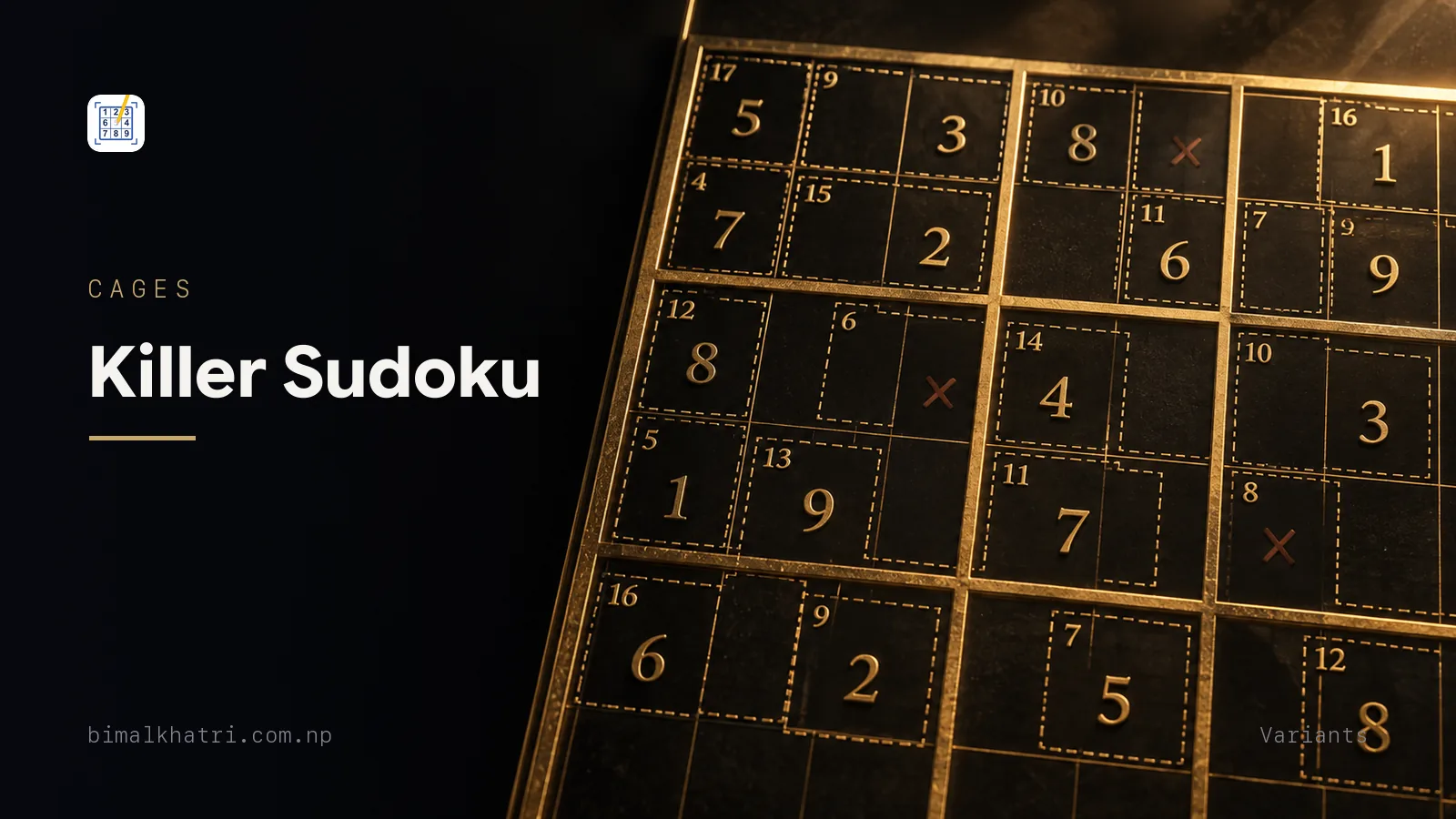
Killer Sudoku is ordinary Sudoku with one rule bolted on. The grid is carved into dashed shapes called cages, each printed with a small sum in its top left corner, and the digits inside a cage must add up to that sum without repeating.
Everything else is the game you already know. Nine rows, nine columns, nine 3x3 boxes, the digits 1 to 9, no repeat in any of them. The cages sit on top of those constraints rather than replacing them.
What puts people off is the blank start. Most Killer puzzles arrive with no given digits at all, so the first move has to come out of arithmetic instead of out of a number you can already see. That is what the sum tables below are for. Learn a dozen cage sums and the opening stops being a blank page.
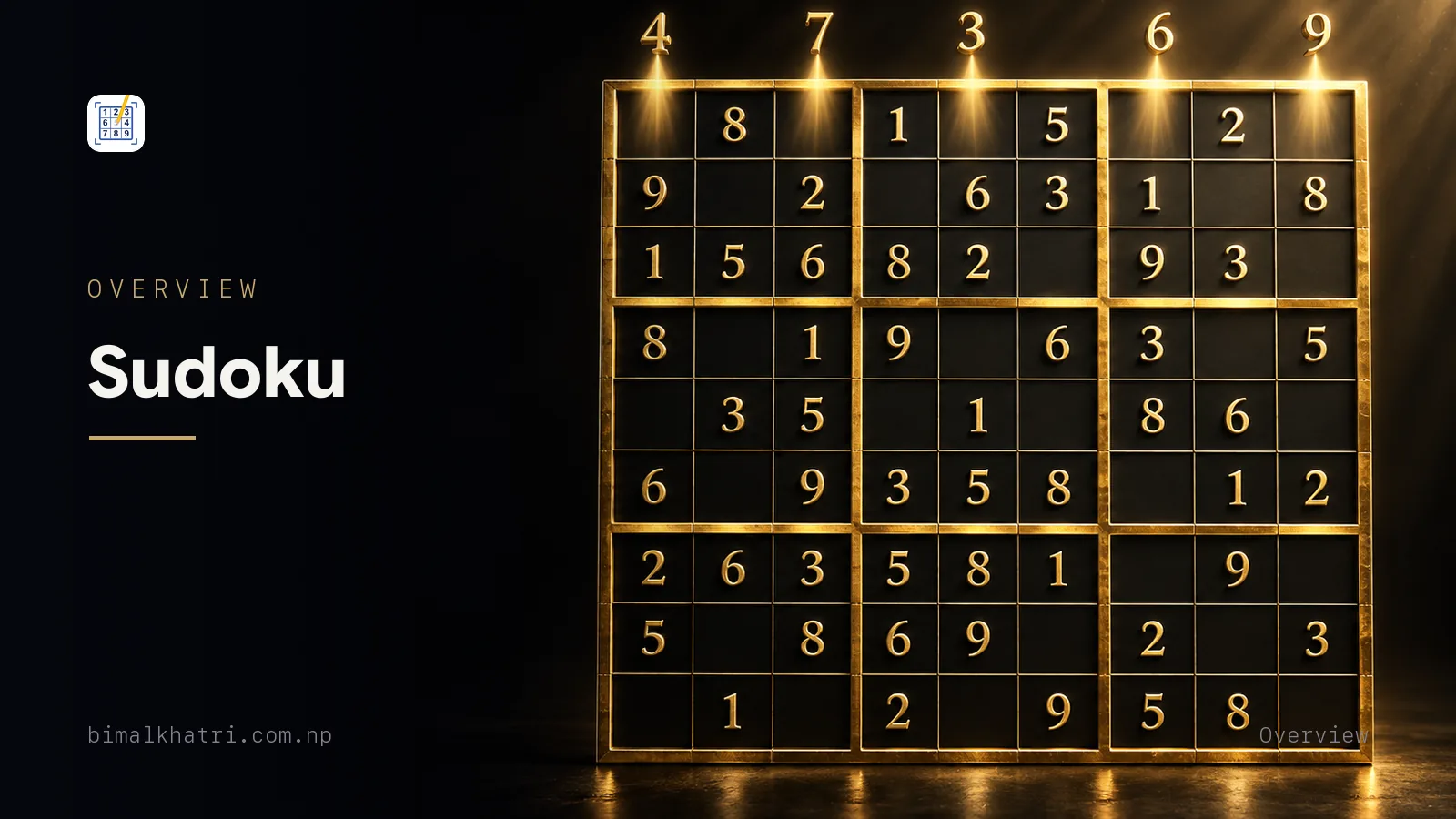
No cages, but the same grid underneath. Sudoku Master is the plain 9x9 game, free, with all 4,000 of its puzzles bundled in the app so it never wants a connection. No ads while you solve.
The rules, all of them
| Rule | What it means in practice |
|---|---|
| The classic constraints still hold | Every row, column and 3x3 box holds 1 to 9 once each |
| A cage adds to its number | The sum in the corner is the total of every digit in the dashed outline |
| A cage never repeats a digit | Two 4s in one cage is illegal even when the cells are in different rows, columns and boxes |
| Cages ignore the printed lines | One cage can straddle two boxes, two rows or both |
| A cage holds 1 to 9 cells | Every cell belongs to exactly one cage |
| A proper puzzle has one solution | If yours has two, it is broken rather than hard |
The no-repeat rule inside a cage is the one that does the work. A two-cell cage sitting in one row would forbid a repeat anyway, because the row does. A two-cell cage split across a box boundary would not, and the cage rule steps in and forbids it there too. Treat the cage as a fourth kind of unit and you will not get caught.
Two consequences fall straight out of that. A one-cell cage is a given wearing a costume: a cage of 7 in a single cell means the cell is a 7. And a nine-cell cage always sums to 45, so it tells you nothing at all.
The 45 rule, which is just addition
Add the digits 1 to 9 and you get 45. Since every row, column and box holds each digit once, every row, column and box sums to 45. That single number is the most useful thing on this page.
Use it in two directions.
Innies. If the cages covering a box leave one cell out, that cell equals 45 minus the total of those cages.
Outies. If the cages covering a box spill one cell over the edge, that spare cell equals the total of the cages minus 45.
There is a worked outie further down that hands you a digit before you have written a single pencil mark. The same trick works on a row, on a column, and on whole bands of three boxes, where the target is 135 rather than 45.
The cage sums worth memorising
A cage of n cells has a smallest possible total and a largest possible total, and near those two ends only one combination fits. Those are the cages that give you real information.
| Cells | Lowest sum | Highest sum |
|---|---|---|
| 2 | 3 | 17 |
| 3 | 6 | 24 |
| 4 | 10 | 30 |
| 5 | 15 | 35 |
For every cage size, the two lowest totals and the two highest totals have exactly one combination each. That is the whole memorisation job, and it is sixteen lines.
| Cells | Sum | The only digits that fit |
|---|---|---|
| 2 | 3 | {1,2} |
| 2 | 4 | {1,3} |
| 2 | 16 | {7,9} |
| 2 | 17 | {8,9} |
| 3 | 6 | {1,2,3} |
| 3 | 7 | {1,2,4} |
| 3 | 23 | {6,8,9} |
| 3 | 24 | {7,8,9} |
| 4 | 10 | {1,2,3,4} |
| 4 | 11 | {1,2,3,5} |
| 4 | 29 | {5,7,8,9} |
| 4 | 30 | {6,7,8,9} |
| 5 | 15 | {1,2,3,4,5} |
| 5 | 16 | {1,2,3,4,6} |
| 5 | 34 | {4,6,7,8,9} |
| 5 | 35 | {5,6,7,8,9} |
One more freebie. An eight-cell cage leaves exactly one digit out of the nine, so its sum is 45 minus the missing digit. A cage of 8 cells summing to 40 is missing the 5, and every other digit is in there.
The near-misses matter almost as much, because a cage with two combinations still pins something down.
- Two cells summing to 5 is
{1,4}or{2,3}, so neither cell can hold 5 or anything above it. - Three cells summing to 8 is
{1,2,5}or{1,3,4}. Both contain a 1, so that cage holds a 1 wherever it sits. - Three cells summing to 22 is
{5,8,9}or{6,7,9}. Both contain a 9. - Four cells summing to 12 is
{1,2,3,6}or{1,2,4,5}. No 7, 8 or 9 can be in it, and a 1 and a 2 both are.
You do not need the full combination table printed in the back of the book. You need the trick that generates it: fill the cage with the smallest legal digits, see how much slack is left, and hand the slack to the largest cell. A four-cell cage of 12 starts at 1+2+3+4, which is 10, leaving 2 to spare. Push it all into the last cell and the biggest digit possible is 6.
A worked opening: one box, five cages
Here is the top left corner of a Killer grid with the rest cut away. Each letter is a cage.
ABB......
ACC......
EDD......
FFG......
HHG......
III......
..I......
.........
.........| Cage | Sum | Cells |
|---|---|---|
| A | 11 | r1c1, r2c1 |
| B | 7 | r1c2, r1c3 |
| C | 9 | r2c2, r2c3 |
| D | 17 | r3c2, r3c3 |
| E | 1 | r3c1 |
| F | 13 | r4c1, r4c2 |
| G | 15 | r4c3, r5c3 |
| H | 6 | r5c1, r5c2 |
| I | 12 | r6c1, r6c2, r6c3, r7c3 |
Cages A to E tile box 1 exactly. Work them in order of how much they give you.
Cage E is one cell and its sum is 1. So r3c1 is a 1. Write it in.
Cage D is two cells summing to 17, which only 8 and 9 can do. You do not know which is which and it does not matter yet. Both cells are in row 3 and both are in box 1, so 8 and 9 are now gone from every other cell of row 3 and every other cell of box 1. Arithmetic just handed you a naked pair.
Now the box arithmetic. Box 1 sums to 45. You have placed the 1 and locked 17 into cage D, so the other six cells hold 2, 3, 4, 5, 6 and 7 in some order, totalling 27. Check that against the cages: 11 plus 7 plus 9 is 27. The sums agree, which means you copied them correctly. Do that check on every box before you trust a deduction built on it.
Cage A, two cells summing to 11. The options are {2,9}, {3,8}, {4,7}
and {5,6}. Cage D owns the 8 and the 9, so the first two die. Cage A is
{4,7} or {5,6}.
Cage B, two cells summing to 7. The options are {1,6}, {2,5} and
{3,4}. The 1 is already sitting at r3c1, so cage B is {2,5} or {3,4}.
Cage C, two cells summing to 9. The options are {1,8}, {2,7}, {3,6}
and {4,5}. Drop the 1 and the 8 and three survive.
Those three cages have to share out 2, 3, 4, 5, 6 and 7 with nothing left over, and only two ways of doing it fit:
| Arrangement | Cage A | Cage B | Cage C |
|---|---|---|---|
| First | {4,7} | {2,5} | {3,6} |
| Second | {5,6} | {3,4} | {2,7} |
The box will not settle itself, and that is normal. Look at where the 7 goes in each: in the first arrangement it is in column 1, in the second it is in row 2. So one fact from outside decides the whole box. Cross-hatch the 7 down from boxes 2 and 3, or across from the rest of column 1, and five cages collapse at once.
Count what a minute of addition bought. One digit placed, a naked pair, and three cages cut to two candidates each, on a grid that started with nothing written on it.
The outie that gives you a digit for nothing
Now look at box 4, the three rows below. Cages F, G and H sit inside it and
cover six cells. Cage I covers the other three cells of box 4 and then reaches
down into r7c3, which belongs to box 7.
Add the four sums.
| Cage | Sum |
|---|---|
| F | 13 |
| G | 15 |
| H | 6 |
| I | 12 |
| Total | 46 |
Those four cages cover all nine cells of box 4, which come to 45, plus exactly
one cell that does not belong to it. So r7c3 is 46 minus 45, which is 1.
No candidates. No pencil marks. One digit placed in a box you have not even looked at yet. Innies and outies are the reason experienced Killer solvers spend their first two minutes adding rather than writing, and on grids with no givens they are often the only way in.
How to open a Killer grid
- Add the cage sums box by box. Any box whose cages tile it exactly gives you a check. Any box with a spare cell or a spilling cage gives you a digit.
- Ring every unique-sum cage. Two cells at 3, 4, 16 or 17. Three cells at 6, 7, 23 or 24. Those are your givens.
- Turn each of those into an elimination. A unique two-cell cage whose cells share a row, a column or a box is a naked pair, and it clears both digits out of that whole unit.
- Apply the size limits everywhere else. A low sum caps the biggest digit in the cage, a high sum raises the smallest, and both narrow cells you have not thought about yet.
- Only then start on candidates, and only in the boxes the first four steps have already dented.
- From there it is ordinary Sudoku. Singles, pairs, pointing pairs, all of it, with the cage sums as an extra source of eliminations rather than a replacement for the usual ones.
The rhythm is different from a classic grid. On a classic puzzle you scan for a digit that has nowhere else to go. On a Killer you add, subtract, and only scan once the addition has stopped paying.
What the cages change, and what they leave alone
Every classic technique still works, because every classic constraint is still there. Naked pairs, hidden singles, pointing pairs and box-line reduction all behave exactly as they do on a plain grid. The cages simply give you more ways to reach the same eliminations, and they usually reach them earlier.
The differences worth knowing:
Difficulty is not about clue count here. A Killer with no givens can be gentler than a hard classic grid, because a well-built cage layout leaks information from the first minute. The cage shapes matter more than the number of digits printed on the page, which is zero either way.
Arithmetic is not the hard part. All of it is addition and subtraction inside 45. If you can add 8 and 9 you have the maths. What takes practice is noticing which cage is worth adding up.
Big cages are usually noise. A six-cell cage in the middle of the grid rules out very little on its own. Work the small ones and the box totals, and let the big cages fall out at the end.
I built Sudoku Master. There are no cages in it anywhere: nine ordinary boxes, digits 1 to 9, nothing on the page to add up. Caged puzzles want a book or an app written for them, and sending you to one costs me nothing. What the app is for is the second half of every Killer grid, the stretch after the arithmetic has stopped paying, when you are back to hunting singles like anybody else.
Mistakes that cost people the grid
Treating a cage total as a set of digits in order. The sum tells you which digits are in the cage, never which cell holds which. A 17 in two cells is 8 and 9 in one order or the other, and guessing the order is guessing.
Forgetting that a cage bans repeats across box lines. This is the single most common slip. A cage that crosses from box 1 into box 2 still cannot hold two 6s, even though nothing else on the grid would stop it.
Adding the cages of a box and getting 45 without checking the cells. The total only means something if those cages cover every cell of the box exactly once. Miss a spilling cell and you will place a digit that is off by whatever that cell held.
Writing candidates before adding. Pencil marks on a blank Killer grid means writing 1 to 9 into eighty-one cells. Do the cage arithmetic first and half of those marks never get written.
Reading the sum as the cell count. The little number in the corner is a total, not a size. A 12 can be two cells, three cells or four.
Questions people ask
Is Killer Sudoku harder than normal Sudoku?
At the same billed difficulty, usually yes for a first-timer and not for long. The blank grid is the shock. Once the sum tables and the 45 rule are in your head, a medium Killer takes about as long as a medium classic, because the cages give back the information the missing givens took away.
Do you need to be good at maths to solve one?
No. Every calculation in the game is adding small whole numbers, and the biggest total on the grid is 45. There is no multiplication, no algebra, and nothing you cannot do on your fingers. The skill being tested is logic, the same as always.
Can a cage cross into another box?
Yes, and most do. Cages ignore the printed box lines completely. A cage may cover cells in two boxes, in three rows, or wrap around a corner, and the no-repeat rule follows it wherever it goes.
What is the 45 rule?
The digits 1 to 9 add to 45, so every row, every column and every 3x3 box sums to 45. Compare that against the cages covering a unit and any leftover cell falls out by subtraction. It is the workhorse technique of the whole variant.
How do you start when there are no numbers on the grid?
Find the unique-sum cages first: two cells at 3, 4, 16 or 17, three cells at 6, 7, 23 or 24. Each of those is a fixed set of digits. Then run the 45 rule over every box to look for an innie or an outie. One of the two almost always opens the grid.
How big can a cage get?
Nine cells, and at that size it must sum to 45 and tells you nothing. In practice most puzzles stay between one and five cells, because a cage larger than that rules out very little.
Does a Killer puzzle always have exactly one solution?
A properly made one does, exactly as in the classic game. If you reach a point where two different digits both work and nothing in the grid can separate them, either the puzzle is faulty or there is a technique you have not applied yet. Assume the second one first.
Can two cages have the same sum?
Yes, as often as the setter likes. The sums are not labels and they are not
unique. Two 17-cages in the same box are perfectly legal, and if both hold two
cells, both are {8,9}, which is worth spotting rather than worrying about.
Keep reading
- Types of Sudoku, from classic to Samurai, for where the caged version sits among the other variants
- How to play Sudoku: the complete rules, the base game that all of this is built on
- Naked pairs, triples and quads, because a two-cell 17 is a naked pair and should be used as one
- The complete Sudoku guide, the whole series in one page, if you want the map before the detail
- Jigsaw Sudoku: when the boxes stop being squares, the other variant that changes the shape of the grid
- Samurai Sudoku: five grids, one puzzle, if you want scale rather than arithmetic
Get it: Sudoku Master, free on iPhone and Android. Classic 9x9 across four grades, and no ads while you solve.