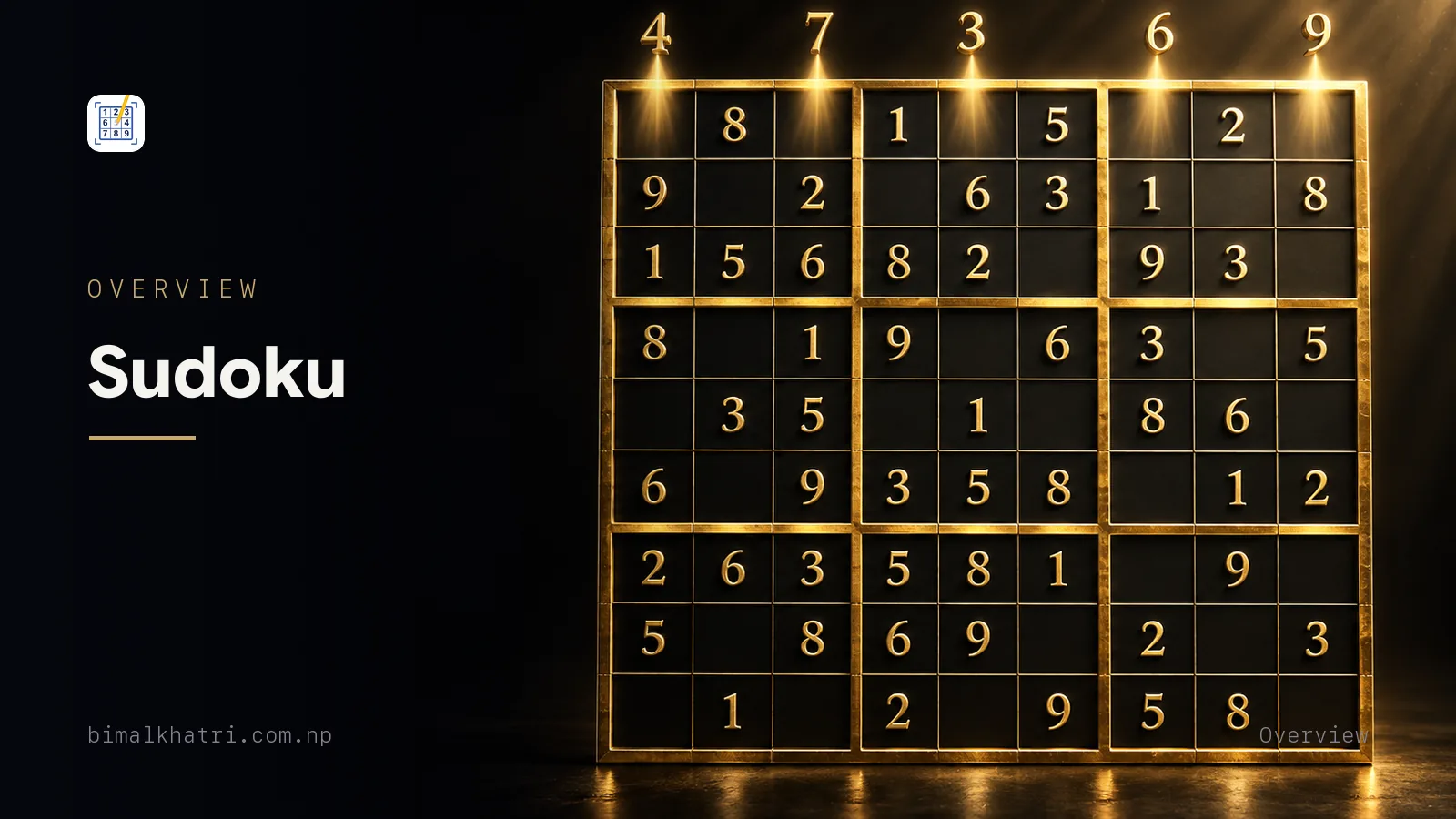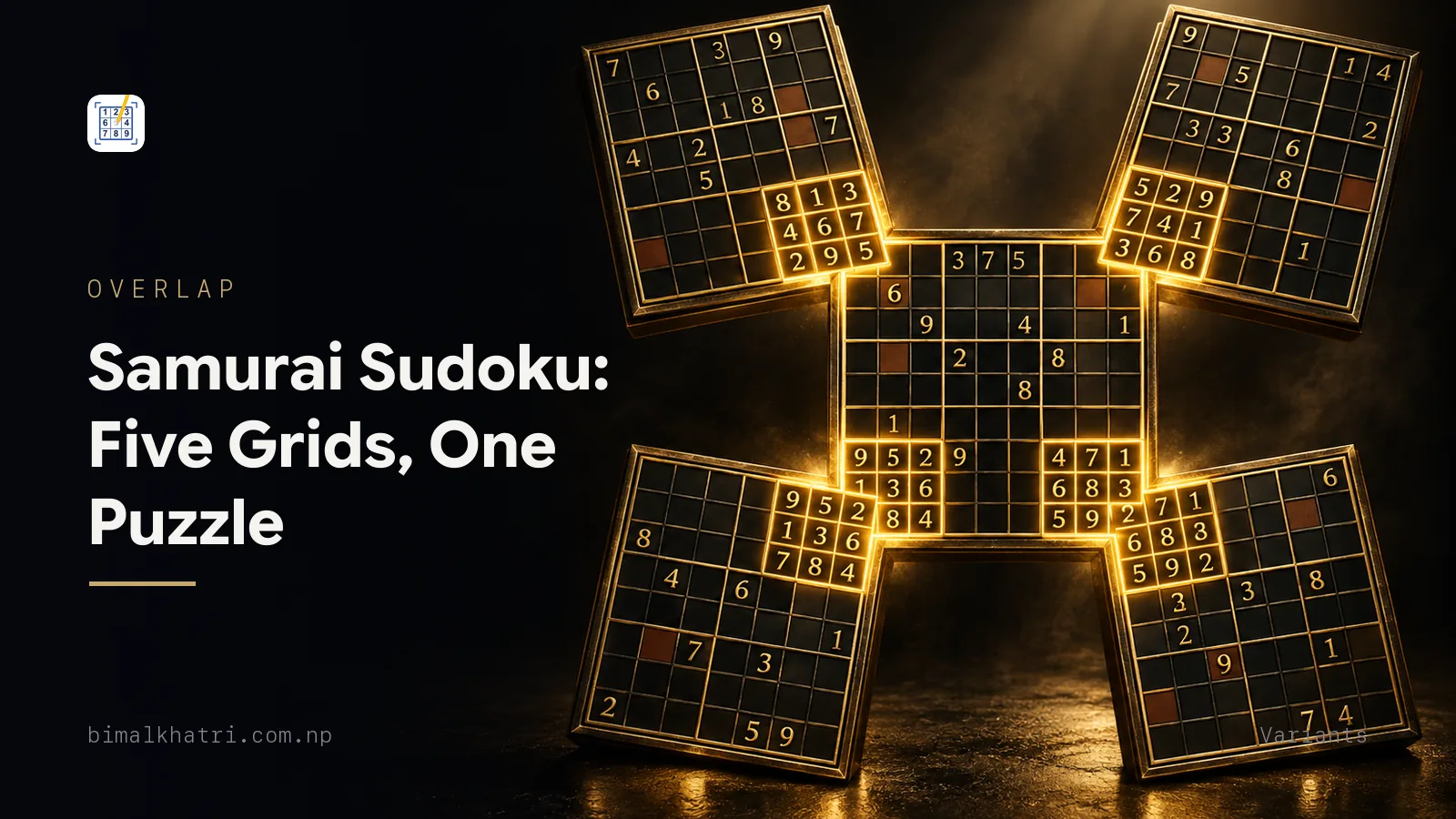
A samurai Sudoku is five ordinary Sudoku grids overlapping in an X, and it adds no new rule. Each of the five obeys the one you already know: the digits 1 to 9, once each, in every row, every column and every 3x3 box of that grid.
What changes is geography. Four boxes belong to two grids at once, so a digit written in one of those boxes has to satisfy both grids at the same time. That is the entire difference. It is also the only reason the puzzle is worth doing, because it produces a move a single grid can never make.
Below: the shape, that move worked in full, and a real 98-clue samurai to try it on.
The shape
Letters mark which grid a cell belongs to, and # marks the four shared boxes.
AAAAAAAAA   BBBBBBBBB
AAAAAAAAA   BBBBBBBBB
AAAAAAAAA   BBBBBBBBB
AAAAAAAAA   BBBBBBBBB
AAAAAAAAA   BBBBBBBBB
AAAAAAAAA   BBBBBBBBB
AAAAAA###CCC###BBBBBB
AAAAAA###CCC###BBBBBB
AAAAAA###CCC###BBBBBB
      CCCCCCCCC
      CCCCCCCCC
      CCCCCCCCC
DDDDDD###CCC###EEEEEE
DDDDDD###CCC###EEEEEE
DDDDDD###CCC###EEEEEE
DDDDDDDDD   EEEEEEEEE
DDDDDDDDD   EEEEEEEEE
DDDDDDDDD   EEEEEEEEE
DDDDDDDDD   EEEEEEEEE
DDDDDDDDD   EEEEEEEEE
DDDDDDDDD   EEEEEEEEE
Four grids sit at the corners of a 21 by 21 square. The fifth sits in the middle, pushed six rows down and six columns across, which lands each of its corner boxes exactly on a corner box of one outer grid.
Now count the cells. Five grids of 81 is 405. Four boxes get counted twice, so take off 36. A samurai has 369 cells. The 21 by 21 square holds 441, and the 72 left over are the four notches, printed blank because they are not part of the puzzle at all.
| The shared box | In the outer grid | In the centre grid |
|---|---|---|
| Top left | the top-left grid's box 9 | box 1 |
| Top right | the top-right grid's box 7 | box 3 |
| Bottom left | the bottom-left grid's box 3 | box 7 |
| Bottom right | the bottom-right grid's box 1 | box 9 |
One thing to notice before you start solving. The four outer grids never touch each other. The top-left grid and the top-right grid share nothing, so anything one of them works out reaches the other only by passing through the centre.
Solving on a phone? Sudoku Master is the classic 9x9 game: 4,000 puzzles, a camera that reads a printed grid, and no ads while you solve. Free on iPhone and Android.
Two addresses for the same cell
Inside any one grid the usual notation works. Rows 1 to 9 from the top, columns
1 to 9 from the left, so r4c7 means row 4, column 7. A samurai needs the grid
named too, because 36 cells answer to two names.
Take the box shared by the bottom-left grid and the centre. It is the bottom-left grid's box 3, sitting at that grid's rows 1 to 3 and columns 7 to 9. It is also the centre grid's box 7, at the centre's rows 7 to 9 and columns 1 to 3. Same nine cells, same nine digits, two coordinate systems laid over them.
The top-right cell of that box is r1c9 in the bottom-left grid and r7c3 in
the centre. Get used to saying both. Half the mistakes people make in a samurai
come from placing a digit in one grid and forgetting to look at it in the other.
Twenty peers become thirty-two
A cell's peers are the cells that may not repeat it, and an ordinary grid gives every cell 20 of them. A shared cell answers to two grids, so it has to be counted twice over.
| Where the peers come from | Cells it adds |
|---|---|
| Bottom-left grid, row 1 | 8 |
| Bottom-left grid, column 9 | 8 |
| Centre grid, row 7 | 6, since two of its eight are already in the row above |
| Centre grid, column 3 | 6, same overlap on the column |
| The shared box | 4, the rest being counted already |
| Total | 32 |
Twelve more constraints than an ordinary cell, on every one of the 36 shared cells. That cuts both ways, and both ways are useful. Those cells are the easiest in the puzzle to pin down, and a wrong digit in one of them poisons two grids instead of one. You usually catch it fast for the same reason.
A samurai to solve
Here is a real one. Blanks inside a grid are . as usual, and the wide gaps are
the notches.
.........   .....62..
6....5...   ...83..46
.89....7.   .3..2....
7...9.16.   .8....76.
.9.24..8.   ..3....2.
3..6.1...   ..41....5
...7......6...79....4
.3.9..6.............3
.2........25..9..8.5.
      ..84.....
      ..1.7...4
      .....9...
..8..........7..6.3..
....9......16.......1
...7.4.82.....5....2.
..58.....   9....74..
......6..   ...8....6
4.61.3.7.   3..6.....
8......4.   ..1......
...2...6.   ....74..8
..2.178..   .36.8.2..
That is 98 clues across 369 cells, and every move in it is a single: a cell with one candidate left, or a digit with one home left in some row, column or box. No pairs, no rectangles, nothing above hidden singles. Take any one of the 98 clues away and it stops falling to singles alone.
Long rather than hard. Most good samurai are built that way, because 369 cells of genuinely difficult logic would be a punishment rather than a puzzle.
The move only a samurai has
Work the box shared by the bottom-left grid and the centre.
Here is the bottom-left grid pulled out on its own. It is a fragment of the samurai, not a complete puzzle: treated as a standalone Sudoku it has 817 different completions.
..8......
....9....
...7.4.82
..58.....
......6..
4.61.3.7.
8......4.
...2...6.
..2.178..
The shared box is this grid's box 3, top right, rows 1 to 3 and columns 7 to 9:
...
...
.82
Seven cells to fill. Ask where the 6 goes.
Column 7 already has a 6, at r5c7. Column 8 already has one, at r8c8. Rows
1, 2 and 3 have none, so they say nothing at all. That leaves column 9, and
r3c9 is the 2, so the 6 is at r1c9 or r2c9.
Two cells. This grid has nothing more to give on that digit, and a solver looking only at these 81 cells would now have to guess.
So look at the same box from the other side. This is the centre grid, also a fragment, also unsolvable on its own:
....6...7
6........
....25..9
..84.....
..1.7...4
.....9...
.......7.
.....16..
.82.....5
The shared box is this grid's box 7, bottom left, rows 7 to 9 and columns 1 to 3. Same nine cells, same 8 and 2 sitting in the bottom row, new address.
Where does the centre grid put its 6? Row 8 has one at r8c7. Column 1 has one
at r2c1. Rows 7 and 9 are clear of 6s, and so are columns 2 and 3. That leaves
row 7, at r7c2 or r7c3.
Two cells again. Stuck again.
Now put the two readings on the same box. The bottom-left grid says the 6 is somewhere in the right-hand column. The centre grid says it is somewhere in the top row. A row and a column meet exactly once.
..6
...
.82
That cell is r1c9 of the bottom-left grid and r7c3 of the centre. Neither
grid could place it. Together they place it without a guess, and the digit
immediately does two jobs: it clears column 9 of the bottom-left grid and row 7
of the centre.
That is the samurai move, and it is the only new one. Everything else on the page is ordinary Sudoku, done five times.
The order to work in
The technique list does not change, so the skill being tested is really bookkeeping. This order keeps the bookkeeping small.
- Cross-hatch all five grids before you write a single pencil mark. Samurai clues are thin per grid and scanning picks up a surprising amount of them.
- Work one grid until it stalls, then move on. Staring at a stalled grid costs you the same here as anywhere.
- The moment you place a digit inside a shared box, stop and switch to the other grid that owns that box. That digit is worth more there than whatever you were about to do next.
- When a grid stalls, go and read its shared boxes in the neighbour's coordinates. That is where the unstick lives, nine times out of ten.
- Only start pencil marks once scanning has truly stopped, and only for one grid at a time. Marking 369 cells up front is not a plan, it is an afternoon.
- Mark a shared box once, then read those marks from both sides. Two copies of the same box drift apart, and the drift is silent.
The centre grid is the one to keep coming back to. It is the only grid that touches all four overlaps, so it receives from everywhere and feeds everywhere. In the puzzle above it also carries the fewest clues of its own.
One grid on its own will not finish
That is by design, not by accident. If each of the five stood up alone, the overlaps would be decoration.
| Grid | Clues of its own | Completions on its own |
|---|---|---|
| Top left | 21 | more than a thousand |
| Top right | 23 | 414 |
| Centre | 18 | more than a thousand |
| Bottom left | 22 | 817 |
| Bottom right | 22 | more than a thousand |
Those clue counts add up to 106, which is 8 more than the puzzle's 98. Eight clues sit inside shared boxes and belong to two grids each.
Seventeen is the fewest clues a proper Sudoku can have, established in 2012 by searching every smaller arrangement by computer. That is a floor for the game as a whole, not a promise that any particular 18 clues will do. The centre grid here has 18 and thousands of finishes. There is more on that result in the seventeen-clue post.
What a solver can and cannot do with one
A classic 9x9 solver cannot take the whole thing. It expects 81 cells and 27 groups, and this has 369 cells and 135 groups, four of the boxes doing double duty.
The tempting move is to feed it one grid at a time. Do not. A backtracking solver returns the first complete grid it finds, and if you hand it the top-right grid above, there are 414 grids it might find. One of them is the right answer. That is how you get a tidy, confident, wrong page of digits, and you will not notice until the neighbouring grid contradicts it forty cells later. There is more on how these solvers work in the solver post.
I built Sudoku Master, so let me be exact about it: the game and the solver in it are classic 9x9. The solver runs backtracking, hands back a finished grid, and does not narrate how it got there. That is fine for the newspaper puzzle in your hand and it is the wrong tool for a five-grid layout, which is why this page is a method and not a button.
A solver written for the five-grid form does exist as software, and it works exactly the way you just did on the 6: the shared cells carry constraints from both grids, and the search treats them as one cell with 32 peers rather than two cells with 20.
Check your answer
The finished puzzle:
214879356   418596237
673125948   792831546
589436271   536724819
748593162   985342761
196247583   173659428
352681794   624187395
461752839164257913684
837914625397841265973
925368417825369478152
      278453916
      961278534
      543619782
748521396542178462395
261398754981623795841
593764182736495138627
915876423   962517483
387942615   514823976
426153978   387649512
879635241   841256739
134289567   259374168
652417839   736981254
You can also check it without the key. Each grid has 27 groups to test, and every group must hold 1 to 9 once. Test the four shared boxes twice, once from each grid, because that is where a contradiction hides best. The full method is in checking a Sudoku answer.
Common mistakes
Placing a digit in one grid and not the other. The most expensive habit available, and it costs nothing to fix. Every time you fill a shared cell, say its other address out loud before you move.
Pencil-marking everything before you start. 369 cells of candidates takes longer to write than the puzzle takes to scan, and most of it is thrown away by the third placement.
Expecting the corner grids to talk to each other. They do not touch. If the top-left grid is stuck, the answer is in the centre or in its own cells, never directly in the top-right.
Treating one stalled grid as a stalled puzzle. Five grids means five places to be working. A samurai almost never stalls everywhere at once, and if it does, you have made an error somewhere earlier. The same checklist for a stuck grid applies here, run per grid.
Printing it too small. A samurai is 21 cells across and 21 down, more than twice the width of a normal grid. On A4 portrait it comes out cramped, and cramped cells kill pencil marks. Landscape, or a bigger sheet. There is more on printing puzzles usably.
Questions people ask
Is samurai Sudoku harder than a normal Sudoku?
It is longer, not necessarily harder. Every technique is one you already have, and the puzzle on this page needs nothing above singles. What it demands is stamina and tidy bookkeeping across five grids. A hard classic grid asks for a technique you may not know; a samurai usually asks for an hour.
Where should I start on a samurai Sudoku?
The grid with the most clues, then the shared boxes it touches. In the puzzle above that is the top-right grid at 23 clues. Cheap placements there flow straight into the centre, and the centre feeds all four corners.
How long does a samurai Sudoku take?
There is no published standard, and the honest guide is arithmetic: 369 cells against 81 is four and a half times the work. Time yourself on a classic grid of the grade you enjoy and multiply. Splitting it over two sittings is normal and costs you nothing, since the grid remembers where you were.
Can a normal Sudoku solver solve a samurai?
Not as one puzzle, and feeding it one grid at a time is worse than useless. Each of the five grids has hundreds or thousands of legal completions on its own, and a solver will confidently return one of them. Only a solver that knows about the overlaps can do it.
Do the four outer grids constrain each other?
Only through the centre. The top-left and bottom-right grids do not share a single cell, so nothing passes between them directly. Every piece of information travels corner to centre to corner.
What happens if I put a wrong digit in a shared box?
It breaks both grids, so you get two chances to spot it. That usually means the contradiction turns up sooner than an error elsewhere would, often in the grid you were not looking at. When a grid suddenly has a row with no home for a digit, check the shared box first.
Can I solve just one of the five grids?
No, and that is deliberate. The five grids here carry 18 to 23 clues each, and each has hundreds or thousands of valid completions when read alone. The overlaps supply what is missing, which is the whole design.
Is there an app that plays samurai Sudoku?
Some do. The one I built does not, and I would rather say that here than have you find out after installing it: it plays classic 9x9. For the five-grid form, a puzzle book or a printed sheet is still the most comfortable way to play, because the layout needs the width.
Keep reading
- Types of Sudoku, from classic to samurai, for where this sits among the variants
- Jigsaw Sudoku: when the boxes stop being squares, the variant that changes the shape of a box instead of adding grids
- Killer Sudoku rules and the cage sums worth memorising, the variant that adds arithmetic
- Sudoku X: what two diagonals change, the smallest rule change of the lot
- The full Sudoku guide, start there if you would rather see the whole picture in order
- Seventeen clues: the smallest Sudoku that can exist, for why a lone corner grid cannot finish
Get it: Sudoku Master, free on iPhone and Android. One grid at a time, 4,000 of them, and no account to make.