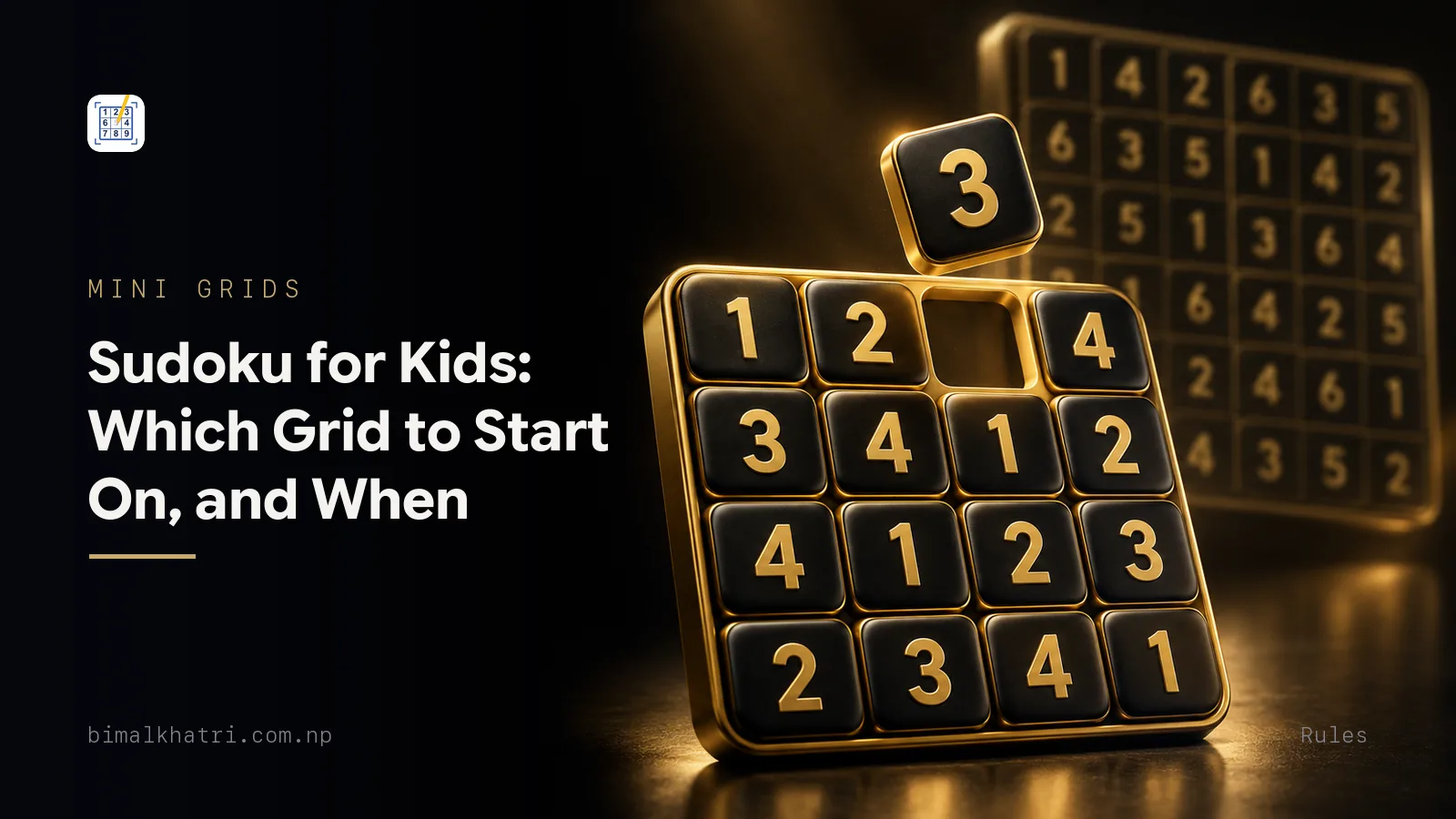
Start a child on a 4x4 grid. Digits 1 to 4, four boxes of two cells by two, and the same single rule the full puzzle runs on: no digit repeats in a row, a column or a box. Move up to 6x6 when they can finish a 4x4 without being rescued. The 9x9 comes last, and it is a bigger step than the change in size suggests.
That order has nothing to do with age. It is about how much a child has to hold in their head before they can write one digit down.
| Grid | Digits | Box shape | Cells | Peers per cell |
|---|---|---|---|---|
| 4x4 | 1 to 4 | 2 by 2 | 16 | 7 |
| 6x6 | 1 to 6 | 2 rows by 3 columns | 36 | 12 |
| 9x9 | 1 to 9 | 3 by 3 | 81 | 20 |
A cell's peers are every other cell in its row, its column and its box. They are the whole game. Every digit you place is a statement about peers, so that last column is the number of things a child has to check before they can be sure. Seven is a glance. Twenty is a job.
When the full grid finally arrives: Sudoku Master carries a thousand easy puzzles with 36 given digits each, and no ads while you solve, so a first proper grid does not get interrupted halfway through.
Start here: the 4x4
Four rows, four columns, and four boxes that are the two-by-two squares in each corner. Every row, every column and every box holds 1, 2, 3 and 4 exactly once.
1 . 3 .
. 4 . 2
2 . 4 .
. 3 . 1
Cells are named the way they are on a full-size grid. Rows count from the top, columns from the left, so r2c3 means row 2, column 3. The 1 in the corner is r1c1 and the 4 under it is r2c2.
Solve it with them out loud, one cell at a time.
Row 1 holds a 1 and a 3, so r1c2 and r1c4 take 2 and 4 in some order. Column 2 already has a 4 at r2c2. So r1c2 is 2, and r1c4 is 4.
Row 2 now needs 1 and 3 at c1 and c3. Column 1 has the 1 at the top, so r2c1 is 3 and r2c3 is 1.
Row 3 needs 1 and 3 at c2 and c4. Column 2 is holding 2, 4 and 3 by now, which leaves 1. So r3c2 is 1 and r3c4 is 3.
Row 4 takes what is left over: 4 at c1, 2 at c3.
Nothing in that was a guess, and that is the point of the whole exercise. Sixteen cells is small enough that a child can see the entire puzzle in one look, which means they never have to trust a rule they cannot check. They are not learning a technique yet. They are learning that the answer is always already in the grid.
There is no maths in it, and that surprises people
Sudoku contains no arithmetic. Nothing is added, nothing is compared, and no digit is worth more than another. Replace 1, 2, 3 and 4 with a cat, a dog, a fish and a bird and the puzzle is unchanged. Say that to a child who thinks numbers are homework, because it is true and it removes the objection before it forms.
Picture grids are real Sudoku on that basis. Four different pictures, each appearing once per row, once per column and once per box. If a child can read digits comfortably, use digits, because they carry over to every grid they will ever meet later. If reading digits is still effortful, pictures take away the one barrier that has nothing to do with the puzzle.
The 6x6, where the box stops being a square
Six rows, six columns, digits 1 to 6. The thing that catches children, and a fair number of adults, is the box shape. A 6x6 box is two rows tall and three columns wide, so the six boxes are rectangles lying on their sides.
1 2 . 4 5 .
. . 6 . . .
2 . 4 . 6 1
5 . . . 3 .
3 4 5 . 1 2
. 1 . . 4 5
Boxes are numbered left to right, then top to bottom, so box 1 is rows 1 and 2 across columns 1 to 3. Trace its outline with a finger before anyone writes anything. A child still hunting for a square will scan the wrong six cells for half an hour and conclude they are bad at this.
Now a first move worth doing together. Box 1 holds 1, 2 and 6. It is missing 3, 4 and 5, and its empty cells are r1c3, r2c1 and r2c2. Ask where the 4 can go.
- Not r1c3. Row 1 already has a 4, over at r1c4.
- Not r2c2. Column 2 already has a 4, down at r5c2.
- That leaves r2c1. Write the 4 there.
Two eliminations and the cell fell out. That move is called cross-hatching, and it is the technique that carries all the way up to the hardest puzzles an adult will ever attempt. Learning it here, where only two things had to be ruled out, is why the 6x6 stage is worth more than its size suggests. There is a longer walkthrough in cross-hatching a grid, written for the full-size puzzle but identical in method.
The rest of that grid solves the same way, one forced cell at a time. No pencil marks are needed anywhere in it.
The 9x9 is a bigger jump than it looks
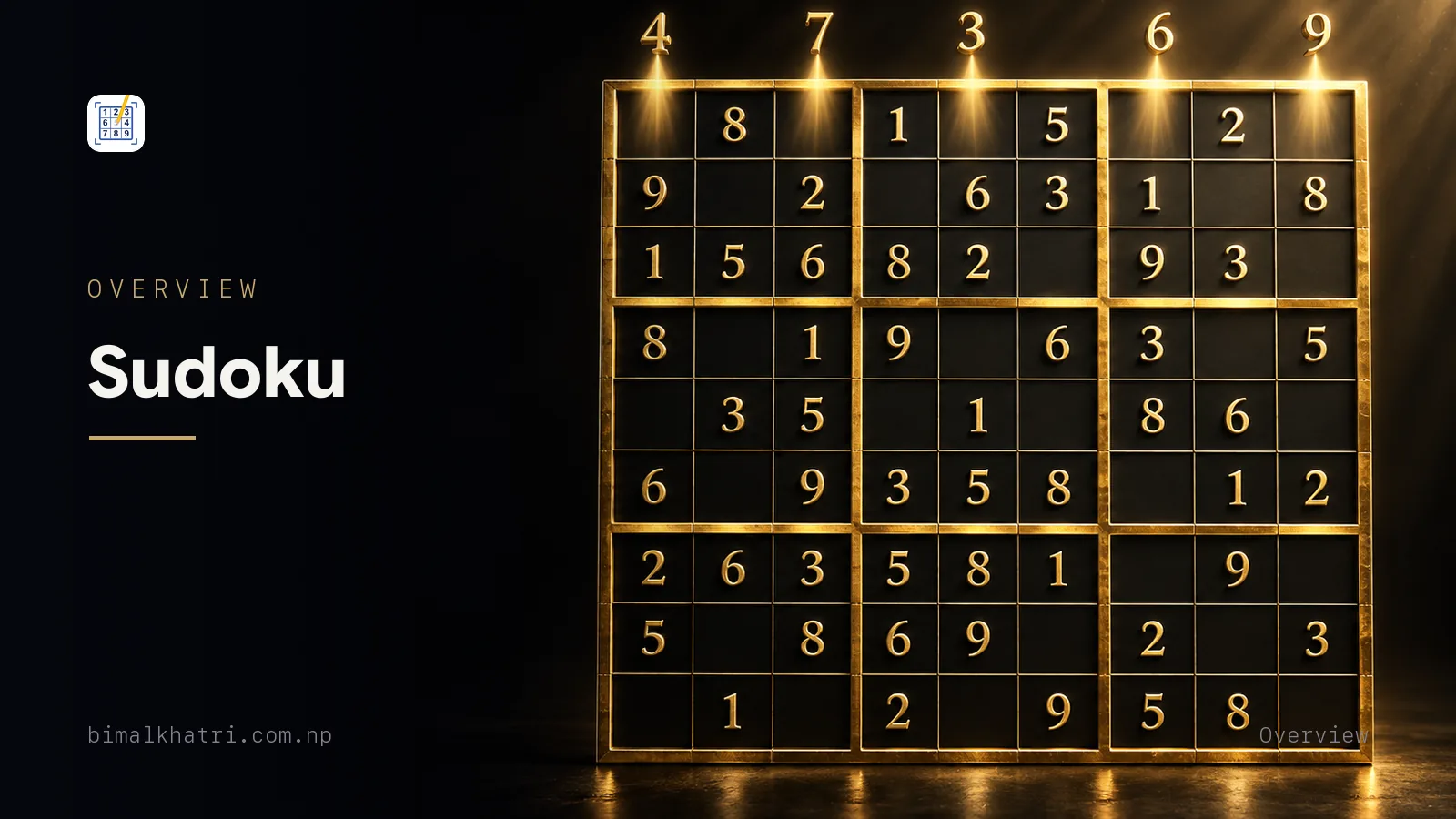
Here is an easy full-size puzzle. 36 of the 81 cells arrive filled, which is the friendliest a 9x9 comes.
. 6 7 5 . 9 . . 8
. . . 7 2 . . 5 1
. 9 5 . 8 . 6 . 2
9 . . . 3 4 . 1 .
6 7 1 . 9 . . 2 .
. 4 . . 6 7 . 8 .
4 . 6 . . . 8 . .
. . . 6 . . 1 . 7
. . . 3 . 8 . 6 .
Same rule, same technique, five times the grid. Two things go wrong at this point and neither of them is about logic.
The first is that the puzzle no longer fits in one look. On a 4x4 a child sees every constraint at once. On a 9x9 they have to look away from the cell they are solving, remember what they saw, and look back. That is a real skill and it arrives later than the ability to spot a missing digit.
The second is stamina. An easy 9x9 runs long past the attention a seven-year-old brings to a table. Nobody has to finish a Sudoku in one go, so let them take a corner of it and leave the sheet where it is. A half-solved grid waits perfectly well until Saturday.
I built Sudoku Master, which only plays the full 9x9, so the 4x4 and 6x6 above stay a paper job. What a screen buys a child at this stage is a cheaper mistake: one tap to undo, instead of an eraser and a hole in the page. Three of its settings are worth changing before you hand the phone over.
- Game over at 3 mistakes: off. A child experimenting is a child learning, and a puzzle that ends on the third try punishes exactly that.
- Row, column and box highlighting: on. Tap a cell and the three lines governing it light up. That is the picture a child cannot yet build from memory, and the phone builds it for nothing.
- Timer: off. A clock turns a puzzle into a test, and nobody asked for a test.
Three tests, instead of an age
Two children born in the same month can be a year apart on each of these, which is why the usual "ages 5 and up" label on the box is close to useless. Test what the puzzle actually asks for.
Can they find the missing one? Show four cells holding 1, 3 and 4, with a gap. If the answer comes back as 2 without a count on fingers, the core skill is there and a 4x4 will work today.
Can they carry a fact across the page? "This row already has a 3" has to survive the journey from one side of the grid to a box on the other. This is the skill that decides whether 6x6 is fun or miserable, and it is the real gate between the two small grids.
Can they be wrong without the afternoon ending? A crossed-out digit is normal here. If a mistake stops play, stay on the small grid a while, where being wrong costs one rubbed-out square rather than twenty minutes.
Move up a size when they have finished the current one twice, unaided, with no part of it guessed. Guessed and correct is not finished.
Sitting next to a child who is solving
Worth doing:
- Ask "how did you know?" after a correct digit. The reason is the skill. The digit is just a digit.
- Point at a box, never at a cell. "Have a look at this box" leaves the find to them. "Put a 5 there" ends the puzzle and hands them nothing.
- Print it big, and use a pencil with a rubber on the end. Cramped grids and pen are both discouraging for no good reason. There is a page on printing puzzles so they are usable.
- Stop while they still want another one.
Worth avoiding:
- Filling in "just one to get you started". That one is usually the cell they were three seconds from finding.
- Timing them. Nothing about speed helps at this stage.
- Calling it brain training out loud. It is a puzzle. Sell it as a puzzle.
Check the puzzle before you hand it over
Solve it yourself first. On a 4x4 that costs you under a minute, and it catches the failure that does the most damage.
A Sudoku that has been made properly has exactly one answer. Grids from free printable sites sometimes have two, and sometimes none, usually because a digit went missing when the page was laid out. A puzzle with two solutions cannot be finished by logic at all, so a child working on one eventually guesses, gets it right, and learns that guessing is how the game works. Unteaching that takes months. If you hit a point where two digits both look legal and nothing rules either out, suspect the puzzle before you suspect the child.
Ignore clue counts as a difficulty label while you are at it. A 4x4 with nine givens is not automatically kinder than one with eight. Difficulty is set by the hardest step the grid forces on you, not by how full it starts. For a child, "easy" has a stricter meaning than the cover's: every digit in it can be found by reading a single row, column or box, and nothing has to be written in the corners.
What it does for a child, honestly
Sudoku is sold to parents as brain training. Here is what can honestly be claimed for it.
From the research, nothing about children. The study people reach for is PROTECT, and it ran on adults between 50 and 93. It was observational, so it could only report that regular puzzlers scored better, never that the puzzles were the reason, and its authors said so plainly. Nobody has run a children's version. There is no finding here to pass on. What the evidence does and does not support is set out in is Sudoku good for your brain.
The wider literature does not rescue it either. People get better at what they practise, and the case that a puzzle habit spills over into schoolwork is thin. That is a general result about brain training rather than a mark against this puzzle.
So claim the small things, which are real and need no citation. A child who is solving is not scrolling. Sitting with one problem for ten minutes is a skill, and this is a cheap place to fail at it. And it is one of the few games at a kitchen table where the adult is not obviously winning.
Questions people ask
Does my child need to be good at maths to play Sudoku?
No. There is no arithmetic anywhere in the game. The digits are only symbols, and the same puzzle works with four animals or four colours. Children who dislike number work often take to it fastest, because nothing is being calculated.
Where can I get 4x4 and 6x6 puzzles that are not broken?
Printable sheets are everywhere, and the quality varies a lot. Solve each one yourself before it reaches the table. It takes a minute on a small grid and catches the two-solution puzzles, which are the ones that teach guessing.
My child keeps guessing. Is that allowed?
A correctly made puzzle never needs one, so a guess means a step was missed or the sheet is faulty. Do not correct the digit. Ask how they knew, and the answer usually shows which of the three constraints they skipped. If they can give a reason, it was not a guess.
Should children use pencil marks?
Not on 4x4, and rarely on 6x6. Small grids are meant to be solvable by looking, and writing candidates in every empty cell turns a two-minute puzzle into bookkeeping. Pencil marks earn their place on the 9x9, where a cell can have five possibilities at once.
What is mini Sudoku?
It is the general name for the smaller grids, usually 4x4 and 6x6, sometimes printed with pictures instead of digits. The rules are identical to the full game. Only the number of symbols and the box shape change.
Is Sudoku good for a child's brain?
Nobody has tested it. The research that gets quoted was done on older adults, and it could only show an association rather than a cause. Hand a child a Sudoku because they like it and because it rewards patience, not as a treatment for anything.
My child finds 6x6 easy. What now?
Move to a 9x9 marked easy, expect it to take several sittings, and stay nearby for the first two. If that goes badly, the gap is usually stamina rather than logic, and a week of 6x6 grids finished quickly is a better bridge than a hard puzzle finished slowly.
Can two children share one puzzle?
Yes, and taking turns works better than racing. One rule keeps it civil: you may only write a digit if you can say why it goes there. That turns the whole thing into an argument about evidence, which is the skill you were after.
Keep reading
- 4x4, 6x6 and 16x16 grids, for what changes as the grid grows and where the small sizes come from
- How to play Sudoku, for the rules question you cannot answer at the table
- Your first Sudoku, solved one move at a time, a complete 9x9 walkthrough to read alongside a child
- Cross-hatching, the scanning method from the 6x6 example, worked on a full grid
- Nine beginner mistakes, most of which start as habits picked up on the small grids
- Sudoku: the complete guide, for how all of this fits together
For the full-size grid: Sudoku Master is free on iPhone and Android. The link sends you to whichever store your phone uses.