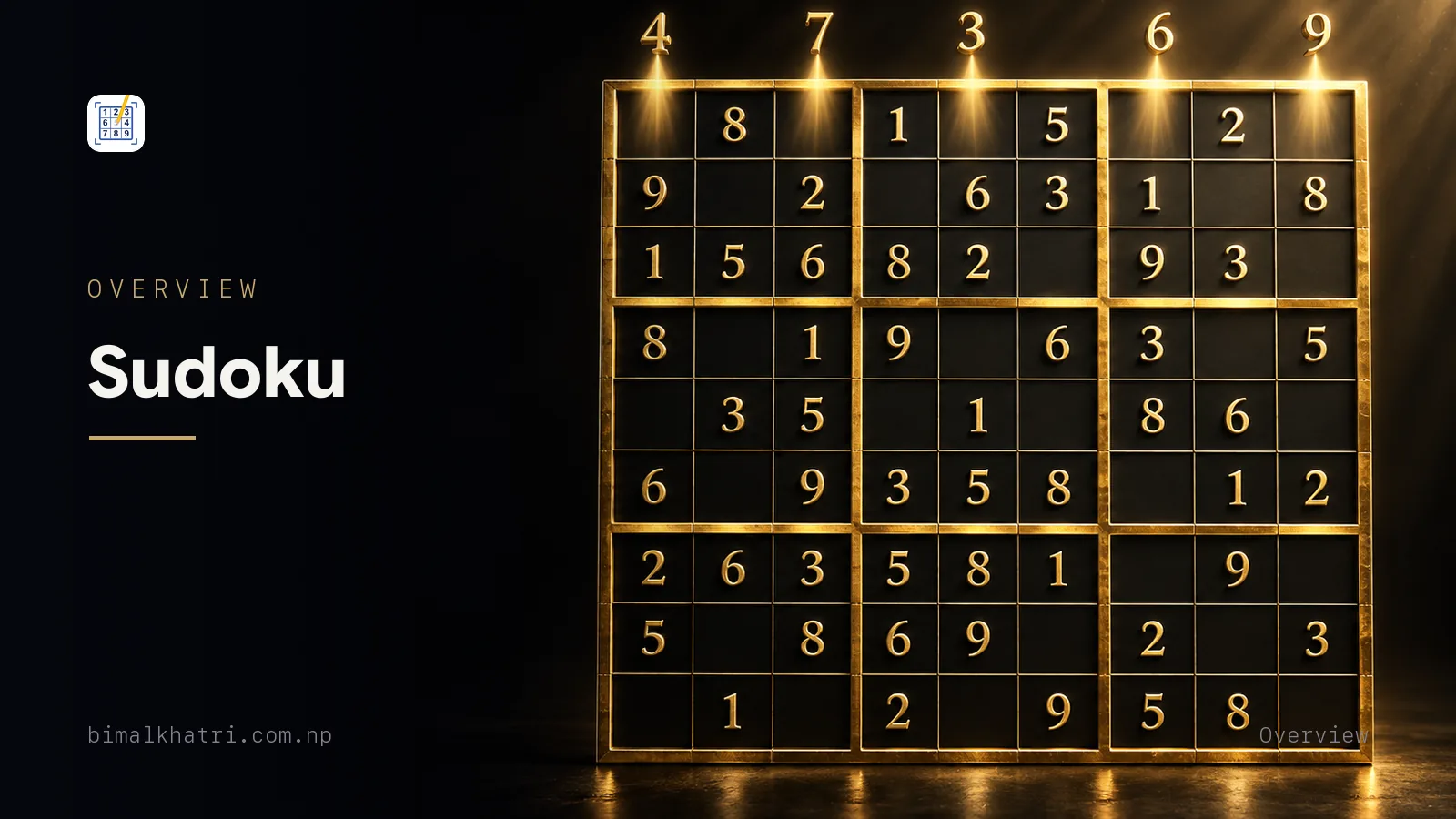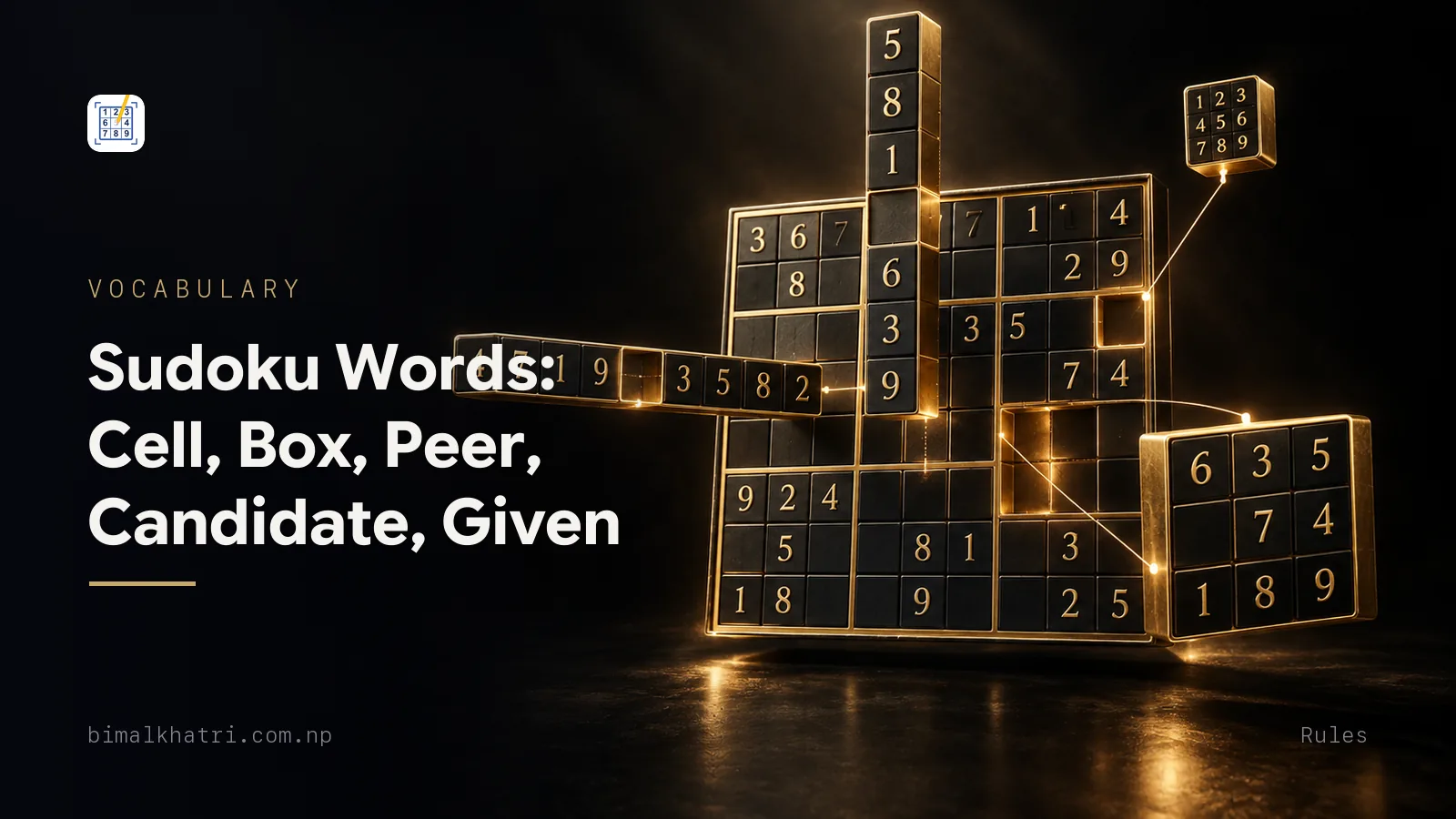
A cell is one of the 81 squares. A box is one of the nine 3x3 blocks. A given is a digit printed before you start, a candidate is a digit that could still go in an empty cell, and a peer is any of the 20 cells sharing a row, a column or a box with the one you are looking at.
Those five words carry the rest of the vocabulary. Every named technique, from a naked single to a swordfish, is a sentence about givens, candidates and peers.
Below is each term in the order you meet it, with one grid in front of it so the words point at something real rather than at a definition.
On your phone? Sudoku Master has 4,000 classic puzzles across four difficulties, free, and no ads while you solve.
The grid, and how to name a cell
This is the puzzle every example on this page uses. Thirty digits are printed; the dots are empty.
5 3 . . 7 . . . .
6 . . 1 9 5 . . .
. 9 8 . . . . 6 .
8 . . . 6 . . . 3
4 . . 8 . 3 . . 1
7 . . . 2 . . . 6
. 6 . . . . 2 8 .
. . . 4 1 9 . . 5
. . . . 8 . . 7 9
Cell. One square. There are 81.
Row. A horizontal line of nine cells. Rows are numbered 1 to 9 from the top.
Column. A vertical line of nine cells, numbered 1 to 9 from the left.
Box. A 3x3 block. Also called a block, a region or a nonet. The nine are numbered along the top band first, then the middle band, then the bottom, so box 1 sits in the top left corner and box 9 in the bottom right.
The r-c notation. A cell is written r4c7: row 4, column 7. Row first,
always. In the grid above r1c1 holds the 5 and r9c9 holds the 9. Some books
letter the rows instead and call the same cell D7, and a few solver sites use
R4C7 in capitals. This site uses lowercase r4c7.
Band and stack. Three boxes side by side make a band; three boxes stacked make a stack. You rarely need the words until a technique works across one.
Unit. A row, a column or a box. Also called a house or a group. There are 27 of them: 9 rows, 9 columns, 9 boxes. Each one holds each of the digits 1 to 9 exactly once.
Given, candidate, peer
Given. A digit printed at the start. Also called a clue or a start digit. Givens never change, and if you have written over one you have made a mistake somewhere else.
Candidate. A digit that could still legally go in an empty cell. Solving is mostly the work of deleting candidates until one is left.
Peer. Every cell that shares a row, a column or a box with a given cell. The count is 20, not 24: the row supplies 8 and the column supplies 8, and of the box's 8 four have already been counted by the row and the column. No cell may hold the same digit as any of its peers, and that single sentence is the entire ruleset.
Now watch the three words work together. Take r1c3, the third cell of the top
row, which is empty.
- Its row already holds 5, 3 and 7.
- Its column already holds 8, at
r3c3. - Its box already holds 5, 3, 6, 9 and 8.
Six different digits sit on its peers, so six digits are gone. What is left is
{1,2,4}, and those three are the candidates of r1c3. Nothing about that step
required a technique with a name. It is just the rule, applied once.
Elimination. Removing a candidate from a cell because a peer rules it out. Every technique in the game is a way of finding an elimination you could not see directly.
Placement. Writing a digit in for good. A placement is worth more than an elimination, because it eliminates that digit from all 20 peers at once.
Pencil marks, notes and the two ways to write them
Pencil mark. A candidate written into a cell. On paper it goes small in a corner; in an app it is a note.
The words candidate and pencil mark get used as if they were the same thing, and they are not. A candidate is a fact about the grid. A pencil mark is your handwriting. If you forget to rub one out after placing a digit, the candidate is gone but the pencil mark is still sitting there lying to you. Most wrong answers in a hard puzzle start exactly there.
Corner marks and centre marks. Two conventions borrowed from digital solving. Corner marks list where a digit could go inside a box. Centre marks list every candidate a cell still has.
Snyder notation. Marking only the digits that appear in exactly two cells of a box, rather than everything. It keeps the grid readable.
Full notation. Writing every candidate in every empty cell. Slow, complete, and the state most technique articles assume you are in.
Single, naked, hidden
A single is a cell you can fill right now. There are two kinds, and telling them apart is the first real skill in the game.
Naked single. A cell with exactly one candidate left. Nothing hidden about it: you look at the cell, and one digit is all that fits. Some books call this a sole candidate or a forced cell.
The centre of our grid, r5c5, is one.
- Row 5 holds 4, 8, 3 and 1.
- Column 5 holds 7, 9, 6, 2, 1 and 8.
- Box 5 holds 6, 8, 3 and 2.
That is every digit except 5. So r5c5 is a 5, and you can write it in without
looking at another cell.
Hidden single. A digit that fits in only one cell of a unit, even though that cell has other candidates too. The digit is hidden behind them.
Look at box 7, the bottom left, where only the 6 at r7c2 is filled. Where can
the 8 go?
- Column 1 already has an 8 at
r4c1, sor7c1,r8c1andr9c1are out. - Column 3 already has an 8 at
r3c3, sor7c3,r8c3andr9c3are out. - That leaves column 2. Row 7 already has an 8 at
r7c8, sor7c2is out, and it was filled anyway. Row 9 has an 8 atr9c5, sor9c2is out.
Only r8c2 is left, and it takes the 8. Its own candidate list is {2,7,8},
so staring at the cell would have told you nothing. The box told you.
That is the whole naked-and-hidden distinction, and it repeats all the way up the technique ladder. Naked means you found it by looking at a cell. Hidden means you found it by looking at a unit.
Pairs, triples and the word subset
Naked pair. Two cells in one unit holding the identical two candidates,
say {4,7} and {4,7}. One of them is the 4 and the other is the 7, in an
order nobody has to settle, so no third cell in that unit can be either digit.
Naked triple. Three cells in one unit sharing three digits between them. The
cells do not each need all three: {2,5}, {5,9} and {2,9} is a valid triple
on 2, 5 and 9. Same for quads with four.
Hidden pair. Two digits that appear in only two cells of a unit. Those two cells belong to those two digits, so every other candidate in them goes. A hidden pair often sits inside a cell holding five or six pencil marks, which is why it hides.
Subset. The umbrella term for all of these. Naked subsets say "these cells own these digits"; hidden subsets say "these digits own these cells". They are the same statement read from opposite ends.
Locked set. n cells in one unit holding exactly n candidates between them. The formal version of a naked pair or triple.
Locked candidates: pointing and claiming
Locked candidates is the family name for eliminations that come from the overlap between a box and a line. The overlap is always three cells. Books also call the family intersection removal.
Pointing pair. A digit that, inside one box, can only go in cells sharing a row or a column. It must land somewhere in that box, so it must land on that line, so it comes out of the rest of the line outside the box.
Our grid has one. In box 1 the empty cells are r1c3, r2c2, r2c3 and
r3c1, and the 7 fits only in r2c2 and r2c3. Both sit in row 2. Wherever
the 7 in box 1 goes, it is in row 2, so 7 leaves the rest of row 2: out of
r2c7 and r2c9. Two eliminations from a fact you did not have to guess.
Box-line reduction. The reverse direction. A digit that, inside one row or column, can only go in the three cells the line shares with a box. It must land in that box, so it comes out of the rest of the box. Also called claiming, or a claiming pair.
Pointing goes box to line. Claiming goes line to box. That is the only difference.
Fish, wings and chains
Past the subsets, the names stop describing what the technique does and start describing what it looks like on the page.
X-Wing. A digit that appears in exactly two cells in each of two rows, with those cells lining up in the same two columns. The four cells make a rectangle. The digit must sit at opposite corners, so it comes out of the rest of both columns. Works with rows and columns swapped.
Swordfish. The X-Wing over three rows and three columns instead of two. Jellyfish is four. The family name is fish, and the number of lines is called the degree.
XY-Wing. Three cells with two candidates each, arranged so one cell, the pivot, sees both of the others, the pincers. Whichever digit the pivot takes, one pincer is forced, and the digit both pincers share comes out of any cell that sees them both. XYZ-Wing adds a third candidate to the pivot.
Strong link. Two cells in a unit where a digit sits in only those two, so exactly one of them holds it. If one is false the other is true.
Weak link. Two cells in a unit where a digit could be in either, so at most one of them holds it. If one is true the other is false.
Conjugate pair. Another name for a strong link. Chains alternate strong and weak links, and every chain technique with a long name is a rule about that alternation.
Colouring. Marking the two ends of every strong link for a digit in two colours, then looking for a contradiction: two cells of the same colour in one unit, or a cell seeing both colours.
Nishio. Assuming a digit in a cell, following the forced consequences, and watching for a contradiction. Some solvers count it as logic and some count it as guessing with extra steps.
Bifurcation. Splitting the puzzle into two branches on a two-candidate cell and following each. A guess with a plan.
Words about the puzzle rather than the grid
Proper puzzle. A puzzle with exactly one solution. That is the standard, and it matters more than it sounds: a well-formed puzzle can always be finished by logic alone.
Improper puzzle. A puzzle with two or more solutions. It is broken, not hard. No technique will finish it, because at some point the grid genuinely does not care which of two digits you write. If you have found two valid endings, the puzzle was wrong, not you.
Minimal puzzle. A puzzle where removing any given makes it improper. Every clue is load-bearing.
Seventeen. The smallest number of givens a proper 9x9 puzzle can have, settled by exhaustive computer search in 2012 (McGuire, Tugemann and Civario). Collections of 17-clue puzzles are published. Nothing with 16 clues has a single answer, so a 16-clue grid is not extremely hard, it is impossible.
Clue count. How many givens a puzzle has, and the term most often mistaken for difficulty. It is not difficulty. Two grids with the same count can sit two rungs apart on the technique ladder, because what grades a puzzle is the hardest step it makes you take, not how much of it arrives filled in.
Symmetry. Nikoli's convention that the givens are placed symmetrically, and that a puzzle carries at most 32 of them. Handmade puzzles usually follow it, generated ones often do not, and nothing in the rules requires it.
Brute force. Trying digits by machine until the grid works out. The usual method is backtracking: place a digit, move on, and when the grid contradicts itself, walk back and try the next digit. It always finds the answer, and it tells you nothing about how a person would have found it.
Difficulty grades. Easy, medium, hard, expert, evil, extreme. Every publisher sets its own ladder and none of them line up, so a grade places a puzzle inside one book and tells you nothing about any other.
I built Sudoku Master because the puzzles I wanted were usually printed on a page I could not check. It ships 4,000 puzzles graded easy to extreme, it scans a printed grid with the camera and reads it on the device rather than uploading the photo, and its solver runs the backtracking search described above. Be clear about that last part: it returns the finished grid, not a technique-by-technique lesson.
Words from the variants
These words belong to puzzles that add a rule to the classic nine by nine. Classic Sudoku has no arithmetic and no diagonal constraint, so none of it applies to your newspaper puzzle unless the paper says so.
Cage. A dashed outline in Killer Sudoku carrying a small sum. The digits in a cage add to that number and do not repeat. Some cage sums have only one combination: a 2-cell cage of 3 is 1+2, a 2-cell cage of 17 is 8+9, a 3-cell 6 is 1+2+3, and a 3-cell 24 is 7+8+9. Those four are worth memorising.
Killer Sudoku. Classic rules plus cages. Most Killer puzzles start with no given digits at all.
Jigsaw or irregular Sudoku. The nine boxes become nine irregular shapes. Also called nonomino Sudoku.
Samurai. Five overlapping grids sharing four corner boxes.
Sudoku X. Classic rules plus both main diagonals, each of which must also hold 1 to 9. Also called diagonal Sudoku.
Mini grids. 4x4 and 6x6 puzzles for children, the 6x6 using 2x3 boxes. At the other end, 16x16 uses the digits 0 to 9 plus the letters A to F.
Words people get wrong
"You have to guess on hard ones." No. If a proper puzzle needs a guess, the technique that finishes it exists and has not been found yet. That is a real distinction, and it is the reason the improper-puzzle definition above matters.
"Sudoku is maths." Nothing is ever added, subtracted or compared. The digits are nine distinct symbols, and a grid printed in nine shades of grey would solve the same way. It is logic wearing numerals.
"Fewer clues means harder." Handled under clue count above. It survives because the clue count is the one thing about a puzzle you can measure at a glance.
"Number Place." The title the puzzle carried in the American magazine Dell Pencil Puzzles & Word Games, May 1979. Dell printed no bylines, so the authorship rests on a pattern: Howard Garns, a retired architect from Indianapolis, is listed among the contributors to issues that ran the puzzle and missing from those that did not. Credited to him, then, rather than proven his.
"Sudoku means difficult." It does not. 数独 is two characters, 数 for number and 独 for single, so the word says "single numbers". Nikoli clipped it out of a longer Japanese sentence about digits being limited to one apiece.
The whole glossary on one screen
| Term | What it means |
|---|---|
| Cell | One of the 81 squares |
| Box | One of the nine 3x3 blocks. Also block, region, nonet |
| Unit | A row, a column or a box. Also house. There are 27 |
| Given | A digit printed at the start. Also clue |
| Candidate | A digit that could still go in a cell |
| Pencil mark | A candidate you have written down. Also a note |
| Peer | One of the 20 cells sharing a unit with a cell |
| Elimination | Removing a candidate because a peer forbids it |
| Naked single | A cell with one candidate left |
| Hidden single | A digit with one possible cell in a unit |
| Naked pair | Two cells in a unit holding the same two candidates |
| Hidden pair | Two digits that fit in only two cells of a unit |
| Subset | Any naked or hidden pair, triple or quad |
| Pointing pair | A digit confined to one line inside a box |
| Box-line reduction | A digit confined to one box inside a line. Also claiming |
| X-Wing | Two rows, two columns, one digit, four corners |
| Swordfish | The X-Wing across three rows and three columns |
| XY-Wing | A pivot cell and two pincers, all with two candidates |
| Proper puzzle | A puzzle with exactly one solution |
| Brute force | Machine search, usually backtracking |
| Cage | A summed outline in Killer Sudoku |
Questions people ask
Do I have to pencil in every candidate?
No, and on an easy grid the marking takes longer than the solving. Scan for hidden singles first and place what you can. Start writing candidates when the scan stops producing digits, and even then many solvers mark only the digits that fit in exactly two cells of a box.
What is the difference between a candidate and a pencil mark?
A candidate is a digit the rules still allow in a cell. A pencil mark is your record of one. They agree until you place a digit and forget to rub out the marks it kills, and after that your notes describe a grid that no longer exists. Clearing the marks around every placement is the habit that prevents it.
Is guessing allowed in Sudoku?
Nothing stops you, but a proper puzzle never requires it. Every proper puzzle has exactly one solution and can be reached by logic. A guess that works leaves you unable to say why, and one that fails costs every placement you made on top of it.
Do you need to be good at maths to solve a Sudoku?
No. There is no arithmetic in classic Sudoku. The nine digits are symbols that happen to be numerals, and a grid drawn with nine different shapes plays exactly the same. Killer Sudoku is the exception, because its cages carry sums.
How many givens does a normal Sudoku have?
Most published puzzles carry somewhere between the low twenties and the high thirties. Nikoli's handmade convention caps them at 32. The absolute minimum for a puzzle with a single solution is 17, proven by exhaustive computer search in 2012, and no 17-clue puzzle is going to turn up in a beginner's book.
Why do two books use different names for the same technique?
Because nobody standardised the vocabulary. The techniques were named by solvers on forums between 2005 and 2010, several people named the same thing at once, and the names stuck unevenly. Naked single, sole candidate and forced cell are one idea with three names. Read the definition, not the label.
What do easy, medium and hard actually mean?
Whatever the publisher decided. There is no shared scale, so a hard puzzle in one newspaper can be gentler than another's medium. What difficulty tracks in practice is the hardest technique the grid makes you use, and how often it makes you use it.
How many Sudoku grids are there?
6,670,903,752,021,072,936,960, counted exhaustively by Felgenhauer and Jarvis in 2005. Neither that number nor any of its relatives affects your morning puzzle.
Keep reading
- How to play Sudoku, the rules these words describe, stated once and properly
- Every Sudoku technique in order, from scanning to chains, easiest first
- Naked and hidden singles, the two terms above worked through full grids
- How to use pencil marks, for when full notation starts drowning the grid
- The complete Sudoku guide, if you would rather read the whole thing in one go
Get it: Sudoku Master, free on iPhone and Android. The link sends you to whichever store your phone uses.