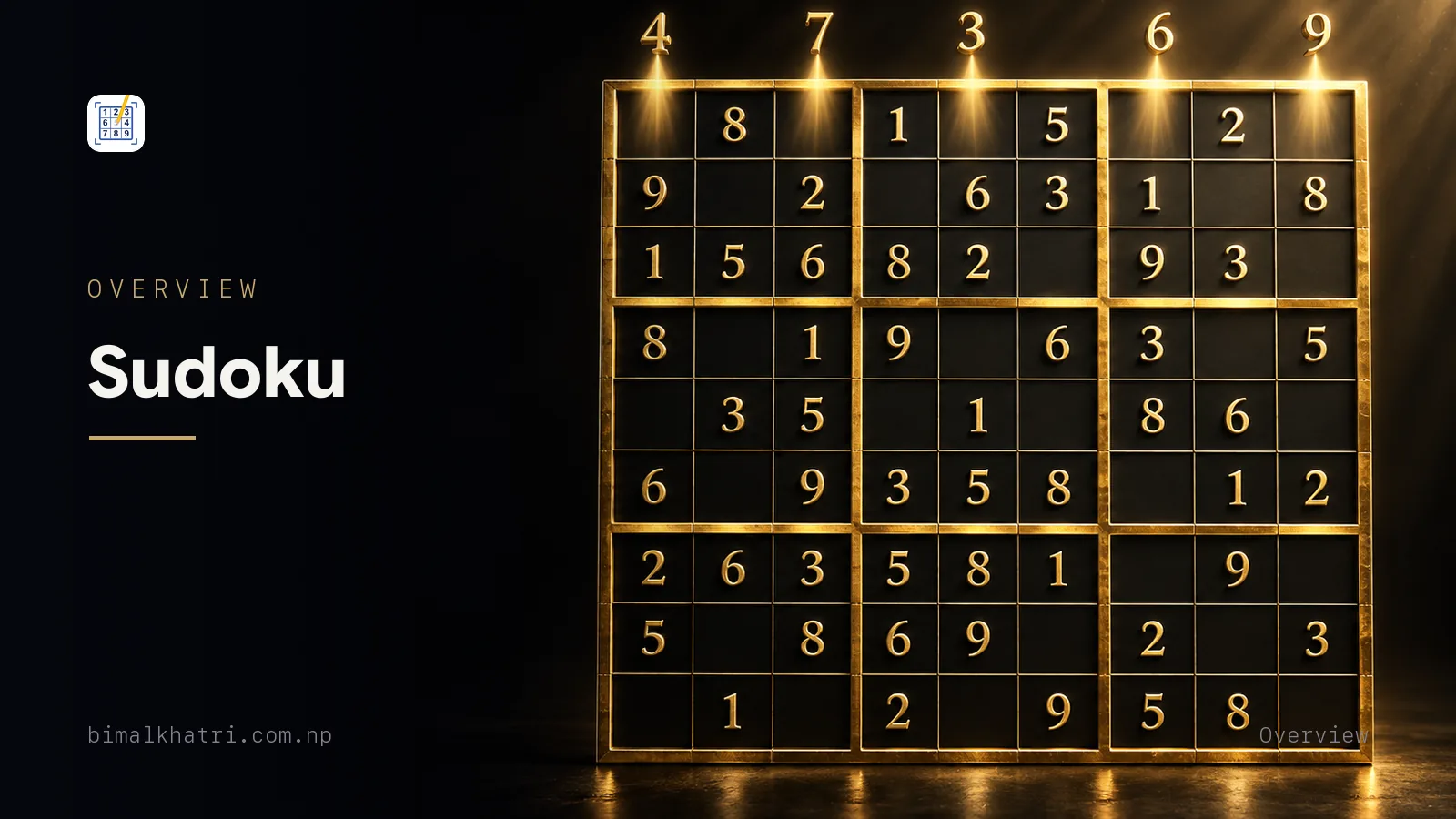
Sudoku is Japanese, and it means single numbers. The word is two characters. 数 is sū, number. 独 is doku, single or solitary. Together they state the only rule the puzzle has: every digit stands alone in its row, its column and its box.
It is also an abbreviation. Nikoli, the Japanese puzzle publisher, ran the puzzle in 1984 under a longer phrase, 数字は独身に限る, roughly "the digits must be single", and cut it down to 数独. The two characters that survived the cut are the first of each of those two key words. So the name is not decoration. It is the rule, shortened until only the two load-bearing characters were left.
Two things it does not mean. It does not mean "difficult", which is the usual guess. And it was not the puzzle's first name: the modern grid was printed in America five years earlier under a plain English title, Number Place.
Want the grid rather than the etymology? Sudoku Master holds 4,000 classic 9x9 puzzles in four grades. It runs with no signal, and no ads while you solve.
The two characters, one at a time
| Written | Read | What it carries |
|---|---|---|
| 数 | sū | number, figure |
| 独 | doku | single, solitary |
| 数独 | sūdoku | single numbers |
The macron on that first u marks a long vowel, so the opening syllable is held a beat longer than the two that follow. Three syllables, no stress worth arguing about: su-do-ku. English speakers tend to say soo-DOH-koo. Borrowed words pick up local accents and this one has picked up several.
Read the pair in the other order and you get a fair gloss too. Number, single. Single numbers. A grid where no digit is allowed company.
The sentence the name was cut out of
Nikoli's full phrase, 数字は独身に限る, translates roughly as "the digits must be single". That is worth sitting with for a second, because it is an instruction rather than a description. It does not say the grid contains numbers. It says what the numbers are not allowed to do.
Here is a puzzle, written the way this series writes them. Rows are numbered 1
to 9 from the top, columns 1 to 9 from the left, so r4c7 is the seventh cell
of the fourth row. A dot is an empty cell.
53..7....
6..195...
.98....6.
8...6...3
4..8.3..1
7...2...6
.6....28.
...419..5
....8..79
Take r1c1. It holds a 5. Now look at the three groups that cell belongs to.
- Row 1 reads
53..7..... There is no second 5 in it. - Column 1 reads 5, 6, blank, 8, 4, 7, blank, blank, blank going down. No second 5.
- Box 1, the top left nine cells, holds 5, 3, 6, 9 and 8. No second 5.
That 5 is single three times over. Turn it around and you have the definition of a legal digit: it does not repeat among the cell's twenty peers, meaning the twenty other cells that share its row, its column or its box. Eight plus eight plus eight, minus the four counted twice inside the box.
Now break it, because the failure shows the meaning better than the success
does. Write a 5 into r1c8 and row 1 becomes 53..7..5.. No arithmetic has
gone wrong, since there is no arithmetic anywhere in the game. What went wrong
is that the 5 stopped being single. A properly made Sudoku has exactly one
solution, and that grid now has none.
The name says nothing about maths
Nothing in 数独 mentions adding. The complete ruleset is nine rows, nine columns, nine boxes, the digits 1 to 9, no repeats. That is all of it.
Which means the digits are not really digits. Replace them with nine colours, nine letters or nine animals and the puzzle is identical to solve, because at no point do you do anything to a number except place it. Digits are used because everybody already knows the order they come in, and because nine of them fit in a small square. People who say "I am bad at maths, so I cannot do Sudoku" have been misled by the typeface.
Some variants do add arithmetic, and they are honest about it in their own names. Killer Sudoku draws dashed cages with a target sum in the corner, and there the adding is real. Sudoku X asks for 1 to 9 on both main diagonals as well. Those are extra rules stacked on top of the word, not inside it. The types of Sudoku piece lays out the whole family.
The name is Japanese. The puzzle is not.
The grid is five years older than the word, and it is American. It ran in Dell Pencil Puzzles & Word Games for May 1979 under the flat English title Number Place. Credit for that goes to Howard Garns, an architect in Indianapolis, though Dell printed no bylines on its puzzles, so "credited" is as far as the evidence reaches. Garns died in 1989, five years after a publisher in a country he had no dealings with had given his puzzle a new name.
Why did English end up with the Japanese label instead of the American one? Because of who did the carrying. The man who sold the puzzle to The Times of London in 2004 had picked it up in a Tokyo bookshop, so the name that travelled was the one on the Japanese covers. Number Place would have crossed into any language without trouble. Nobody was carrying it. The history of Sudoku walks the whole route, with the dates and the four people usually named.
Four things people think the word means
| What you hear | What is actually the case |
|---|---|
| "Sudoku means difficult" | It means single numbers. Difficulty belongs to a particular grid, not to the word |
| "Sudoku means number place" | Number Place was the American magazine title. 数独 says single numbers |
| "The name means you need maths" | No arithmetic appears anywhere in the ruleset |
| "It is an old word" | Nikoli coined the short form in 1984, so the label is younger than the grid it labels |
Why "single" turns up again in the technique names
Open any solving guide and the first two moves listed are the naked single and the hidden single. Same word, and not by coincidence. The name of the game is also the name of the two moves that finish most puzzles.
A naked single is a cell with one candidate left. Every other digit has been ruled out by a peer, so only one thing can go there.
A hidden single is the same idea seen from the digit's side. Inside one row, column or box, only one cell can still take that digit, even if that cell has four candidates written in it and none of them look special.
Both are the word 独 read as an instruction. Find the thing that is alone, then write it in. Naked singles and hidden singles works both through on real grids, and between them they solve every easy puzzle you will ever meet.
I built Sudoku Master, so here is what the name is worth to a program. The rule fits in three lines: no repeat in the row, no repeat in the column, no repeat in the box. Each of the app's 4,000 puzzles ships next to its own solved grid, so a wrong digit can be caught with no connection and no account behind it. Everything else on the screen is comfort. A timer. Highlighting for the row, column and box you are sitting in. Pencil marks that clear themselves when a value lands, if you turn that on. Underneath all of it, the rule has not moved since 1979.
What it means in Hindi, Nepali and everywhere else
The word travels as a word, not as a meaning. In Hindi it is written सुडोकु, which is a transliteration rather than a translation: the sounds cross over, the sense stays behind in Japanese. It has no Hindi meaning of its own, and there is no older Hindi word underneath it.
So "sudoku meaning in Hindi" is a common search with an awkward answer. People typing it want one of two things. Either the Japanese sense put into their own language, which is number plus single, or the spelling itself, सुडोकु. Neither one involves Hindi meaning anything.
English is in the same position, which is easy to forget because the word looks native there now. Nobody translated it. It arrived as a label and stayed one.
Does knowing the meaning help you solve?
A little, and more than you would expect from a piece of trivia.
The name is a one-line summary of what to check. When a grid stops moving, the useful question is not "what goes here". It is "what is already alone, and where have I not looked". Alone in a row. Alone in a column. Alone in a box, or alone in a cell that has run out of other options.
Every technique above the beginner level is a longer route to that same question. Cross-hatching sweeps a box against the rows and columns crossing it. Pointing pairs and X-Wings get there by ruling enough out that one candidate is left standing alone.
Questions people ask
How do you pronounce sudoku?
Three syllables, su-do-ku, with the first vowel long. That is what the macron in sūdoku marks. English speakers usually land on soo-DOH-koo, stressing the middle, and that is close enough that nobody is going to stop you.
Is sudoku Japanese or American?
The name is Japanese and the grid is American. Nikoli named it 数独 in 1984. The puzzle it was naming had already been running in an American magazine since May 1979, under an English title. Both things are true at once, which is why the question keeps getting asked.
Who came up with the name?
Maki Kaji, at Nikoli, in 1984. The magazine's own title for the puzzle was 数字 は独身に限る. Kaji kept the first character of 数字 and the first of 独身 and dropped everything else, which is the whole of it.
Does sudoku mean "difficult" in Japanese?
No. That reading gets repeated a lot and there is nothing in either character to support it. 数 is number, 独 is single. A puzzle marked extreme and a puzzle marked easy carry exactly the same name.
What was sudoku called before it was called sudoku?
Number Place, the title Dell used from May 1979. The name did not travel with the puzzle to Japan in any lasting way, and when the puzzle came back to the English-speaking world in 2004 it came back with the Japanese label instead.
What does sudoku mean in Hindi?
Nothing on its own. It is written सुडोकु in Devanagari, which spells out the Japanese word rather than translating it. The meaning stays the Japanese one: number, single, so single numbers.
Is sudoku a maths puzzle?
No. There is no addition, no multiplication and no counting in classic Sudoku. Swap the digits for nine letters and the solving is unchanged. Killer Sudoku is the variant that does involve adding, and it says so in its own rules.
How is sudoku written in Japanese?
数独, two characters. The full phrase it was shortened from is 数字は独身に限る, and the romanised form you will see in dictionaries is sūdoku, with the macron marking the long first vowel.
Keep reading
- The history of Sudoku, for the full route from a Dell magazine in 1979 to the front of The Times in 2004
- How to play Sudoku: the complete rules, which is the rule the name states, written out properly
- Sudoku words: cell, box, peer, candidate, given, for the rest of the vocabulary you will meet in a solving guide
- Naked singles and hidden singles, where the word "single" becomes a technique you can use
- Types of Sudoku, from classic to samurai, for the variants that add a rule the two characters never promised
- Sudoku: rules, techniques and solving, the overview this page sits inside
Get it: Sudoku Master, free on iPhone and Android. Four grades, 4,000 puzzles, and no ads while you solve.