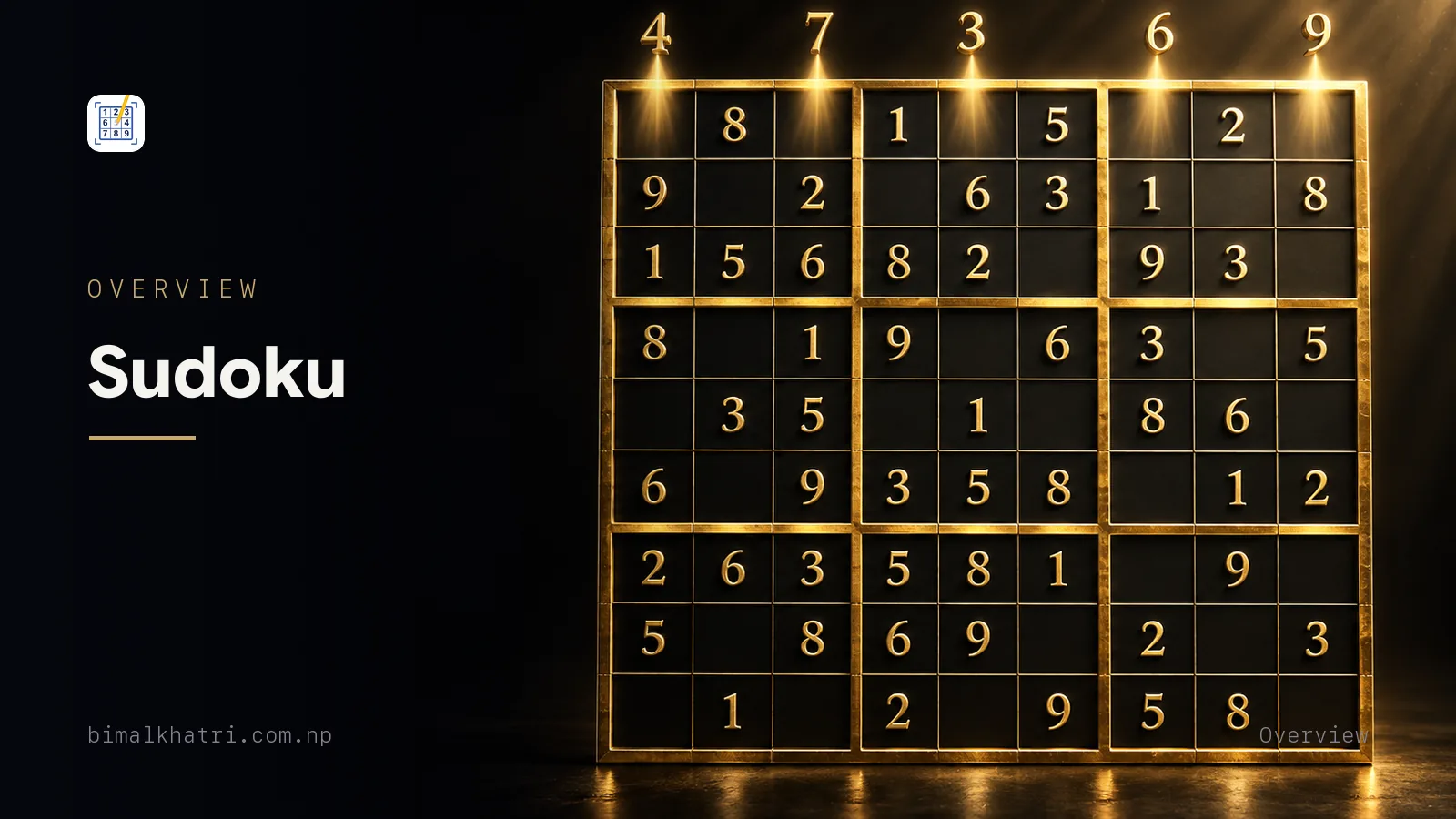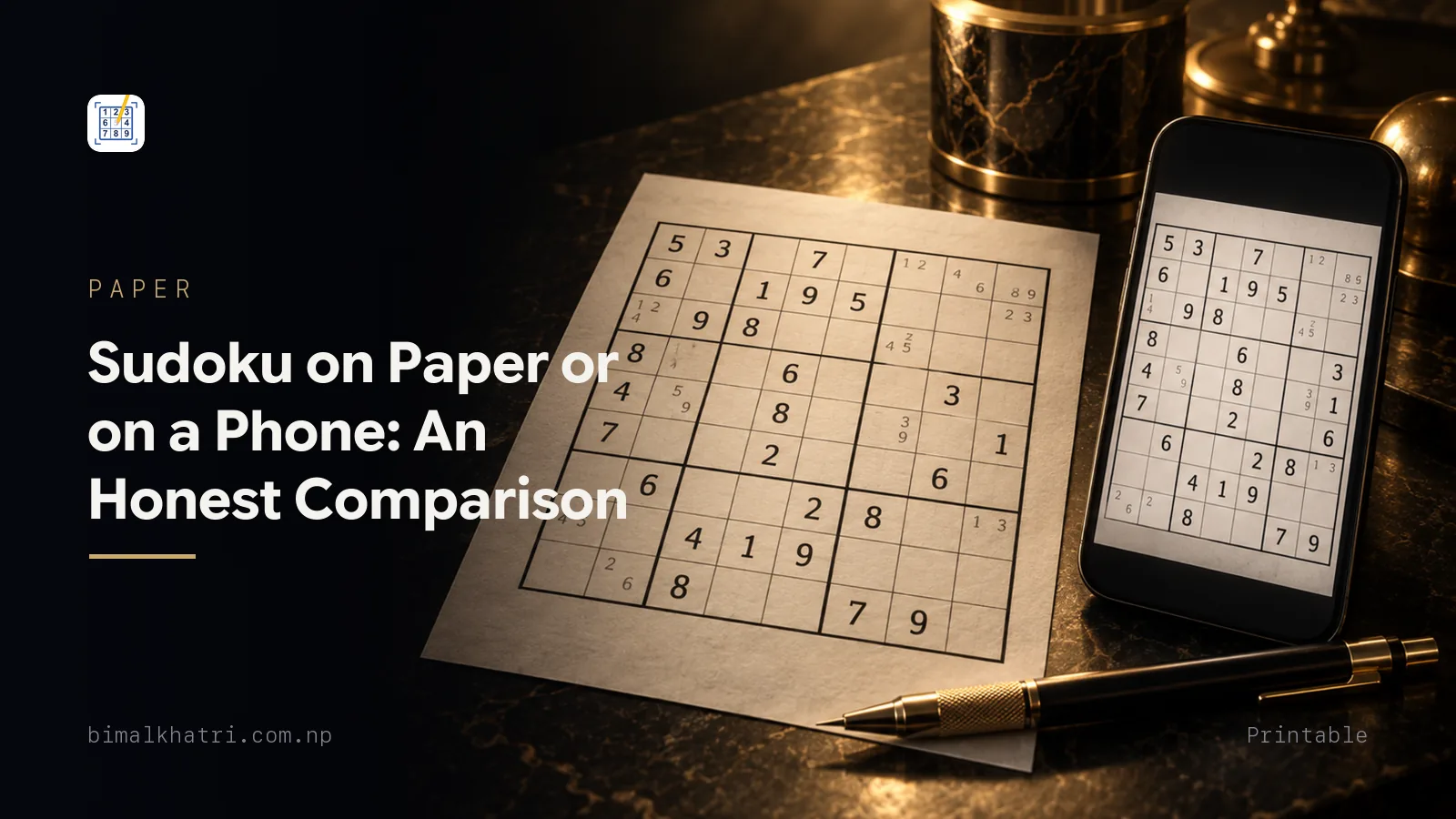
Paper wins when you need the whole grid in front of you and marks that stay where you put them. A phone wins when the window is ten minutes long and a wrong digit needs to cost you nothing. Most people who argue about this are really arguing about two different situations.
The split is not screen against print. It is pencil marks, and what happens to them when you place a digit. Everything else on the usual list, portability, battery, eye strain, the romance of a sharp pencil, is smaller than that one thing.
Solving on paper today? Sudoku Master reads a printed grid through the camera and checks it against the answer, so you do not wait for tomorrow's paper. Free, works offline, and no ads while you solve.
The short answer, by what you are doing
| What you are doing | Better on |
|---|---|
| Learning a technique you have never used | Paper |
| An easy or medium grid in a queue | Phone |
| A grid that needs a full candidate marking | Whichever has cells you can read |
| Checking a newspaper answer today | Phone |
| Solving with somebody watching over your shoulder | Paper |
| Keeping times, streaks and a record | Phone |
| An hour at a table with a coffee | Paper |
| Anything after dark without a lamp | Phone |
Nobody has to pick one. Split the two by job rather than by loyalty, which is what the last section does.
Pencil marks decide this argument
Here is a real medium puzzle, 31 givens, 50 empty cells.
.638..7..
...6...25
.5...1.8.
2..3.8.4.
5...4.6..
.41.....7
.97..24.8
....34.6.
...5.9..3
Write every candidate into every empty cell and you are putting 141 small digits
onto that page. Box 7, bottom left, takes 22 of them across seven cells: r7c1
is {1,3,6}, r8c1 is {1,8}, r8c2 is {1,2,8}, r8c3 is {2,5,8},
r9c1 is {1,4,6,8}, r9c2 is {1,2,8} and r9c3 is {2,4,6,8}.
Four small digits inside one printed square. Before you buy any book, write
{1,4,6,8} into one cell of it with the pencil you actually use. If the four
marks touch each other, that book will not take a full marking, and about half
of Sudoku technique is unavailable to you in it.
Now the part that costs paper the most. Four cells in this grid fall to plain
scanning with no marks at all: r1c6 is 5, r4c2 is 7, r5c6 is 7 and r7c4
is 1. Take the last one. Place that 1, and if you have written full candidates
you now have to strike a 1 out of six other cells: r7c1, r7c5, r7c8,
r5c4, r8c4 and r9c5.
Six small erasures, each inside a cell holding other marks you need to survive. Do that fifty times in one puzzle and you understand why marked-up paper grids end up grey. An app setting called auto-remove notes when a value is placed does those six strikes as you tap the 1. Not every app has one, and an app without it is a worse notepad than the paper was.
Then comes the move that no setting handles. After those four placements,
column 4 has r5c4 and r6c4 both reading {2,9}. Two cells, two digits, so
the 2 and the 9 of that column live in those two cells and nowhere else. Both
also sit in box 5, so the pair works twice.
r3c4was{2,4,7,9}. It becomes{4,7}.r4c5was{1,5,6,9}. It becomes{1,5,6}.r6c5was{2,5,6,9}. It becomes{5,6}.
Nothing removes those for you. The auto-remove setting fires when you place a
value, and here you placed nothing, you deduced something. So the naked pair
costs the same three edits on both, and the difference is only in the quality of
the edit: a tap takes out exactly the 9 in r4c5, while a rubber takes out the
9 and smudges the 1, 5 and 6 sitting next to it. That is the whole argument in
one cell. Pencil marks without drowning in
them covers when it is worth writing all 141 in the
first place, which is less often than people think.
What paper is genuinely better at
The whole grid is always in view. This is the big one and it is easy to miss. An X-Wing is four cells sitting at the corners of a rectangle, say rows 2 and 7 crossed with columns 3 and 8. You cannot see that pattern while zoomed into one box, and a phone grid at full width gives you cells of about 0.75cm, which is where the pinching starts. A book page holds several times that area and never asks you to choose.
Your marks mean what you decided they mean. A dot in the corner, a slash through a digit you have ruled out, a circle round a cell you want to come back to, a chain sketched in the margin next to the grid. No app gives you the margin, and most give you one style of note and no second colour, which is the first thing colouring and chain methods ask for.
Nothing interrupts. No notification lands on a newspaper. No hint button sits one tap from your thumb on the day the grid stalls, which matters more than it sounds, because the temptation is at its highest exactly when you are closest to learning something.
A book waits for you. Puzzle books have no window and no reset. App daily challenges roll over on a schedule, so a day you miss is usually a day gone.
It works flat. No charge, no update, no store account, and you can hand it to somebody across the table.
What the phone is genuinely better at
Undo. On paper, trying an idea means committing graphite, so people do not try. On a screen the cost of being wrong is one tap. A technique you can test cheaply is a technique you will actually test.
Highlighting. Tap a 7 and every other 7 lights up. Turn on row, column and box highlighting and the app draws the exact constraint you were checking in your head. That is cross-hatching done for your eyes rather than by them.
Notes are rendered, not written. A cell with four candidates is legible on a screen at a size where your pencil would produce a grey blob. This is the one place where the small screen is not a problem.
Checking now. A newspaper prints the answer tomorrow. A phone tells you today, and there is a whole page on checking a paper answer without waiting.
Volume in your pocket. A phone carries thousands of grids across every grade, each stored with its answer so none of it needs a connection. A book that size does not fit in a jacket.
A record. Games completed, best and average time, mistake counts, streaks, a heatmap of the month. Paper gives you a finished grid and nothing else. If you care whether you are getting faster, only one of these two can answer that. What counts as fast is in how long a Sudoku should take.
Its own light. Obvious, and it decides more sessions than any feature on either list.
The check button is the real trap
Here is the honest cost of solving on a screen, and it is not eye strain.
Validation turns a logic puzzle into guess-and-check. Two digits look possible in a cell, you cannot see which, so you tap one and watch whether it goes red. You have now finished the puzzle without doing it. Do that for a month and your technique stops moving while your completion rate looks excellent.
Paper cannot be played that way. A wrong digit on paper stays legal for a long time. It can survive ten more placements before the grid finally contradicts itself, and by then you cannot tell which digit lied, so you either restart or you carefully unpick the last twenty minutes. That penalty is paper's entire teaching method: be sure before you write.
You can get the same discipline on a phone, but only on purpose:
- Leave the mistake limit on. A limit of 3 mistakes ends the game, which makes a tap you are not sure about expensive again. Most apps let you turn that limit off, and turning it off is what converts the board into a scratchpad.
- Do not check until you are stuck. Then check, and then work out which deduction was wrong rather than which cell was.
- Treat a hint as a last resort. A hint that hands you a digit teaches nothing at all. When a hint is worth taking sets out the difference.
Buying a Sudoku book
Books are the reason "sudoku paper" gets searched at all, and the number on the cover is the worst thing to buy one on. Seven checks, all runnable in a shop.
| Check | How to run it in the shop | Why it matters |
|---|---|---|
| Cell size | Write {1,4,6,8} into one cell with your pencil | Under a certain size, full candidate marking is off the table |
| One puzzle per page | Flip to the middle | Two per page means your hand covers the other one |
| Paper that takes a rubber | Pencil a digit on page one and erase it | Thin paper pills or ghosts, and a ghost is a candidate you did not mean |
| Binding | Put it on a flat surface and let go | A book that will not lie open makes the left column of every left page painful |
| Answers | Look at the back | Solutions printed as grids are checkable; a compressed string of 81 digits is not |
| Grade spread | Count how many puzzles sit at each level | A book that is 80 per cent easy is a book you finish once |
| Print size | Hold it at reading distance | If size is the whole issue, large print is a real product, not a gimmick |
One warning about grades that costs people money. Difficulty labels are internal to a publisher. One book's hard is another's medium and neither is lying, because there is no shared scale, and the same is true of apps and newspapers. What actually sets difficulty is the hardest technique the grid forces you to use and how often it forces you. What makes a Sudoku easy or extreme goes through the ladder. Buy one book, learn where its "hard" sits relative to your own solving, and do not expect that reading to transfer to the next publisher.
Clue count does not help you here either. A 30-clue puzzle can be harder than a 24-clue one, so a cover promising "only 22 clues" is promising nothing.
Newspapers are a third thing, not paper
A newspaper grid is not the same product as a book grid, and the differences all run one way.
You get one puzzle at whatever grade that paper prints, so the slot picks you rather than the other way round. The cells are sized for the column, which is usually below the threshold for full candidate marking. The answer arrives tomorrow, in tomorrow's paper, which you may not buy. And the grade is that paper's own, so a NYT hard and a USA Today hard are not two names for one thing. The newspaper comparison has the detail.
Printing your own solves the cell size problem completely, and it is the cheapest fix on this page. Most printable grids come off the printer too small anyway, so printing them so they are usable is worth reading before you burn a cartridge.
Splitting the two by job
Three jobs, and each has an obvious home.
Learn on paper. A new technique needs the whole grid, room in the margin and no undo button. Sit down once with one puzzle and a rubber, and give the technique a whole session rather than three ruined commutes.
Practise on the phone. Once you know a technique, what you need is repetition and short sessions, and that is the thing a pocket does well.
Check on the phone, whatever you solved on. Photograph the paper grid, let it read the digits, and find out whether the puzzle is broken or you are. That question has a real answer, because a correctly made grid admits one completion and no other. Guessing will not tell you which of the two it was.
One caution on that last move. A solver returns a finished grid, not a lesson. Ask it while you still want to solve the puzzle and you have spent the puzzle. When to use a solver is a genuine judgement call and worth a minute of thought before you point a camera at a grid you were enjoying.
What I built, and where it does not help
I built Sudoku Master because those two moves, the practice session in a queue and the paper grid I could not settle, kept needing two different apps.
The camera is the part that matters to this page. It takes a photo or an image from your gallery, you crop to the grid, and the digits are read on the device by Google ML Kit. The photo is not uploaded anywhere. Recognition is imperfect on a creased newspaper, so every read digit can be tapped and corrected in a grid editor before you solve, and there is a manual entry screen for the days a photo will not do. Scans are saved, so the puzzle you scanned on the bus is still there that evening.
Behind that are 4,000 classic puzzles across easy, medium, hard and extreme, all bundled in the app, which is what "works offline" means here. Daily, weekly and monthly challenges run at each grade. The settings that change how it feels are the timer, game over at 3 mistakes, highlight same number, highlight row column and box, auto-remove notes, sound and music, and both dark and light themes.
Where it will not help you. It plays classic nine by nine and nothing else, so the cage and irregular-shape puzzles in some books are outside it. The solver returns a completed grid by backtracking, not a technique-by-technique explanation, so it settles a puzzle rather than teaching one. There is no account, no sync between phones and no leaderboard. On ads the honest position is that there are banners on the home and statistics screens and on the scanner, and an interstitial when you leave the scanner. There are none on the playing board. No ads while you solve.
Common mistakes
Buying a book by puzzle count. Four hundred grids you cannot pencil into is worse than a hundred you can. Cell size first, count second.
Marking up every cell out of habit. Writing 141 candidates into a grid that gives up four cells to plain scanning is four minutes spent to save none. Scan first, mark only the region that resists.
Deciding paper is for serious people. The undo button is a real advantage for learning, not a moral failing. The disadvantage is the check button, and that one you can switch off.
Restarting a paper grid because one digit went wrong. Find the contradiction first. Often the bad digit is recent, and the erasure is three cells rather than thirty.
Questions people ask
Should I do Sudoku in pen or pencil?
Pencil, unless you never write candidates. A pen commits you, and the whole point of a candidate is that it is provisional. Pen is fine for placing digits you have proved, and plenty of people use pencil for marks and pen for placements, which also makes the finished grid readable.
How big does a Sudoku square need to be?
Big enough to hold four small digits without them touching, using the pencil you own. That is a test, not a measurement, because it depends on your pencil and your handwriting as much as the print. Run it in the shop on one cell before you pay for 200 pages.
Are Sudoku books worth buying?
Yes, if you solve regularly and want something that does not reset, interrupt or need charging. Judge it on cell size, one puzzle per page, paper that erases cleanly and answers printed as grids. Ignore the number on the cover.
Does using an app make you worse at Sudoku?
Only through the check button. Highlighting and auto-removed notes save you bookkeeping, not thinking. Tapping digits to see which one turns red replaces the thinking entirely, and that is the habit to watch for.
Can I check a paper Sudoku before the answer prints?
Yes. Photograph the grid, have it read and solved, and compare. It works well on a flat, well-lit page and badly on a crease or a shadow, and any read digit can be corrected before you solve.
Do the difficulty labels in a book match the ones in an app?
No, and there is no reason to expect them to. Publishers use their own scales. Difficulty comes from the hardest technique a grid forces on you, so two puzzles both labelled hard can be a full rung apart.
Why do I make more mistakes on paper?
Because nothing stops you. A wrong digit stays legal for a long time, and by the point the grid finally contradicts itself the bad move is twenty placements back. The fix is not more care in general. It is refusing to write a digit you cannot justify.
Is a tablet better than either?
For size, yes. A 10-inch screen gives you a grid wider than most printed books with a brightness you control, which is a real answer for anyone whose problem is small print. It keeps the phone's undo and loses the phone's portability.
Keep reading
- Sudoku, from the rules up, the guide that runs from the rules to the advanced techniques
- Printable Sudoku: how to print them so they are actually usable, which fixes the cell size problem for good
- How to check a newspaper Sudoku answer without waiting a day, the move that makes paper less frustrating
- Scan a Sudoku with your phone camera, for what the photo route actually does and where it fails
- Best Sudoku app: the seven tests to run before you keep one, if the phone side is where you are heading
- Sudoku for seniors: large print and an easier on-ramp, if size is the whole reason you are reading this
Get it: Sudoku Master, free on iPhone and Android. Point the camera at the grid in your newspaper, correct any digit it misreads, and get the answer without waiting for tomorrow's edition.