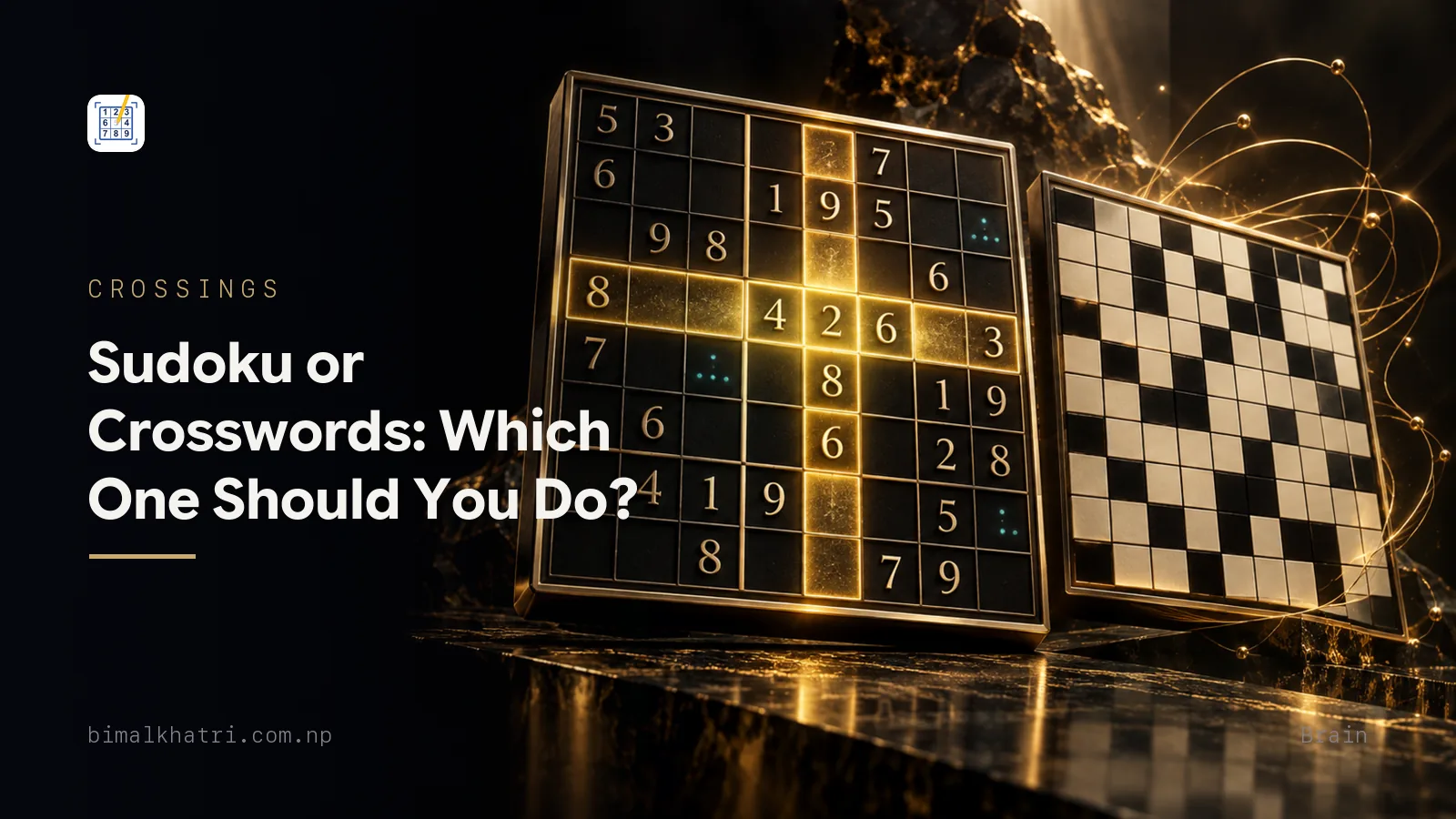
Do the crossword if you want a puzzle that pays you back for everything you have ever read. Do the Sudoku if you want one that puts every piece of the argument on the page, on any day, in any language.
That is the real split, and it is not numbers against words. Underneath, the two puzzles are the same machine: a pile of constraints, and one arrangement that satisfies all of them. What differs is where the constraints are kept. A Sudoku keeps every one of them printed in front of you. A crossword keeps half of them in your head, and you find out how much you have only after you sit down.
The brain argument is the one people reach for, and it settles nothing. That section is further down, and it is shorter than you expect.
Ten minutes and no newspaper? Sudoku Master carries 4,000 puzzles at four grades and works with no signal, so the queue you are standing in is enough. Free, and no ads while you solve.
The short answer, by what you want tonight
| What you want | Take |
|---|---|
| To finish something | Sudoku |
| To learn something you did not know | Crossword |
| A puzzle in a language that is not your first | Sudoku |
| Eleven minutes on a platform | Sudoku |
| An hour with somebody else at the table | Crossword |
| To know whether you are getting better | Sudoku |
| To be genuinely surprised by one answer | Crossword |
| Proof at the end that you were right | Sudoku |
Nobody has to choose. Most newspapers print both on the same page, and the sensible thing is to treat them as two different hobbies that happen to share a sheet of paper.
Both are constraint puzzles. Only one prints all its constraints
Here is a real Sudoku, 30 givens, one solution.
6.8.92...
.7.3.....
2..7.645.
84....16.
...52.87.
..76..59.
.1....6.7
..2......
.9...53..
Look at r1c7, the empty cell in the top right box, seventh column. It has
twenty peers: the eight other cells in its row, the eight in its column, and the
eight in its box, minus the four counted twice. Eleven of those twenty are
already filled.
Its row shows 6, 8, 9 and 2. Its column shows 4, 1, 8, 5, 6 and 3. Its box adds
a 5. Between them that is eight different digits, and only the 7 is missing. So
r1c7 is a 7, and there is no second opinion available.
Now notice what the argument did not use. It did not use arithmetic, because Sudoku has none. It did not use anything you learned at school or read in a newspaper. It used eleven printed symbols and one rule, and the rule fits in a sentence: no digit repeats in a row, a column or a box. Reprint that same grid with nine letters instead of nine digits and every deduction survives untouched, because the digits are labels and nothing else. The 16x16 version of the game proves the point by using 0 to 9 and then A to F, and the letters behave exactly like the numbers.
Now the crossword. Same idea, different storage.
Across 7. Wading bird (4)

  _   B   _   S
  1   2   3   4
The B and the S came from two down answers you already solved, and they are
doing precisely the work the peers did a moment ago: cutting a large field down
to a small one. That part is logic, and it is good logic. The field itself,
though, is the set of four-letter wading birds, and that set is not printed
anywhere on the page. It is in your head or it is nowhere. If IBIS is in there,
the clue takes four seconds. If it is not, you can stare at _B_S until the tea
goes cold and the grid will not help you, because the grid has already told you
everything it knows.
That is the whole difference, and every practical consequence below falls out of it.
What a bad day does to each
A Sudoku degrades gently. Tired, on a bus, on an easy grid, you still finish. You go slower, you make more slips, and the grid catches most of them for you: put a digit where it does not belong and a contradiction turns up a few moves later. A proper puzzle has exactly one solution, so the puzzle is never the thing that failed.
A crossword on a bad day can simply stop. Not because you are stupid, but because the clue wanted a river in Belgium and you do not have a river in Belgium. There is no technique that produces the word. You wait for a crossing letter, or you look it up, and looking it up feels different from looking up a Sudoku technique because the thing you learned helps you exactly once.
The honest counterweight, and it matters. A hard Sudoku that needs a technique you have never met is just as closed as that clue. The grid sits there, legal and unfinished, and staring harder does nothing at all. Anyone who tells you Sudoku is always winnable by pure effort has not met an extreme grid.
The difference is that the Sudoku wall has a name, and there are not many walls in total. The list of named techniques ends somewhere past colouring and chains, and you could learn every rung on it in a season. Learn the rung above the one that stopped you and a class of grids that used to be closed opens permanently. Nobody can hand you the matching list of every word you do not yet know.
Two different curves of improvement
Sudoku improvement is steppy and legible. You are stuck at the same point for weeks, you learn what a naked pair is in about ten minutes, and grids that beat you last month fall over. You can name the thing you learned. You can also measure it, because the same difficulty grade takes you less time than it did.
Crossword improvement is a slope, and it is mostly accumulation. More words, more of the setter's habits, more of the small vocabulary that crosswords use far more often than English does. It is real progress, and it arrives so smoothly that you rarely catch it happening. Ask a crossword solver what they learned this month and most of them cannot tell you, which is not a criticism. It just means the feedback is poor, and poor feedback makes a habit harder to keep going.
If you want the daily thing to feel like it is going somewhere, that difference is worth more than any argument about which puzzle is better for you. There is a full list of the rungs in every Sudoku technique in order, and it is short enough to read in one sitting.
The brain question, and why it does not decide this
No experiment has ever set word puzzles against number puzzles. The work people are half-remembering is PROTECT, a 2019 survey of more than 19,000 older adults by the University of Exeter and King's College London, and it staged no contest. It asked people what they already did with their own time. Those who reported doing number puzzles most often came out best on its cognitive tests.
That design is why it cannot rank two hobbies. Nobody was assigned a puzzle, so if sharper people drift towards grids on their own, the grids collect the credit for the drift. The authors were clear about the limit. And no work anywhere shows that either puzzle lowers a person's risk of dementia. The evidence at full length, with its edges left visible, is in is Sudoku good for your brain.
A second reason the argument goes nowhere here. Whatever practice buys you tends to stay inside the thing you practised, which is the oldest complaint about brain-training claims. Follow that through and a crossword buys you crosswords, a Sudoku buys you Sudoku, and "better for you" turns back into "which one do you want to be good at".
So decide on the part that needs no citation at all. The puzzle that helps you is the one you are still doing in March. The one you drop in October does nothing for anybody.
The practical differences that actually decide it
| Question | Sudoku | Crossword |
|---|---|---|
| Works in a second language | Yes, the digits are labels | No, it is welded to one language |
| Travels between countries | Yes | Poorly, the references are local |
| Needs a dictionary | Never | Sometimes, and that is allowed |
| Checkable by you alone | Yes, the rules verify the grid | Only against the answer key |
| Interrupted after four minutes | Resume exactly where you were | Resume, but you lose the half-formed hunch |
| Two people at once | Awkward, one grid one thinker | Natural, and better out loud |
| Difficulty label means something | Only within one publisher | Only within one setter |
| Teaches you a fact | No | Often |
The verification row is the one people underrate. When you finish a Sudoku you know it is right, because the rules are the check. A crossword needs somebody else's answer key, or a friend, or tomorrow's paper. That is also why a Sudoku can be settled by a camera and a crossword cannot.
The two-people row runs the other way, and it is the strongest thing a crossword has. A crossword is a conversation. One person reads the clue out, another one gets it, and the pleasure is partly social. Sudoku is solitary by construction, which is a feature at 6am and a limitation on a Sunday afternoon.
Brain games like Sudoku, if you want more of the same
If what you liked was the closed logic, the nearest things are Sudoku's own relatives. These are all played on paper and in plenty of apps, and each adds exactly one rule to the classic game.
| Variant | The one extra rule |
|---|---|
| Killer | Dashed cages carry a sum, and digits inside a cage do not repeat |
| Jigsaw | The nine boxes become nine irregular shapes |
| Sudoku X | Both main diagonals must hold 1 to 9 as well |
| Samurai | Five grids overlap, sharing four corner boxes |
| 16x16 | Digits 0 to 9 plus A to F, in 4x4 boxes |
Killer is the interesting one for this comparison, because it is the single member of the family that really is arithmetic. Some cage sums have only one possible set of digits, and those are the footholds: in a two-cell cage a 3 can only be 1 and 2, and a 17 can only be 8 and 9. In a three-cell cage a 6 is only 1, 2 and 3, and a 24 is only 7, 8 and 9. Learn those four and a cage grid opens up. The full rules take five minutes.
If what you liked was the wordplay rather than the logic, the crossword's own family is where to go, and a cryptic is the deep end of it. That is somebody else's subject and I am not going to pretend otherwise.
How to run both without dropping one
The split that works is by situation, not by loyalty.
Sudoku for the small windows. Ten minutes, one hand, a bus, a queue, the five minutes before a meeting starts. It survives interruption because the state is all on the grid.
The crossword for the sit-down. It wants a table, a drink and no hurry, and it is much better with a second person. Treat it as an occasion rather than a daily duty and you will finish more of them.
Do the Sudoku first when you are tired. Logic on a low battery is slow but functional. Recall on a low battery is the first thing to go, and a crossword is almost entirely recall.
Keep one measurable. If you want the habit to stick, track one of them and let the other be pure enjoyment. Sudoku is the one that measures easily: a completion time on a fixed grade is a real number that moves. There is a working version of this in a daily Sudoku habit that sticks.
What I built, and what it will not do for you
I built Sudoku Master because the small-window half of that split kept being the half I had nothing good for. It plays classic nine by nine, 4,000 puzzles at easy, medium, hard and extreme, all bundled in the app so it works with no signal and no account. The camera part is the reason it exists: point it at the grid in the newspaper, crop, and the digits are read on the device by Google ML Kit, so the photo never leaves your phone. Recognition is imperfect on a creased page, so every digit it reads can be corrected before you solve.
What it will not do. It plays no word puzzles at all, so it is no use for the other half of the newspaper. It plays the classic grid and nothing else, so none of the variants listed further up this page are in it. The solver returns a finished grid by backtracking rather than a technique-by-technique explanation, so it settles an argument instead of teaching a method. There is no account and no sync. On ads the honest position is that there are banners on the home and statistics screens and on the scanner, an interstitial when you leave the scanner, and none at all on the playing board.
Common mistakes
Reading "better for your brain" as settled. It is not settled for either puzzle, and the study everyone quotes cannot show cause. Choose on enjoyment.
Deciding Sudoku is a maths puzzle and stopping there. People who believe they are bad with numbers skip the one puzzle on the page that never asks them to calculate anything.
Judging a crossword by whether you finished it. A crossword you finished taught you nothing. The one that beat you had four words in it worth keeping.
Grinding a hard Sudoku with the technique you already have. If the grid has stopped moving, the missing thing is usually a named method rather than more effort. The checklist for a stuck grid works through them in order.
Questions people ask
Why can I finish a Sudoku but never the crossword?
Because a Sudoku hands you every fact you need and a crossword assumes some of them. Nothing in a Sudoku grid depends on what you have read, which country you grew up in, or how big your vocabulary is. A crossword depends on all three. This is not a difference in your ability, it is a difference in what the two puzzles are made of.
Is Sudoku a maths puzzle?
No. There is no arithmetic anywhere in classic Sudoku and no cell is added to any other. The digits are nine distinct symbols, chosen because everyone can tell them apart quickly. Killer Sudoku is the exception, and it is a different puzzle with a sum written on each cage.
Which one is harder?
Neither, and the question does not survive contact with the puzzles. A crossword is hard in proportion to the gap between your vocabulary and the setter's. A Sudoku is hard in proportion to the most advanced move it demands, which is why the number of clues it starts with tells you so little.
Which puzzle is better for memory?
There is no result to quote, because that comparison has never been run. What exists is survey work on puzzling in general, and a survey cannot show that the puzzle caused what it found. Anybody handing you a winner is filling the gap with an opinion.
Can I get better at crosswords the way I get better at Sudoku?
Partly. The wordplay conventions in a cryptic really are a learnable system, and learning them feels like learning a Sudoku technique. General knowledge does not work that way. It accumulates, and it accumulates at the speed of reading rather than practice.
Is there a word puzzle that works like Sudoku?
Sudoku printed with nine letters instead of nine digits is the closest thing, and it is the same puzzle wearing a costume. The letters are still labels, the deductions are identical, and any word that shows up in a row is a coincidence the setter arranged.
Does it matter which one I do, as long as I do one every day?
Not on any evidence worth quoting. Build the habit around whichever one survives a bad week, give it a fixed time, and let the other be an occasional treat. A puzzle you enjoy for a year beats the theoretically superior one you abandon in week three.
Should a child start with Sudoku or a crossword?
Sudoku, usually, and on a 4x4 or 6x6 grid rather than the full nine. It needs no vocabulary, so a child who is still learning to read can do it, and the smaller grids give a finish inside a few minutes. There is more on picking the grid size in Sudoku for kids.
Keep reading
- Is Sudoku good for your brain? What the studies actually found, for the evidence at full length rather than the four paragraphs above
- Sudoku: rules, techniques and solving, for what to read before and after this one
- A daily Sudoku habit that actually sticks, for turning either puzzle into something you still do in March
- Types of Sudoku, from classic to Samurai, if the logic side is the half you enjoyed
- Newspaper Sudoku: USA Today, LA Times and the Washington Post, where both puzzles sit on the same page
- How to play Sudoku: the complete rules for beginners, if you are arriving from the crossword side
Get it: Sudoku Master, free on iPhone and Android. The link sends you to whichever store your phone uses.