Vela is the sails of the dismantled ship Argo Navis, and like its sister constellations it sits in a brilliant stretch of the southern Milky Way.
It holds two things of real scientific weight: the Vela Supernova Remnant, the expanding wreckage of a star that exploded around eleven thousand years ago, and at its heart the Vela Pulsar, a neutron star spinning eleven times a second. It was one of the first objects to prove that pulsars are what supernovae leave behind.
Where to find Vela
Vela sits between Carina and Puppis, along the southern Milky Way. From the southern hemisphere, look between Canopus and the Southern Cross.
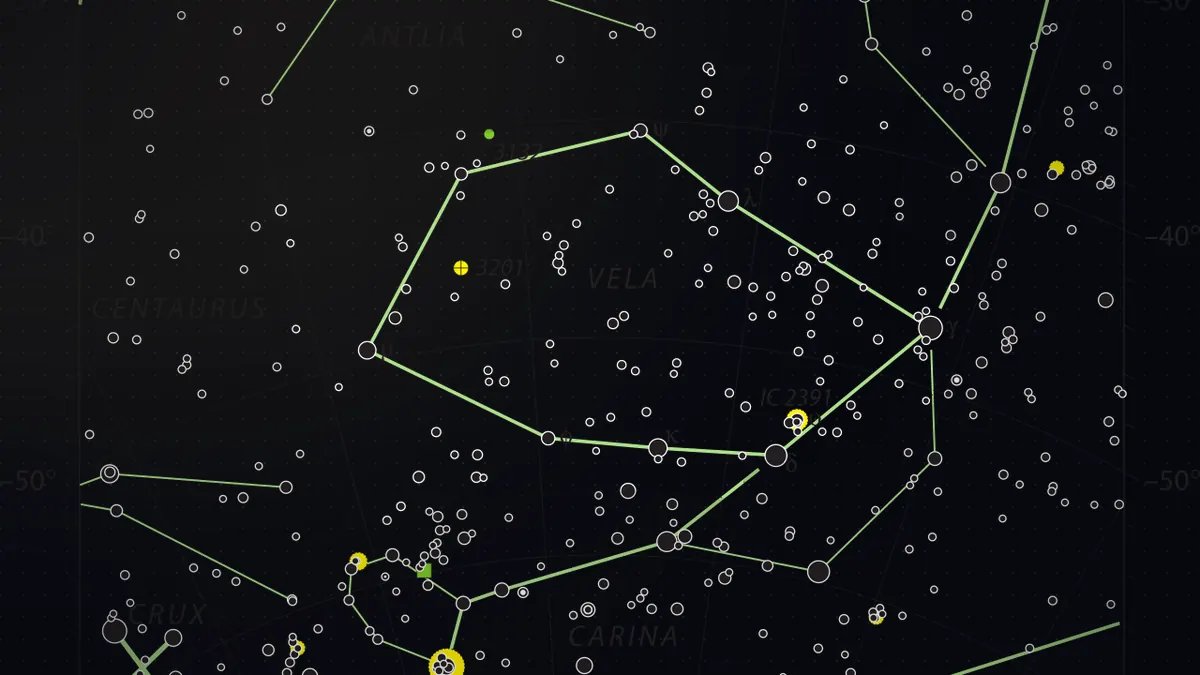
The most useful landmark is the False Cross, formed by two stars of Vela and two of Carina. It is larger than the real Southern Cross and its stars are more evenly spaced, and it fools people constantly, including navigators, historically. The genuine Southern Cross is smaller, brighter and has the two Pointer stars nearby.
Knowing both crosses and being able to tell them apart is a genuinely useful southern-sky skill.
In sky coordinates Vela sits at right ascension 9h 00m and declination −50.0°. Right ascension is the sky's version of longitude and declination its version of latitude, so those two numbers pin the constellation to one spot on the celestial sphere the way a map reference pins a town. It is a far-southern constellation, so southern observers own it and much of the northern hemisphere never sees it at all. You can see it from anywhere south of latitude 30°N, including the whole southern hemisphere, and it sits highest after dark in March.
What Vela actually looks like
A broad scatter of moderately bright stars across the Milky Way, with no single tidy pattern. Two of its stars form half of the False Cross, which is the most recognisable feature.
As with Puppis, the star naming reveals the constellation's origin. Vela has no Alpha or Beta star: its brightest is Gamma Velorum, because the earlier Bayer letters from Argo Navis went to Carina. Three constellations, one interrupted alphabet.
The sails were the part of the ship that Lacaille assigned to the northern and central section of the old figure, which is why Vela sits between the keel below and the stern to the west.
The stars of Vela
- Regor (Gamma Velorum, magnitude 1.8) — the brightest star and one of the most remarkable multiple systems in the sky. It contains the nearest and brightest Wolf-Rayet star: a massive star that has blown away its outer hydrogen layers, exposing a searing core and pouring out a fierce stellar wind. It is sometimes called the Spectral Gem of the Southern Skies for its extraordinary spectrum.
- Delta Velorum — an eclipsing binary and part of the False Cross.
- Kappa Velorum — the other False Cross member from Vela.
- The Vela Pulsar — the collapsed core left by the supernova, spinning about eleven times a second and detectable in radio, optical, X-ray and gamma rays. It is one of the brightest gamma-ray sources in the sky.
The story behind the name
Vela shares the Argo Navis mythology with Carina and Puppis: the ship of Jason and the Argonauts, sailed to Colchis to recover the Golden Fleece, and afterwards placed in the sky.
Its separate existence dates only from Lacaille's 1750s survey, when he divided the unmanageable Argo into three. He is responsible for a remarkable share of the southern sky: fourteen constellations of his own invention plus this three-way split.
There is a modern footnote worth knowing. The Vela satellites, launched by the United States in the 1960s to detect clandestine nuclear tests by their gamma-ray signature, instead discovered gamma-ray bursts coming from deep space: among the most energetic events in the universe. The satellites were named after the constellation, and their accidental discovery opened an entire field of astrophysics.
What else is hiding in Vela
- The Vela Supernova Remnant — the expanding shell of a star that exploded roughly 11,000 years ago, about 800 light years away. It covers a huge area of sky, and long-exposure photographs show an intricate web of glowing filaments. Parts are reachable visually with a wide field and a nebula filter under dark skies.
- The Gum Nebula — an enormous, very faint emission region spanning more than 30 degrees across Vela and Puppis, probably an ancient supernova remnant. It is one of the largest structures in the sky.
- NGC 3132, the Eight-Burst or Southern Ring Nebula — a bright, beautiful planetary nebula and an early James Webb Space Telescope target. Excellent in a modest telescope.
- NGC 2547 — a bright open cluster, well placed for binoculars.
- The Pencil Nebula (NGC 2736) — a sharply defined filament of the Vela remnant, looking like a streak of light.
When and where to see it
Best placed in the evening sky in March, through the southern summer and autumn.
Vela is a southern constellation reaching only to about 30°N in its northernmost parts, so most of it is inaccessible from Europe and much of North America. Southern observers get it high overhead.
The supernova remnant is a demanding target that rewards a dark sky, a wide field and an OIII filter. NGC 3132 is far easier and looks good in almost anything. If you are learning the southern sky, spend a few minutes deliberately comparing the False Cross with the real Southern Cross. It is the kind of practical knowledge that saves confusion later.
Vela at a glance
| Name | Vela |
| Abbreviation | Vel |
| Genitive form | Velorum |
| Meaning | the Sails |
| Family | Heavenly Waters family |
| First recorded | ancient (Ptolemy); 1756, Lacaille, split from Argo Navis |
| Right ascension | 9h 00m |
| Declination | −50.0° |
| Area | 500 square degrees (32nd largest of 88) |
| Main stars in the figure | 5 |
| Stars brighter than magnitude 3 | 5 |
| Named Bayer / Flamsteed stars | 50 |
| Brightest star | γ Vel (magnitude 1.75) |
| Messier objects | None |
| Meteor showers | Delta Velids, Gamma Velids, Puppid-Velids |
| Visible from | Anywhere south of latitude 30°N, including the whole southern hemisphere |
| Best seen at 9 pm in | March |
| Bordering constellations | Antlia, Carina, Centaurus, Puppis, Pyxis |
Where to go next
Its neighbours in the sky
Vela borders all of these, which makes them the natural next targets once you can pick it out: Antlia, Carina, Centaurus, Puppis, Pyxis.
The rest of the Heavenly Waters family
Vela belongs to the Heavenly Waters family: constellations tied to water, ships and the sea. The others are: Carina, Columba, Delphinus, Equuleus, Eridanus, Piscis Austrinus, Puppis, Pyxis.
Start from the beginning
If you are starting from scratch, the complete beginner's guide to the 88 constellations covers what a constellation actually is, how the sky is carved up, and links to every one of them.
Star chart: Vela IAU chart by IAU and Sky & Telescope magazine (Roger Sinnott & Rick Fienberg), used under CC BY 3.0. Observing data cross-checked against Wikipedia's Vela entry.