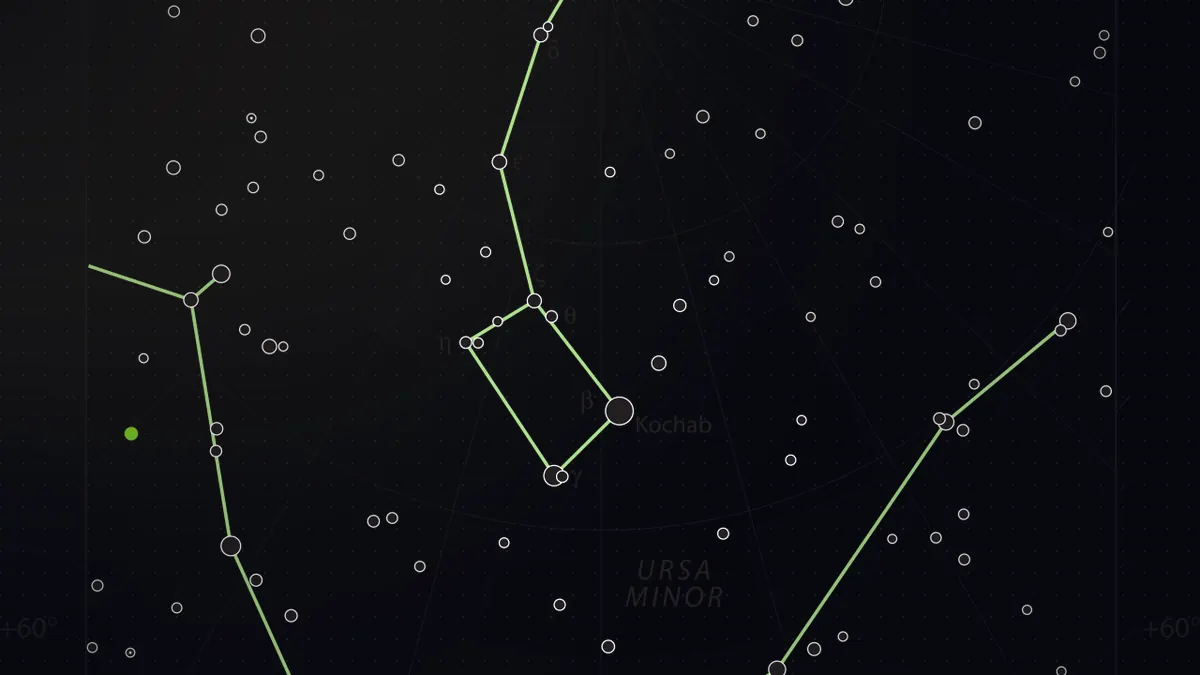
Ursa Minor is not a bright constellation. Most of its stars are faint enough that suburban light wipes them out entirely. It is on this list anyway because of one star at the tip of its tail: Polaris, the North Star.
Polaris sits almost exactly above Earth's north pole, which means it barely moves. Every other star in the sky wheels around it through the night. For thousands of years that made it the most practically valuable star there is: the one that told sailors which way was north and how far north they had come.
Where to find Ursa Minor
Find the Big Dipper in Ursa Major, then use the Pointer stars Dubhe and Merak. Draw a line through them, extend it roughly five times the gap between them, and you arrive at a moderately bright star sitting on its own. That is Polaris.
A common misconception is worth clearing up: Polaris is not an especially bright star. It is only magnitude 2, about as bright as the Dipper's stars. People expect a beacon and are often disappointed. What makes it special is position, not brilliance.
From Polaris, the rest of the Little Dipper curls away: the handle first, then a faint bowl. Under city skies you will typically get Polaris and the two bowl stars, and nothing else.
In sky coordinates Ursa Minor sits at right ascension 0h 00m and declination +65.4°. Those two numbers work like a grid reference. Right ascension runs around the sky the way longitude runs around the Earth, and declination measures north and south the way latitude does. It is a far-northern constellation, so northern observers get the best of it and it never rises for much of the southern hemisphere. You can see it from anywhere north of latitude 0°S, including the whole northern hemisphere, and it sits highest after dark in June.
What Ursa Minor actually looks like
Ursa Minor is a smaller, fainter echo of the Big Dipper: seven stars, four in a bowl and three in a handle, which is why it is called the Little Dipper. The crucial difference is orientation: the Little Dipper's handle curves the opposite way, and Polaris is at the end of the handle rather than the bowl.
The two brightest bowl stars, Kochab and Pherkad, are sometimes called the Guardians of the Pole because they circle Polaris through the night. Those two plus Polaris are usually all you can see without a dark sky, and picking out the full seven is a decent test of how good your conditions really are.
The stars of Ursa Minor
- Polaris (Alpha Ursae Minoris, magnitude 1.97) — a yellow-white supergiant about 400 light years away. It is also the brightest Cepheid variable in the sky, pulsing slightly in brightness on a roughly four-day cycle. Cepheids are how astronomers measure cosmic distances, so the North Star is also a rung on the distance ladder.
- Kochab (Beta) — an orange giant, and very nearly as bright as Polaris. Around 1500 BC it was closer to the pole than Polaris was, and served as the pole star of its era.
- Pherkad (Gamma) — the other Guardian, a white giant.
Polaris will not hold its job forever. Earth's axis wobbles over a 26,000-year cycle called precession, so the pole star changes. Thuban in Draco held the role for the pyramid builders; in about 12,000 years it will be Vega in Lyra.
The story behind the name
In Greek myth Ursa Minor is Arcas, son of Callisto, placed in the sky beside his transformed mother. An alternative version makes it Ida, one of the nymphs who cared for the infant Zeus on Crete.
The constellation's real story, though, is navigation. Phoenician sailors used these stars so consistently that the Greeks sometimes called the group the Phoenician. Because a star's height above the horizon equals your latitude, measuring Polaris told a navigator exactly how far north they were: a technique that worked for centuries before anyone could measure longitude at all.
The same star anchors stories elsewhere. Several North American traditions describe it as a nail or a fixed point the sky is pinned to, and Norse sources call it the world spike. Every culture that lived in the far north noticed that one star refuses to move.
What else is hiding in Ursa Minor
Ursa Minor is close to the galactic pole and contains no Messier objects. It is a quiet corner of sky, and that is worth saying plainly rather than overselling it.
- The Ursa Minor Dwarf Galaxy — a small satellite galaxy of the Milky Way, about 200,000 light years away and made mostly of very old stars. It is extremely diffuse and effectively an astrophotography-only target.
- NGC 6217 — a barred spiral galaxy, reachable with a medium telescope, and one of the first objects imaged after Hubble's 2009 servicing mission.
- The Ursids — a modest meteor shower peaking around 22 December, typically about ten meteors an hour. It gets overlooked because it lands in the same week as Christmas.
The real observing project here is not an object at all: photograph the region for an hour with a fixed camera and you get star trails circling a near-motionless Polaris.
When and where to see it
Best placed in the evening in June, but as with Ursa Major that hardly matters, from the northern hemisphere it is circumpolar and visible every clear night of the year.
Its usefulness depends entirely on where you stand. At the north pole Polaris sits directly overhead. At the equator it hugs the horizon. Cross into the southern hemisphere and it disappears completely, which is why southern navigators had to develop entirely different techniques using the Southern Cross.
You need only your eyes for Polaris. For the full Little Dipper you need a genuinely dark sky, and if you can trace all seven stars, your conditions are good enough for almost anything else in this guide.
Ursa Minor at a glance
| Name | Ursa Minor |
| Abbreviation | UMi |
| Genitive form | Ursae Minoris |
| Meaning | the Little Bear |
| Family | Ursa Major family |
| First recorded | ancient (Ptolemy) |
| Right ascension | 0h 00m |
| Declination | +65.4° |
| Area | 256 square degrees (56th largest of 88) |
| Main stars in the figure | 7 |
| Stars brighter than magnitude 3 | 3 |
| Named Bayer / Flamsteed stars | 23 |
| Brightest star | Polaris (magnitude 1.97) |
| Messier objects | None |
| Meteor showers | Ursids |
| Visible from | Anywhere north of latitude 0°S, including the whole northern hemisphere |
| Best seen at 9 pm in | June |
| Bordering constellations | Camelopardalis, Cepheus, Draco |
Where to go next
Its neighbours in the sky
Everything here shares a border with Ursa Minor. Find one and the rest are a short hop away: Camelopardalis, Cepheus, Draco.
The rest of the Ursa Major family
Ursa Minor belongs to the Ursa Major family: the circumpolar northern group anchored by the Big Dipper. The others are: Boötes, Camelopardalis, Canes Venatici, Coma Berenices, Corona Borealis, Draco, Leo Minor, Lynx, Ursa Major.
Start from the beginning
New to all this? The 88 constellations: a complete beginner's guide explains what a constellation actually is, how the sky is divided up, and lists all 88 with a link to each one.
Star chart: Ursa Minor IAU chart by IAU and Sky & Telescope magazine (Roger Sinnott & Rick Fienberg), used under CC BY 3.0. Observing data cross-checked against Wikipedia's Ursa Minor entry.