Leo Minor has a difficult position in life: a small, faint constellation squeezed between two of the most recognisable patterns in the northern sky, Leo below and Ursa Major above. Nobody looking at that part of the sky is looking at Leo Minor.
It has three stars worth the name and no Messier objects. But it does hold one of the strangest objects ever found by an amateur: a glowing green cloud lit by the ghost of a quasar that switched off two hundred thousand years ago.
Where to find Leo Minor
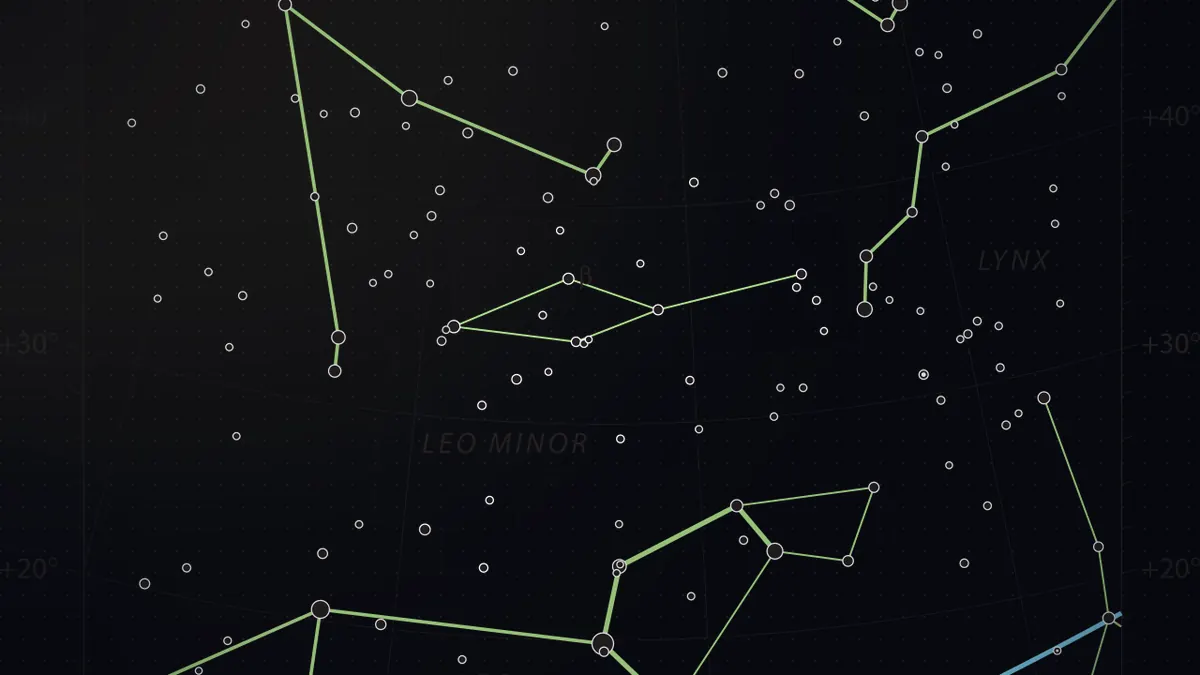
Find Leo first — the backwards question mark of the Sickle, with bright Regulus at its base. Then look immediately north, into the gap between Leo's back and the front feet of the Great Bear.
That narrow strip is Leo Minor. You are looking for a small, shallow triangle of faint stars, nothing brighter than magnitude 3.8. There are 37 stars here above magnitude 6.5 but only three above 4.5, so the constellation is more of a suggestion than a pattern.
If you can see the triangle at all, your sky is in decent shape.
In sky coordinates Leo Minor sits at right ascension 9h 22m and declination +22.8°. Declination is latitude by another name and right ascension is longitude, so the pair fixes the constellation at one point on the celestial sphere. It sits in the northern half of the sky, riding high for northern observers and low for southern ones. Practically speaking it is visible from anywhere north of latitude 45°S, including the whole northern hemisphere, with the best evening views around April.
What Leo Minor actually looks like
Three stars forming a thin, flattened triangle. That is the entire figure.
Classical astronomers did not treat these stars as a separate group at all. They were simply the unclaimed space between the Lion and the Bear. Johannes Hevelius designated Leo Minor in 1687, and his choice of a smaller lion was a straightforward nod to the far more impressive constellation next door.
One quirk gives Leo Minor away as an afterthought: it has no Alpha star. When Francis Baily assigned Bayer letters, Beta Leonis Minoris was labelled but the brightest star was somehow never given Alpha, and the omission was never corrected.
The stars of Leo Minor
- Praecipua (46 Leonis Minoris, magnitude 3.83) — the brightest star here, an orange giant about 95 light years away. The name means 'the chief one', which is the sort of grand title you give a star when it is the best you have.
- Beta Leonis Minoris (magnitude 4.4) — the second brightest, and the only star in the constellation with a Bayer designation. It is a binary pairing an orange giant with a yellow-white main-sequence star.
- 21 Leonis Minoris — a rapidly rotating white star, third brightest.
- SDSS J102915+172927 — an extraordinarily metal-poor star, made almost entirely of hydrogen and helium. Stars like this are relics from the very early universe, and their existence challenges models of how the first generations of stars could form at all.
The story behind the name
There is no mythology, because Leo Minor did not exist before 1687. Hevelius created it from stars that had never belonged to any figure.
That is itself the interesting part. By the seventeenth century, European astronomers were engaged in a slow land grab, naming every unclaimed patch of sky. Hevelius alone introduced Leo Minor, Lynx, Canes Venatici, Sextans, Scutum, Vulpecula and Lacerta: seven of the modern 88, most of them faint fillers between famous neighbours.
Not all of his inventions survived; the IAU's 1922 standardisation quietly dropped a number of similar creations. Leo Minor made the cut mostly because the sky needed complete coverage, and somebody had to own this strip.
What else is hiding in Leo Minor
No Messier objects, and the galaxies here are faint. One target, however, is genuinely famous.
- Hanny's Voorwerp — a cloud of glowing green gas beside the galaxy IC 2497, discovered in 2007 by Hanny van Arkel, a Dutch schoolteacher taking part in the Galaxy Zoo citizen-science project. It turned out to be a light echo: gas being illuminated by a quasar in IC 2497 that shut down roughly 200,000 years ago. We are seeing the afterglow of something that has already ended. It is far too faint for amateur telescopes, but it is one of the best modern examples of an amateur finding something professionals had missed.
- NGC 3432, the Knitting Needle Galaxy — an edge-on spiral being distorted by a companion.
- The Leonis Minorids — a very minor meteor shower peaking in late October.
When and where to see it
Best placed in the evening sky in April, alongside Leo and the spring galaxy season.
It reaches to about 45°S, so it is visible from most of the world, but it is a northern constellation in practice and southern observers get it low and washed out.
You need a reasonably dark sky just to see the triangle, and a telescope with dark skies for anything else. Realistically, Leo Minor is a completist's constellation: you find it because you are working through all 88, and the satisfaction is in having ticked off one of the hardest easy ones.
Leo Minor at a glance
| Name | Leo Minor |
| Abbreviation | LMi |
| Genitive form | Leonis Minoris |
| Meaning | the lesser Lion |
| Family | Ursa Major family |
| First recorded | 1690, Hevelius |
| Right ascension | 9h 22m |
| Declination | +22.8° |
| Area | 232 square degrees (64th largest of 88) |
| Main stars in the figure | 3 |
| Stars brighter than magnitude 3 | 0 |
| Named Bayer / Flamsteed stars | 34 |
| Brightest star | Praecipua (magnitude 3.83) |
| Messier objects | None |
| Meteor showers | Leonis Minorids |
| Visible from | Anywhere north of latitude 45°S, including the whole northern hemisphere |
| Best seen at 9 pm in | April |
| Bordering constellations | Cancer, Leo, Lynx, Ursa Major |
Where to go next
Its neighbours in the sky
Everything here shares a border with Leo Minor. Find one and the rest are a short hop away: Cancer, Leo, Lynx, Ursa Major.
The rest of the Ursa Major family
Leo Minor belongs to the Ursa Major family: the circumpolar northern group anchored by the Big Dipper. The others are: Boötes, Camelopardalis, Canes Venatici, Coma Berenices, Corona Borealis, Draco, Lynx, Ursa Major, Ursa Minor.
Start from the beginning
New to all this? The 88 constellations: a complete beginner's guide explains what a constellation actually is, how the sky is divided up, and lists all 88 with a link to each one.
Star chart: Leo Minor IAU chart by IAU and Sky & Telescope magazine (Roger Sinnott & Rick Fienberg), used under CC BY 3.0. Observing data cross-checked against Wikipedia's Leo Minor entry.