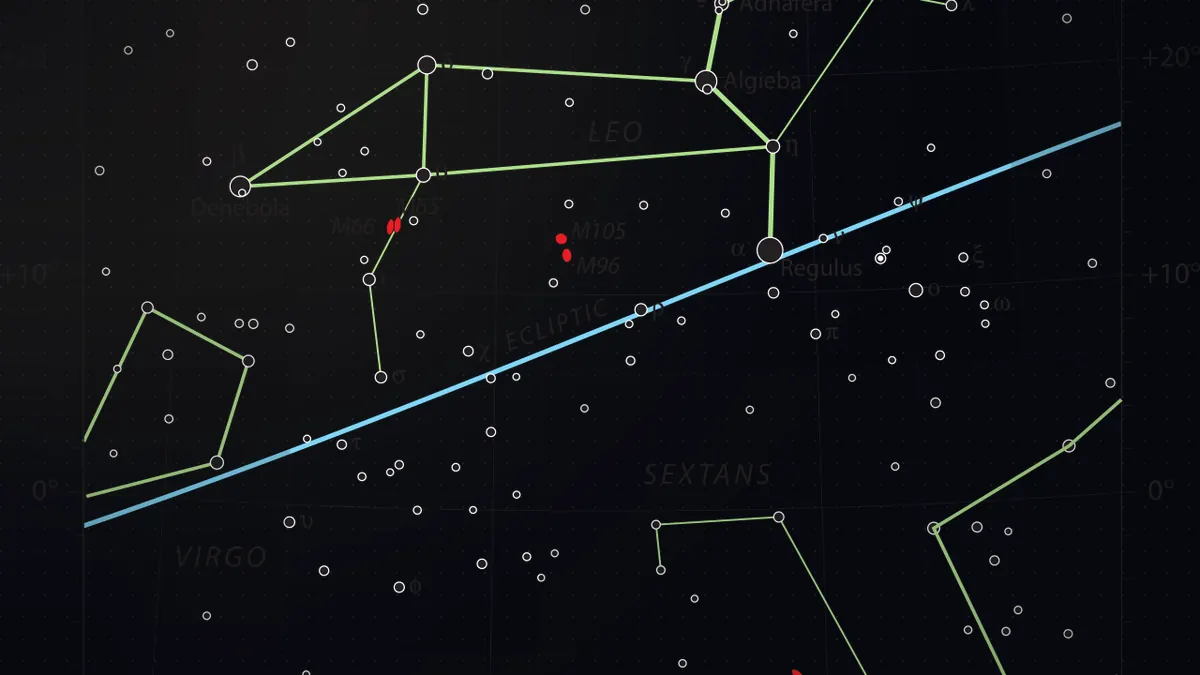
Leo is one of the small number of constellations that actually resembles its namesake. A backwards question mark forms the lion's head and mane, a bright triangle behind it makes the hindquarters, and the whole thing reads convincingly as a big cat lying down facing west.
It is the herald of spring in the northern hemisphere, it holds the first-magnitude star Regulus, and beneath it lie some of the most accessible galaxies in the sky.
Where to find Leo
Use the Big Dipper, but a different part of it than usual. The two stars at the bottom of the Dipper's bowl — the ones opposite the Pointers — point away from Polaris and down towards Leo. Some observers use the phrase 'a hole in the bottom of the bowl leaks onto Leo'.
What you are looking for is the Sickle: six stars in a backwards question mark, with bright bluish-white Regulus as the dot at the bottom. Behind it, to the east, a distinct triangle of stars ends in Denebola, the tail.
Regulus sits almost exactly on the ecliptic, so the Moon and planets pass close by it regularly.
In sky coordinates Leo sits at right ascension 11h 00m and declination +15.0°. Right ascension is the sky's version of longitude and declination its version of latitude, so those two numbers pin the constellation to one spot on the celestial sphere the way a map reference pins a town. It sits in the northern half of the sky, riding high for northern observers and low for southern ones. In practice you can see it from between latitudes 85°N and 60°S, and it stands highest in the evening sky around April.
What Leo actually looks like
Two pieces, and both are easy. The Sickle — a backwards question mark — forms the head and mane, curving up and over from Regulus. The triangle to its east forms the rear body and tail.
Put them together and the lion is genuinely visible: head down, mane raised, haunches back. It is one of the best figure-to-name matches among the ancient constellations, and it holds up under suburban skies because the main stars are bright.
The lion has been read as a lion for a very long time: Mesopotamian, Persian, Greek, Roman and Jewish traditions all identify these stars with a big cat, which is unusual continuity.
The stars of Leo
- Regulus (Alpha Leonis, magnitude 1.4) — 'the little king', about 79 light years away and the twenty-first brightest star in the sky. It spins extraordinarily fast, completing a rotation in about 16 hours, which has flattened it into a distinct oval. If it spun much faster it would tear itself apart.
- Denebola (Beta Leonis) — the tail, from Arabic for 'the lion's tail'.
- Algieba (Gamma Leonis) — one of the finest double stars in the sky, a pair of golden-orange giants that a small telescope separates beautifully. If you look at one double star in Leo, make it this one.
- Wolf 359 — one of the closest stars to the Sun at 7.9 light years, but a red dwarf so faint you need a telescope. Science-fiction readers may recognise the name from Star Trek.
The story behind the name
Leo is the Nemean Lion, killed by Hercules as the first of his twelve labours. Its hide could not be pierced by any weapon, so Hercules strangled it and afterwards wore its skin as armour, which is why he is usually drawn wearing a lion pelt.
The lion connection is far older than Hercules. In Mesopotamia these stars were a lion as early as the third millennium BC, and the identification passed through Persian, Turkish and Jewish astronomy essentially unchanged. There is an old and appealing idea that the Sphinx combines a lion's body and human head because the Nile flooded when the Sun was in Leo and the constellation Virgo was rising: an attractive theory that historians treat with some caution.
Regulus was one of the four Royal Stars of Persia, watchers of the sky's four quarters alongside Aldebaran, Antares and Fomalhaut.
What else is hiding in Leo
Leo looks out of the galactic plane, so like Virgo and Coma Berenices it is galaxy country.
- The Leo Triplet — M65, M66 and NGC 3628 — three spiral galaxies close enough together to fit in one low-power telescope field. M65 and M66 are bright and easy; NGC 3628, the Hamburger Galaxy, is an edge-on spiral with a thick dust lane and is fainter. Getting all three at once is one of the great satisfactions of spring observing.
- M95, M96 and M105 — a second galaxy group a little further west, also within reach of a modest telescope.
- The Leonids — a meteor shower peaking around 17 November, produced by Comet Tempel-Tuttle. Normally modest, it periodically produces spectacular storms: in 1833 observers reported meteors falling like snow, and 1966 produced thousands per hour. The comet returns every 33 years, so outbursts cluster around those dates.
When and where to see it
Best placed in the evening sky in April, and a reliable marker of spring in the northern hemisphere from February to June.
Leo straddles the celestial equator, so it is visible from essentially everywhere on Earth: one of the more democratic constellations.
The Sickle and Regulus handle city light fine. The galaxies do not: they want a dark sky and a telescope, and they reward patience more than aperture. Algieba is the exception — a bright double that splits nicely even from a suburb, and a genuinely lovely sight.
Leo at a glance
| Name | Leo |
| Abbreviation | Leo |
| Genitive form | Leonis |
| Meaning | the Lion |
| Family | Zodiac family |
| First recorded | ancient (Ptolemy) |
| Right ascension | 11h 00m |
| Declination | +15.0° |
| Area | 947 square degrees (12th largest of 88) |
| Main stars in the figure | 9 |
| Stars brighter than magnitude 3 | 5 |
| Named Bayer / Flamsteed stars | 92 |
| Brightest star | Regulus (α Leo) (magnitude 1.35) |
| Messier objects | 5 |
| Meteor showers | Leonids |
| Visible from | Between latitudes 85°N and 60°S |
| Best seen at 9 pm in | April |
| Bordering constellations | Cancer, Coma Berenices, Crater, Hydra, Leo Minor, Lynx, Sextans, Ursa Major, Virgo |
Where to go next
Its neighbours in the sky
Everything here shares a border with Leo. Find one and the rest are a short hop away: Cancer, Coma Berenices, Crater, Hydra, Leo Minor, Lynx, Sextans, Ursa Major, Virgo.
The rest of the Zodiac family
Leo belongs to the Zodiac family: the twelve constellations the Sun, Moon and planets travel through. The others are: Aquarius, Aries, Cancer, Capricornus, Gemini, Libra, Pisces, Sagittarius, Scorpius, Taurus, Virgo.
Start from the beginning
New to all this? The 88 constellations: a complete beginner's guide explains what a constellation actually is, how the sky is divided up, and lists all 88 with a link to each one.
Star chart: Leo IAU chart by IAU and Sky & Telescope magazine (Roger Sinnott & Rick Fienberg), used under CC BY 3.0. Observing data cross-checked against Wikipedia's Leo entry.