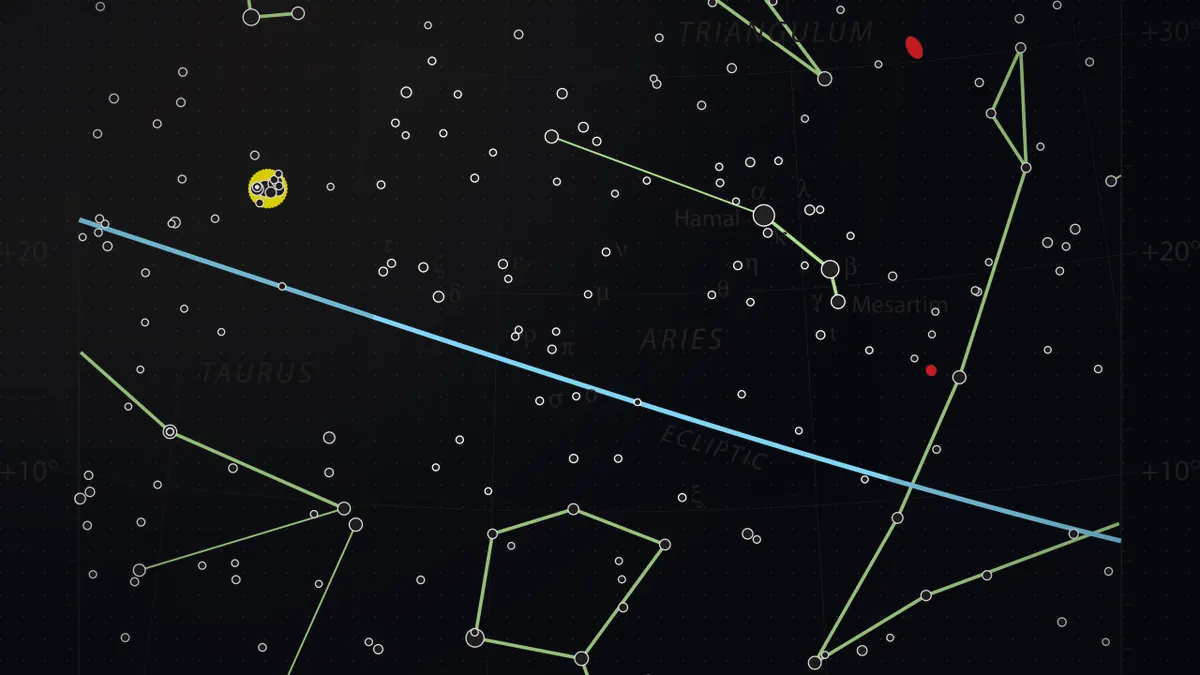
Aries is famous out of all proportion to how it looks. Everyone knows it as the first sign of the zodiac; almost nobody can point at it. The whole constellation amounts to a short, gently bent line of three stars.
Its importance is historical. Two thousand years ago the Sun crossed the celestial equator in Aries each spring, so this was where the astronomical year began. That crossing point is still called the First Point of Aries: even though it drifted out of Aries centuries ago and now sits in Pisces.
Where to find Aries
Aries lives in a quiet stretch between the Pleiades in Taurus and the Great Square of Pegasus. Those two are your landmarks; Aries is the modest thing in between.
Find the Pleiades (the small, tight knot of stars that most people mistake for the Little Dipper), and look west. The first noticeable pair of stars you reach, with a fainter third nearby, is the ram's head. Hamal is the brighter of the pair.
It helps to know you are looking for something modest. At magnitude 2, Hamal is perfectly visible from a suburb, but it will not leap out.
In sky coordinates Aries sits at right ascension 1h 46m and declination +31.2°. Right ascension is the sky's version of longitude and declination its version of latitude, so those two numbers pin the constellation to one spot on the celestial sphere the way a map reference pins a town. It sits in the northern half of the sky, riding high for northern observers and low for southern ones. In practice you can see it from anywhere north of latitude 60°S, including the whole northern hemisphere, and it stands highest in the evening sky around December.
What Aries actually looks like
Three stars (Hamal, Sheratan and Mesarthim) form a short crooked line, sometimes described as a bent hockey stick. That is the practical constellation.
Star charts draw a ram lying down with its head turned back over its shoulder, the bright stars marking the horn. You will not see a ram. What you will see is a small angled line, and knowing that in advance saves a lot of squinting.
Babylonian astronomers originally saw this region as a hired farm worker before it became a ram, and given the shape, neither reading is obviously better supported by the stars themselves.
The stars of Aries
- Hamal (Alpha Arietis, magnitude 2.0) — an orange giant about 66 light years away with a confirmed planet. The name is Arabic for 'the lamb'.
- Sheratan (Beta Arietis) — a white star whose name means 'the two signs', referring to it and Mesarthim marking the equinox in antiquity.
- Mesarthim (Gamma Arietis) — a lovely matched double star, two nearly identical white stars easily split in a small telescope. Robert Hooke found it by accident in 1664 while tracking a comet, making it one of the first telescopic doubles ever recorded.
- Teegarden's Star — a very faint red dwarf close to us that hosts several planets in or near its habitable zone. Invisible to the eye, but one of the more promising nearby systems known.
The story behind the name
Aries is the ram with the Golden Fleece. In the Greek story a flying golden-fleeced ram was sent to rescue two children, Phrixus and Helle, from being sacrificed. Helle fell off during the flight into the strait afterwards named the Hellespont; Phrixus survived, and the fleece was hung in a grove where it was later sought by Jason and the Argonauts.
The constellation's real significance is calendrical. Because the Sun sat in Aries at the March equinox in classical times, Aries opened the zodiac and the astronomical year. But Earth's axis wobbles over a 26,000-year cycle, and that wobble — precession — has slid the equinox backwards through Pisces.
This is the cleanest illustration of why astronomical constellations and astrological signs no longer line up. If you are 'an Aries', the Sun was most likely in Pisces on your birthday.
What else is hiding in Aries
Aries looks away from the Milky Way into fairly empty sky, so it has no Messier objects and little for small instruments.
- NGC 772 — a spiral galaxy with one prominent, elongated arm drawn out by a companion. Reachable in a medium telescope as a faint oval; the structure needs aperture or a camera.
- NGC 697 — another faint spiral, for the same audience.
- The Daytime Arietids — one of the strongest meteor showers of the year, peaking in early June. The catch is in the name: the radiant is near the Sun, so it happens in daylight and was discovered by radar. You cannot watch it, but a few earlygrazers sometimes appear just before dawn.
Mesarthim is the realistic observing target. It is an easy, pretty double and it is genuinely worth the two minutes.
When and where to see it
Best placed in the evening sky in December, and reasonably available from October through January.
It sits north of the celestial equator but low enough to be seen from almost anywhere on Earth, so no hemisphere misses out entirely. Northern observers get it higher and cleaner.
The three main stars survive moderate light pollution. Everything else here needs a telescope and dark skies. Realistically, Aries is a constellation you learn for its place in the zodiac and its role in the precession story, rather than for the view.
Aries at a glance
| Name | Aries |
| Abbreviation | Ari |
| Genitive form | Arietis |
| Meaning | the Ram |
| Family | Zodiac family |
| First recorded | ancient (Ptolemy) |
| Right ascension | 1h 46m |
| Declination | +31.2° |
| Area | 441 square degrees (39th largest of 88) |
| Main stars in the figure | 4 |
| Stars brighter than magnitude 3 | 2 |
| Named Bayer / Flamsteed stars | 61 |
| Brightest star | Hamal (α Ari) (magnitude 2.00) |
| Messier objects | None |
| Meteor showers | May Arietids, Autumn Arietids, Delta Arietids, Epsilon Arietids, Daytime-Arietids, Aries-Triangulids |
| Visible from | Anywhere north of latitude 60°S, including the whole northern hemisphere |
| Best seen at 9 pm in | December |
| Bordering constellations | Cetus, Perseus, Pisces, Taurus, Triangulum |
Where to go next
Its neighbours in the sky
Aries borders all of these, which makes them the natural next targets once you can pick it out: Cetus, Perseus, Pisces, Taurus, Triangulum.
The rest of the Zodiac family
Aries belongs to the Zodiac family: the twelve constellations the Sun, Moon and planets travel through. The others are: Aquarius, Cancer, Capricornus, Gemini, Leo, Libra, Pisces, Sagittarius, Scorpius, Taurus, Virgo.
Start from the beginning
Not sure where to begin? The guide to all 88 constellations explains how the sky is divided, what a constellation really is, and links to each of the 88.
Star chart: Aries IAU chart by IAU and Sky & Telescope magazine (Roger Sinnott & Rick Fienberg), used under CC BY 3.0. Observing data cross-checked against Wikipedia's Aries entry.