Auriga is one of the great underrated constellations of the northern winter. It is a large, bright pentagon anchored by Capella, the sixth brightest star in the night sky, and it sits right in the Milky Way, which means it is stuffed with star clusters.
Three of them are Messier objects, all three are excellent in binoculars, and they sit close enough together that you can hop between them in a single session. For a beginner with a small telescope, Auriga offers more reward per minute than almost anywhere else in winter.
Where to find Auriga
Capella does the work. Look high in the northern winter sky for a brilliant yellow-white star. It is the brightest thing in that part of the sky and hard to mistake.
From Orion, go up past Taurus and keep going; Capella is the next bright star. From the Big Dipper, follow the two Pointers backwards, away from Polaris, and you arrive in Auriga.
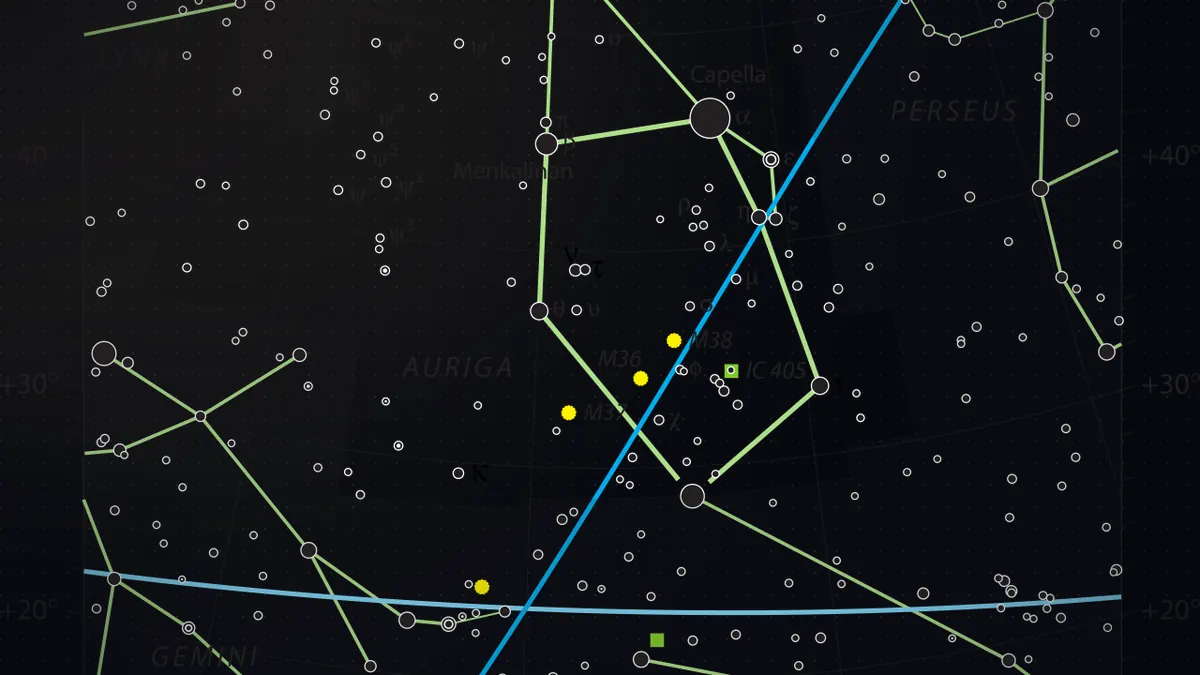
Around Capella, five stars form a rough pentagon. Just below Capella sits a small, tight triangle of fainter stars called the Kids: three young goats the charioteer carries. Inside and below the pentagon lie the three clusters.
In sky coordinates Auriga sits at right ascension 4h 37m and declination +56.2°. Those two numbers work like a grid reference. Right ascension runs around the sky the way longitude runs around the Earth, and declination measures north and south the way latitude does. It is a far-northern constellation, so northern observers get the best of it and it never rises for much of the southern hemisphere. In practice you can see it from anywhere north of latitude 40°S, including the whole northern hemisphere, and it stands highest in the evening sky around February.
What Auriga actually looks like
A large pentagon, near enough a circle, which is one of the most geometrically satisfying shapes in the sky. Capella sits at the northern corner, and Elnath at the southern corner is shared with Taurus: it marks the bull's horn tip and the charioteer's foot at the same time.
The figure is a charioteer holding a goat and her kids, which is an odd combination and clearly a merger of two older ideas. The pentagon plus the little triangle of the Kids is what you actually see, and both are easy.
Because the Milky Way runs through it, the interior of the pentagon is richly populated with faint stars under a good sky.
The stars of Auriga
- Capella (Alpha Aurigae, magnitude 0.08) — the sixth brightest star in the night sky, 43 light years away. It looks like a single yellow star but is actually four stars: two yellow giants orbiting closely, plus a distant pair of red dwarfs. The name means 'little she-goat'.
- Menkalinan (Beta Aurigae) — an eclipsing binary whose brightness dips slightly every two days.
- Almaaz (Epsilon Aurigae) — one of the strangest stars known. Every 27 years it dims for around two years, eclipsed by an enormous, dark, dusty disc surrounding an unseen companion. The nature of that disc was argued over for a century; the last eclipse ran from 2009 to 2011, and the next is not until the 2030s.
- Elnath (Beta Tauri) — the shared star, officially in Taurus but geometrically part of Auriga's pentagon.
The story behind the name
Auriga is usually identified as Erichthonius, a legendary king of Athens who was lame and therefore invented the four-horse chariot to get around: an invention so admired that Zeus placed him in the sky.
The goat is a separate tradition entirely, grafted on. Capella represents Amalthea, the goat that suckled the infant Zeus while he was hidden from his father Cronus. One of her horns became the cornucopia, the horn of plenty. The Kids are her offspring.
That a chariot-driving king ended up carrying a goat and three kids on his shoulder is a good illustration of how constellations actually formed: not as designed pictures, but as older regional traditions colliding and being stitched together by later cataloguers who did not want to discard anything.
What else is hiding in Auriga
Three Messier clusters, all worth your time.
- M36 — a compact, bright open cluster of hot young stars. The smallest of the three and good at higher magnification.
- M37 — the finest of the three and arguably one of the best open clusters in the sky. It is rich, dense and resolves into hundreds of stars, with a noticeably orange star near the centre. If you only look at one Auriga cluster, make it this.
- M38 — a looser, more scattered cluster whose brighter stars are sometimes described as forming a crooked pi shape. The small cluster NGC 1907 sits nearby for contrast.
- The Flaming Star Nebula (IC 405) — an emission and reflection nebula lit by a runaway star that wandered into it. A photographic favourite.
All three Messier clusters fit within a few degrees, making Auriga an ideal binocular sweep.
When and where to see it
Best placed in the evening sky in February, with a season from November through March.
Auriga is a northern constellation, reaching to about 40°S. Northern observers get Capella almost overhead in winter; southern observers see it low in the north.
Capella is bright enough for any city. The clusters need reasonably dark skies but are forgiving: M37 and M38 are visible in binoculars from a decent suburb. Because the three clusters lie along a short line, they are the perfect first star-hopping exercise: find one, and the others are a short push away in the same direction.
Auriga at a glance
| Name | Auriga |
| Abbreviation | Aur |
| Genitive form | Aurigae |
| Meaning | the Charioteer |
| Family | Perseus family |
| First recorded | ancient (Ptolemy) |
| Right ascension | 4h 37m |
| Declination | +56.2° |
| Area | 657 square degrees (21st largest of 88) |
| Main stars in the figure | 5 |
| Stars brighter than magnitude 3 | 4 |
| Named Bayer / Flamsteed stars | 65 |
| Brightest star | Capella (α Aur) (magnitude 0.08) |
| Messier objects | 3 |
| Meteor showers | Aurigids, Delta Aurigids |
| Visible from | Anywhere north of latitude 40°S, including the whole northern hemisphere |
| Best seen at 9 pm in | February |
| Bordering constellations | Camelopardalis, Gemini, Lynx, Perseus, Taurus |
Where to go next
Its neighbours in the sky
These constellations share a border with Auriga, so once you have found it you already know where to look next: Camelopardalis, Gemini, Lynx, Perseus, Taurus.
The rest of the Perseus family
Auriga belongs to the Perseus family: the northern sky's Andromeda myth, told across nine constellations. The others are: Andromeda, Cassiopeia, Cepheus, Cetus, Lacerta, Pegasus, Perseus, Triangulum.
Start from the beginning
Not sure where to begin? The guide to all 88 constellations explains how the sky is divided, what a constellation really is, and links to each of the 88.
Star chart: Auriga IAU chart by IAU and Sky & Telescope magazine (Roger Sinnott & Rick Fienberg), used under CC BY 3.0. Observing data cross-checked against Wikipedia's Auriga entry.