Cassiopeia is the northern sky's other great signpost. Where the Big Dipper is a saucepan, Cassiopeia is a W: five bright stars in a clear zigzag, sitting on the opposite side of Polaris.
That opposition is what makes it so useful. When the Dipper is low and awkward, Cassiopeia is high, and vice versa. Between the two, you can find north from the northern hemisphere on any clear night of the year.
Where to find Cassiopeia
Look north. You are looking for five bright stars in a zigzag: a W or an M depending on the time of night and year, since it rotates around the pole.
It is genuinely easy: the stars are bright, the shape is distinctive, and nothing else nearby looks like it. If you can already find the Big Dipper, draw a line from the Dipper through Polaris and continue an equal distance on the far side. That lands you on Cassiopeia.
It also works in reverse. The deeper V of the W points roughly towards Polaris, so Cassiopeia can find north for you when the Dipper is below the horizon or lost behind buildings.
In sky coordinates Cassiopeia sits at right ascension 22h 57m and declination +77.7°. Those two numbers work like a grid reference. Right ascension runs around the sky the way longitude runs around the Earth, and declination measures north and south the way latitude does. It is a far-northern constellation, so northern observers get the best of it and it never rises for much of the southern hemisphere. You can see it from anywhere north of latitude 12°S, including the whole northern hemisphere, and it sits highest after dark in November.
What Cassiopeia actually looks like
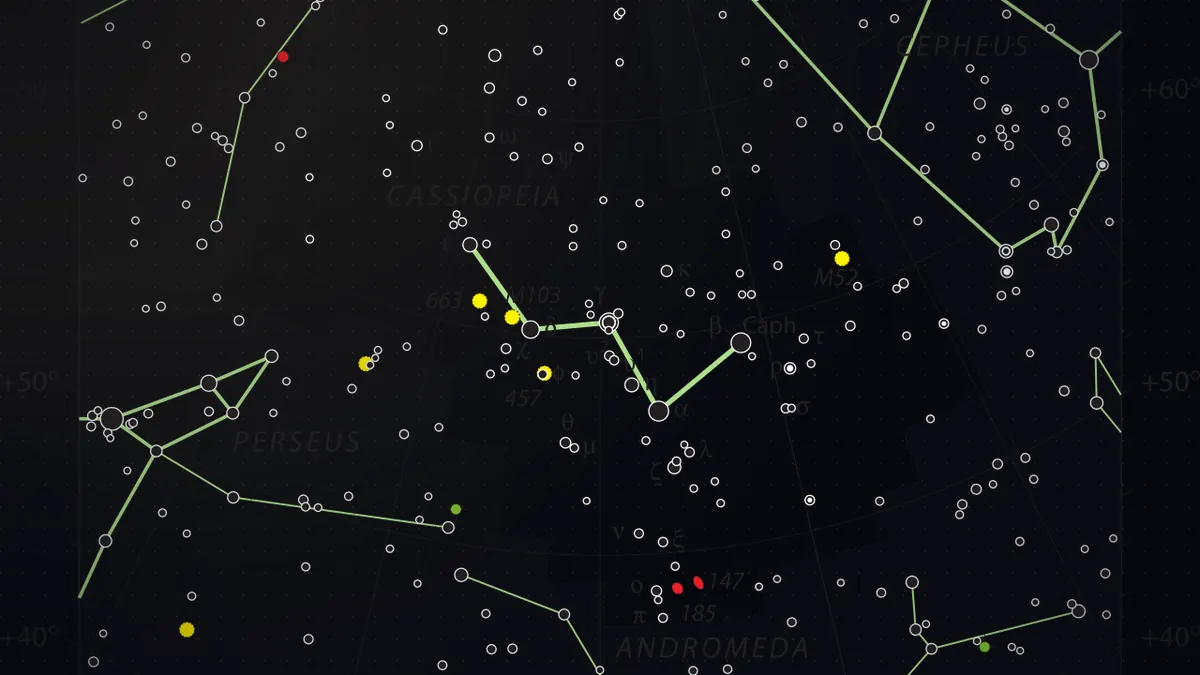
Five stars in a zigzag: Schedar, Caph, Gamma Cassiopeiae, Ruchbah and Segin. Drawn as a queen seated on a throne, with the W forming the chair.
Because it is circumpolar it turns through a full circle around Polaris over 24 hours, so the letter is sometimes a W, sometimes an M, and often on its side. That rotation is part of the myth: Cassiopeia was placed on a revolving throne so that for half of every night she hangs upside down, a humiliation for her vanity.
Cassiopeia lies squarely in the Milky Way, so the whole area is dense with faint background stars and open clusters.
The stars of Cassiopeia
- Schedar (Alpha Cassiopeiae, magnitude 2.2) — an orange giant, the brightest star, its name from the Arabic for 'the breast'.
- Caph (Beta) — a yellow-white star that rotates so fast it is noticeably flattened. It also sits almost exactly on the same line of right ascension as the vernal equinox, making it a traditional reference point.
- Gamma Cassiopeiae — the middle star of the W and a genuinely erratic variable. It spins near its break-up speed, flinging out a disc of gas that causes unpredictable brightness changes. It is the prototype of the Gamma Cassiopeiae class of variable stars.
- Tycho's Star (SN 1572) — no longer visible, but historically enormous. In November 1572 a new star appeared here, bright enough to see in daylight. Tycho Brahe showed it had no measurable parallax, proving it lay far beyond the Moon and demolishing the doctrine that the heavens were unchanging.
The story behind the name
Cassiopeia was the queen of Aethiopia and the mother of Andromeda. Her boast that she surpassed the sea nymphs in beauty triggered the entire chain of events: Poseidon's anger, the sea monster Cetus, and Andromeda chained to the rock.
Her punishment was tailored to the offence. Placed in the sky near the pole, her throne circles endlessly, leaving her hanging head-downwards for half of each night. The vain queen is put on permanent display in an undignified position.
Not every culture saw a queen. Some Arabic traditions read the W as a kneeling camel or a hand stained with henna, and several Native American traditions saw it as a group of figures around a fire. The zigzag is distinctive enough that essentially every sky-watching culture named it something.
What else is hiding in Cassiopeia
Sitting in the Milky Way, Cassiopeia is thick with open clusters.
- M52 — a rich, compact open cluster, excellent in a small telescope and easy to find by extending a line through two of the W's stars.
- M103 — a smaller, sparser cluster and one of the last objects added to Messier's catalogue.
- NGC 457, the Owl or ET Cluster — a personal favourite of many observers. Two bright stars form eyes, with lines of fainter stars spreading out as a body and outstretched arms. Once you see the little figure you cannot unsee it, and it is a brilliant object to show someone new to a telescope.
- The Heart and Soul Nebulae (IC 1805 and IC 1848) — two vast star-forming regions, primarily photographic.
- Cassiopeia A — the remnant of a star that exploded around 1680. It is the brightest radio source in the sky beyond the Solar System, though visually almost nothing.
When and where to see it
Best placed in the evening sky in November, but from most northern latitudes Cassiopeia is circumpolar: visible every clear night of the year, simply at different angles.
It is firmly northern, reaching only to about 20°S, so southern observers see it low or not at all.
The W survives serious light pollution, which makes Cassiopeia one of the most reliable constellations for city observers. The clusters need binoculars or a telescope and darker conditions. If you have one hour and a small telescope, spend it sweeping the Milky Way band through Cassiopeia. You will trip over clusters without even aiming.
Cassiopeia at a glance
| Name | Cassiopeia |
| Abbreviation | Cas |
| Genitive form | Cassiopeiae |
| Meaning | the Seated Queen |
| Family | Perseus family |
| First recorded | ancient (Ptolemy) |
| Right ascension | 22h 57m |
| Declination | +77.7° |
| Area | 598 square degrees (25th largest of 88) |
| Main stars in the figure | 5 |
| Stars brighter than magnitude 3 | 4 |
| Named Bayer / Flamsteed stars | 53 |
| Brightest star | α Cas (Schedar) (magnitude 2.24) |
| Messier objects | 2 |
| Meteor showers | Perseids |
| Visible from | Anywhere north of latitude 12°S, including the whole northern hemisphere |
| Best seen at 9 pm in | November |
| Bordering constellations | Andromeda, Camelopardalis, Cepheus, Lacerta, Perseus |
Where to go next
Its neighbours in the sky
Cassiopeia borders all of these, which makes them the natural next targets once you can pick it out: Andromeda, Camelopardalis, Cepheus, Lacerta, Perseus.
The rest of the Perseus family
Cassiopeia belongs to the Perseus family: the northern sky's Andromeda myth, told across nine constellations. The others are: Andromeda, Auriga, Cepheus, Cetus, Lacerta, Pegasus, Perseus, Triangulum.
Start from the beginning
New to all this? The 88 constellations: a complete beginner's guide explains what a constellation actually is, how the sky is divided up, and lists all 88 with a link to each one.
Star chart: Cassiopeia IAU chart by IAU and Sky & Telescope magazine (Roger Sinnott & Rick Fienberg), used under CC BY 3.0. Observing data cross-checked against Wikipedia's Cassiopeia entry.