Lacerta is a small, faint zigzag of stars squeezed between Cygnus, Cassiopeia and Andromeda. Nothing in it reaches magnitude 3.7, and it has no mythology, no bright showpiece and no Messier objects.
It does have one genuine claim to importance. An object here that was catalogued as a variable star — BL Lacertae — turned out not to be a star at all, but the blazing core of a distant galaxy pointing a jet almost directly at Earth. It gave its name to an entire class of the most violent objects in the universe.
Where to find Lacerta
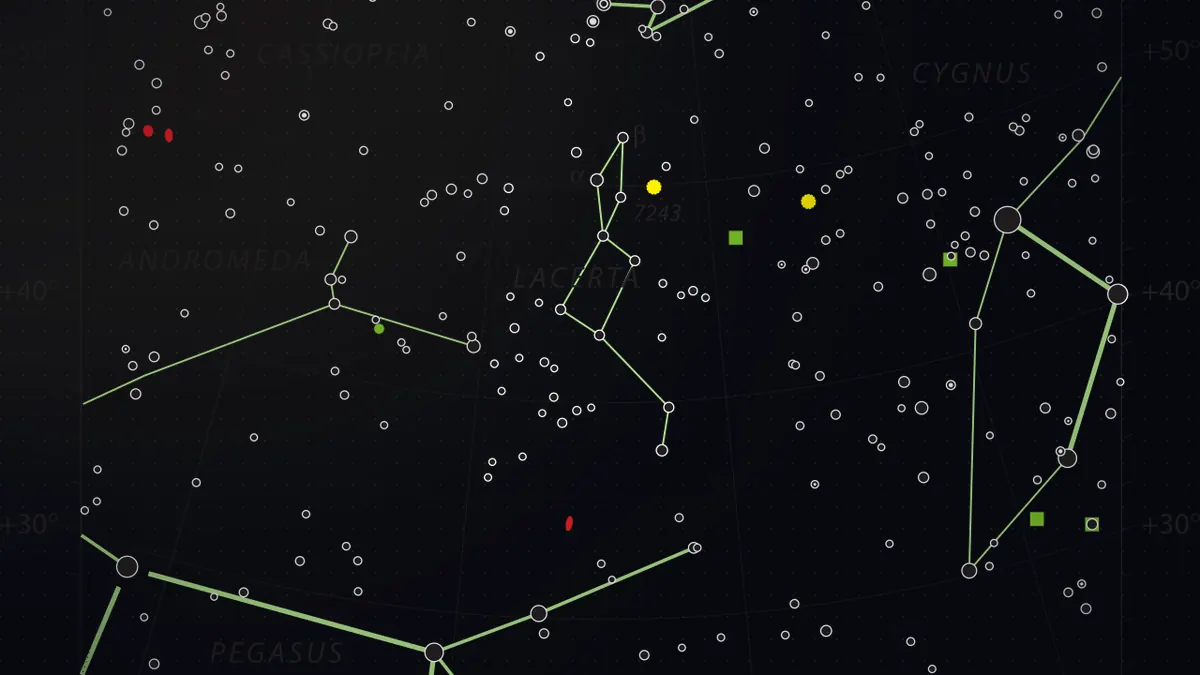
Lacerta occupies the gap between the Northern Cross of Cygnus and the W of Cassiopeia. Draw a line between those two very obvious patterns and Lacerta is roughly midway, slightly to the south.
You are looking for a small zigzag of faint stars, sometimes called 'Little Cassiopeia' because it repeats the W shape at a much smaller scale and much lower brightness.
Give your eyes time to adapt. This is a constellation that simply does not appear until you are properly dark-adapted, and from a city it is not there at all.
In sky coordinates Lacerta sits at right ascension 22h 30m and declination +45.0°. Right ascension is the sky's version of longitude and declination its version of latitude, so those two numbers pin the constellation to one spot on the celestial sphere the way a map reference pins a town. It sits in the northern half of the sky, riding high for northern observers and low for southern ones. In practice you can see it from anywhere north of latitude 34°S, including the whole northern hemisphere, and it stands highest in the evening sky around October.
What Lacerta actually looks like
A narrow zigzag — a compressed W or M, made of stars around magnitude 4 and 5. That is the whole figure.
Charts draw a lizard, and the zigzag does suggest something small and quick moving between the larger constellations, which is a more generous reading than most modern constellations earn.
Johannes Hevelius created Lacerta in 1687 to fill the gap. He had considered other options for this patch of sky, and others tried to rename it, at various points it was proposed as Sceptrum, honouring a French king, and as Frederici Honores for Frederick the Great. None of the royal flattery stuck, and the lizard survived.
The stars of Lacerta
- Alpha Lacertae (magnitude 3.8) — the brightest star, a white main-sequence star about 100 light years away. It is the only star here most people will ever pick out.
- Beta Lacertae — a yellow giant, second brightest and noticeably fainter.
- EV Lacertae — a small red dwarf that in 2008 emitted a flare thousands of times more powerful than anything the Sun produces, briefly becoming visible to the naked eye. A useful reminder that small stars can be far more violent than large ones.
- BL Lacertae — catalogued as a variable star in 1929, reclassified in 1968 when radio observations revealed it was extragalactic. It is the prototype blazar: an active galactic nucleus whose relativistic jet points nearly straight at us, producing wild and rapid brightness changes.
The story behind the name
There is no mythology. Lacerta was invented in 1687 by Johannes Hevelius, one of seven constellations he added to fill unclaimed gaps between the classical figures.
Its real story is about naming politics. Because faint filler constellations had no ancient claim, they were repeatedly targeted for renaming in honour of patrons and monarchs. Augustin Royer tried to make this patch Sceptrum et Manus Iustitiae for Louis XIV; Johann Bode later proposed Frederici Honores for Frederick the Great of Prussia. Neither survived.
That pattern repeated across the sky in the seventeenth and eighteenth centuries, and almost all such flattery was eventually stripped out. The IAU's 1922 settlement kept the modest lizard and discarded the kings, which feels like the right outcome.
What else is hiding in Lacerta
Lacerta sits in the Milky Way, so the background is rich even though the catalogued objects are modest. There are no Messier objects.
- NGC 7243 — a loose, bright open cluster and the constellation's best target for small telescopes or binoculars.
- NGC 7209 — another open cluster, sparser and fainter.
- BL Lacertae — around magnitude 14 to 17 and highly variable. Serious amateurs with large telescopes do monitor it, and knowing that its light comes from a jet of matter accelerated to near light speed by a supermassive black hole about a billion light years away makes it worth the pointing exercise even if you see almost nothing.
The most rewarding use of Lacerta is simply sweeping it with binoculars. The Milky Way runs through here, and the star fields are pleasant even without a specific target.
When and where to see it
Best placed in the evening sky in October, through the late summer and autumn.
It is a northern constellation and does not reach far south, so southern hemisphere observers see little or nothing of it.
Sky darkness is the whole story. From a city Lacerta does not exist; from a dark rural site the zigzag emerges readily and the surrounding Milky Way makes the area genuinely attractive. Treat it as a completist's target and a nice binocular sweep, and do not expect it to compete with the spectacular neighbours on either side.
Lacerta at a glance
| Name | Lacerta |
| Abbreviation | Lac |
| Genitive form | Lacertae |
| Meaning | the Lizard |
| Family | Perseus family |
| First recorded | 1690, Hevelius |
| Right ascension | 22h 30m |
| Declination | +45.0° |
| Area | 201 square degrees (68th largest of 88) |
| Main stars in the figure | 5 |
| Stars brighter than magnitude 3 | 0 |
| Named Bayer / Flamsteed stars | 17 |
| Brightest star | α Lac (Stellio) (magnitude 3.76) |
| Messier objects | None |
| Meteor showers | None |
| Visible from | Anywhere north of latitude 34°S, including the whole northern hemisphere |
| Best seen at 9 pm in | October |
| Bordering constellations | Andromeda, Cassiopeia, Cepheus, Cygnus, Pegasus |
Where to go next
Its neighbours in the sky
These constellations share a border with Lacerta, so once you have found it you already know where to look next: Andromeda, Cassiopeia, Cepheus, Cygnus, Pegasus.
The rest of the Perseus family
Lacerta belongs to the Perseus family: the northern sky's Andromeda myth, told across nine constellations. The others are: Andromeda, Auriga, Cassiopeia, Cepheus, Cetus, Pegasus, Perseus, Triangulum.
Start from the beginning
Not sure where to begin? The guide to all 88 constellations explains how the sky is divided, what a constellation really is, and links to each of the 88.
Star chart: Lacerta IAU chart by IAU and Sky & Telescope magazine (Roger Sinnott & Rick Fienberg), used under CC BY 3.0. Observing data cross-checked against Wikipedia's Lacerta entry.