Perseus is the hero at the centre of the sky's biggest story. Around him stand every other character: Andromeda the chained princess, her parents Cepheus and Cassiopeia, the sea monster Cetus and the winged horse Pegasus. Nine constellations, one myth.
He also owns two of the best things in the northern sky: Algol, a star that visibly dims every 2.87 days and was called the Demon Star long before anyone knew why, and the Perseids, the most watched meteor shower of the year.
Where to find Perseus
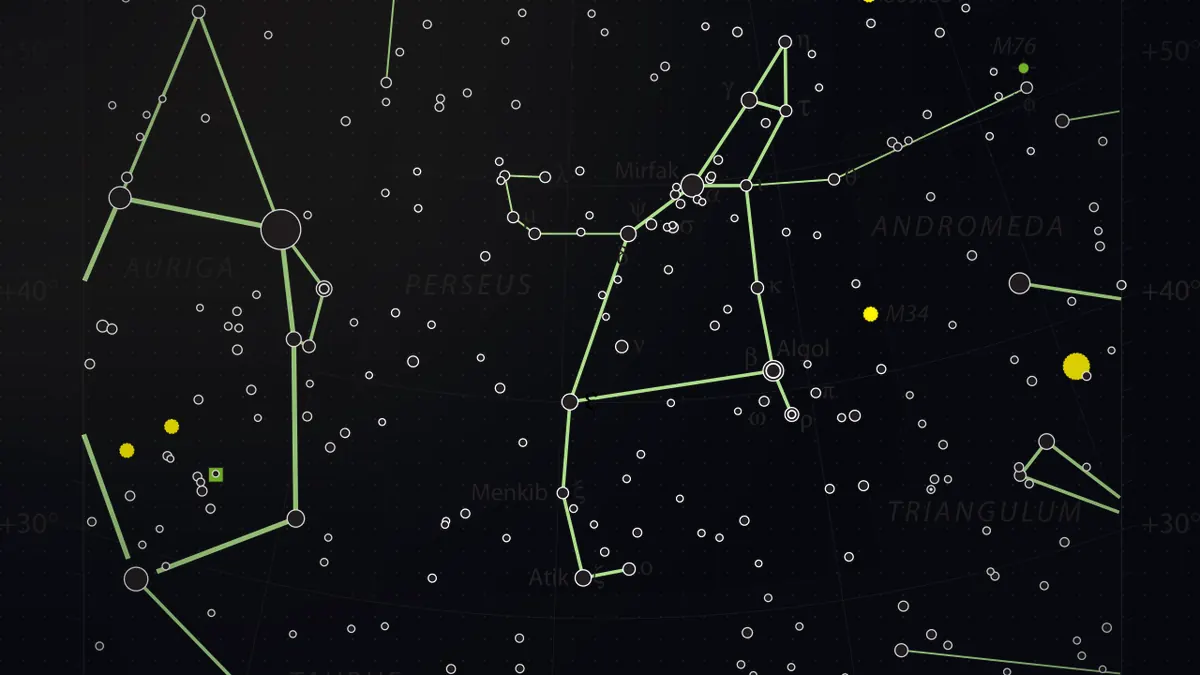
Find the W of Cassiopeia, which is unmistakable in the northern sky. Perseus lies immediately below and east of it, between Cassiopeia and brilliant Capella in Auriga.
You are looking for a rough letter K or an upside-down Y: a curving chain of stars branching in two. The brightest, Mirfak, sits at the bend.
Once you have Mirfak, sweep the area around it with binoculars. Perseus sits in the Milky Way, and the whole region is a rich field of stars. Between Perseus and Cassiopeia, look for a pair of faint fuzzy patches close together, the Double Cluster.
In sky coordinates Perseus sits at right ascension 3h 00m and declination +45.0°. If the units look unfamiliar, the idea behind them is not: declination is the sky's latitude, right ascension is its longitude, and together they place the constellation exactly. It sits in the northern half of the sky, riding high for northern observers and low for southern ones. You can see it from anywhere north of latitude 35°S, including the whole northern hemisphere, and it sits highest after dark in December.
What Perseus actually looks like
A curving chain of stars with a fork in it. Mirfak marks the hero's body at the bend, one branch running up towards Cassiopeia and another running down towards Taurus.
Charts draw Perseus striding, sword raised in one hand and the severed head of Medusa held out in the other. That head is where Algol sits, the Gorgon's eye. It is a coincidence that has fascinated people for centuries: the star assigned to the demon's eye is the one that unpredictably dims, as if blinking.
The whole figure is bright enough to trace from a suburb, which makes it one of the more approachable large constellations.
The stars of Perseus
- Mirfak (Alpha Persei, magnitude 1.8) — a yellow-white supergiant about 5,000 times more luminous than the Sun. It sits inside the Alpha Persei Cluster, a loose group of young stars that binoculars show beautifully.
- Algol (Beta Persei) — the famous one. It is an eclipsing binary: two stars orbiting so that one passes in front of the other every 2.87 days, dropping the combined brightness from magnitude 2.1 to 3.4 for about ten hours. The change is easily visible to the naked eye if you know what to compare it with. In 1783 the teenage astronomer John Goodricke correctly proposed the eclipse explanation: a remarkable piece of reasoning decades before anyone could confirm it.
- Rho Persei — a red giant near Algol, useful as a brightness comparison when Algol is dimming.
- GK Persei — a nova that erupted in 1901 and now flares as a dwarf nova every few years.
The story behind the name
Perseus was sent to kill Medusa, the Gorgon whose gaze turned people to stone. He succeeded by looking only at her reflection in his polished shield, cut off her head, and flew away with it. From her blood sprang the winged horse Pegasus.
Flying home, he found Andromeda chained to a rock as a sacrifice to the sea monster Cetus, sent to punish her mother Cassiopeia for boasting that she was more beautiful than the sea nymphs. Perseus used Medusa's head to turn the monster to stone and married Andromeda.
Every one of those characters is a constellation, and they are all clustered in the same region of autumn sky. It is the most complete narrative scene in the heavens. You can point at the whole cast in one sweep, which is not true of any other myth.
What else is hiding in Perseus
- The Double Cluster (NGC 869 and NGC 884) — two rich open clusters side by side, close enough to share a binocular field. It is one of the finest sights in the northern sky and visible to the naked eye as a brightening in the Milky Way between Perseus and Cassiopeia. Both clusters are young and genuinely physically associated.
- M34 — a bright, loose open cluster, easy in binoculars.
- The California Nebula (NGC 1499) — a long emission nebula shaped like the US state. Bright in photographs, notoriously hard visually.
- The Perseids — the year's most popular meteor shower, peaking around 12–13 August at 50 to 100 meteors an hour. The parent body is Comet Swift-Tuttle. Its popularity owes as much to timing as to strength: it peaks on warm northern-hemisphere summer nights, which makes lying outside for hours actually pleasant.
When and where to see it
Best placed in the evening sky in December, though the constellation is well up from late summer through winter, and the Perseids arrive in August when it is rising after midnight.
Perseus is a northern constellation, reaching only to about 35°S, so southern observers get it low or not at all. For the Perseids this matters: the shower is dramatically better from the northern hemisphere.
Algol is the standout naked-eye project. Look up its next eclipse time, compare it with nearby stars over a few hours, and you can watch a star measurably change in a single evening. Very few objects let you see astronomy happening in real time.
Perseus at a glance
| Name | Perseus |
| Abbreviation | Per |
| Genitive form | Persei |
| Meaning | Perseus |
| Family | Perseus family |
| First recorded | ancient (Ptolemy) |
| Right ascension | 3h 00m |
| Declination | +45.0° |
| Area | 615 square degrees (24th largest of 88) |
| Main stars in the figure | 19 |
| Stars brighter than magnitude 3 | 5 |
| Named Bayer / Flamsteed stars | 65 |
| Brightest star | α Per (Mirfak) (magnitude 1.79) |
| Messier objects | 2 |
| Meteor showers | Perseids, September Perseids |
| Visible from | Anywhere north of latitude 35°S, including the whole northern hemisphere |
| Best seen at 9 pm in | December |
| Bordering constellations | Andromeda, Aries, Auriga, Camelopardalis, Cassiopeia, Taurus, Triangulum |
Where to go next
Its neighbours in the sky
Perseus borders all of these, which makes them the natural next targets once you can pick it out: Andromeda, Aries, Auriga, Camelopardalis, Cassiopeia, Taurus, Triangulum.
The rest of the Perseus family
Perseus belongs to the Perseus family: the northern sky's Andromeda myth, told across nine constellations. The others are: Andromeda, Auriga, Cassiopeia, Cepheus, Cetus, Lacerta, Pegasus, Triangulum.
Start from the beginning
If you are starting from scratch, the complete beginner's guide to the 88 constellations covers what a constellation actually is, how the sky is carved up, and links to every one of them.
Star chart: Perseus IAU chart by IAU and Sky & Telescope magazine (Roger Sinnott & Rick Fienberg), used under CC BY 3.0. Observing data cross-checked against Wikipedia's Perseus entry.