Taurus is one of the few constellations that delivers on every level at once. It has a brilliant orange first-magnitude star, the two finest open star clusters in the sky, and the shattered remains of a supernova that Chinese astronomers watched explode in the year 1054.
It is also very old. The bull appears in Babylonian records, and a 17,000-year-old painting at Lascaux in France shows a bull with a pattern of dots above its shoulder that looks unnervingly like the Pleiades.
Where to find Taurus
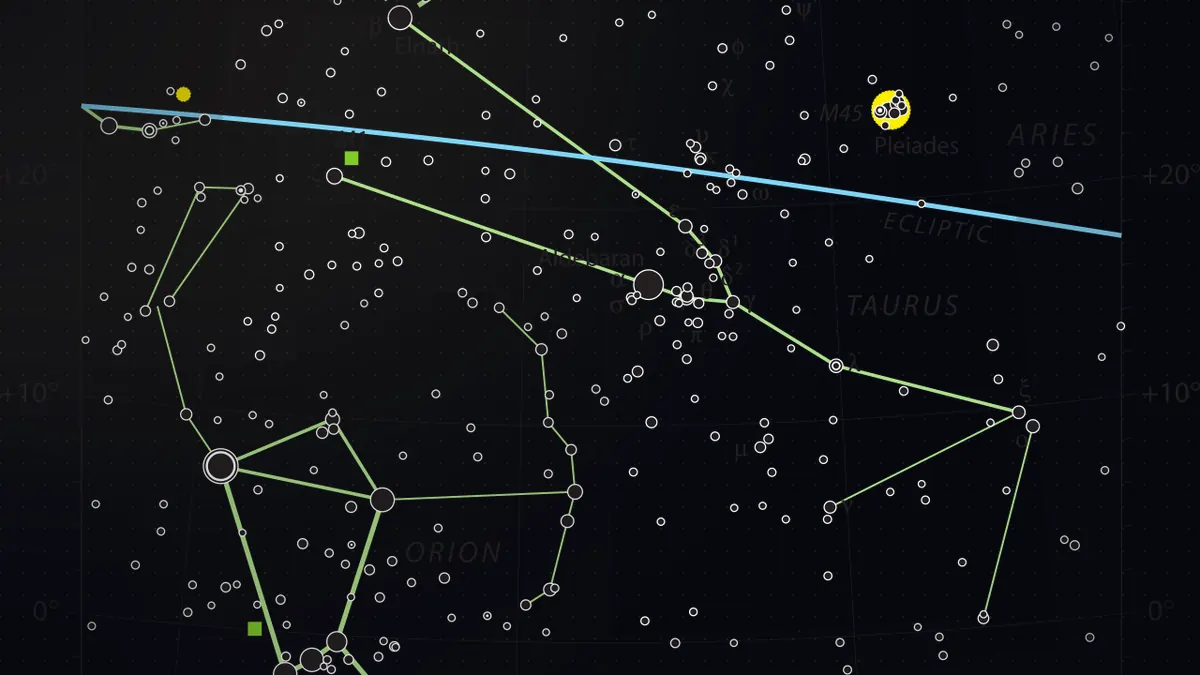
Start from Orion's Belt and follow it up and to the right (northern hemisphere). The first bright star you hit is orange Aldebaran, the eye of the bull.
Around Aldebaran you will see a distinct V-shape of fainter stars lying on its side. That is the Hyades cluster, forming the bull's face. Continue past it in the same direction and you reach a small, tight, misty knot of stars: the Pleiades.
Almost everyone mistakes the Pleiades for the Little Dipper at first glance. If you have ever noticed a tiny dipper-shaped smudge in a winter sky and wondered what it was, you have already found Taurus.
In sky coordinates Taurus sits at right ascension 4h 54m and declination +19.0°. Right ascension is the sky's version of longitude and declination its version of latitude, so those two numbers pin the constellation to one spot on the celestial sphere the way a map reference pins a town. It sits in the northern half of the sky, riding high for northern observers and low for southern ones. Practically speaking it is visible from between latitudes 89°N and 59°S, with the best evening views around January.
What Taurus actually looks like
Taurus is drawn as the front half of a bull, charging at Orion. The V-shaped Hyades form the face, with Aldebaran as the glaring red eye. Two long lines run out from the top of the V to Elnath and Zeta Tauri, the tips of the horns.
Only the front of the animal is there — no hindquarters — and ancient accounts sometimes explain this as the bull emerging from the sea or half-hidden behind clouds.
There is a nice trick hidden in the V. Aldebaran looks like the brightest member of the Hyades, but it is not a member at all: it sits about 65 light years away, less than half the distance to the cluster. It is a foreground star that happens to line up.
The stars of Taurus
- Aldebaran (Alpha Tauri, magnitude 0.85) — an orange giant roughly 44 times the Sun's diameter, and the fourteenth brightest star in the night sky. The name means 'the follower', because it follows the Pleiades across the sky.
- Elnath (Beta Tauri) — the northern horn tip, a blue giant, and a star with dual citizenship: it was historically shared with Auriga.
- The Pleiades (M45) — the Seven Sisters. Most people see six stars with the naked eye; sharp eyes under dark skies get nine or more. In binoculars it is glorious. The cluster holds over a thousand young hot stars about 440 light years away.
- The Hyades — the nearest open cluster to us at about 150 light years, and the V of the bull's face. Its stars share a common motion through space, which is how we know they were born together.
The story behind the name
In Greek myth this is Zeus disguised as a white bull, carrying off the Phoenician princess Europa to Crete. The half-figure is explained as the bull swimming with only its upper body above the waves.
The Pleiades have their own story: seven sisters, daughters of Atlas, pursued by Orion and placed in the sky for safety, which is why Orion is still chasing them across the winter sky. Most traditions say one sister hid or died, explaining why six are easy to see and the seventh is elusive. Remarkably, that 'lost Pleiad' motif appears independently in Aboriginal Australian, Greek and Native American traditions, and some researchers argue it records a real change in one star's brightness thousands of years ago.
The bull itself is older than Greece. Babylonian records call it the Bull of Heaven, and at that time it marked the spring equinox: the start of the year.
What else is hiding in Taurus
- M45, the Pleiades — the best open cluster in the sky for casual observing. Do not use a telescope; the cluster is bigger than most eyepiece fields. Binoculars are perfect. Long exposures reveal blue reflection nebulosity around the brightest stars, dust the cluster is currently drifting through.
- The Hyades — even larger on the sky, and a beautiful naked-eye and binocular object.
- M1, the Crab Nebula — the expanding debris of a star that exploded as a supernova in 1054 AD. Chinese and Japanese astronomers recorded a 'guest star' bright enough to see in daylight for three weeks. At its centre is a pulsar, a city-sized neutron star spinning 30 times a second. It was the first object in Messier's catalogue and remains one of the most studied objects in astronomy. In a small telescope it is a faint grey smudge, but you are looking at a specific, dated event in recorded human history.
- The Taurids — a long, slow meteor shower running through October and November, known for producing bright fireballs.
When and where to see it
Best placed in the evening sky in January, with a long season running from roughly October to March.
It sits north of the celestial equator but is visible from essentially everywhere populated. Northern observers get it high overhead in winter; southern observers see it lower, in summer, and upside down.
Aldebaran and the Pleiades punch through city light without trouble, which makes Taurus one of the best constellations for urban stargazers. The Crab Nebula is the one target that genuinely needs dark skies and a telescope. Watch also for the Moon and planets passing through: the ecliptic runs right past Aldebaran, and the Moon regularly occults it.
Taurus at a glance
| Name | Taurus |
| Abbreviation | Tau |
| Genitive form | Tauri |
| Meaning | the Bull |
| Family | Zodiac family |
| First recorded | ancient (Ptolemy) |
| Right ascension | 4h 54m |
| Declination | +19.0° |
| Area | 797 square degrees (17th largest of 88) |
| Main stars in the figure | 19 |
| Stars brighter than magnitude 3 | 4 |
| Named Bayer / Flamsteed stars | 132 |
| Brightest star | Aldebaran (α Tau) (magnitude 0.85) |
| Messier objects | 2 |
| Meteor showers | Taurids, Beta Taurids |
| Visible from | Between latitudes 89°N and 59°S |
| Best seen at 9 pm in | January |
| Bordering constellations | Aries, Auriga, Cetus, Eridanus, Gemini, Orion, Perseus |
Where to go next
Its neighbours in the sky
Taurus borders all of these, which makes them the natural next targets once you can pick it out: Aries, Auriga, Cetus, Eridanus, Gemini, Orion, Perseus.
The rest of the Zodiac family
Taurus belongs to the Zodiac family: the twelve constellations the Sun, Moon and planets travel through. The others are: Aquarius, Aries, Cancer, Capricornus, Gemini, Leo, Libra, Pisces, Sagittarius, Scorpius, Virgo.
Start from the beginning
If you are starting from scratch, the complete beginner's guide to the 88 constellations covers what a constellation actually is, how the sky is carved up, and links to every one of them.
Star chart: Taurus IAU chart by IAU and Sky & Telescope magazine (Roger Sinnott & Rick Fienberg), used under CC BY 3.0. Observing data cross-checked against Wikipedia's Taurus entry.