Capricornus is the smallest zodiac constellation and one of the faintest, a wide shallow triangle of modest stars that most people pass over entirely. It is also the possessor of the sky's strangest figure: a sea goat, with the front half of a goat and the tail of a fish.
That odd hybrid is not a Greek whim. It comes from Mesopotamia, where a goat-fish deity was associated with the god Enki, and it is one of the oldest continuously recognised figures in the sky.
Where to find Capricornus
Capricornus sits in a dim stretch of sky between Sagittarius and Aquarius, in a region sometimes called the Sea because so many of its constellations are watery.
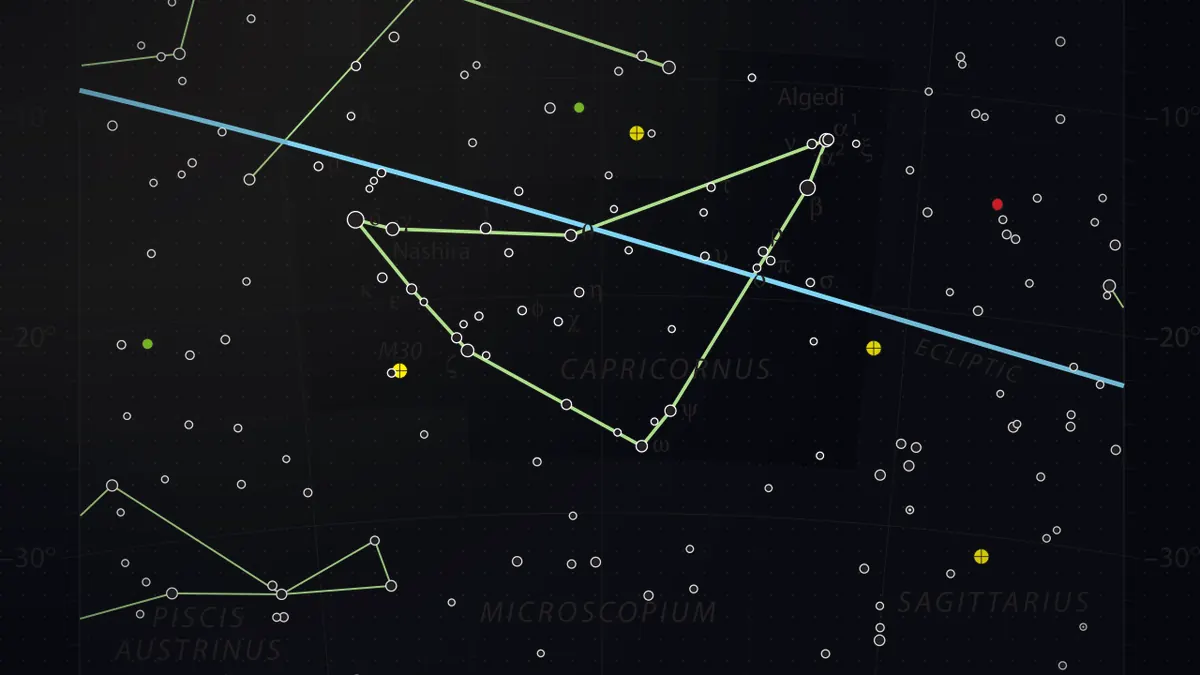
Work east from the Teapot of Sagittarius. The next group you meet is a large, shallow triangle: wide at the western end, tapering to a point in the east. Nothing here is brighter than magnitude 2.8, so wait for your eyes to adapt.
The western corner is the easiest starting point: Algedi and Dabih sit close together and are the constellation's most obvious feature.
In sky coordinates Capricornus sits at right ascension 20h 06m and declination −8.4°. Those two numbers work like a grid reference. Right ascension runs around the sky the way longitude runs around the Earth, and declination measures north and south the way latitude does. It straddles the celestial equator, which is the happy case: essentially everyone on Earth can see it. In practice you can see it from anywhere south of latitude 62°N, including the whole southern hemisphere, and it stands highest in the evening sky around September.
What Capricornus actually looks like
A large, flattened triangle, often likened to a bikini bottom or a boat's hull. Two moderately bright stars at the western end, a long tapering body, and a modest star at the eastern tip.
You are not going to see a goat, let alone a goat with a fish tail. The triangle is what you get, and it is perfectly identifiable once you accept that.
Being faint, Capricornus is a useful marker of sky quality. If the triangle is obvious, you are somewhere reasonably dark; if you cannot find it at all, that tells you something about your conditions before you waste an hour hunting galaxies.
The stars of Capricornus
- Deneb Algedi (Delta Capricorni, magnitude 2.85) — the brightest star, an eclipsing binary whose brightness dips slightly as its companion passes in front. The name means 'the tail of the goat'.
- Algedi (Alpha Capricorni) — a genuine curiosity: two unrelated stars that happen to lie in the same direction, one about 690 light years away and the other around 100. Sharp eyes can split them without optics, and binoculars make it easy. It is a line-of-sight coincidence, not a real pair.
- Dabih (Beta Capricorni) — another wide double, splittable in binoculars, with a pleasing colour difference.
Splitting both Algedi and Dabih on the same night is a nice little observing project that needs no more than a pair of binoculars.
The story behind the name
The sea goat traces back to the Babylonian Suhur-mash, the goat-fish, linked to Enki, god of water and wisdom. The Greeks absorbed the figure and attached it to Pan, who escaped the monster Typhon by leaping into the Nile and transforming, but only half successfully, leaving him with a fish's tail and a goat's front.
Another version identifies it with Amalthea, the goat that suckled the infant Zeus.
Like Cancer, Capricornus lent its name to a line of latitude. The Tropic of Capricorn marks the Sun's southernmost point, which fell in this constellation two thousand years ago. Precession has since shifted it into Sagittarius, so the name records where the sky used to be rather than where it is.
What else is hiding in Capricornus
A quiet constellation, with one solid target and one very good story.
- M30 — a compact globular cluster, and the constellation's only Messier object. It has undergone core collapse, meaning its centre is unusually dense. In a small telescope it is a fuzzy ball; larger apertures begin to resolve the outer stars.
- Neptune's discovery — in September 1846, Johann Galle pointed the Berlin Observatory telescope at a position in Capricornus calculated by Urbain Le Verrier from irregularities in Uranus's orbit, and found the planet within an hour, less than a degree from the prediction. It remains one of the great triumphs of mathematical astronomy: a planet found on paper before it was found in the sky.
- HCG 87 — a compact group of interacting galaxies, a photographic target requiring serious aperture.
When and where to see it
Best placed in the evening sky in September, with a season through late summer and autumn.
It lies south of the celestial equator, so southern observers get it higher, but it is comfortably visible from most northern latitudes too.
The faintness is the main obstacle. From a city Capricornus effectively vanishes, sandwiched between brighter neighbours. From a dark site the triangle is easy and the double stars are a pleasure. Bring binoculars rather than a telescope: Algedi and Dabih are the real attractions here, and both are wide pairs that a telescope over-magnifies.
Capricornus at a glance
| Name | Capricornus |
| Abbreviation | Cap |
| Genitive form | Capricorni |
| Meaning | the Sea-Goat |
| Family | Zodiac family |
| First recorded | ancient (Ptolemy) |
| Right ascension | 20h 06m |
| Declination | −8.4° |
| Area | 414 square degrees (40th largest of 88) |
| Main stars in the figure | 9 |
| Stars brighter than magnitude 3 | 1 |
| Named Bayer / Flamsteed stars | 49 |
| Brightest star | δ Cap (Deneb Algedi) (magnitude 2.85) |
| Messier objects | 1 |
| Meteor showers | Alpha Capricornids, Chi Capricornids, Sigma Capricornids, Tau Capricornids, Capricornids-Sagittariids |
| Visible from | Anywhere south of latitude 62°N, including the whole southern hemisphere |
| Best seen at 9 pm in | September |
| Bordering constellations | Aquarius, Aquila, Microscopium, Piscis Austrinus, Sagittarius |
Where to go next
Its neighbours in the sky
Everything here shares a border with Capricornus. Find one and the rest are a short hop away: Aquarius, Aquila, Microscopium, Piscis Austrinus, Sagittarius.
The rest of the Zodiac family
Capricornus belongs to the Zodiac family: the twelve constellations the Sun, Moon and planets travel through. The others are: Aquarius, Aries, Cancer, Gemini, Leo, Libra, Pisces, Sagittarius, Scorpius, Taurus, Virgo.
Start from the beginning
New to all this? The 88 constellations: a complete beginner's guide explains what a constellation actually is, how the sky is divided up, and lists all 88 with a link to each one.
Star chart: Capricornus IAU chart by IAU and Sky & Telescope magazine (Roger Sinnott & Rick Fienberg), used under CC BY 3.0. Observing data cross-checked against Wikipedia's Capricornus entry.