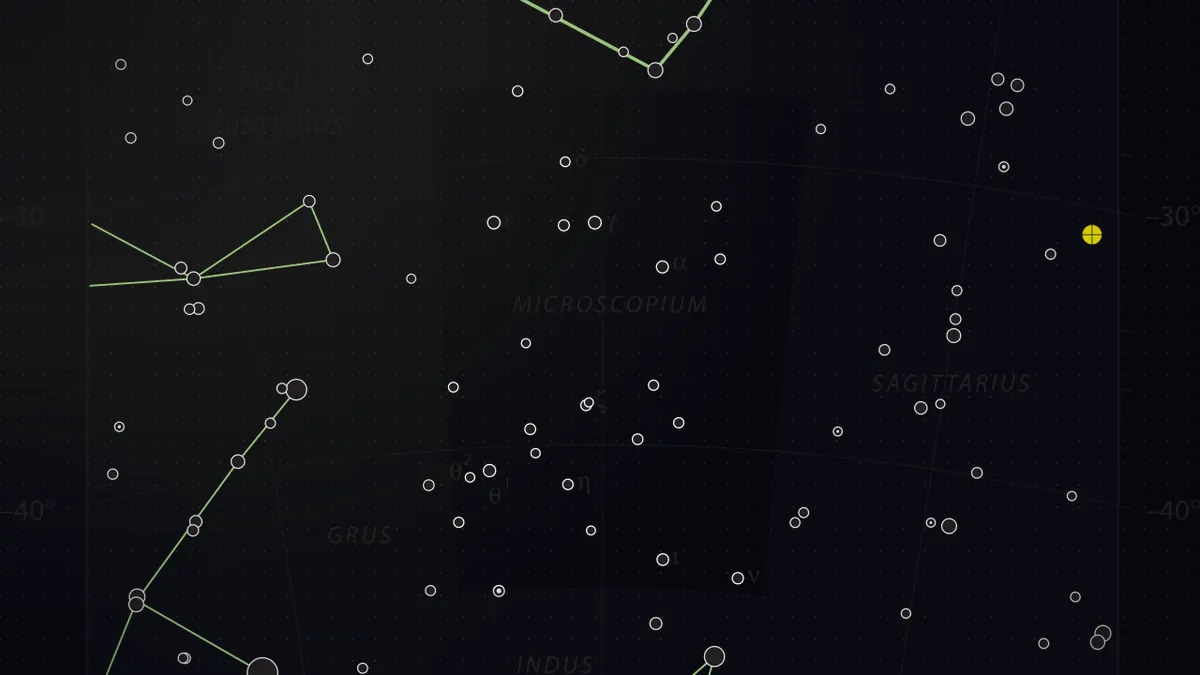
Microscopium is one of the fainter constellations in the sky, with nothing brighter than magnitude 4.7. It sits south of Capricornus in a genuinely empty-looking stretch of the autumn sky.
It contains one object of real scientific importance: AU Microscopii, a very young red dwarf surrounded by a debris disc we can photograph directly, with at least two planets already detected. It is one of the best places in the sky to watch a planetary system being assembled.
Where to find Microscopium
Microscopium lies directly south of Capricornus and west of Fomalhaut in Piscis Austrinus.
Because its own stars are so faint, navigate from those. Find the large shallow triangle of Capricornus, then look south. Or find Fomalhaut and move west.
You will need a genuinely dark sky. This is one of the constellations where a suburban site yields nothing at all. Even under good conditions you are looking for a handful of fifth-magnitude stars with no pattern to guide you.
In sky coordinates Microscopium sits at right ascension 21h 00m and declination −36.0°. Declination is latitude by another name and right ascension is longitude, so the pair fixes the constellation at one point on the celestial sphere. It sits in the southern half of the sky, high for southern observers and low on the horizon for northern ones. In practice that means you can find it from anywhere south of latitude 45°N, including the whole southern hemisphere; it rides highest in the evening sky in September.
What Microscopium actually looks like
There is no figure. A few faint stars are scattered across the area with no discernible arrangement, and the microscope drawn on charts is entirely notional.
Lacaille created it in the 1750s as part of his fourteen instrument constellations, naming it after the compound microscope: another symbol of Enlightenment science, and a natural companion to the telescope he placed nearby.
There is a pleasing symmetry in Lacaille putting the two instruments of magnification — one for the very distant and one for the very small — into adjacent regions of the southern sky.
The stars of Microscopium
- Gamma Microscopii (magnitude 4.7) — the brightest star, a yellow giant about 220 light years away. It is thought to have passed close to the Solar System around 3.9 million years ago, close enough to have possibly disturbed the Oort Cloud.
- Epsilon Microscopii — a white star, second brightest.
- AU Microscopii — the significant one. A red dwarf only about 23 million years old, roughly 32 light years away, surrounded by a debris disc seen nearly edge-on. Astronomers have observed fast-moving ripples travelling outward through the disc, a phenomenon still not fully explained. At least two planets have been confirmed, making it a rare case where we can study planets and their birth material at the same time.
- Lacaille 8760 — a nearby red dwarf, one of the brightest of its type and about 12.9 light years away.
The story behind the name
There is no mythology. Microscopium is a Lacaille creation from the 1750s, named for the compound microscope.
The eighteenth century was a period when the microscope was doing to biology what the telescope had done to astronomy: revealing an entire realm of structure nobody had known existed. Placing both instruments in the sky was Lacaille's way of marking that.
It is worth noting that his fourteen constellations were not universally admired. Contemporaries and later astronomers sometimes found them graceless compared with the inherited Greek figures, and there were proposals to replace them. But because Lacaille's catalogue was so accurate and so widely used, his names stuck, and all fourteen survived the IAU's 1922 settlement intact.
What else is hiding in Microscopium
Faint constellation looking out of the galactic plane, with no Messier objects.
- AU Microscopii's debris disc — not visible to amateurs, but the reason this constellation appears in current research. It is one of only a handful of debris discs bright enough and close enough to image in detail, and the moving features within it are an active research puzzle.
- NGC 6925 — an edge-on spiral galaxy appearing as a thin spindle of light, the best conventional telescope target here.
- The Microscopium Void — an enormous region of relatively empty space in this direction, one of several large voids in the cosmic web.
Visually this is a thin constellation. Its interest is almost entirely in AU Microscopii and what is happening around it right now.
When and where to see it
Best placed in the evening sky in September, through the southern spring and northern autumn.
It lies south of the celestial equator but reaches far enough north to be visible low from much of the northern hemisphere. Southern observers get it considerably higher.
A dark sky is essential, from anywhere with light pollution Microscopium is simply absent. Even under good conditions the constellation is a collection of faint stars rather than a pattern. Find it for completeness, point at AU Microscopii, and appreciate that a planetary system is being built there while you watch.
Microscopium at a glance
| Name | Microscopium |
| Abbreviation | Mic |
| Genitive form | Microscopii |
| Meaning | the Microscope |
| Family | La Caille family |
| First recorded | 1756, Lacaille |
| Right ascension | 21h 00m |
| Declination | −36.0° |
| Area | 210 square degrees (66th largest of 88) |
| Main stars in the figure | 5 |
| Stars brighter than magnitude 3 | 0 |
| Named Bayer / Flamsteed stars | 13 |
| Brightest star | γ Mic (magnitude 4.67) |
| Messier objects | None |
| Meteor showers | Microscopiids |
| Visible from | Anywhere south of latitude 45°N, including the whole southern hemisphere |
| Best seen at 9 pm in | September |
| Bordering constellations | Capricornus, Grus, Indus, Piscis Austrinus, Sagittarius, Telescopium |
Where to go next
Its neighbours in the sky
Microscopium borders all of these, which makes them the natural next targets once you can pick it out: Capricornus, Grus, Indus, Piscis Austrinus, Sagittarius, Telescopium.
The rest of the La Caille family
Microscopium belongs to the La Caille family: eighteenth-century southern constellations named after instruments. The others are: Antlia, Caelum, Circinus, Fornax, Horologium, Mensa, Norma, Octans, Pictor, Reticulum, Sculptor, Telescopium.
Start from the beginning
Not sure where to begin? The guide to all 88 constellations explains how the sky is divided, what a constellation really is, and links to each of the 88.
Star chart: Microscopium IAU chart by IAU and Sky & Telescope magazine (Roger Sinnott & Rick Fienberg), used under CC BY 3.0. Observing data cross-checked against Wikipedia's Microscopium entry.